
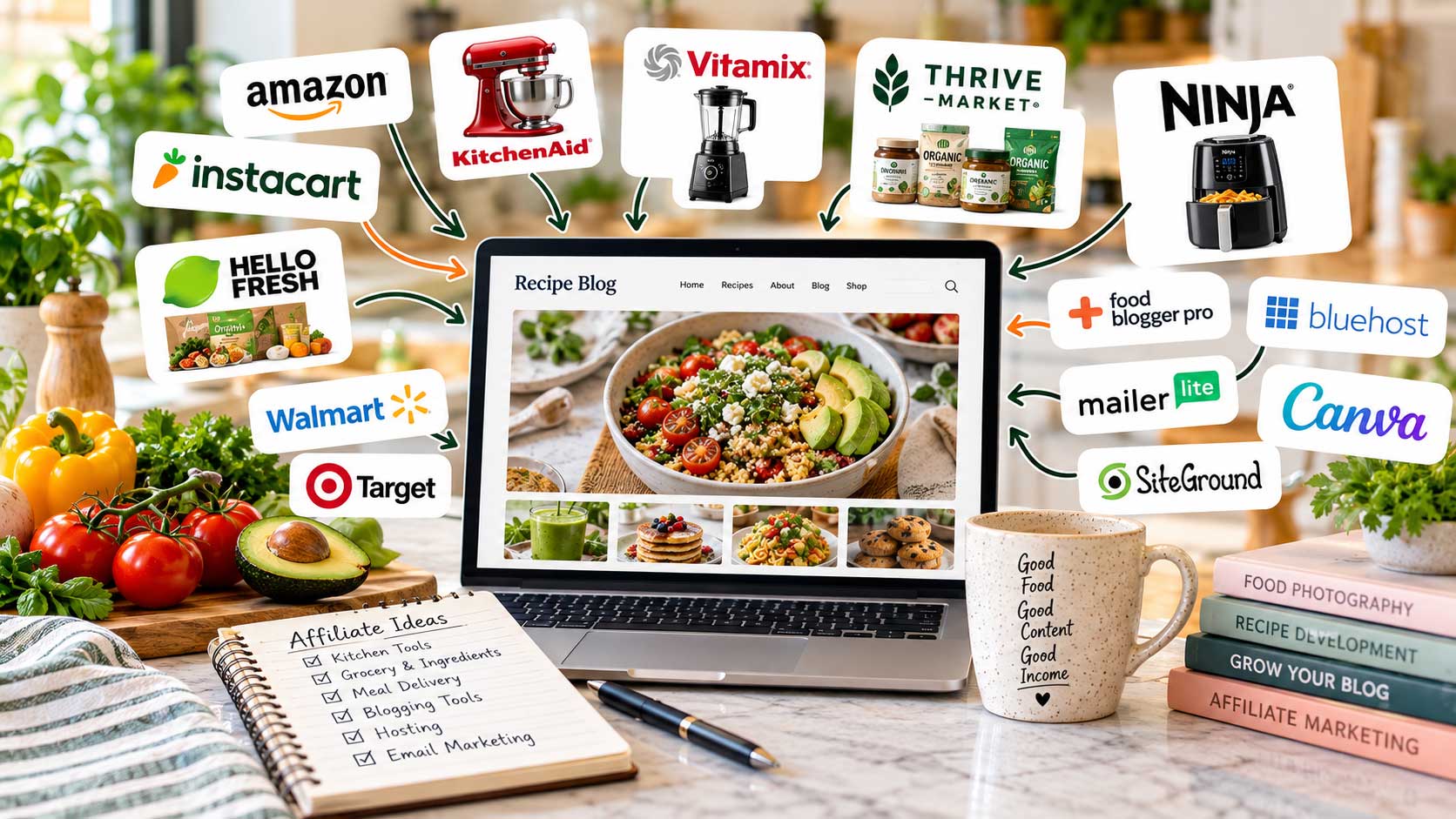
Affiliate marketing can be one of the most practical ways to monetize a food blog beyond display advertising. Instead of earning only from pageviews and ad impressions, you can earn a commission when readers purchase products or services you recommend.
And for food bloggers, the opportunities go far beyond groceries.
You can recommend kitchen appliances, cookware, baking tools, meal delivery services, specialty ingredients, photography equipment, blogging software, WordPress plugins, hosting, and many other products that naturally fit your content.
The key is choosing affiliate programs that match what your readers are already looking for.
A baking blog, for example, might promote stand mixers, baking pans, decorating tools, and specialty ingredients. A healthy recipe blog could recommend blenders, organic foods, grocery delivery services, meal kits, or other products that fit its audience.
You also don’t need massive traffic to get started.
A smaller food blog with highly targeted content can generate affiliate sales when readers arrive through searches such as “best blender for smoothies” or “best Dutch oven for sourdough bread.” These visitors aren’t just looking for information—they may already be researching a product they plan to buy.
In this guide, we’ll look at some of the best affiliate programs for food bloggers, from food and kitchen brands to blogging tools and recurring software programs. We’ll also cover how affiliate programs work, what to look for before joining one, and practical ways to use affiliate links naturally throughout your food blog.
Important: Affiliate commission rates, cookie periods, eligibility requirements, and program availability can change. Always verify the latest terms directly with the affiliate program before promoting an offer.
How Do Affiliate Programs for Food Bloggers Work?
Affiliate programs allow food bloggers to earn commissions by recommending relevant products or services to their readers.
After joining a program, you receive a unique tracking link. When someone clicks that link and completes a qualifying purchase or other required action, you may earn a commission according to the program’s terms.
For example, if you publish a homemade pizza recipe, you might naturally recommend:
- a pizza stone
- a stand mixer
- a digital kitchen scale
- specialty flour
- a pizza cutter
- a grocery delivery service
If a reader clicks one of those links and makes a qualifying purchase, the merchant or affiliate network tracks the referral and credits the commission to your account.
Affiliate Disclosure: Some links in this article may be affiliate links. If you make a purchase or sign up through one of these links, iFoodBloggers may earn a commission at no extra cost to you.
How Affiliate Tracking Works
Most affiliate programs use cookies or another tracking method to identify visitors you refer.
The cookie duration is the period during which a purchase may still be attributed to your referral.
For example, a program with a 30-day cookie may credit you for an eligible purchase made within 30 days of the initial click, depending on its attribution rules.
Payment structures also vary.
Some programs pay:
- a percentage of the sale
- a flat fee for each new customer
- a commission for a subscription
- a recurring commission
- a payment for another qualifying action
This is why it is important to review the commission structure, tracking window, and eligibility rules before joining a program.
You Do Not Need to Turn Every Recipe Into a Sales Page
One of the easiest ways to weaken affiliate content is to add promotional links everywhere.
Recommendations work best when they genuinely help the reader.
If a smoothie recipe requires a blender, linking to a blender you recommend makes sense. If you publish a sourdough guide, recommending a Dutch oven, kitchen scale, proofing basket, or bread flour can also feel natural.
The goal is to help readers complete the task they already came to your website to accomplish.
When a recommendation fits the content, it can make the article more useful while also creating an additional revenue opportunity for your food blog.
Affiliate Marketing Can Complement Display Advertising
Food bloggers do not have to choose between affiliate marketing and display ads.
Many established blogs use several monetization methods at the same time, including:
- display advertising
- affiliate marketing
- sponsored content
- digital products
- memberships
- courses
- cookbooks
- brand partnerships
Affiliate marketing is especially useful because revenue is not based only on pageviews.
A smaller article attracting readers who are actively researching a product may sometimes generate more affiliate revenue than a much larger informational post.
That is why product reviews, comparison articles, kitchen equipment guides, ingredient recommendations, and buying guides can become valuable supporting content for a recipe website.
What Makes a Good Affiliate Program for Food Bloggers?
Not every affiliate program is a good fit for every food blog.
The strongest programs are usually the ones that match your audience, your content, and the types of products your readers are already interested in buying.
Before joining a program, consider a few important factors.
Relevance to Your Audience
Start with products and services that make sense for your readers.
A baking blog might perform well with affiliate programs for stand mixers, baking pans, decorating supplies, flour, chocolate, and specialty ingredients.
A healthy recipe blog may have better opportunities with blenders, meal delivery services, organic foods, or grocery delivery.
The closer the product matches the reader’s intent, the more natural the recommendation feels.
Commission Rate
Affiliate programs can pay in several different ways.
Some offer a percentage of each sale, while others pay a fixed amount for every new customer, subscription, or qualifying action.
A higher commission can be attractive, but it should not be the only factor you consider.
A program offering a smaller commission on a popular product may generate more revenue than a high-paying program for something your readers rarely purchase.
Cookie Duration
Cookie duration determines how long a referred visitor may remain associated with your affiliate link.
Some programs have very short attribution periods, while others may track qualifying purchases for several weeks.
Longer cookie periods can be helpful for products that require more research before someone decides to buy.
However, always check the complete attribution rules because cookie duration alone does not determine whether a sale will be credited.
Average Order Value
Products with a higher average order value can sometimes generate larger commissions per conversion.
For example, a premium blender, espresso machine, cookware set, or stand mixer may produce a larger commission than a low-cost kitchen utensil.
That does not mean inexpensive products should be ignored.
Lower-priced items can convert more easily, especially when they solve a simple problem for the reader.
A balanced affiliate strategy often includes both.
Brand Reputation
Be selective about the companies you recommend.
Readers are more likely to trust brands with reliable products, good customer service, and a strong reputation.
Promoting a poor-quality product simply because it offers a high commission can damage the trust you have built with your audience.
That trust is usually worth far more than a single affiliate sale.
Conversion Potential
Consider how likely your audience is to actually buy the product.
A program can offer excellent commissions and still perform poorly if the product does not match why people visit your site.
Commercial-intent articles often work especially well for affiliate marketing.
Examples include:
- Best Blenders for Smoothies
- Best Stand Mixers for Home Bakers
- Best Air Fryers for Families
- Best Dutch Ovens for Bread
- Best Meal Delivery Services
- Best Kitchen Scales for Baking
- Best Food Processors for Home Cooks
Readers searching for these topics are often much closer to making a purchase than someone reading a general informational article.
Program Reliability
Before investing time creating affiliate content, check whether the program has a good reputation for tracking referrals and paying commissions.
It is also worth reviewing:
- payment schedules
- minimum payout thresholds
- available payment methods
- geographic restrictions
- prohibited promotional methods
- deep-linking options
- available banners or promotional assets
Affiliate programs can change their commission structures, networks, and terms, so review your most important partnerships regularly.
Think Beyond Food Products
Some of the best affiliate opportunities for food bloggers are not food products at all.
Running a food blog may require hosting, WordPress plugins, email marketing software, photography equipment, design tools, SEO software, and recipe plugins.
If your website also teaches food blogging, these programs can become especially valuable.
If your website also teaches food blogging, these programs can become especially valuable. Tools for SEO, email marketing, WordPress, design, and productivity can all become natural recommendations. Our guide to the best SEO tools for food bloggers covers many of the platforms bloggers can use to research keywords, monitor performance, and grow search traffic.
Thrive Market
It is a strong affiliate option for food bloggers who focus on healthy eating, organic groceries, specialty diets, pantry staples, or natural products.
The company operates as a membership-based online marketplace offering organic and non-GMO groceries along with household, personal care, pet, and other everyday products. Members can also browse by dietary preferences and lifestyles, which makes Thrive Market especially relevant for content covering gluten-free, vegan, paleo, keto, and other specialized diets.
Thrive Market currently charges $59.95 for an annual membership and promotes member-only prices of up to 30% off on eligible products. Grocery orders over $49 qualify for free shipping, while frozen orders have a separate free-shipping threshold.
Thrive Market is easy to work naturally into recipe and pantry content. A blogger might mention it when recommending specialty ingredients, putting together a healthy grocery guide, or helping readers find products that are difficult to locate locally.
Does Thrive Market Have an Affiliate Program?
Yes. Thrive Market currently operates an affiliate program for publishers, creators, and other partners with an established audience. Affiliates receive dedicated referral links and can earn commissions for qualifying members they refer.
You can review the official Thrive Market affiliate program information before applying, including its current application process and eligibility guidance.
Thrive Market says it works with audiences of different sizes, including smaller established communities, although applications are reviewed before acceptance. Its help center notes that affiliate applications may take approximately 8–10 weeks to receive a response.
Commission: Varies; verify the current offer when applying
Cookie duration: Verify current terms in the affiliate dashboard
Best for: Healthy food, organic groceries, specialty diets, and pantry content
Older affiliate guides may list $40 for an annual membership, $4 for a monthly membership, and a 14-day cookie. Because Thrive Market does not currently publish those figures on its official affiliate pages, verify the latest commission and tracking terms directly through the affiliate dashboard before relying on them.
Why Thrive Market Can Work Well for Food Bloggers
Thrive Market has a natural connection to recipe content because readers are already looking for ingredients.
Instead of adding an unrelated promotional banner to a recipe, you can recommend a relevant pantry staple, specialty ingredient, or grocery source at the point where the reader may actually need it.
That makes Thrive Market especially useful for blogs built around healthy recipes, organic food, specialty diets, meal planning, or ingredient-focused content.
HelloFresh Affiliate Program
HelloFresh is one of the most recognizable meal-kit services and can be a natural fit for food bloggers who publish recipes, meal-planning content, weeknight dinner ideas, or articles for busy families.
The service delivers pre-portioned ingredients and step-by-step recipes directly to customers. That makes it especially relevant for readers who want to cook at home but may not have much time for meal planning or grocery shopping.
For food bloggers, HelloFresh can fit naturally into meal-kit comparisons, family dinner guides, beginner cooking content, and articles focused on convenient weeknight meals.
Does HelloFresh Have an Affiliate Program?
Yes. HelloFresh accepts affiliate and content-publisher partnership applications in the United States, including applications from independent blogs and niche media websites.
According to HelloFresh’s U.S. affiliate program information, commissions start at $10 for each new customer, with a 14-day cookie duration. Some higher-performing publishers may also qualify for additional bonuses.
Commission: Starting at $10 per new customer
Cookie duration: 14 days
Best for: Recipe blogs, meal planning, family meals, beginner cooking, and meal-delivery content
HelloFresh also runs creator and influencer partnerships. Eligible creators may receive personalized promotional codes and other opportunities to earn rewards when new customers place qualifying orders.
This can be useful for food bloggers who also have audiences on Pinterest, Instagram, TikTok, YouTube, or other social platforms.
Why HelloFresh Can Work Well for Food Bloggers
HelloFresh connects directly with one of the main reasons people visit food blogs: deciding what to cook.
For example, an article about quick dinners for busy families could mention a meal-kit service as an alternative for weeks when readers do not want to plan meals or shop for every ingredient themselves.
HelloFresh can also fit well into commercial-intent articles such as HelloFresh Review, HelloFresh vs. Home Chef, Best Meal Kits for Families, or Best Meal Delivery Services for Beginners.
These types of articles attract readers who are already comparing services and may be much closer to signing up than someone browsing a general recipe.
As with any affiliate partnership, commission rates, bonuses, promotional offers, and eligibility requirements can change. Check the latest HelloFresh program terms before publishing specific promotional claims.
Home Chef Affiliate Program
Home Chef is another meal-kit service that can fit naturally into recipe, meal-planning, and family-food content.
The company offers meal kits with pre-portioned ingredients and step-by-step recipes, along with ready-made options through its Tempo brand. Home Chef also lets customers customize certain meals by changing, upgrading, or doubling proteins.
For food bloggers, Home Chef can work well in articles about easy weeknight dinners, family meal planning, beginner-friendly cooking, convenient dinner ideas, and meal-delivery comparisons.
Does Home Chef Have an Affiliate Program?
Yes. Home Chef operates an affiliate program through CJ Affiliate, also known as Commission Junction.
Approved partners can use Home Chef or Tempo promotional materials on their websites and earn commissions when they refer qualifying new customers.
Commission: Varies; check the current offer inside CJ Affiliate
Cookie duration: Verify current attribution terms in the affiliate dashboard
Affiliate network: CJ Affiliate
Best for: Meal planning, family recipes, convenient dinners, beginner cooking, and meal-kit comparisons
Older versions of this article listed a flat $10 commission and a 30-day cookie, but Home Chef’s current public affiliate information does not confirm those exact terms. It is better to verify the latest rates inside CJ Affiliate rather than present older figures as current.
Home Chef also operates a separate customer referral program. That program is different from the formal affiliate program and is intended primarily for personal referrals. If you plan to earn commissions through your blog, use Home Chef’s official affiliate program rather than its regular customer referral links.
Why Home Chef Can Work Well for Food Bloggers
Home Chef is especially relevant for readers who enjoy cooking but do not always have time to plan recipes, shop for ingredients, and prepare everything from scratch.
For example, an article about planning five weeknight dinners could mention Home Chef as an alternative for especially busy weeks.
It can also fit naturally into commercial-intent content such as Home Chef Review, Is Home Chef Worth It?, Home Chef vs. HelloFresh, Best Meal Kits for Couples, or Best Meal Delivery Services for Busy Families.
These topics attract readers who are already comparing meal-kit services and may be closer to signing up, which makes them particularly suitable for affiliate marketing.
Nuts.com Affiliate Program
Nuts.com can be a useful affiliate partner for food bloggers who publish recipes, baking content, snack ideas, healthy eating guides, gift guides, or articles about specialty ingredients.
The company sells nuts, dried fruit, chocolates, snacks, baking ingredients, coffee, pantry products, and other specialty foods. Nuts.com has been operating online since 1999 and traces its roots back to a family nut shop founded in 1929.
That broad product range gives food bloggers plenty of natural ways to recommend relevant products inside recipes, pantry guides, snack roundups, baking articles, and seasonal gift content.
Does Nuts.com Have an Affiliate Program?
Nuts.com has historically operated an affiliate program, but its current public website does not clearly publish up-to-date commission rates, cookie duration, or enrollment terms.
Older affiliate guides may list an 8% commission for new customers, 2% for returning customers, and a 30-day cookie. Because those terms are not clearly confirmed on Nuts.com’s current public website, verify the latest commission and tracking details directly through the affiliate platform before promoting the program.
Commission: Verify current terms before publishing
Cookie duration: Verify current attribution period
Best for: Snacks, baking, specialty ingredients, healthy eating, gift guides, and pantry content
This is a good example of why affiliate articles need regular updates. Commission rates and tracking windows can change even when the merchant itself remains active.
Why Nuts.com Can Work Well for Food Bloggers
What makes Nuts.com particularly useful for food bloggers is its product selection.
A recipe blogger can recommend ingredients readers may actually need, such as almonds, walnuts, dried fruit, chocolate, seeds, baking ingredients, or specialty pantry products.
A homemade granola recipe, for example, could naturally mention nuts, chia seeds, and dried fruit from the same retailer. A holiday guide could feature gift baskets, chocolates, snack boxes, or baking ingredients without making the recommendations feel forced.
Nuts.com also offers Auto Delivery on eligible products and currently advertises a 5% discount on qualifying recurring orders. That can be useful for readers who regularly buy pantry staples.
Rather than relying only on a generic Nuts.com review, the program can fit naturally into commercial content such as Best Nuts for Baking, Best Healthy Snacks for Work, or Best Food Gifts for Christmas.
That keeps the affiliate recommendation closely connected to what the reader is already looking for.
Instacart Affiliate Program
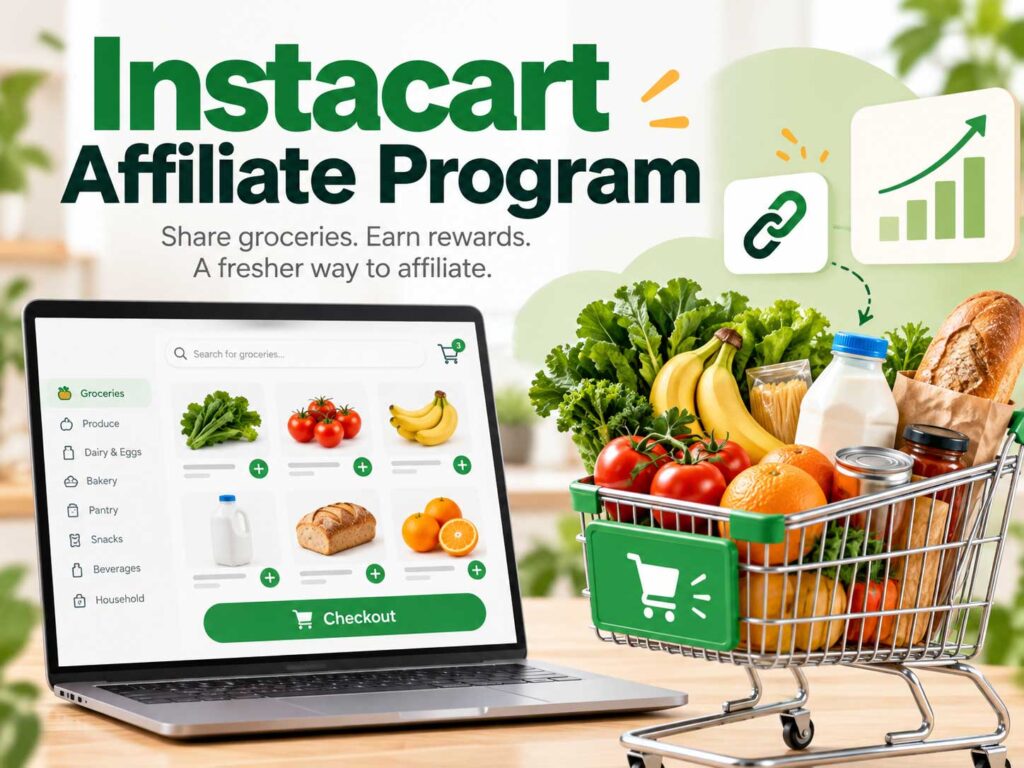
Instacart can be an especially interesting affiliate option for food bloggers because it connects recipe content directly with grocery shopping.
Instead of simply recommending an ingredient, a blogger can potentially help readers move from a recipe or shopping list to purchasing groceries through Instacart.
That makes the platform particularly relevant for meal plans, grocery guides, recipe collections, pantry content, and other articles where readers may need several ingredients at once.
Does Instacart Have an Affiliate Program?
Yes. Instacart currently supports affiliate partnerships through its developer and partner ecosystem.
Instacart is a little different from a traditional product affiliate program. Instead of promoting one specific food brand, bloggers can connect recipes and shopping lists with the grocery-buying process itself. Instacart specifically includes publishers and bloggers among the types of partners it works with.
Affiliate network: Impact
Commission: Varies according to the current partner agreement
Cookie duration: Verify current terms inside Impact
Best for: Recipes, grocery content, meal planning, shopping lists, and food-focused websites
Older versions of this article listed a 7-day cookie and described commissions as coming from customers or shoppers. Instacart’s current public documentation does not confirm those as universal terms, so verify the latest commission and attribution details inside the partner dashboard before publishing them.
Instacart also has a separate customer referral program, but that is different from its formal affiliate and publisher partnerships. For a monetized food blog, the official affiliate program is the more appropriate option to investigate.
Why Instacart Can Work Well for Food Bloggers
Instacart is different from many traditional affiliate programs because the opportunity is not centered on one particular product or food brand.
Instead, it can become part of the shopping process itself.
For example, someone reading a chicken curry recipe may need chicken, coconut milk, curry powder, onions, garlic, rice, and fresh herbs. Rather than sending the reader to several different retailers, a grocery-shopping integration can make it easier to move from discovering the recipe to purchasing the ingredients.
Instacart has also supported its Tastemakers system and other recipe-shopping integrations that connect publishers with Instacart’s shopping experience. For larger recipe websites, this type of integration may be more useful than simply adding a standard banner or text link.
That creates strong opportunities for content such as 7-Day Family Meal Plans, Healthy Grocery Lists, or Easy Weeknight Dinner Collections, where readers may want to purchase several ingredients in one order.
For recipe-heavy websites, that direct connection between content, ingredients, and grocery shopping is what makes Instacart especially interesting as an affiliate opportunity.
Wildly Organic Affiliate Program
Wildly Organic is a strong fit for food bloggers focused on organic foods, healthy eating, specialty diets, natural ingredients, baking, or pantry staples.
The company sells products such as coconut oil, cacao, nuts and seeds, dried fruit, gluten-free flours, natural sweeteners, cooking oils, grains, seasonings, and other organic foods.
That gives food bloggers plenty of natural opportunities to recommend relevant products inside recipes, ingredient guides, baking content, smoothie articles, and healthy pantry roundups.
Does Wildly Organic Have an Affiliate Program?
Yes. Wildly Organic operates an active affiliate program, and in this case the core commission details from the older article are still largely accurate.
Affiliates start at 10% commission on completed orders and can earn as much as 20% as sales volume increases. The program also uses a 30-day cookie duration.
Commission: 10%–20%
Cookie duration: 30 days
Minimum payout: $50
Affiliate platform: Affiliatly
Best for: Organic foods, healthy recipes, baking, specialty diets, pantry products, and natural ingredients
Joining the program is free, and affiliate payments are generally processed monthly once the account reaches the $50 minimum payout threshold.
Wildly Organic uses a tiered commission structure. Affiliates begin at 10%, with higher rates available as they generate more qualifying orders. The company’s current FAQ says commissions can increase to 15% and eventually 20% at higher sales volumes.
Those tiers reset quarterly, and commissions may be capped at 10% during scheduled sales.
That structure can make the program particularly attractive for established food bloggers who are able to generate consistent sales.
Why Wildly Organic Can Work Well for Food Bloggers
Wildly Organic works especially well for recipe bloggers because many of its products can be recommended as ingredients readers may already need.
A gluten-free brownie recipe, for example, could recommend cacao powder, coconut oil, natural sweeteners, nuts, or gluten-free flour. A smoothie article could feature cacao, coconut products, dried fruit, nuts, or seeds.
Wildly Organic can also work well in commercial content such as Best Organic Pantry Staples, Best Gluten-Free Baking Ingredients, Best Natural Sweeteners for Baking, or Healthy Smoothie Pantry Essentials.
Because the program currently offers a 30-day cookie window, readers do not necessarily have to purchase immediately after clicking an affiliate link for a qualifying order to potentially generate a commission.
For food bloggers with strong organic, gluten-free, healthy-eating, baking, or natural-food content, Wildly Organic is one of the older programs from the original article that is still worth keeping.
Sunfood Superfoods Affiliate Program
Sunfood Superfoods can be a good fit for food bloggers who cover smoothies, healthy eating, plant-based recipes, functional ingredients, or specialty pantry products.
The company sells products such as cacao powder, matcha, maca, chia seeds, moringa powder, goji berries, spirulina, chlorella, beet powder, superfood blends, nuts, seeds, and other specialty foods.
That makes Sunfood especially relevant for smoothie recipes, healthy breakfast content, plant-based recipes, ingredient guides, and pantry-focused articles.
Does Sunfood Superfoods Have an Affiliate Program?
Sunfood’s current website still references an Affiliate Program on product pages, which indicates that affiliate partnerships remain part of the company’s business.
However, Sunfood does not currently publish clear public details for its commission percentage, cookie duration, or payout threshold.
Older affiliate guides may list commissions of 10%–20% and a 30-day cookie, but Sunfood’s current website does not clearly publish those terms. Verify the latest details directly during the application process or inside the affiliate dashboard.
Commission: Verify current program terms
Cookie duration: Verify current attribution period
Best for: Smoothies, superfoods, plant-based recipes, healthy eating, and specialty ingredients
Sunfood also considers partnership and influencer opportunities, which may give established food bloggers additional ways to work with the brand beyond standard affiliate links.
Why Sunfood Can Work Well for Food Bloggers
Sunfood fits especially well into recipe content because many of its products can be used as ingredients rather than simply promoted alongside a recipe.
A smoothie recipe, for example, might use cacao powder, chia seeds, maca, matcha, beet powder, goji berries, or spirulina. That allows a blogger to recommend the actual ingredient being used rather than adding an unrelated promotion.
Sunfood can also work well in commercial content such as Best Superfoods for Smoothies, Best Smoothie Pantry Staples, How to Use Matcha Powder, or Best Ingredients for Smoothie Bowls.
The company also offers Subscribe & Save on eligible products, which can be useful for ingredients readers purchase repeatedly, such as matcha, cacao powder, chia seeds, or superfood blends.
That repeat-purchase potential can make Sunfood more interesting than a product someone buys only once.
For food bloggers focused on smoothies, plant-based recipes, or specialty ingredients, Sunfood remains a relevant program to investigate.
Vitamin Shoppe Affiliate Program for Food Bloggers
The Vitamin Shoppe is worth considering for food bloggers who cover protein shakes, healthy snacks, superfoods, herbs, or wellness-focused recipes.
The company has been operating since 1977 and today sells a broad range of vitamins, minerals, sports nutrition products, proteins, herbs, superfoods, natural beauty products, and other wellness-related items. It also operates more than 600 stores in the United States.
For food bloggers, the strongest fit is likely content connected to protein shakes, smoothie ingredients, healthy snacks, herbs, superfoods, and wellness-oriented pantry products.
Does Vitamin Shoppe Have an Affiliate Program?
Yes. The Vitamin Shoppe currently operates an official affiliate program through CJ Affiliate.
You can review the official Vitamin Shoppe affiliate program page for its latest commission information and application details.
According to its current affiliate page, approved publishers can use tracked text links, banners, and other promotional materials and earn up to 10% commission on referred sales.
Commission: Up to 10%
Affiliate network: CJ Affiliate
Cookie duration: Verify current terms inside CJ Affiliate
Best for: Protein products, healthy snacks, herbs, superfoods, wellness content, and smoothie-related articles
Older versions of this article listed a 30-day cookie duration, but The Vitamin Shoppe’s current public affiliate page does not confirm that tracking period. Verify the latest attribution window inside CJ Affiliate before publishing it as current.
Why Vitamin Shoppe Can Work Well for Food Bloggers
The Vitamin Shoppe can fit naturally into food content when its products are closely connected to what readers are already making or shopping for.
A protein smoothie article, for example, could naturally discuss protein powders or superfood ingredients. Healthy snack guides, smoothie ingredient roundups, or articles about pantry staples can also create relevant opportunities.
The retailer currently offers categories including protein and fitness products, food and drinks, herbs and natural remedies, and healthy snacks, making it broader than a traditional vitamin-only store.
For food bloggers with a health, fitness, smoothie, or wellness angle, The Vitamin Shoppe is worth including as a more specialized affiliate option alongside broader retailers such as Amazon or Target.
Amazon Associates for Food Bloggers
Amazon Associates remains popular with food bloggers for one simple reason: readers can find almost every type of kitchen product in one place.
That includes kitchen appliances, cookware, baking tools, knives, thermometers, coffee equipment, storage containers, cookbooks, pantry products, and many other items related to cooking.
This broad product selection makes Amazon especially useful for recipe posts, equipment guides, buying guides, and kitchen-product comparisons.
How Much Does Amazon Associates Pay?
Amazon uses different commission rates depending on the product category.
For the standard U.S. Amazon Associates program, Kitchen products currently earn 4.5% commission, while Grocery and Amazon Fresh products currently earn 1%.
Kitchen commission: 4.5%
Grocery commission: 1%
Cookie duration: Generally 24 hours
Best for: Kitchen equipment, cookware, appliances, utensils, recipe tools, and broad product recommendations
Amazon’s standard tracking window is shorter than many other affiliate programs. A customer generally needs to add a qualifying item to their cart within 24 hours after arriving through your affiliate link.
There is an important exception. If the customer adds the product to their cart during that 24-hour window but completes the purchase later, the affiliate may still receive a commission if the order is completed before the cart expires, which is typically within 90 days.
Commission rates and program policies can change, so bloggers should always check Amazon’s current Associates terms before publishing specific figures.
Why Amazon Works Well for Food Bloggers
Amazon’s broad product selection is what makes the program especially useful for food bloggers.
A homemade pizza recipe could naturally recommend a pizza stone, pizza peel, kitchen scale, stand mixer, dough scraper, or pizza cutter. A bread recipe could feature a Dutch oven, proofing basket, thermometer, or bread knife. A smoothie recipe could link to a blender, reusable cups, or storage containers.
That allows bloggers to add useful product recommendations without changing the main purpose of the recipe.
Kitchen equipment can be especially attractive because Amazon’s current commission rate for Kitchen products is higher than its Grocery rate. That makes commercial content such as Best Blenders for Smoothies, Best Air Fryers for Families, Best Dutch Ovens for Bread, or Best Stand Mixers for Home Bakers particularly relevant.
Another advantage is that commissions are not always limited to the exact product originally linked. If a reader follows your affiliate link and purchases other qualifying items during the eligible shopping session, those purchases may also generate commissions according to Amazon’s rules.
For most recipe bloggers, Amazon Associates is worth considering because it combines a massive product catalog with products readers are already familiar with buying online.
Walmart Affiliate Program for Food Bloggers
Walmart can be a useful affiliate partner for food bloggers because it combines groceries, pantry products, kitchen appliances, cookware, storage products, and everyday household items in one place.
That makes it especially flexible for recipe websites that publish more than individual recipes. Walmart can fit naturally into kitchen equipment guides, baking content, meal-prep articles, grocery shopping posts, seasonal cooking guides, and budget-focused product roundups.
Does Walmart Have an Affiliate Program?
Yes. Walmart operates an affiliate program that allows approved publishers to earn commissions by referring shoppers to eligible products on Walmart.com.
Commission rates can vary by product category and over time, so it is better to verify the current terms inside the affiliate platform before publishing exact percentages.
Commission: Varies by product category
Cookie duration: Verify current program terms
Best for: Kitchen equipment, groceries, meal-prep products, household items, and budget-conscious shopping content
Walmart’s broad catalog gives food bloggers the ability to promote both inexpensive everyday products and higher-value kitchen purchases through the same retailer.
Why Walmart Can Work Well for Food Bloggers
One of Walmart’s biggest advantages is familiarity. Many readers already shop there for groceries and household products, so recommending a relevant product can feel natural when it fits the content.
A meal-prep article, for example, could feature food storage containers, slow cookers, sheet pans, kitchen scales, or reusable bags. A baking guide could recommend mixers, baking pans, cooling racks, measuring tools, or decorating supplies.
Walmart can be especially useful for budget-focused content such as Best Kitchen Tools Under $25, Budget-Friendly Baking Essentials, Affordable Meal-Prep Containers, or Best Small Kitchen Appliances on a Budget.
There is also plenty of overlap with Amazon, but that does not mean bloggers have to choose only one. Pricing, availability, shipping options, and product selection can differ between retailers, so offering more than one buying option may sometimes be helpful.
For food bloggers who publish practical shopping, kitchen, and budget-focused content, Walmart can be a useful addition to a broader affiliate strategy.
Target Affiliate Program for Food Bloggers
Target is a strong affiliate option for food bloggers because it offers kitchen appliances, cookware, baking supplies, food storage, groceries, home products, and seasonal items under one familiar retail brand.
That gives food bloggers opportunities far beyond simply linking to ingredients. Target can fit naturally into kitchen equipment guides, baking content, meal-prep articles, coffee-related posts, entertaining guides, holiday cooking content, and gift roundups.
Does Target Have an Affiliate Program?
Yes. Target operates the Target Partners Program, its official affiliate program for websites, bloggers, and creator networks with primarily U.S.-based audiences. The program runs through Impact.
Target currently advertises commissions of up to 8% on qualifying purchases, although the exact rate can vary depending on the product category and other program terms.
Commission: Up to 8% on qualifying purchases
Cookie duration: 7 days
Affiliate network: Impact
Best for: Kitchen products, cookware, appliances, home goods, entertaining, and seasonal content
Target’s program uses a 7-day cookie window with last-click attribution. Qualifying purchases made during that attribution period may generate commissions according to the program’s terms.
That tracking window is considerably longer than Amazon Associates’ standard 24-hour shopping window, which can be useful for higher-priced products that readers may want more time to consider.
Why Target Can Work Well for Food Bloggers
Target’s broad catalog makes it particularly useful for bloggers who combine recipes with kitchen, home, and lifestyle content.
A baking article could recommend mixing bowls, measuring cups, baking sheets, cake pans, stand mixers, or storage containers. A coffee guide could feature coffee makers, grinders, mugs, or milk frothers. Seasonal content creates even more opportunities, from Thanksgiving serving pieces to holiday baking tools and kitchen gifts.
Target can also work well in commercial articles such as Best Kitchen Essentials at Target, Best Target Kitchen Finds Under $50, Best Target Products for Meal Prep, or Target Holiday Baking Essentials.
There is considerable overlap between Target, Amazon, and Walmart, but that can be useful. Pricing, availability, product selection, and shipping options differ, so giving readers more than one legitimate purchasing option may improve a buying guide when done selectively.
Target has also expanded its creator partnerships through programs such as Target Ambassadors, giving eligible creators additional opportunities for commissions, campaigns, and brand collaborations.
For food bloggers who publish kitchen, seasonal, entertaining, gift, or lifestyle content, Target can be one of the stronger broad-retailer affiliate programs to consider.
KitchenAid Affiliate Program for Food Bloggers
KitchenAid is one of the most recognizable kitchen brands in the world, making it a natural fit for food bloggers who publish recipes, baking content, kitchen equipment guides, or product comparisons.
The brand is best known for its stand mixers, but its product range also includes food processors, blenders, hand mixers, attachments, countertop appliances, and major kitchen appliances.
For food bloggers, that creates opportunities to recommend higher-value products that readers may already be actively researching.
Does KitchenAid Have an Affiliate Program?
KitchenAid has worked with affiliate and publisher partners, but exact U.S. commission rates, cookie duration, and current enrollment terms are not clearly published on the brand’s public consumer website.
Because affiliate arrangements can change, bloggers should verify the current terms directly with KitchenAid or its active affiliate network before publishing specific commission percentages.
Commission: Verify current program terms
Cookie duration: Verify current attribution period
Best for: Baking, kitchen appliances, equipment reviews, gift guides, and premium kitchen content
KitchenAid also sells directly through KitchenAid.com and regularly features promotions and special offers on countertop and major appliances, giving bloggers additional opportunities for seasonal or deal-focused content.
Why KitchenAid Can Work Well for Food Bloggers
KitchenAid becomes particularly interesting when your content moves into higher-priced kitchen equipment.
A reader purchasing a stand mixer, food processor, blender, or other premium appliance can represent a more valuable affiliate conversion than someone purchasing a low-cost utensil, depending on the program’s current commission structure.
KitchenAid stand mixers are especially well suited to baking blogs. They can be mentioned naturally in recipes for bread, pizza dough, cookies, cakes, brioche, cinnamon rolls, or frosting.
They also create strong commercial-content opportunities such as Best KitchenAid Mixer for Home Bakers, KitchenAid Artisan vs. Professional, Is a KitchenAid Stand Mixer Worth It?, or Best Stand Mixers for Bread Dough.
Attachments create another useful angle. KitchenAid offers accessories for tasks such as pasta making, slicing, shredding, grinding, and other food preparation, which can support articles like Best KitchenAid Attachments or KitchenAid Pasta Attachment Review.
Rather than relying on generic banner ads, KitchenAid is best promoted through detailed equipment guides, comparisons, and tutorials where readers are already researching a purchase.
Relevant recipes can then internally link to those commercial pages, creating a natural path from recipe content to equipment guide to affiliate recommendation.
For food bloggers who publish baking or kitchen-equipment content, KitchenAid is one of the most relevant premium brands to investigate for affiliate partnerships.
Vitamix Affiliate Program for Food Bloggers
Vitamix is one of the stronger kitchen-appliance affiliate opportunities for food bloggers, especially those publishing smoothie recipes, soups, sauces, nut butters, healthy recipes, or blender comparisons.
Unlike general retailers, Vitamix focuses heavily on premium blending equipment and accessories. That makes it particularly attractive for bloggers whose readers may already be researching a higher-value kitchen purchase.
Does Vitamix Have an Affiliate Program?
Yes. Vitamix operates an official affiliate program through CJ Affiliate.
The company specifically looks for websites and blogs focused on food, nutrition, health, fitness, blending, and related topics. According to Vitamix’s current affiliate information, commissions for content-focused affiliates start at 10%.
Commission: Starting at 10% for content affiliates
Affiliate network: CJ Affiliate
Cookie duration: Verify current CJ program terms
Best for: Smoothies, soups, sauces, plant-based recipes, healthy food content, and blender reviews
Vitamix is more selective than some general affiliate programs. Applicants are expected to have an active website or blog in a relevant niche, and affiliates are currently expected to generate at least six qualifying machine sales per year to remain active.
Food bloggers interested in applying can review the official Vitamix affiliate program requirements before submitting an application.
Approved affiliates also receive access to tracking links, banners, and sales reporting through CJ Affiliate.
Why Vitamix Can Work Well for Food Bloggers
Vitamix combines strong recipe relevance with relatively high product prices, which can make qualifying sales more valuable.
A premium blender can cost several hundred dollars, so a percentage-based commission can be considerably more valuable than commissions from inexpensive kitchen tools.
Vitamix is especially well suited to buying guides and comparison articles such as Best Vitamix Blender for Smoothies, Best Blenders for Smoothies, Vitamix vs. Ninja, or Is a Vitamix Worth It?
Recipe content can support those commercial pages naturally. A smoothie, soup, hummus, pesto, nut butter, or frozen-dessert recipe can link readers to a detailed blender guide rather than turning the recipe itself into a sales page.
For a premium product like Vitamix, the direct manufacturer program may also be worth considering alongside broader retailers such as Amazon, especially because Vitamix currently advertises starting commissions of 10% for content affiliates.
For food bloggers with strong smoothie, healthy-recipe, or blender-focused content, Vitamix can be one of the more commercially attractive appliance affiliate programs to consider.

Ninja Kitchen Affiliate Program for Food Bloggers
Ninja Kitchen is another strong affiliate opportunity for food bloggers because its products cover several popular kitchen categories, including blenders, air fryers, food processors, countertop cooking appliances, and other small kitchen equipment.
That makes Ninja especially relevant for bloggers who publish smoothie recipes, air fryer recipes, meal-prep content, kitchen appliance reviews, and product comparisons.
Does Ninja Kitchen Have an Affiliate Program?
Yes. SharkNinja operates an official affiliate program through Impact. The official SharkNinja affiliate program page currently advertises commissions of up to 20% on qualifying sales.
The company currently advertises commissions of up to 20% on qualifying sales generated through trackable affiliate links. Approved partners may also receive access to special promotions, campaigns, and other partnership opportunities.
Commission: Up to 20%
Affiliate network: Impact
Cookie duration: Verify current attribution terms inside Impact
Best for: Blenders, air fryers, food processors, countertop appliances, and kitchen-product content
Because rates may vary by product, promotion, or partner arrangement, bloggers should check the current terms inside Impact before publishing specific commission claims.
Why Ninja Can Work Well for Food Bloggers
Ninja fits food content especially well because its appliances are directly connected with popular recipe categories.
A smoothie recipe can naturally feature a blender. An air fryer recipe can link to the appliance used to prepare it. A homemade pizza or bread article could recommend a food processor or mixer for dough preparation.
Ninja also works especially well in buying guides and comparison articles such as Ninja vs. Vitamix, Best Ninja Blender for Smoothies, Best Ninja Air Fryer, or Ninja Food Processor Review. These searches often attract readers who are already comparing products and may be closer to making a purchase.
Its broad product range is another advantage. A single SharkNinja affiliate relationship can potentially support content around blenders, food processors, air fryers, and other countertop appliances rather than requiring a different program for every category.
SharkNinja also promotes direct-purchase benefits such as exclusive products and bundles, a 60-day return policy, and free shipping on qualifying orders over $99. Those benefits can make direct manufacturer links useful alongside retailers such as Amazon or Walmart.
For food bloggers with appliance-heavy content, Ninja can be one of the stronger programs to consider because it combines recognizable products, broad kitchen relevance, and commissions currently advertised at up to 20%.
Sur La Table Affiliate Program for Food Bloggers
Sur La Table is a strong affiliate option for food bloggers who publish kitchen equipment reviews, cookware guides, baking content, gift guides, or premium kitchen recommendations.
Unlike general retailers, Sur La Table is focused heavily on cooking and kitchen products. Its catalog includes cookware, cutlery, bakeware, kitchen tools, dinnerware, appliances, gifts, and other products designed for home cooks.
That makes it particularly relevant for bloggers covering cookware, Dutch ovens, knives, baking equipment, coffee gear, pasta making, entertaining, and kitchen gifts.
Does Sur La Table Have an Affiliate Program?
Yes. Sur La Table operates an official affiliate program and specifically invites websites with an interest in cooking to apply.
The program is managed through Ascend by Partnerize, where approved affiliates can access tracking links, promotional assets, reporting, and commission payments.
Commission: Verify current Partnerize terms
Cookie duration: Verify current attribution period
Affiliate platform: Ascend by Partnerize
Best for: Cookware, knives, bakeware, appliances, premium kitchen products, and gift guides
Sur La Table does not currently publish one universal commission rate or cookie duration on its public affiliate page, so bloggers should verify the latest terms inside Partnerize before publishing specific figures.
The brand also operates The Kitchen Table, a creator community with additional opportunities for creators, including content initiatives and affiliate-based promotions.
Why Sur La Table Can Work Well for Food Bloggers
Sur La Table has an unusually close connection to cooking content because nearly its entire catalog revolves around the kitchen.
A homemade pasta article, for example, could naturally recommend a pasta machine, pasta attachments, drying racks, or specialty utensils. The same approach works for baking, grilling, coffee, bread making, entertaining, and other food-related topics.
Sur La Table is especially well suited to premium commercial content such as Best Dutch Ovens, Best Chef’s Knives, Best Stainless Steel Cookware Sets, Best Espresso Machines, or Best Baking Pans.
Seasonal promotions create another opportunity. Sur La Table regularly runs deals across cookware, knives, kitchen tools, and other categories, making it suitable for timely content such as Black Friday Kitchen Deals, Holiday Baking Essentials, or Best Kitchen Gifts on Sale.
For food bloggers publishing premium kitchen and equipment content, Sur La Table is a strong program to consider because nearly its entire catalog is relevant to the cooking niche.
ButcherBox Affiliate Program for Food Bloggers
ButcherBox is a strong affiliate option for food bloggers who publish meat recipes, grilling content, meal-planning guides, high-protein recipes, or premium food recommendations.
The company delivers meat and seafood directly to customers and offers products such as beef, chicken, pork, and seafood. Its core offering includes grass-fed beef, organic chicken, and heritage-breed pork.
That makes ButcherBox especially relevant for steak recipes, grilling guides, barbecue content, meal prep, freezer stocking, and meat-delivery comparisons.
Does ButcherBox Have an Affiliate Program?
Yes. ButcherBox operates an official affiliate program for publishers and creators.
Approved affiliates receive unique tracking links and can earn commissions when referred customers make qualifying purchases. ButcherBox also provides promotional assets, landing pages, exclusive offers, and support for approved partners.
Commission: Varies; verify current affiliate terms
Cookie duration: Verify current attribution period
Best for: Meat recipes, grilling, meal prep, high-protein content, and food-delivery comparisons
ButcherBox also works with partners across blogs, social media, email marketing, and other approved channels. Some affiliates may also qualify for product-sampling or promotional opportunities.
The company has a separate customer referral program, but that is different from its formal affiliate program. Food bloggers monetizing public website content should use the official affiliate program rather than ordinary member referral links.
Why ButcherBox Can Work Well for Food Bloggers
ButcherBox fits naturally into recipe content because the product being promoted can be the main ingredient itself.
A steak recipe could mention where readers can purchase quality beef. A grilling article could recommend meat alongside thermometers, seasonings, or cooking equipment. A weekly meal-prep guide could feature chicken, ground beef, pork, or seafood as part of the shopping plan.
Its subscription model also makes ButcherBox commercially interesting. Members receive recurring deliveries and can adjust their order details and delivery frequency, while subscription benefits may include free shipping, rotating member offers, and other perks.
ButcherBox works especially well in reviews, comparisons, and buying guides such as ButcherBox Review, Is ButcherBox Worth It?, ButcherBox vs. Crowd Cow, or Best Meat Delivery Services.
Recipe content can then support those pages through internal links. For example, steak, chicken, barbecue, or beef recipes can point readers toward a larger guide such as Where to Buy High-Quality Meat Online.
That creates a natural path from recipe content to buying guide to affiliate recommendation without turning every recipe into a sales page.
Crowd Cow Affiliate Program for Food Bloggers
Crowd Cow is a strong affiliate option for food bloggers who publish meat recipes, grilling guides, seafood content, meal planning, or premium food recommendations.
The company sells beef, pork, chicken, seafood, bison, and Japanese Wagyu sourced from independent farms and producers. Customers can buy individual products or create customizable recurring shipments.
That makes Crowd Cow especially relevant for steak recipes, barbecue content, seafood guides, premium meat articles, meal prep, and meat-delivery comparisons.
Does Crowd Cow Have an Affiliate Program?
Yes. Crowd Cow operates an official partner program through Impact.
Approved partners can use trackable links across websites, social media, and newsletters. Crowd Cow says partners can earn commissions on qualifying orders and may also have access to bonuses, higher CPA rates, promotional support, and product credits through its Cow Cash program.
Commission: Varies; verify current Impact terms
Affiliate network: Impact
Cookie duration: Verify current attribution period
Best for: Meat recipes, grilling, seafood, Wagyu, premium food content, and meat-delivery comparisons
Crowd Cow does not publicly list one universal commission percentage or cookie duration, so those details are best confirmed directly inside Impact.
Why Crowd Cow Can Work Well for Food Bloggers
Crowd Cow fits naturally into recipe content because the products being promoted are often the main ingredients themselves.
A steak recipe can point readers toward beef, while a salmon recipe can connect naturally with seafood. Grilling guides can feature steaks, burgers, chicken, or other proteins alongside relevant cooking equipment.
Crowd Cow is particularly interesting for premium content because it offers products such as Japanese Wagyu as well as everyday meat and seafood. That opens the door to commercial articles such as Best Places to Buy Wagyu Online, Best Meat Delivery Services, Best Steak Delivery Services, or Best Seafood Delivery Services.
It also creates a natural comparison opportunity with ButcherBox. While ButcherBox is more heavily centered on recurring meat subscriptions, Crowd Cow emphasizes broader product selection, customizable orders, and both one-time and recurring purchases.
That also makes Crowd Cow vs. ButcherBox a useful comparison topic for readers who are already considering a meat-delivery service.
Recipe content can then support those buying guides through internal links, creating a simple path from recipe content to buying guide to affiliate recommendation.
For food bloggers with strong steak, seafood, grilling, barbecue, or premium-food content, Crowd Cow is one of the more relevant direct-to-consumer affiliate programs to consider.
Food Blogger Pro Affiliate Program
Food Blogger Pro is a natural affiliate opportunity for bloggers who teach other people how to start, grow, or monetize a food website.
The platform is built specifically for food bloggers and offers training on topics such as content creation, SEO, monetization, advertising, photography, and running a food-blogging business. Its membership also includes a private community, expert support, live Q&A sessions, coaching, and other educational resources.
That makes Food Blogger Pro especially relevant for websites publishing food-blogging tutorials, SEO guides, monetization content, WordPress resources, and blogging-tool recommendations.
Does Food Blogger Pro Have an Affiliate Program?
Food Blogger Pro has historically operated an affiliate program for members and publishers.
Its published materials have described the program as a recurring affiliate model, where qualifying referrals can continue generating commissions while the referred customer remains subscribed. However, the detailed commission terms publicly available today come from older material rather than a newly published 2026 affiliate page.
Because of that, bloggers should verify current availability, commission rates, and attribution terms directly with Food Blogger Pro before publishing specific payout claims.
Commission: Verify current program terms
Cookie duration: Verify current attribution period
Best for: Food-blogging tutorials, monetization content, SEO, blogging resources, and creator education
Food Blogger Pro currently offers membership plans at $35 per month, $99 per quarter, and $350 per year, although pricing can change.
Why Food Blogger Pro Can Work Well for Food Bloggers
Food Blogger Pro is different from most programs in this guide because it is aimed at people who want to become better food bloggers rather than people shopping for ingredients or kitchen products.
That makes it especially relevant for websites that teach readers how to start, grow, and monetize a food blog.
A reader searching for How to Start a Food Blog, How to Make Money Food Blogging, Best Food Blogging Courses, or Best Resources for Food Bloggers is already looking for education, tools, and business support.
Food Blogger Pro can fit naturally into that journey alongside hosting, WordPress themes, recipe plugins, email marketing software, SEO tools, photography equipment, and design platforms.
Its recurring membership model can also make it more commercially interesting than a one-time physical-product sale, provided the current affiliate terms still support recurring commissions.
For websites that teach people how to build and grow food blogs, Food Blogger Pro is one of the most directly relevant education-focused affiliate programs to investigate.
WP Recipe Maker Affiliate Program
WP Recipe Maker is one of the most relevant affiliate opportunities for websites that teach people how to build and grow recipe blogs.
The plugin is designed specifically for WordPress recipe websites and helps bloggers add structured recipe cards to their posts. Its features include ingredients, instructions, cooking times, servings, nutrition information, notes, print-friendly layouts, and other tools that make recipe content easier to organize and use.
That makes WP Recipe Maker a natural fit for food-blogging tutorials, recipe SEO content, WordPress guides, and plugin comparisons.
Does WP Recipe Maker Have an Affiliate Program?
WP Recipe Maker has offered an affiliate program for publishers who recommend the plugin.
Because commission rates and cookie periods can change, bloggers should verify the current terms directly through WP Recipe Maker before publishing exact figures.
Commission: Verify current program terms
Cookie duration: Verify current attribution period
Best for: Food-blogging tutorials, WordPress resources, recipe-plugin comparisons, and recipe SEO content
WP Recipe Maker offers both free and premium options, which can make it easier to recommend to newer bloggers. Readers can start with the free version and upgrade later if they need more advanced features.
Why WP Recipe Maker Can Work Well for Food Bloggers
WP Recipe Maker is easier to recommend than a general WordPress plugin because it solves a problem nearly every recipe blogger has: displaying recipes in a consistent, structured format.
It helps organize recipe information in a structured format and can support recipe schema by providing fields for details such as ingredients, cooking times, servings, nutrition information, and ratings. Proper structured data does not guarantee higher rankings, but it can help recipe content become eligible for enhanced search features when Google’s requirements are met.
WP Recipe Maker also fits naturally into plugin reviews, comparisons, and tutorials such as Best WordPress Recipe Plugins, WP Recipe Maker Review, WP Recipe Maker vs. Tasty Recipes, or How to Add a Recipe Card to WordPress.
Tutorials are especially useful because the affiliate recommendation appears at the exact point where the reader needs to choose a recipe plugin.
Recipe plugins also need to work properly alongside your broader SEO setup. Our guide to the best WordPress SEO plugins for food bloggers explains how tools such as Rank Math, Yoast, AIOSEO, and WP Recipe Maker can work together without creating unnecessary duplicate schema.
For a website focused on teaching food bloggers, WP Recipe Maker is one of the most relevant software affiliate programs to investigate.
Affiliate income is only valuable if your site remains secure and reliable. As your blog grows, it is also worth reviewing the best WordPress security plugins for food bloggers to protect your content, rankings, affiliate links, and other website assets.
Web Hosting Affiliate Programs for Food Bloggers
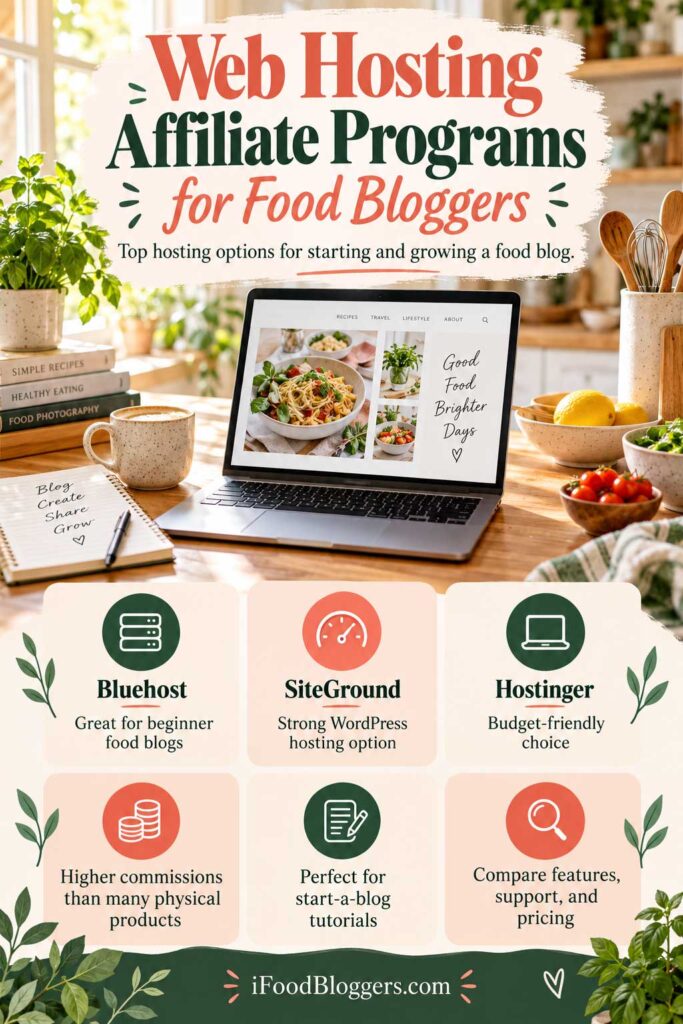
Web hosting affiliate programs can be especially valuable for bloggers who teach other people how to start a food blog.
If you are still comparing the broader options for building a website, our guide to the best blogging platforms for food bloggers explains the differences between self-hosted WordPress and other free and paid blogging platforms.
Anyone building a self-hosted WordPress food blog will need web hosting, so hosting recommendations fit naturally into beginner tutorials and website setup guides.
Hosting commissions can also be considerably higher than those available from many physical products, making this one of the more commercially valuable affiliate categories for food-blogging education sites.
Bluehost Affiliate Program
Bluehost is one of the most recognizable hosting affiliate programs for WordPress publishers.
The company currently advertises commissions starting at $65 per qualified sale and a 30-day cookie window.
Commission: $65+ per qualified sale
Cookie duration: 30 days
Best for: Beginner blogging tutorials, WordPress setup guides, and start-a-food-blog content
Bluehost can fit naturally into articles such as How to Start a Food Blog, Best Web Hosting for Food Bloggers, or How Much Does It Cost to Start a Food Blog?
The strongest approach is not simply telling readers to buy hosting, but explaining what they should look for and why a particular provider may fit their needs.
SiteGround Affiliate Program
SiteGround is another established hosting affiliate option and uses a volume-based commission structure.
Its program pays affiliates for qualifying Shared, Cloud, and Reseller hosting sales. SiteGround also currently pays approved commissions weekly after the required holding period, with no standard minimum payout balance unless the affiliate sets one manually.
Commission: Starts at $50 per qualifying sale and can increase with volume
Cookie duration: Verify current program terms
Payout schedule: Weekly after the applicable holding period
Best for: WordPress hosting comparisons, food-blogging tutorials, and established publishers
SiteGround can work particularly well in comparison content such as Best Hosting for Food Bloggers, Bluehost vs. SiteGround, or SiteGround vs. Hostinger.
Hostinger Affiliate Program
Hostinger can be particularly interesting because it uses a percentage-based commission structure.
Hostinger says eligible sales earn commissions starting at 40%, with higher earnings possible as performance increases. Its affiliate agreement provides for tracking cookies lasting up to 30 days.
Commission: Starting at 40%
Cookie duration: Up to 30 days
Best for: Budget hosting, website-building tutorials, hosting comparisons, and blogging education
Hostinger currently requires at least $100 in approved commissions for PayPal payouts and $500 for bank transfers.
Why Hosting Affiliate Programs Can Work Well for Food Bloggers
Hosting fits naturally into the journey of someone starting a food blog.
A comprehensive How to Start a Food Blog guide can move readers through choosing a domain, buying hosting, installing WordPress, selecting a theme, adding a recipe plugin, setting up SEO, and eventually building an email list.
That gives hosting a clear role in the tutorial rather than making it feel like an unrelated promotion.
Hosting comparisons can also attract strong commercial intent because readers searching for Best Web Hosting for Food Bloggers, Bluehost vs. SiteGround, or Best Cheap Hosting for a Food Blog already know they need hosting and are deciding which provider to choose.
The high commissions are attractive, but they should not be the only reason to recommend a host. Performance, support, backups, security, renewal pricing, ease of use, and scalability all matter because readers may depend on that hosting provider for years.
For websites that teach people how to start and grow food blogs, hosting affiliate programs can become one of the most valuable parts of a broader affiliate strategy.
Canva Affiliate Program for Food Bloggers
Canva is one of the most useful design tools for food bloggers because it can be used to create Pinterest pins, social media graphics, recipe ebooks, lead magnets, media kits, presentations, and other visual content.
That makes Canva especially relevant for websites that teach people how to start, grow, and market a food blog.
Does Canva Have an Affiliate Program?
Canva has operated affiliate and referral partnerships through Impact and other creator-partnership programs, but its public enrollment structure has changed over time.
As of 2026, Canva’s official partner pages emphasize several types of partnerships rather than publishing one universal affiliate commission structure for all creators and publishers.
Older affiliate guides may reference fixed commissions and a 30-day cookie, but Canva’s partnership structure has changed over time. Verify the latest terms directly through Canva or its current partner platform.
Commission: Verify current Canva partner terms
Cookie duration: Verify current attribution terms
Best for: Blogging tutorials, Pinterest marketing, social media, branding, lead magnets, and content creation
Why Canva Can Work Well for Food Bloggers
Food blogging is highly visual, which makes Canva easy to integrate into educational content.
A single recipe may need several Pinterest pins, social graphics, an email image, or a printable resource. Canva allows bloggers to create reusable templates so they do not have to design everything from scratch.
It is especially useful for Pinterest, where food bloggers can create branded vertical graphics for recipes, list posts, seasonal content, and tutorials.
Canva can also help bloggers create lead magnets such as recipe ebooks, meal planners, grocery lists, pantry checklists, and baking conversion charts. These resources can support email-list growth and give bloggers another reason to recommend the platform.
Canva is also one of several tools that can make the day-to-day work of running a blog easier. See our guide to productivity tools for food bloggers for more tools that can help streamline content creation and blogging tasks.
Media kits are another natural use case. Food bloggers who work with brands can use Canva to create professional media kits showing website traffic, social audiences, sponsorship options, and previous collaborations.
That makes Canva a natural fit for articles such as How to Create Pinterest Pins for a Food Blog, How to Create a Recipe Ebook, How to Create a Food Blogger Media Kit, or Best Tools for Food Bloggers.
Even if Canva’s partnership structure changes, it remains a useful tool to cover because visual content, Pinterest graphics, ebooks, lead magnets, and social media are part of everyday food-blogging work.
Email Marketing Affiliate Programs for Food Bloggers
Email marketing tools can be some of the most attractive affiliate programs for bloggers who teach other people how to build and grow food websites.
Food bloggers use email platforms to collect subscribers, send newsletters, deliver lead magnets, promote new recipes, build automated sequences, and bring readers back to their websites.
Because these tools usually charge monthly or annual subscription fees, some email-marketing affiliate programs also offer recurring commissions.
Two strong options to consider are Kit and MailerLite.
If you want to compare these with additional platforms, our guide to the best email marketing services for food bloggers covers more options for newsletters, subscriber management, automation, and audience growth.
Kit Affiliate Program
Kit, formerly known as ConvertKit, is an email marketing platform built around creators and online businesses.
It can be especially relevant for food bloggers who want to build an email list, automate welcome sequences, deliver lead magnets, or promote digital products.
Kit currently operates its affiliate program through PartnerStack.
Commission: 50% of qualifying referred payments during the first 12 months
Affiliate platform: PartnerStack
Minimum payout: $5
Best for: Food-blogging tutorials, email marketing guides, creator businesses, and digital-product content
Kit also uses performance-based affiliate tiers. Affiliates who reach the required number of paying referrals can qualify for additional recurring commissions after a referred customer’s first 12 months, with higher tiers offering larger recurring percentages.
That structure can make Kit especially interesting for bloggers who consistently refer other creators.
MailerLite Affiliate Program
MailerLite is another strong option for bloggers who want a relatively accessible email marketing platform.
Its affiliate program currently pays a 30% recurring commission on qualifying referred subscriptions, which can make one successful referral more valuable over time than a one-time physical-product commission.
Commission: 30% recurring
Cookie duration: 45 days
Affiliate platform: Trackdesk
Minimum payout: $100 from at least two qualifying referrals
Best for: New bloggers, newsletters, lead magnets, automation, and email-marketing tutorials
MailerLite’s current program uses a 45-day referral window, giving referred visitors more time to sign up than programs with very short attribution periods.
Why Email Marketing Affiliate Programs Can Work Well for Food Bloggers
Email software fits naturally into food-blogging education because almost every growing blog eventually needs a way to build an audience outside search and social media.
A food blogger might offer a free meal plan, recipe ebook, grocery list, pantry checklist, or baking conversion chart in exchange for an email signup. Kit or MailerLite can then deliver that resource and help the blogger build a welcome sequence or regular newsletter.
That makes these tools natural recommendations inside articles such as How to Build an Email List for Your Food Blog, Best Email Marketing Tools for Food Bloggers, or Kit vs. MailerLite.
The recurring commission structure is another advantage. Instead of earning once when a reader purchases a physical product, a qualifying software referral may continue generating commissions while the customer remains subscribed, depending on the program’s terms.
For websites teaching food blogging, email-marketing platforms can therefore become some of the most valuable affiliate partnerships because they combine strong relevance with recurring-revenue potential.

Best Affiliate Programs for Food Bloggers Compared
The best affiliate program depends on the type of food content you publish, your audience, and what your readers are most likely to buy.
Here is a quick comparison of the programs covered in this guide.
| Affiliate Program | Best For | Commission | Cookie / Tracking Window |
|---|---|---|---|
| Thrive Market | Organic food, healthy eating, specialty diets | Varies | Verify current terms |
| HelloFresh | Meal kits, family meals, meal planning | Starting at $10 per new customer | 14 days |
| Home Chef | Meal kits, easy dinners, meal planning | Varies | Verify current terms |
| Nuts.com | Baking, snacks, pantry ingredients | Verify current terms | Verify current terms |
| Instacart | Grocery shopping, recipes, meal plans | Varies | Verify current terms |
| Wildly Organic | Organic foods, baking, healthy recipes | 10%–20% | 30 days |
| Sunfood Superfoods | Smoothies, superfoods, healthy eating | Verify current terms | Verify current terms |
| The Vitamin Shoppe | Protein products, superfoods, healthy snacks | Up to 10% | Verify current terms |
| Amazon Associates | Kitchen equipment and broad product recommendations | Varies by category | Generally 24 hours |
| Walmart | Kitchen, grocery, meal prep, budget content | Varies | Verify current terms |
| Target | Kitchen, home, seasonal and entertaining content | Up to 8% | 7 days |
| KitchenAid | Baking and premium kitchen appliances | Verify current terms | Verify current terms |
| Vitamix | Blenders, smoothies, soups and healthy recipes | Starting at 10% for content affiliates | Verify current terms |
| Ninja Kitchen | Blenders, air fryers and small appliances | Up to 20% | Verify current terms |
| Sur La Table | Cookware, knives, bakeware and premium kitchen products | Verify current terms | Verify current terms |
| ButcherBox | Meat recipes, grilling and high-protein content | Varies | Verify current terms |
| Crowd Cow | Meat, seafood, Wagyu and premium food delivery | Varies | Verify current terms |
| Food Blogger Pro | Blogging education and food-blog growth | Verify current terms | Verify current terms |
| WP Recipe Maker | Recipe plugins and WordPress tutorials | Verify current terms | Verify current terms |
| Bluehost | Starting a food blog and hosting tutorials | $65+ per qualified sale | 30 days |
| SiteGround | WordPress hosting and blogging tutorials | Starting at $50 per sale | Verify current terms |
| Hostinger | Budget hosting and website-building tutorials | Starting at 40% | Up to 30 days |
| Kit | Email marketing and creator businesses | 50% for first 12 months | Verify current terms |
| MailerLite | Email marketing and newsletters | 30% recurring | 45 days |
| Canva | Pinterest, graphics, ebooks and media kits | Verify current terms | Verify current terms |
Affiliate terms can change, so always confirm the latest commission rate, tracking period, and eligibility requirements before applying or publishing specific promotional claims.
Which Affiliate Programs Are Best for Recipe Bloggers?
Recipe-focused websites should usually prioritize products and services that relate directly to cooking and food.
Recipe-focused blogs will usually find the strongest opportunities in kitchen equipment, groceries, specialty ingredients, meal delivery, and food-shopping services. Blogs that also publish kitchen buying guides have even more options because appliances and cookware often carry higher order values.
These programs can be incorporated naturally into recipes, buying guides, equipment comparisons, ingredient recommendations, gift guides, and seasonal shopping content.
Which Programs Are Best for Food-Blogging Websites?
If your audience includes people who want to start or grow their own food blogs, software and business-focused affiliate programs can be especially valuable.
Food Blogger Pro and WP Recipe Maker are directly connected to recipe publishing, while hosting companies such as Bluehost, SiteGround, and Hostinger fit naturally into start-a-blog tutorials.
Kit and MailerLite can be recommended in email-marketing content, while Canva fits well into tutorials covering Pinterest, graphics, ebooks, lead magnets, and media kits.
These programs can also complement one another. A reader starting a food blog may eventually need hosting, WordPress tools, a recipe plugin, email marketing software, and design tools.
Don’t Choose an Affiliate Program Based Only on Commission Rate
A high commission does not automatically make a program profitable.
A 20% commission on a product your audience rarely wants may earn less than a much smaller commission on something readers regularly purchase.
Consider the full picture, including audience relevance, product price, conversion potential, brand reputation, tracking period, repeat-purchase potential, and how naturally the product fits your content.
Reader intent matters most.
Someone searching for best blender for smoothies may already be shopping for a blender. Someone reading how to start a food blog will probably need hosting. A blogger researching how to grow an email list may be ready to choose an email marketing platform.
Matching the right affiliate offer to that existing need is generally more important than simply choosing whichever program advertises the highest commission.
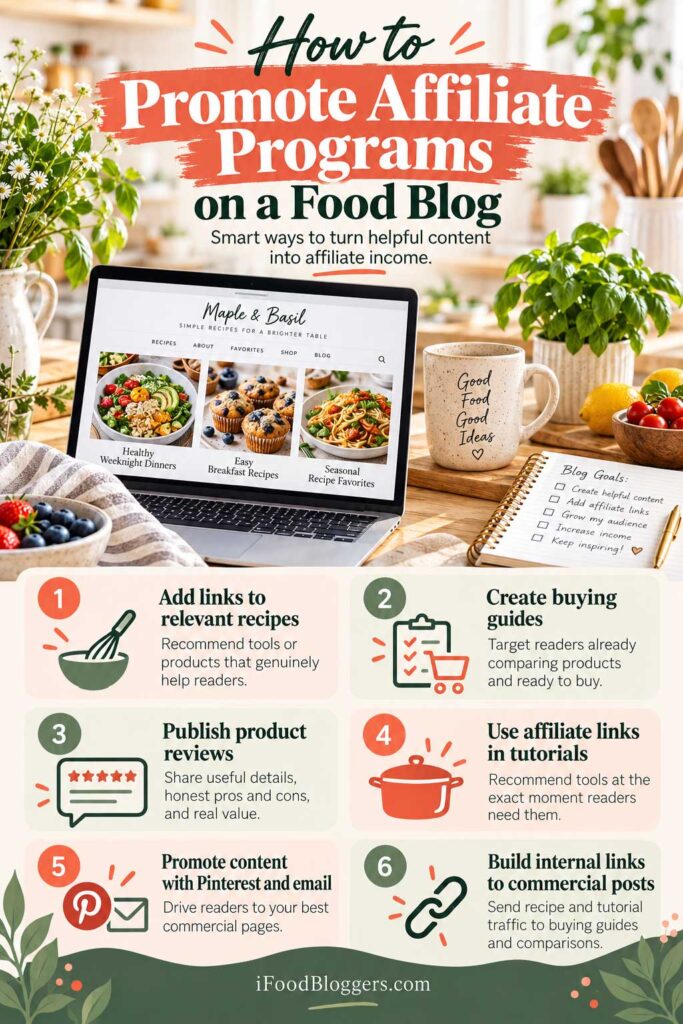
How to Promote Affiliate Programs on a Food Blog
Joining affiliate programs is the easy part. The harder part is placing recommendations where they are useful, relevant, and likely to convert.
The strongest affiliate strategy is usually not to add banners everywhere. It is to create content around problems your readers are already trying to solve.
Add Affiliate Links Where They Naturally Help
Recipes can support affiliate recommendations when a product genuinely helps readers prepare the dish.
A smoothie recipe might link to a blender or reusable smoothie cup. A sourdough recipe might recommend a Dutch oven, kitchen scale, proofing basket, or thermometer.
The key is to stay selective. Readers do not need an affiliate link attached to every ingredient or utensil.
The same principle applies to tutorials. A guide such as How to Start a Food Blog could naturally recommend hosting, a recipe plugin, email marketing software, or design tools at the point where the reader actually needs them.
That usually feels far more useful than placing generic promotional banners throughout the page.
Create Commercial-Intent Content
Buying guides, product reviews, and comparison articles are some of the strongest affiliate-content formats because they attract readers who are already researching a purchase.
Examples include Best Blenders for Smoothies, Best Air Fryers for Families, Vitamix vs. Ninja, ButcherBox vs. Crowd Cow, or Kit vs. MailerLite.
Product reviews should go beyond repeating manufacturer descriptions. Cover practical details such as performance, limitations, pricing, who the product is best for, and how it compares with alternatives.
Whenever possible, firsthand testing, original photos, and real observations can make the content much more useful and credible.
Build Resource Pages and Seasonal Guides
A dedicated resources page can collect the tools and products you regularly recommend, such as cookware, kitchen appliances, photography equipment, hosting, recipe plugins, and email marketing platforms.
Keep it curated. A short list of products you genuinely recommend is more useful than hundreds of affiliate links.
Seasonal content can also create strong opportunities. Gift guides, holiday baking articles, Black Friday roundups, and kitchen-product guides can perform well in both search and Pinterest when published early enough.
Use Pinterest and Email to Support Affiliate Content
Pinterest can be especially useful for food bloggers because recipes, kitchen products, meal planning, and gift ideas are highly visual.
Instead of sending every Pinterest visitor directly to a merchant, send them to useful content on your own website.
For example:
Pinterest Pin → Best Blenders for Smoothies → Affiliate Recommendation
Email can work the same way.
A seasonal newsletter might include holiday recipes, kitchen gift guides, cookware recommendations, or meal-planning resources and send readers back to your commercial content.
Avoid turning every email into a sales message. Readers are more likely to stay subscribed when most emails remain genuinely useful.
Update Older High-Traffic Posts
You do not always need to create new content.
Review older articles that already receive traffic and ask whether there is a product, service, or related buying guide that could genuinely help someone reading the page.
A smoothie recipe might link to your blender guide. A bread recipe could link to a Dutch oven comparison. A food-blogging tutorial could point readers toward your hosting or email-marketing guide.
This can sometimes create affiliate opportunities faster than waiting for a completely new article to rank.
SEO tools can help you identify which older pages already receive impressions and clicks and may be worth improving first. See our guide to the best SEO tools for food bloggers for tools that can help with keyword research, Search Console data, competitor research, and content updates.
Build Internal Links Toward Commercial Pages
Internal linking is one of the strongest ways to connect informational traffic with affiliate content.
Imagine you have 50 smoothie recipes.
Instead of placing several blender links inside every recipe, create one excellent guide such as Best Blenders for Smoothies and link relevant recipes to it.
The structure becomes:
Recipe → Buying Guide → Affiliate Merchant
You can repeat the same model across the site:
Bread Recipes → Best Dutch Ovens
Air Fryer Recipes → Best Air Fryers
Baking Recipes → Best Stand Mixers
Food Blogging Tutorials → Best Hosting for Food Bloggers
This creates focused commercial pages supported by related informational content.
Do Not Overload Pages With Affiliate Links
More links do not automatically mean more revenue.
Too many affiliate links can make an article feel promotional and distract readers from the information they came to find.
A few well-placed recommendations that genuinely help the reader are usually more valuable than dozens of unrelated product links.
The goal is simple: help readers make better decisions while creating a natural opportunity for your blog to earn a commission.
Affiliate Disclosure Requirements for Food Bloggers
If you earn money when readers purchase products through your affiliate links, that relationship should be disclosed clearly.
In the United States, the Federal Trade Commission says affiliate marketers should disclose their relationship with retailers clearly and conspicuously so readers understand that the recommendation may generate a commission. The FTC’s official Endorsement Guides provide additional guidance for affiliate marketers on how and where these relationships should be disclosed. The FTC also says the closer the disclosure is to the recommendation or affiliate link, the better.
For food bloggers, that means readers should not have to search through an About page, footer, or legal page to discover that some links may earn you money.
Where Should You Put an Affiliate Disclosure?
For most blog posts containing affiliate links, the simplest approach is to place a clear disclosure near the beginning of the article.
For example:
Affiliate disclosure: We may earn a commission if you purchase through links on this page, at no additional cost to you.
Clear wording is better than simply labeling something an “affiliate link.” The FTC notes that consumers may not understand that this phrase means the publisher can earn money from purchases.
The same principle applies when affiliate recommendations appear on Pinterest, Instagram, TikTok, YouTube, Facebook, newsletters, or other platforms. The financial relationship should be disclosed in a way users are likely to notice.
You should also disclose other material relationships when relevant, such as receiving free products, discounts, sponsorship payments, gifts, or other benefits connected to a recommendation.
Amazon Associates Has Additional Disclosure Requirements
Amazon Associates has its own disclosure rules in addition to general advertising requirements.
Amazon currently requires Associates to clearly and prominently identify themselves with the statement:
“As an Amazon Associate I earn from qualifying purchases.”
Amazon also requires affiliate-link disclosures to be clear and conspicuous near the relevant links or product recommendations. Its current guidance gives examples such as “(paid link),” “#ad,” or “#CommissionsEarned” for link-level disclosure.
If you participate in Amazon Associates, make sure your site follows both Amazon’s current Operating Agreement and applicable disclosure requirements.
Keep Affiliate Recommendations Honest
Disclosure is only one part of responsible affiliate marketing.
The FTC’s guidance also says endorsements should reflect honest opinions and experiences and should not include deceptive or unsupported claims.
That means you should not claim that you personally tested a blender, cookware set, meal kit, or other product if you did not.
It is perfectly reasonable to publish research-based comparisons without personally owning every product, but the wording should not imply firsthand experience when there was none.
Clear disclosures and honest recommendations help readers understand the relationship behind your links while protecting the trust that makes affiliate marketing effective in the first place.
Note: This section provides general information and is not legal advice. Disclosure requirements can vary depending on your location, audience, platform, and individual affiliate agreements.
How Much Can Food Bloggers Make With Affiliate Marketing?
There is no fixed amount a food blogger can earn from affiliate marketing.
Two blogs with similar traffic can generate very different revenue depending on what readers are searching for, which products are promoted, and how closely the content matches buying intent.
A recipe attracting thousands of visitors looking for a quick dinner may generate relatively little affiliate income. A smaller article about the best blender for smoothies may earn more because the reader is already researching something they may want to buy.
Traffic Matters, but Buying Intent Matters More
More traffic creates more opportunities for affiliate clicks, but the quality of that traffic often matters more than raw pageviews.
Compare someone searching how long to bake chicken breast with someone searching best meat thermometer for chicken.
The first visitor primarily wants information. The second may already be considering a purchase.
That is why a strong affiliate strategy usually combines informational content that attracts readers with commercial content that helps them make purchasing decisions.
A Simple Affiliate Revenue Example
Imagine a buying guide receives 5,000 visits per month.
If 20% of visitors click an affiliate link, 3% of those clicks convert, and the average commission is $8, a hypothetical calculation might look like this:
5,000 visitors × 20% = 1,000 affiliate clicks
1,000 clicks × 3% = 30 sales
30 sales × $8 = $240 per month
This is only an example. Actual click-through rates, conversion rates, product prices, and commissions can vary significantly between websites and affiliate programs.
Higher-value products can also change the economics considerably. If a $500 appliance pays a 10% qualifying commission, one sale could theoretically generate $50.
That is one reason appliance reviews and equipment guides can be commercially valuable even when they receive less traffic than recipe posts.
Recurring Affiliate Programs Can Add Long-Term Value
Software, memberships, and subscription services work differently from many physical-product programs.
Some email marketing tools, hosting companies, and creator platforms offer recurring or extended commissions.
For example, a qualifying software referral may continue generating commissions over several months rather than producing only one payment.
That can make blogging tools especially interesting for websites that teach readers how to start or grow food blogs.
Smaller Blogs Can Still Generate Affiliate Income
You do not need hundreds of thousands of monthly visitors to make affiliate marketing worthwhile.
A smaller site can still generate revenue if it attracts readers through highly targeted commercial searches such as Best Blender for Green Smoothies, Best Dutch Oven for Sourdough, Best Hosting for a Food Blog, or Best Recipe Plugin for WordPress.
Even modest traffic can be valuable when readers arrive specifically because they are researching a purchase.
Established blogs have another advantage: they may already have dozens or hundreds of posts receiving traffic.
Instead of creating only new affiliate content, you can review existing articles and connect them to relevant commercial guides.
For example:
Smoothie Recipes → Best Blenders for Smoothies
Bread Recipes → Best Dutch Ovens
Food Blogging Tutorials → Best Hosting for Food Bloggers
This can create new affiliate opportunities without requiring a major increase in overall traffic.
Focus on Relevance and Diversification
Increasing traffic is not the only way to increase affiliate revenue.
Better internal linking, stronger product relevance, clearer calls to action, improved comparison content, and updates to older high-traffic posts can all improve performance.
It is also risky to depend entirely on one affiliate program. Commission rates, tracking periods, eligibility requirements, and even entire programs can change.
A more sustainable approach is to build several complementary revenue sources around products and services your audience genuinely needs.
Affiliate marketing usually grows over time as your site develops more commercial content and connects that content with relevant informational pages.
The goal is not to turn every recipe into a sales page. It is to create a useful path from helpful content → buying guide → relevant affiliate recommendation.
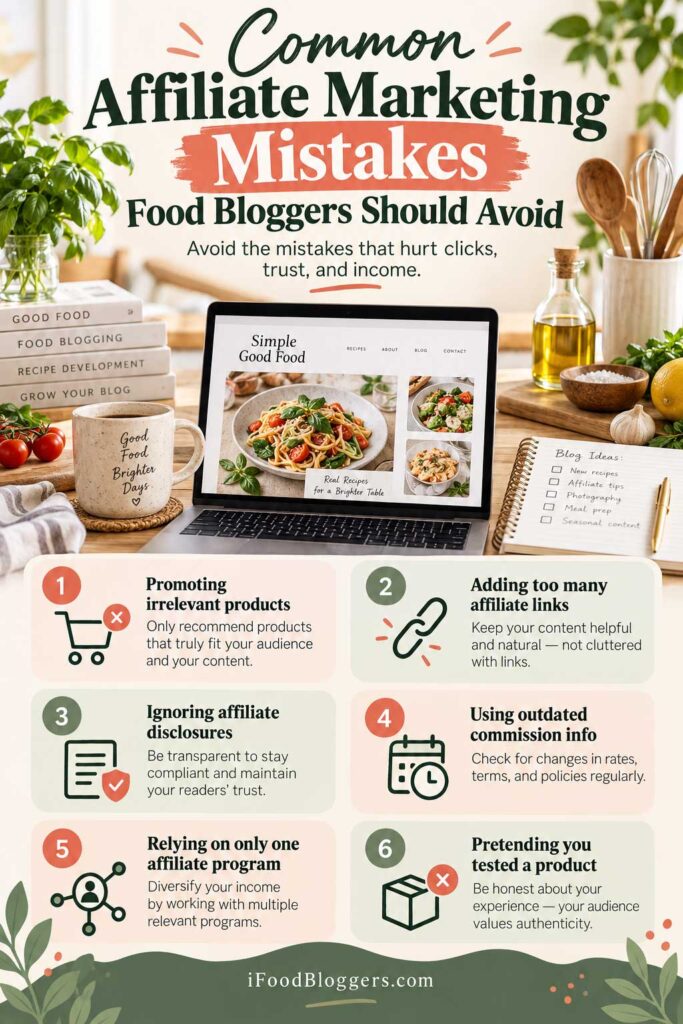
Common Affiliate Marketing Mistakes Food Bloggers Should Avoid
Affiliate marketing can become a useful revenue stream, but a few common mistakes can reduce conversions, weaken reader trust, or create unnecessary compliance problems.
The goal should be to make affiliate recommendations genuinely useful rather than turning every article into a sales page.
Promoting the Wrong Products or Too Many Links
One of the biggest mistakes is recommending products simply because they offer a high commission.
The product should make sense for the reader.
A smoothie article can naturally recommend a blender. A bread recipe can link to a Dutch oven or kitchen scale. A guide about starting a food blog can recommend hosting or a recipe plugin.
The closer the recommendation matches the reader’s immediate need, the more useful it becomes.
The same applies to link volume. More affiliate links do not automatically mean more sales.
Linking every utensil, ingredient, and appliance mentioned in a recipe can make the page feel cluttered and overly promotional. A few carefully chosen recommendations are usually more useful than dozens of links.
Choosing Programs Only by Commission Rate
A 20% commission may look more attractive than a 5% commission, but that does not automatically make the program more profitable.
You also need to consider product price, audience relevance, brand recognition, conversion potential, tracking period, repeat-purchase behavior, and customer experience.
A smaller commission on a product your readers regularly buy may outperform a much higher commission on something they do not need.
It is also risky to depend entirely on one affiliate program. Merchants can reduce commissions, change networks, shorten tracking periods, restrict promotional methods, or discontinue programs completely.
Using several relevant programs can make your affiliate income less dependent on one company.
Using Outdated or Misleading Information
Affiliate terms change frequently.
A program that pays one commission rate today may offer something completely different a few months later.
That is why important affiliate content should be reviewed regularly. Check commission rates, cookie periods, payout requirements, program availability, affiliate networks, and eligibility rules.
If current information cannot be verified, it is better to tell readers to confirm the latest terms than to publish an outdated number as fact.
The same principle applies to product reviews.
Do not claim that you tested a blender, cookware set, meal kit, or other product if you did not. Research-based comparisons can still be useful, but the wording should make it clear when your conclusions are based on research rather than firsthand testing.
Ignoring Disclosure and Reader Trust
Readers should understand when you may earn money from a recommendation.
Do not bury affiliate disclosures at the bottom of a page or rely on vague wording. Use a clear disclosure and follow the requirements of the affiliate programs you participate in.
Trust also depends on the quality of your recommendations.
Affiliate reviews become weak when they simply repeat manufacturer descriptions. Useful content should explain important features, limitations, alternatives, pricing considerations, and who the product may or may not suit.
Whenever possible, original photos, testing, and firsthand observations can make the content significantly stronger.
Sending Readers Away Too Quickly
Not every affiliate click needs to go directly from a recipe to a merchant.
Sometimes it is better to send the reader to a useful commercial page on your own website first.
For example:
Smoothie Recipe → Best Blenders for Smoothies → Affiliate Merchant
This gives readers more information before they leave your site and allows your buying guides and comparison articles to rank independently.
It also strengthens internal linking across your website.
Ignoring Mobile Experience and Performance Data
A large share of food-blog traffic comes from mobile devices, so affiliate tables, buttons, product boxes, and comparison sections should be easy to use on smaller screens.
Avoid oversized banners, tiny text, extremely wide tables, crowded buttons, and excessive pop-ups.
You should also track what actually converts.
Affiliate dashboards can show which articles, products, and links generate clicks and sales. A relatively small buying guide may sometimes outperform several larger posts.
Use that information to decide which content deserves updates, stronger internal links, or additional supporting articles.
Expecting Fast Results
Affiliate marketing usually takes time.
Commercial articles may need time to be indexed, rank in search results, gain Pinterest visibility, build links, or earn reader trust.
A strong strategy also includes more than product reviews. Buying guides, comparisons, tutorials, resource pages, seasonal content, and relevant recipe recommendations can all play a role.
The most sustainable approach is to treat affiliate marketing as part of your broader content strategy rather than a quick way to monetize every page.
Frequently Asked Questions About Affiliate Programs for Food Bloggers
What is the best affiliate program for food bloggers?
There is no single best program for every food blog.
Recipe-focused sites may do well with kitchen appliances, cookware, groceries, meal delivery, and specialty ingredients. Blogs that teach food blogging may have better opportunities with hosting, recipe plugins, email marketing tools, design software, and education platforms.
The most important factor is relevance. A product that closely matches what your readers already want is usually more valuable than an unrelated offer with a higher commission.
Can beginner food bloggers use affiliate marketing?
Yes. You do not necessarily need a large audience to get started.
Some programs accept newer websites, while others prefer established blogs with consistent traffic.
Even with a smaller site, you can begin creating affiliate-friendly content such as product comparisons, kitchen guides, blogging tutorials, resource pages, and gift guides so those articles have time to gain traffic as your site grows.
Do food bloggers need a lot of traffic to make affiliate sales?
Not always.
Traffic helps, but buying intent can matter more than raw pageviews.
An article about best blender for smoothies may attract fewer visitors than a popular recipe but still generate more affiliate revenue because readers are actively researching a purchase.
What types of affiliate products work best for food blogs?
The best products depend on your niche.
Common opportunities include kitchen appliances, cookware, baking equipment, food storage, grocery delivery, meal kits, specialty ingredients, blogging tools, hosting, WordPress plugins, email marketing software, and design tools.
The strongest options are usually those that naturally complement the content you already publish.
Can I use multiple affiliate programs on the same food blog?
Yes, as long as the individual program terms allow it.
Many bloggers work with several merchants and affiliate networks at the same time.
A kitchen guide might include both direct manufacturer links and large retailers, while a food-blogging tutorial might recommend hosting, a recipe plugin, and an email platform.
Using multiple programs can also reduce your dependence on a single merchant.
Can I use Amazon Associates with other affiliate programs?
Generally, yes.
Participating in Amazon Associates does not mean your entire site has to use only Amazon links.
You can also work with other retailers and direct brand programs, provided you follow each program’s current terms and disclosure requirements.
Where should I put affiliate links in a recipe post?
Place them where they are relevant and useful.
Good opportunities include equipment recommendations, specialty ingredients, a tools-used section, or links to related buying guides.
Avoid attaching an affiliate link to every ingredient or utensil. The goal is to help the reader, not overwhelm the page.
Should I create separate affiliate articles?
Yes. Dedicated commercial content can be one of the strongest parts of an affiliate strategy.
Articles such as Best Blenders for Smoothies, Best Dutch Ovens for Bread, Best Meal Delivery Services, or Best Hosting for Food Bloggers target readers who are already researching products or services.
Are comparison articles good for affiliate marketing?
Yes. Comparison articles can attract readers who are already deciding between two products or services.
Examples include Vitamix vs. Ninja, ButcherBox vs. Crowd Cow, and Kit vs. MailerLite.
A strong comparison should explain meaningful differences rather than simply promoting whichever option offers the highest commission.
Do I need to disclose affiliate links?
Yes. If you may earn money or receive another material benefit from a recommendation, that relationship should be disclosed clearly where required.
In the United States, the FTC says material connections should be disclosed clearly and conspicuously when consumers would not reasonably expect them.
Individual affiliate programs may also have their own disclosure requirements.
How often should I update an affiliate article?
Review important affiliate content regularly.
Commission rates, tracking periods, networks, pricing, promotional offers, and eligibility rules can all change.
For high-value affiliate articles, checking important program details several times per year is a sensible approach.
Is affiliate marketing better than display advertising for food bloggers?
Neither is automatically better.
Display advertising primarily monetizes pageviews and ad impressions, while affiliate marketing earns revenue when readers complete qualifying actions such as purchases or subscriptions.
Many food bloggers use both. Informational recipe content can generate ad revenue, while buying guides, comparisons, reviews, and tutorials can create affiliate opportunities.
Using several complementary monetization methods can make a food-blogging business less dependent on one revenue source.
Final Thoughts: Choosing the Right Affiliate Programs for Your Food Blog
Affiliate marketing can become a valuable income stream for food bloggers, but the strongest results usually come from relevance rather than volume.
You do not need to join every available program.
A recipe-focused blog may have the best opportunities with kitchen equipment, cookware, groceries, meal kits, specialty ingredients, and food-delivery services. A site that teaches food blogging can also monetize through hosting, recipe plugins, email marketing tools, design software, and education platforms.
The key is matching the recommendation to the reader’s intent.
Someone searching for a smoothie recipe may be interested in a blender. Someone researching the best Dutch oven for bread is much closer to making a purchase. A reader learning how to start a food blog may need hosting, a recipe plugin, and email marketing software.
That is where affiliate marketing works best: when the recommendation helps readers do something they already want to do.
As your site grows, build a balanced mix of informational and commercial content. Recipes and tutorials can attract traffic, while buying guides, comparisons, reviews, and resource pages can create stronger affiliate opportunities.
You can also improve existing content by adding relevant internal links to your best commercial pages instead of filling every article with direct affiliate links.
Most importantly, protect the trust you have built with your readers.
Recommend products carefully, disclose affiliate relationships clearly, keep important program details updated, and avoid promoting something simply because it pays a high commission.
A smaller group of relevant, trustworthy recommendations can be far more valuable than hundreds of poorly matched affiliate links.
Affiliate marketing doesn’t have to replace display ads or other income sources. Used well, it can become another dependable part of a more diversified food-blogging business.
Keep Growing Your Food Blog
If you’re working on growing and monetizing your food blog, these guides can help you build a stronger foundation:
- Best SEO Tools for Food Bloggers — explore tools for keyword research, rankings, technical SEO, competitor analysis, and content optimization.
- Best WordPress SEO Plugins for Food Bloggers — compare WordPress plugins for on-page SEO, schema, sitemaps, redirects, and other technical settings.
- Best Email Marketing Services for Food Bloggers — compare tools for newsletters, subscriber growth, email automation, and lead magnets.
- Best Blogging Platforms for Food Bloggers — compare free and paid options for starting and growing your food blog.
- Productivity Tools for Food Bloggers — discover tools that can make content creation and everyday blogging tasks easier.
- Best WordPress Security Plugins for Food Bloggers — protect your WordPress site from malware, brute-force attacks, vulnerable plugins, and other threats.