
Building traffic to a food blog is important, but getting readers to come back is where email marketing can make a real difference.
Unlike search engines or social media platforms, an email list gives you a direct way to reach people who have already shown an interest in your recipes, cooking tips, meal plans, or other content. Email works even better when it supports a broader content strategy. If you are still working on search visibility, our guide to the Best Free Keyword Research Tools for Food Bloggers can help you find topics and recipes your audience is already searching for. You can use that audience to promote new recipes, highlight seasonal content, recommend products, share helpful resources, and eventually create a more reliable source of repeat traffic and revenue.
The harder part is figuring out which platform actually fits the way you plan to use email.
SSome platforms are clearly built with creators in mind, while others lean more toward ecommerce, sales automation, CRM tools, or high-volume campaigns. Pricing can also vary significantly as your subscriber list grows.
For most food bloggers, a good email marketing platform should make it easy to create attractive newsletters, build signup forms and landing pages, organize subscribers, set up welcome sequences, and connect smoothly with WordPress.
In this guide, we compare some of the best email marketing platforms for food bloggers in 2026, including options for beginners building their first email list and established food websites managing thousands of subscribers.
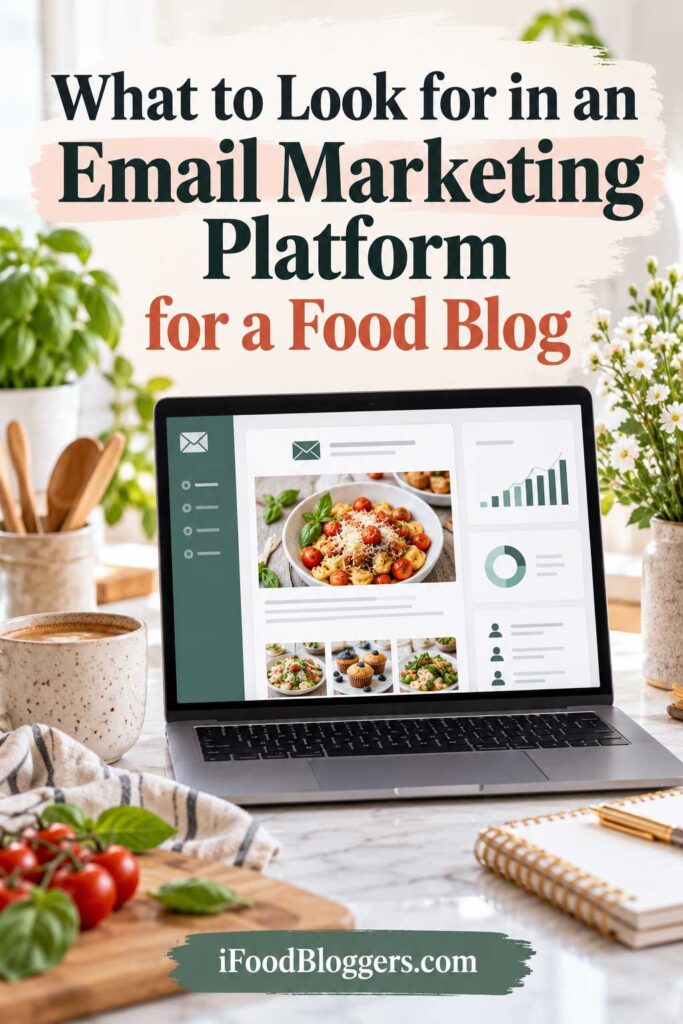
What to Look for in an Email Marketing Platform for a Food Blog
The best email marketing platform is not necessarily the one with the longest list of features. What matters most is whether it helps you grow your audience, communicate with readers, and manage your list without adding unnecessary complexity.
When comparing email marketing platforms for food bloggers, focus on the features you will actually use rather than simply choosing the service with the longest feature list.
Before comparing platforms, it helps to know which features will actually make a difference for a food blog.
Easy Signup Forms and Landing Pages
Your email platform should make it simple to add signup forms to recipe posts, category pages, sidebars, popups, and dedicated landing pages.
This becomes even more important if you use lead magnets such as:
- Free recipe ebooks
- Weekly meal plans
- Grocery lists
- Printable kitchen guides
- Seasonal recipe collections
The easier it is to create and test signup forms, the easier it becomes to turn website visitors into subscribers.
WordPress Integration
Because many food blogs run on WordPress, good integration can save a lot of time. If you are still building your site, our guide to the Best Blogging Platforms for Food Bloggers explains why WordPress remains such a popular option for recipe and content-focused websites.
Your email platform should work smoothly with your website, forms, ecommerce tools, and other plugins without requiring complicated code or manual workarounds.
If you use WordPress, you can browse available integrations and email-related tools in the official WordPress Plugin Directory.
Some providers offer their own WordPress plugins, while others connect through popular form builders and automation tools. The same applies to your recipe setup. See our comparison of the Best WordPress Recipe Plugins for Food Blogs if you are also improving how recipes are displayed and structured on your site.
Email Automation
Automation becomes more valuable as your audience grows.
For example, a new subscriber could automatically receive a free download, a welcome email, a few of your most popular recipes, and a useful cooking or meal-planning resource.
That gives new readers a better introduction to your blog without requiring you to send every message manually.
Subscriber Segmentation and Tags
Not every subscriber will be interested in the same type of content.
One reader may love baking, while another may prefer healthy meals, vegetarian recipes, air fryer ideas, or desserts.
Tags and segments help you organize subscribers by interest so you can send more relevant emails instead of treating your entire list the same way.
Attractive Email Templates
Food content depends heavily on visuals, so your email builder should make it easy to showcase recipe photography without creating cluttered newsletters.
Look for an email builder that lets you create clean layouts with images, buttons, headings, and links without making every message feel overly promotional.
Simple designs often perform well, especially on mobile devices.
Deliverability
Even a beautifully designed newsletter has little value if it consistently lands in the spam folder.
Deliverability depends on several factors, including your sender reputation, subscriber engagement, authentication settings, list quality, and how you collect email addresses.
Google also recommends properly authenticating email with technologies such as SPF, DKIM, and DMARC, particularly for bulk senders. You can review the Gmail sender guidelines for current requirements and recommendations.
A good platform should support modern email authentication and provide enough reporting to help you identify potential delivery problems.
Analytics and Reporting
Useful analytics help you understand which emails and topics your audience responds to most.
Important metrics can include:
- Open rates
- Click-through rates
- Unsubscribe rates
- Subscriber growth
- Link performance
- Automation performance
Over time, this information can help you see which recipes, subject lines, lead magnets, and promotions generate the most engagement.
Pricing as Your List Grows
Do not look only at the entry-level price.
A platform that seems inexpensive with 500 subscribers may become much more expensive when your list grows to 10,000 or 50,000 subscribers.
Compare how each service charges for subscriber count, email volume, automation features, and additional users.
For a growing food blog, long-term scalability can be just as important as the starting price. Your hosting needs can change in much the same way as your audience grows. Our Best Hosting for Food Bloggers guide compares hosting options for different stages of growth.
Quick Comparison of the Best Email Marketing Platforms for Food Bloggers
Before getting into the detailed reviews, here’s a quick look at how the leading options compare.
The best email marketing platforms for food bloggers vary considerably in pricing, automation, free-plan limits, and creator-focused features.
| Email Marketing Platform | Best For | Free Plan | Starting Price* | Key Strength |
|---|---|---|---|---|
| Kit | Food bloggers and creators | Yes — up to 10,000 subscribers | Creator from $33/mo for 1,000 subscribers | Creator-focused email marketing and automation |
| MailerLite | Beginners and budget-conscious bloggers | Yes — up to 250 active subscribers and 2,500 emails/month | Varies by list size | Simple newsletters, forms, landing pages, and automation |
| Brevo | Bloggers who want email + SMS | Yes — 300 emails/day | Starter from $9/mo | Affordable multichannel marketing |
| GetResponse | Bloggers building funnels and selling products | 14-day trial | Starter from $19/mo on monthly billing | Email, automation, funnels, and landing pages |
| ActiveCampaign | Advanced automation | 14-day trial | From $15/mo for under 1,000 contacts | Powerful automations and segmentation |
| Mailchimp | Bloggers who want a familiar platform | Yes — up to 250 contacts and 500 sends/month | Varies by contact count | Broad integrations and easy campaign creation |
| AWeber | Straightforward email marketing | Plan availability varies | Varies by subscriber count | Simple newsletters and established integrations |
| Constant Contact | Small businesses and bloggers who value support | Free trial | Lite from $12/mo | Easy email creation and live customer support |
*Pricing and plan limits can change and may vary based on subscriber count, email volume, billing period, and selected features.
Which Email Marketing Platform Is Best for Food Bloggers?
There is no single platform that will be perfect for every food blog.
Kit is especially attractive for creators because it combines forms, landing pages, subscriber tagging, segmentation, broadcasts, automation, and digital-product tools in one platform.
MailerLite is a strong option for bloggers who value simplicity. Its free plan currently supports up to 250 active subscribers and 2,500 monthly emails, which can be enough for a new blog that is just starting to build an audience.
Brevo can make sense if you want email marketing alongside SMS and other communication tools. Its free plan includes 300 email sends per day and storage for up to 100,000 contacts, while paid Starter plans begin at $9 per month.
For more sophisticated automation, ActiveCampaign is one of the stronger choices. Pricing currently starts at $15 for accounts with fewer than 1,000 contacts, and new users can test the platform with a 14-day trial.
GetResponse is worth considering if you want email marketing combined with landing pages, automation, funnels, webinars, or digital-product tools. Its Starter plan begins at $19 per month when billed monthly, with lower effective pricing available on annual plans.
Mailchimp remains widely used, but its free plan is now much more limited than it was in the past, with up to 250 contacts and 500 monthly sends.
Constant Contact is a good fit for bloggers who value customer support and broader small-business marketing features. Its Lite plan currently starts at $12 per month.
We will look at each platform in more detail below so you can compare the features, limitations, and pricing structure that make the most sense for your food blog.
1. Kit — Best Overall for Food Bloggers
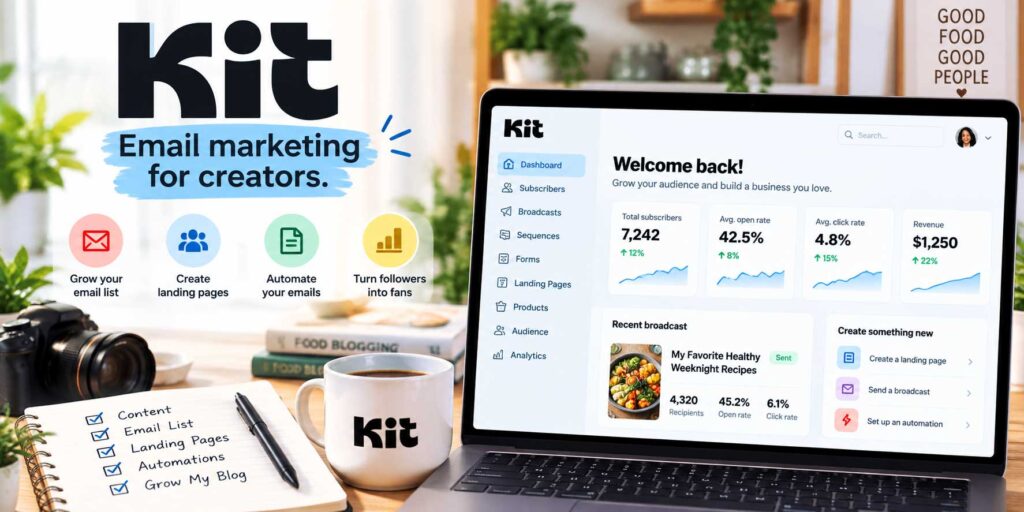
Kit, formerly known as ConvertKit, is an email marketing platform built specifically for creators. That makes it a natural fit for food bloggers, recipe creators, newsletter publishers, and anyone building an audience around content.
Unlike platforms that were originally designed around traditional business marketing, Kit focuses heavily on helping creators grow an email list, organize subscribers, automate campaigns, and eventually monetize their audience.
For a food blogger, that could mean collecting subscribers with a free recipe ebook, tagging readers based on their interests, sending a welcome series, promoting new recipes, or selling meal plans and other digital products.
Why Kit Works Well for Food Bloggers
Kit makes it relatively easy to grow a list and keep subscribers organized as that list gets bigger.
You can create forms and landing pages, deliver free downloads automatically, tag subscribers based on how they joined your list, and segment readers according to their interests.
For example, you might separate readers who are interested in baking, healthy recipes, air fryer meals, vegetarian food, desserts, or weekly meal planning. That makes it easier to send relevant content instead of sending every email to your entire audience.
Kit also includes tools for selling digital products and subscriptions directly through the platform. That can be useful if you eventually want to sell recipe ebooks, printable meal plans, cooking guides, premium newsletters, or other downloadable products.
Email can also work alongside affiliate monetization. Our guide to the Best Affiliate Programs for Food Bloggers covers additional ways to earn from an engaged food-blog audience.
Kit Automations
Automation is one of Kit’s strongest features, although its more advanced automation tools require a paid plan.
With a paid plan, you can build visual automations and automated email sequences that guide new subscribers through a series of messages.
A simple workflow might look like this:
Subscriber downloads a free meal plan → Welcome email → Popular recipes → Cooking tips → Recommended kitchen products → Weekly recipe emails
Once the automation is active, each new subscriber can move through that sequence automatically.
Kit also supports RSS-based campaigns that can help turn newly published blog posts into emails, which is useful for food bloggers who publish recipes regularly.
Kit Free Plan
One of Kit’s biggest advantages in 2026 is its generous free plan.
The free tier currently supports up to 10,000 active subscribers and includes unlimited broadcasts, forms, landing pages, tagging, segmentation, A/B testing, and tools for selling digital products and subscriptions.
The main limitation is automation. Automated email sequences and the visual automation builder are reserved for paid plans, so bloggers who want more sophisticated welcome series and funnels will eventually need to upgrade.
Kit Pricing
For up to 1,000 subscribers, Kit currently lists:
- Free: $0/month, with support for up to 10,000 subscribers
- Creator: $33/month when billed annually
- Pro: $66/month when billed annually
Pricing increases as your subscriber count grows, and Kit also offers a trial of its paid plans.
What Are the Main Advantages of Kit?
Kit’s biggest strength is that it is designed around creators rather than traditional businesses. It combines forms, landing pages, segmentation, tagging, broadcasts, automation, and digital-product tools in one system.
The free plan is especially attractive because it gives newer bloggers room to grow before paying for more advanced features.
Once you move to a paid plan, Kit becomes much more useful for welcome sequences, subscriber journeys, and other automated campaigns.
What Are the Main Drawbacks?
The biggest drawback is that the features that make Kit especially powerful, including automated sequences and visual automations, require a paid plan.
Pricing can also become more expensive as your subscriber list grows.
For bloggers who only want to send a simple newsletter a few times per month, Kit may offer more functionality than they actually need.
Below, we take a closer look at these email marketing platforms for food bloggers and where each one fits best.
Is Kit Good for Food Bloggers?
Yes. Kit is particularly well suited to food bloggers who want to build more than a basic newsletter.
If your goal is to collect subscribers, deliver lead magnets, organize readers by interest, build automated sequences, and eventually monetize your audience with digital products or premium content, Kit provides most of those tools in one platform.
The free plan also makes it possible to build a substantial email list before committing to a paid subscription.
Best for: Food bloggers, recipe creators, and content publishers who want to grow and monetize an email audience.
2. MailerLite — Best for Beginners and Simplicity
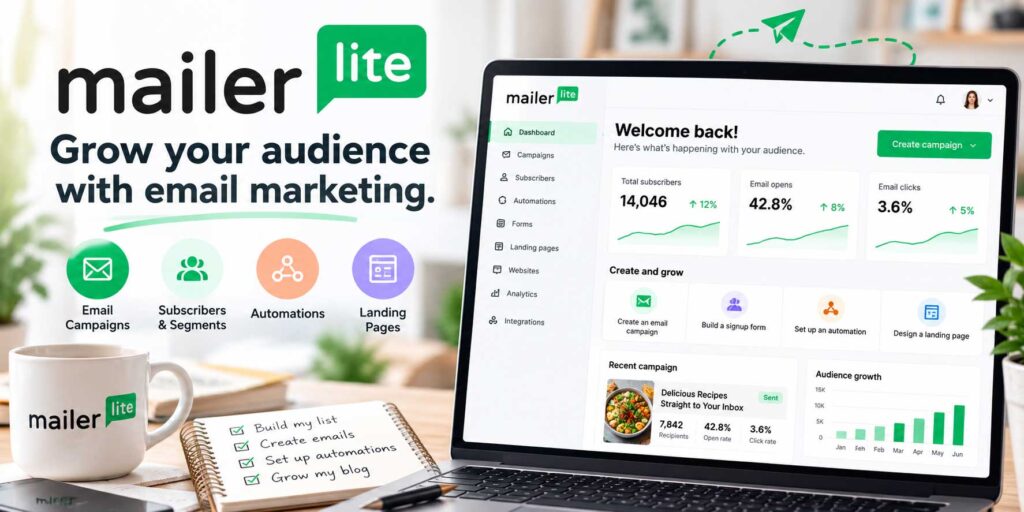
MailerLite is a popular email marketing platform for bloggers, creators, and small businesses that want an easy-to-use system without a steep learning curve.
It is especially appealing to newer food bloggers who want to start building an email list, create attractive newsletters, and set up simple automations without dealing with an overly complicated dashboard.
Why MailerLite Works Well for Food Bloggers
MailerLite combines email marketing with signup forms, landing pages, automation, and other audience-building tools.
A food blogger could use it to promote a free recipe ebook, meal planner, grocery list, or seasonal recipe collection. Subscribers can then be organized into groups so you can send more relevant content based on their interests.
One of MailerLite’s strongest features is its drag-and-drop email editor. It makes it easy to build clean newsletters with recipe photos, headings, buttons, and featured content without needing to work with HTML.
MailerLite Automation
MailerLite includes automation tools that can handle many of the workflows a food blogger is likely to need.
For example, you could create a welcome sequence that delivers a free download, introduces your blog, highlights a few popular recipes, and encourages the subscriber to return to your site.
More advanced workflows can respond to actions such as joining a group, completing a form, or interacting with previous emails, depending on the plan you use.
For most beginner and intermediate food bloggers, MailerLite offers enough automation to be useful without becoming overwhelming.
MailerLite Free Plan
MailerLite still offers a free plan, although the limits became more restrictive in 2026.
The current free tier supports up to 250 active subscribers and 2,500 emails per month.
That is considerably smaller than Kit’s free subscriber allowance, but it can still be enough for a new food blog that is just starting to build an audience.
The free plan also gives you access to core features such as email campaigns, forms, and landing pages.
MailerLite Pricing
Paid pricing depends mainly on your subscriber count and the plan you choose.
The main paid options are:
- Growing Business
- Advanced
Higher tiers add more advanced automation, reporting, additional users, and other marketing features.
As with any email platform, it is worth comparing what MailerLite will cost not only at your current list size, but also after you grow to several thousand subscribers.
What Are the Main Advantages of MailerLite?
MailerLite’s biggest advantage is that it does the basics well without making the dashboard feel overwhelming.
The interface is clean, the email builder is easy to learn, and the platform includes the essential tools most food bloggers need, including newsletters, forms, landing pages, groups, and automation.
It is also a good fit for lead magnets and straightforward welcome sequences, making it easy to start building an email strategy without adding too much complexity.
What Are the Main Drawbacks?
The free plan is now fairly limited, especially compared with Kit.
Bloggers who want more advanced automation or deeper behavioral targeting may also outgrow MailerLite over time.
Pricing increases as your subscriber list grows, so it is important to compare long-term costs before committing to the platform.
Is MailerLite Good for Food Bloggers?
Yes. MailerLite is a strong choice for food bloggers who want a simple email marketing platform that is easy to learn and quick to set up.
It works particularly well for bloggers who mainly want to send newsletters, promote new recipes, deliver lead magnets, and create straightforward automated sequences.
If you value simplicity more than highly advanced automation, MailerLite can be one of the easiest platforms to start with.
Best for: New food bloggers and creators who want an affordable, beginner-friendly email marketing platform.
3. Brevo — Best for Budget-Friendly Email and SMS Marketing
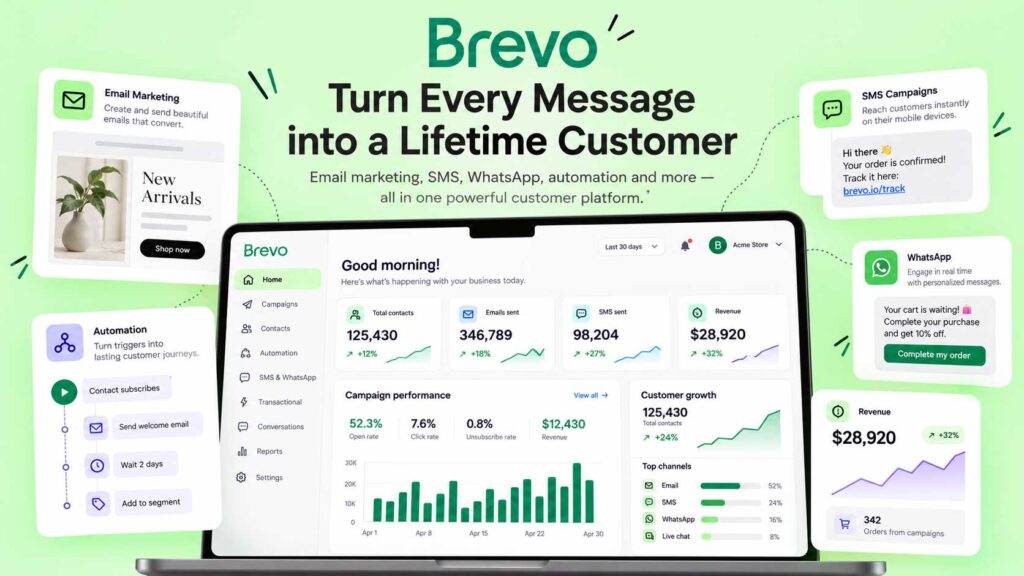
Brevo, formerly known as Sendinblue, combines email marketing with automation, transactional email, SMS, signup forms, landing pages, and customer-management tools.
For food bloggers, it can be a good option if you want more than a basic newsletter service but still want to keep costs relatively controlled.
One of the biggest differences between Brevo and many competing platforms is how it approaches pricing. Instead of focusing mainly on how many contacts you store, Brevo places more emphasis on how many emails you send.
Why Brevo Works Well for Food Bloggers
Brevo includes the core tools most food bloggers need to build and communicate with an email audience.
You can create signup forms, collect subscribers, organize contacts, and send newsletters featuring new recipes, seasonal content, meal-planning ideas, or product recommendations.
Its drag-and-drop editor also makes it fairly easy to build newsletters without coding.
Brevo becomes even more useful if your food blog grows into a broader business. For example, it can support bloggers who sell digital products, run an ecommerce store, offer cooking classes, or manage other customer communications alongside the blog.
Brevo Automation
Brevo includes marketing automation tools that let you build workflows around subscriber behavior.
You could automatically send a welcome email after someone joins your list, then follow up with popular recipes, helpful resources, or a targeted offer.
Workflows can also respond to actions such as email engagement, website activity, and contact data, giving growing blogs more flexibility than a basic newsletter-only platform.
Email and SMS Marketing
One feature that separates Brevo from many creator-focused platforms is its support for multiple communication channels.
In addition to email, Brevo offers SMS and other customer communication tools.
A traditional recipe blogger may never need that, but it can become useful if your brand expands into cooking classes, events, food products, meal services, ecommerce, or local promotions.
That makes Brevo more appealing to bloggers who expect their website to become part of a broader food business.
Brevo Free Plan
Brevo offers a free plan that currently allows up to 300 emails per day.
The platform can store a much larger number of contacts than many competing free plans, but the daily sending limit becomes restrictive once your active subscriber list grows.
For a newer blog, however, the free plan can still be useful for testing the platform and building an initial email strategy before moving to a paid tier.
Brevo Pricing
Brevo’s paid plans are based primarily on monthly email volume and the features included in each tier.
The Starter plan begins at a relatively low monthly price, while higher plans add features such as more advanced automation, reporting, landing pages, and additional marketing tools.
This structure can work well for bloggers who have a larger contact database but do not email every subscriber very frequently.
What Are the Main Advantages of Brevo?
Brevo’s biggest strength is flexibility.
It combines email, SMS, automation, transactional messaging, forms, landing pages, and broader customer communication tools in one platform.
Its pricing can also appeal to bloggers who would rather pay based largely on sending volume than simply on how many contacts are stored in the account.
What Are the Main Drawbacks?
The biggest limitation of the free plan is the 300-email-per-day sending cap, which can become restrictive very quickly as your list grows.
Brevo also includes many business-oriented features that a simple recipe blogger may never use, so the interface can feel broader and less creator-focused than platforms such as Kit.
Some of its more advanced features also require higher-tier plans.
Is Brevo Good for Food Bloggers?
Yes, especially for food bloggers who want affordable email marketing with room to grow into a broader business.
It can be a good fit if you expect to add ecommerce, courses, events, digital products, or additional customer communications over time.
If your main goal is simply to build a creator newsletter and send automated recipe content, Kit or MailerLite may feel more streamlined.
Best for: Food bloggers who want affordable email marketing with SMS, automation, transactional email, and room to expand into a broader online business.
4. GetResponse — Best for Funnels, Landing Pages, and Digital Products
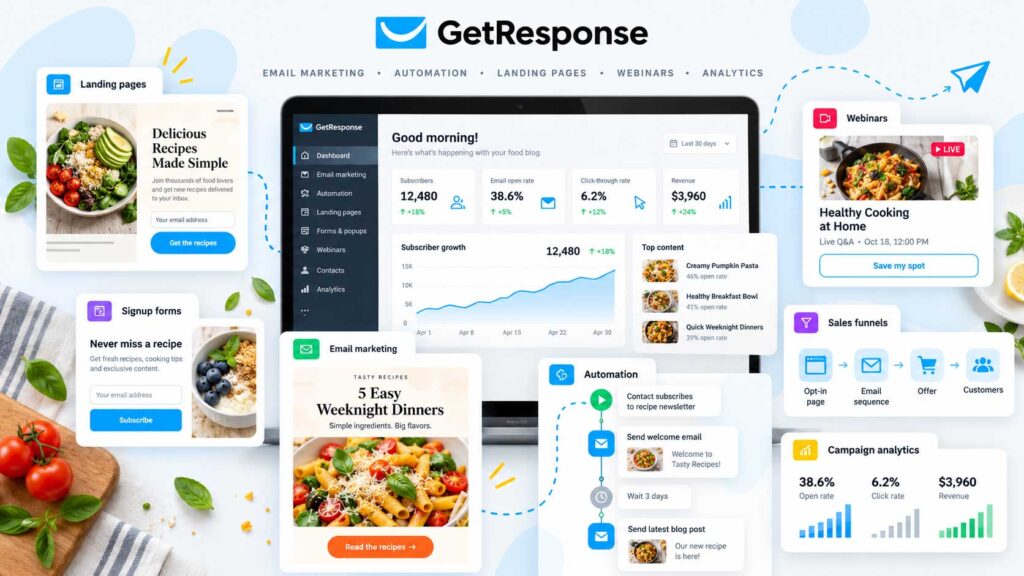
GetResponse goes beyond traditional email marketing by combining newsletters with automation, landing pages, signup forms, sales funnels, webinars, ecommerce tools, and digital-product features.
That makes it a strong option for food bloggers who want to build a larger business around their audience rather than simply send recipe newsletters.
For example, you could use GetResponse to collect subscribers with a free recipe guide, send an automated welcome sequence, promote your most popular content, and eventually guide readers toward a paid meal plan, ebook, or online cooking course.
Why GetResponse Works Well for Food Bloggers
GetResponse includes many of the tools needed to turn blog traffic into both subscribers and customers.
You can create forms and landing pages for lead magnets, send newsletters, segment your audience, and build automated campaigns based on subscriber behavior.
It can be especially useful if you plan to sell recipe ebooks, meal-planning products, courses, memberships, workshops, or other food-related digital products.
Instead of connecting several separate tools, you may be able to manage much of that activity from one platform.
GetResponse Automation
Automation is one of GetResponse’s strongest features.
You can build workflows that respond to actions such as joining a list, clicking a link, opening an email, making a purchase, or entering a particular segment.
A simple workflow for a food blog might look like this:
Reader downloads a free recipe guide → Welcome email → Popular recipes → Meal-planning tips → Digital product offer
More advanced workflows can branch depending on what subscribers click or how they interact with earlier emails.
That makes GetResponse particularly useful for bloggers who want to move beyond a basic weekly newsletter and build more structured funnels.
Landing Pages and Funnels
GetResponse also places a strong emphasis on landing pages and conversion funnels.
You can create dedicated pages for lead magnets, product launches, webinar registrations, and other campaigns without building every page directly inside WordPress.
For food bloggers selling products or services, this can make it easier to build focused campaigns around a specific offer.
Webinars and Online Courses
Another feature that separates GetResponse from many email marketing platforms is its support for webinars and online learning tools.
If you plan to host cooking classes, live demonstrations, food workshops, or educational content, these features can reduce the number of separate platforms you need.
For a traditional recipe blog, however, they may be more than necessary.
GetResponse Pricing
GetResponse offers several plans, with pricing generally increasing based on subscriber count and the features included.
The entry-level plan covers core email marketing, while higher tiers unlock more advanced automation, webinars, ecommerce features, and additional business tools.
Because GetResponse combines so many features, it is worth comparing the cost with what you would otherwise pay for separate email, landing-page, webinar, and funnel software.
What Are the Main Advantages of GetResponse?
The appeal of GetResponse is that you can handle several parts of your marketing from the same account instead of piecing together multiple services.
It is particularly strong for bloggers who want to combine email marketing with automation, landing pages, funnels, webinars, and digital-product sales.
For bloggers selling products or courses, that can mean fewer tools to manage and fewer integrations to maintain.
What Are the Main Drawbacks?
The tradeoff is complexity.
GetResponse can feel like more platform than a small recipe blog needs, especially if your main goal is simply to send newsletters and promote new posts.
Its more advanced tools also require higher-tier plans, and pricing can rise as your subscriber list grows.
Is GetResponse Good for Food Bloggers?
Yes, especially for food bloggers who want to build a business around their content.
If you mainly want to send a weekly recipe newsletter, Kit or MailerLite may feel simpler.
But if you plan to sell ebooks, courses, meal plans, memberships, or other digital products, GetResponse becomes much more attractive because it combines email marketing with landing pages, automation, funnels, and other conversion tools.
Best for: Food bloggers building funnels, selling digital products, running webinars, or creating a more advanced online business around their content.
5. ActiveCampaign — Best for Advanced Email Automation
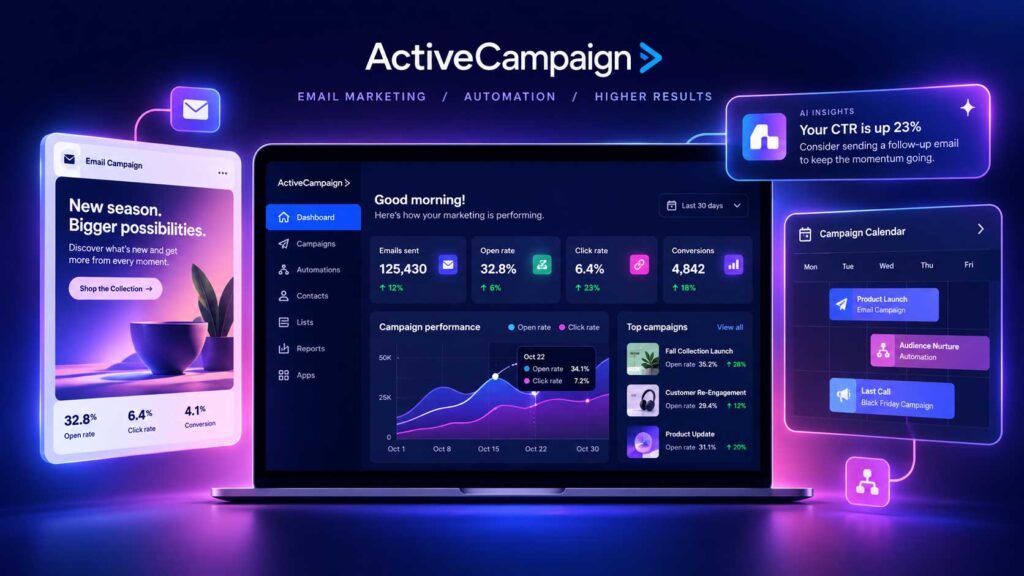
ActiveCampaign is one of the more advanced email marketing platforms on this list, especially when it comes to automation, segmentation, and customer journeys.
It is designed for businesses that want to send highly targeted emails based on subscriber behavior, interests, and actions.
For a food blogger, that level of control becomes more useful as your audience grows and sending the same newsletter to everyone starts to make less sense.
Why ActiveCampaign Works Well for Food Bloggers
ActiveCampaign gives you detailed control over how subscribers move through your email campaigns.
You can create segments based on interests, clicks, website activity, purchases, tags, and other conditions.
For example, you might separate readers who are interested in baking, healthy recipes, vegetarian meals, meal planning, kitchen equipment, or digital products.
That makes it easier to send more relevant emails instead of treating every subscriber the same way.
ActiveCampaign Automation
Automation is the main reason many businesses choose ActiveCampaign.
You can create workflows that react automatically to subscriber behavior.
A food blog automation could look like this:
Reader joins your list → Receives a welcome email → Clicks a baking recipe → Gets tagged as interested in baking → Receives more baking content → Gets an offer for a baking ebook
You can also add conditions, delays, goals, branching paths, and follow-up actions.
For food bloggers with larger lists, multiple content categories, or several products, this level of automation can make email marketing much more personalized.
CRM and Customer Management
ActiveCampaign also includes CRM and sales-focused tools on certain plans.
Most small food bloggers probably do not need a full CRM, but it can become more useful if your business expands into sponsorships, brand partnerships, consulting, cooking classes, courses, or ecommerce.
That makes ActiveCampaign more of a complete marketing platform than a simple newsletter service.
ActiveCampaign Pricing
ActiveCampaign does not offer a long-term free plan.
Instead, it provides a free trial, with paid plans based on your number of contacts and the features you need.
Entry-level pricing can be reasonable for a smaller list, but costs can rise as your subscriber count grows or as you need more advanced automation features.
Because of that, ActiveCampaign usually makes the most sense when you are actually going to use its automation and segmentation capabilities.
ActiveCampaign Pros and Cons
| Pros | Cons |
|---|---|
| Excellent automation builder | More complicated than beginner-friendly platforms |
| Powerful segmentation and tagging | No long-term free plan |
| Strong behavioral targeting | Costs increase as your list grows |
| Useful for personalized funnels | Can be excessive for simple newsletters |
| CRM tools available on certain plans | Some advanced features require higher-tier plans |
Is ActiveCampaign Good for Food Bloggers?
ActiveCampaign is a strong choice for established food bloggers who want advanced automation and highly targeted email campaigns.
If you have a growing subscriber list, multiple content categories, digital products, or different customer segments, ActiveCampaign gives you much more control over who receives each message.
For a new food blogger, however, it may be more platform than you need.
If you are just starting your list, Kit or MailerLite will usually be easier to manage. Once your email strategy becomes more sophisticated, ActiveCampaign becomes much more attractive.
Best for: Established food bloggers who need advanced automation, detailed segmentation, and personalized email funnels.
6. Mailchimp — Best for Bloggers Who Want a Familiar All-in-One Platform
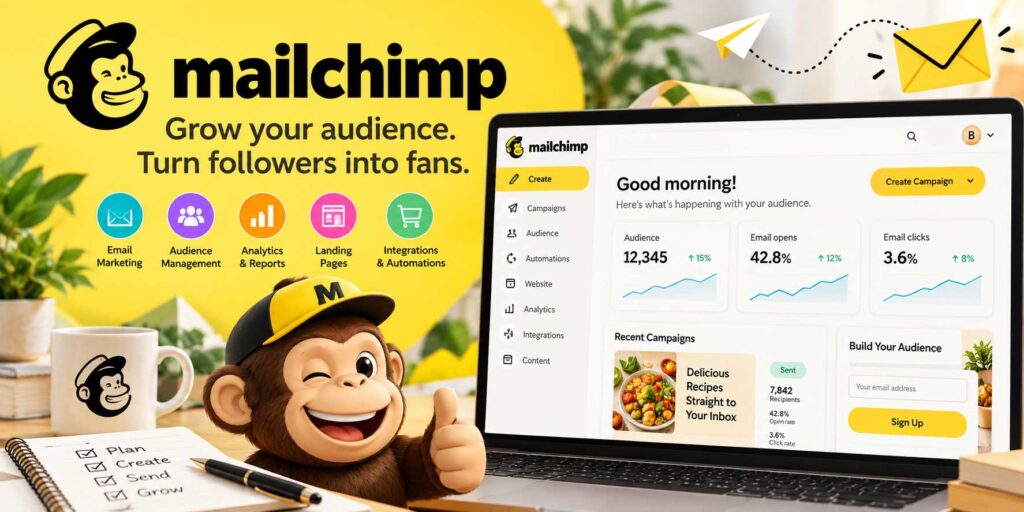
Mailchimp is one of the best-known names in email marketing and is still widely used by bloggers, creators, ecommerce businesses, and small companies.
Its biggest advantage is familiarity. Many food bloggers have either used Mailchimp before or already rely on themes, plugins, forms, and ecommerce tools that integrate with it.
Over time, Mailchimp has also expanded beyond basic newsletters into landing pages, automation, customer journeys, ecommerce features, and broader marketing tools.
Why Mailchimp Works Well for Food Bloggers
Mailchimp covers most of the core needs of a food blog.
You can use it to collect subscribers, create newsletters, promote new recipes, build signup forms, and organize your audience based on interests.
For example, you could segment readers who prefer desserts, healthy meals, weeknight dinners, baking, vegetarian recipes, or holiday cooking. That makes it easier to send more relevant campaigns instead of sending the same content to everyone.
Its email builder is also fairly easy to use and lets you create newsletters with recipe images, buttons, featured content, and links back to your website.
Mailchimp also connects with a huge range of website, ecommerce, and marketing tools. If several parts of your current setup already integrate with Mailchimp, that convenience can be a legitimate reason to stay with it.
Mailchimp Automations
Mailchimp includes automation through its customer journey tools.
You can create automated sequences based on actions such as joining an audience, clicking a link, making a purchase, or meeting specific conditions.
A simple food-blog workflow could look like this:
Subscriber joins your list → Welcome email → Popular recipes → Seasonal recipe collection → Weekly newsletter
More advanced journeys can branch depending on subscriber behavior and interests.
The important thing to check is which automation features are included in your plan, because some functionality is reserved for paid tiers.
Audience Management and Segmentation
Mailchimp allows you to organize subscribers using tags, segments, groups, and audience data.
This becomes more useful as your list grows because it gives you more control over which readers receive each campaign.
One thing to watch carefully is Mailchimp’s audience structure.
If the same contact appears in multiple audiences, list management can become more complicated and may affect how contacts are counted for billing.
For many food bloggers, keeping one well-organized primary audience and using tags or segments is the cleaner approach.
Mailchimp Free Plan
Mailchimp still offers a free option for smaller accounts, but it is much more limited than it was several years ago.
That means the old advice that positioned Mailchimp as one of the most generous free email marketing platforms no longer applies.
The free plan can still be useful for testing the platform and launching a small list, but growing bloggers should compare its paid pricing carefully with alternatives such as Kit, MailerLite, and Brevo.
Mailchimp Pricing
Mailchimp offers several paid tiers, with pricing based mainly on your number of contacts and the features included.
Higher plans generally add greater sending limits, more advanced automation, enhanced reporting, and additional testing tools.
Because the cost can rise significantly as your list grows, it is worth checking what Mailchimp would cost at several subscriber levels before committing long term.
Mailchimp Pros and Cons
| Pros | Cons |
|---|---|
| Well-known and widely supported platform | Free plan is much more limited than it once was |
| Easy-to-use email builder | Pricing can rise quickly as your list grows |
| Large integration ecosystem | Audience structure can be confusing |
| Segmentation and tagging tools | Some automation features require paid plans |
| Customer journey automation | Less creator-focused than Kit |
| Strong ecommerce integrations | May offer more business tools than a simple food blog needs |
Is Mailchimp Good for Food Bloggers?
Yes, especially if you already use it or depend on tools that integrate directly with the platform.
Mailchimp offers a familiar interface, solid campaign tools, automation, segmentation, and a large integration ecosystem.
However, it is no longer automatically the best choice for beginners simply because it offers a free plan.
If you are starting from scratch, it makes sense to compare Mailchimp with Kit, MailerLite, and Brevo before deciding which platform gives you the best mix of features, ease of use, and long-term pricing.
Best for: Food bloggers who want a widely supported email marketing platform with strong integrations and a familiar interface.
7. AWeber — Best for Straightforward Email Marketing
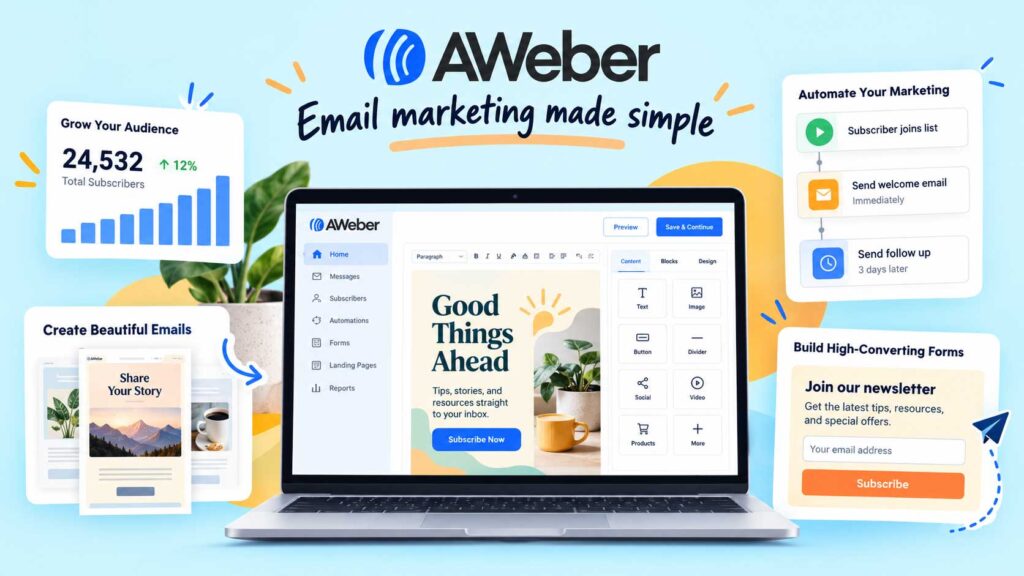
AWeber has been around for a long time and remains a practical option for bloggers and small businesses that want straightforward email marketing.
For food bloggers, its main appeal is simplicity. You can use AWeber to collect subscribers, send recipe newsletters, deliver lead magnets, and create automated campaigns without needing to learn a highly technical system.
Why AWeber Works Well for Food Bloggers
AWeber includes the core tools most food bloggers need to start building an email audience.
You can create signup forms, build landing pages for free downloads, send newsletters, and organize subscribers based on their interests.
For example, you could offer a free recipe ebook and automatically add new subscribers to a welcome campaign featuring your most popular recipes.
AWeber also integrates with WordPress and a wide range of ecommerce, website, and marketing tools, which makes it relatively easy to connect with an existing food blog.
AWeber Automation
AWeber includes automation features that let you trigger campaigns based on subscriber actions.
A simple workflow could look like this:
Reader subscribes → Receives free recipe guide → Welcome email → Popular recipes → Weekly newsletter
You can also use tags to organize subscribers and trigger different campaigns depending on what they are interested in.
The automation tools are generally easier to understand than some of the more advanced systems offered by platforms such as ActiveCampaign, which can be an advantage if you want useful automation without spending too much time building complicated workflows.
Landing Pages and Signup Forms
AWeber includes tools for creating both landing pages and signup forms.
That can be useful if you want to build different lead magnets around specific topics.
For example, you might create one landing page for a 30-Minute Dinner Recipe Guide and another for a Holiday Baking Checklist.
Subscribers who join through each offer can then be tagged or grouped so you have a better idea of what type of content they are interested in.
Email Design
AWeber provides templates and a drag-and-drop email builder for creating newsletters.
You can add recipe photos, buttons, links, and text without writing HTML.
For most food bloggers, a simple design is usually enough. A strong featured image, short introduction, and clear links back to your recipes can often work better than an overly complicated newsletter layout.
AWeber Pricing
AWeber’s pricing depends on your subscriber count and the features included in your plan.
As your list grows, the monthly cost can increase, so it is worth comparing what you would pay not only at your current list size, but also after reaching several thousand subscribers.
That long-term cost can matter more than the entry-level price once your audience starts growing consistently.
AWeber Pros and Cons
| Pros | Cons |
|---|---|
| Long-established email marketing platform | Automation is less advanced than ActiveCampaign |
| Beginner-friendly interface | May feel less modern than some newer platforms |
| Signup forms and landing pages | Pricing increases as your list grows |
| Email automation and subscriber tagging | Some bloggers may get better value from Kit or MailerLite |
| WordPress integrations | Less focused on creator monetization |
| Drag-and-drop email builder | Fewer advanced behavioral targeting options |
Is AWeber Good for Food Bloggers?
Yes. AWeber can be a good choice if you want a reliable email marketing platform without a complicated learning curve.
It covers the main things most food bloggers need: collecting subscribers, sending newsletters, delivering lead magnets, and setting up basic automation.
However, bloggers who want stronger creator monetization tools may prefer Kit, while those who need more advanced automation may find ActiveCampaign more suitable.
Best for: Food bloggers who want a simple, established email marketing platform for newsletters, lead magnets, and basic automation.
8. Constant Contact — Best for Support and Small-Business Marketing
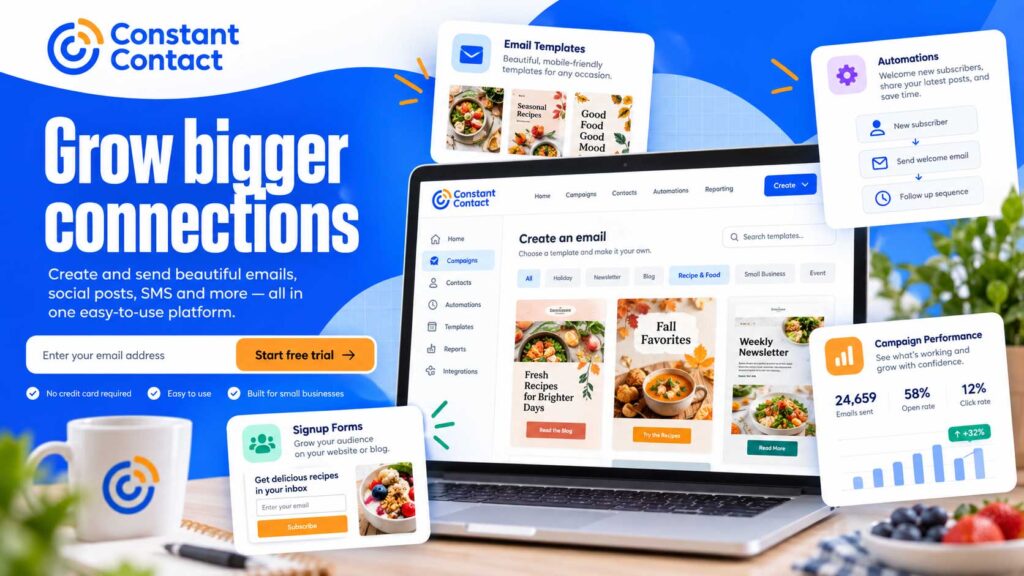
Constant Contact is a long-established email marketing platform built mainly for small businesses, organizations, and entrepreneurs.
For food bloggers, it can be a good fit if you want straightforward email marketing with strong customer support and additional tools for promotions, events, social media, and other business activities.
It is less creator-focused than Kit and less automation-heavy than ActiveCampaign, but it remains relatively easy to use and can work well for bloggers who want dependable email marketing without a steep learning curve.
Why Constant Contact Works Well for Food Bloggers
Constant Contact includes the main tools most food bloggers need to build and communicate with an email audience.
You can create newsletters, collect subscribers through signup forms, organize contacts, and promote new recipes, seasonal content, meal-planning ideas, or product recommendations.
Its drag-and-drop editor also makes it fairly easy to build newsletters without coding, which is useful if you want to create polished emails quickly.
Email Templates and Design
Constant Contact offers a wide selection of customizable email templates.
That can be useful for food bloggers because recipe newsletters often rely heavily on strong photography and clean visual presentation.
You can add images, buttons, text, links, and calls to action while keeping the overall design consistent with your website.
As with most email marketing, simpler layouts are usually better. A clear featured image, short introduction, and a few strong links can often be more effective than an overly complicated newsletter.
Constant Contact Automation
Constant Contact includes automation features that can help you stay in touch with readers without sending every email manually.
You can create welcome emails and automated sequences for new subscribers.
A simple workflow might look like this:
Reader joins your list → Welcome email → Popular recipes → Seasonal recipe collection → Regular newsletter
For bloggers with relatively simple email needs, that may be enough.
If you plan to build more complex funnels with detailed branching, behavioral targeting, and advanced segmentation, platforms such as Kit, GetResponse, or ActiveCampaign may offer more flexibility.
Additional Marketing Tools
Constant Contact goes beyond basic email marketing and includes tools designed for small businesses.
Depending on the plan, you may have access to features for events, surveys, ecommerce, social media, and other promotional campaigns.
These tools can be useful if your food blog is connected to a broader business, such as cooking classes, catering, local events, physical products, or other services.
If you only want to send recipe newsletters, however, you may not need many of these extras.
Customer Support
Customer support is one area where Constant Contact continues to stand out.
That can be especially helpful for bloggers who are new to email marketing and prefer having access to assistance instead of troubleshooting everything on their own.
For less technical users, reliable support can sometimes be just as valuable as having the most advanced feature set.
Constant Contact Pricing
Constant Contact offers several paid plans, with pricing generally based on the number of contacts in your account and the features included.
Higher tiers add more advanced automation, segmentation, reporting, and marketing capabilities.
Because the price rises as your list grows, it is worth comparing what you would pay now with the cost at several thousand subscribers.
Constant Contact Pros and Cons
| Pros | Cons |
|---|---|
| Easy-to-use email editor | No substantial long-term free plan |
| Large selection of templates | Less creator-focused than Kit |
| Signup forms and contact-management tools | Automation is less advanced than ActiveCampaign |
| Strong customer support | Pricing increases as your list grows |
| Useful event and small-business marketing tools | Some features may be unnecessary for a traditional recipe blog |
| Established email marketing provider | Less suitable for complex funnels |
Is Constant Contact Good for Food Bloggers?
Yes, especially for food bloggers who value ease of use, customer support, and broader small-business marketing tools.
It can be a particularly good fit if your food blog is connected to cooking classes, catering, local events, products, or another business.
If your site is mainly content-driven and your goal is to grow and monetize an online audience, Kit may provide a more creator-focused experience.
Best for: Food bloggers and small food businesses that value customer support, straightforward email campaigns, and additional marketing tools.
Which Email Marketing Platform Should You Choose?
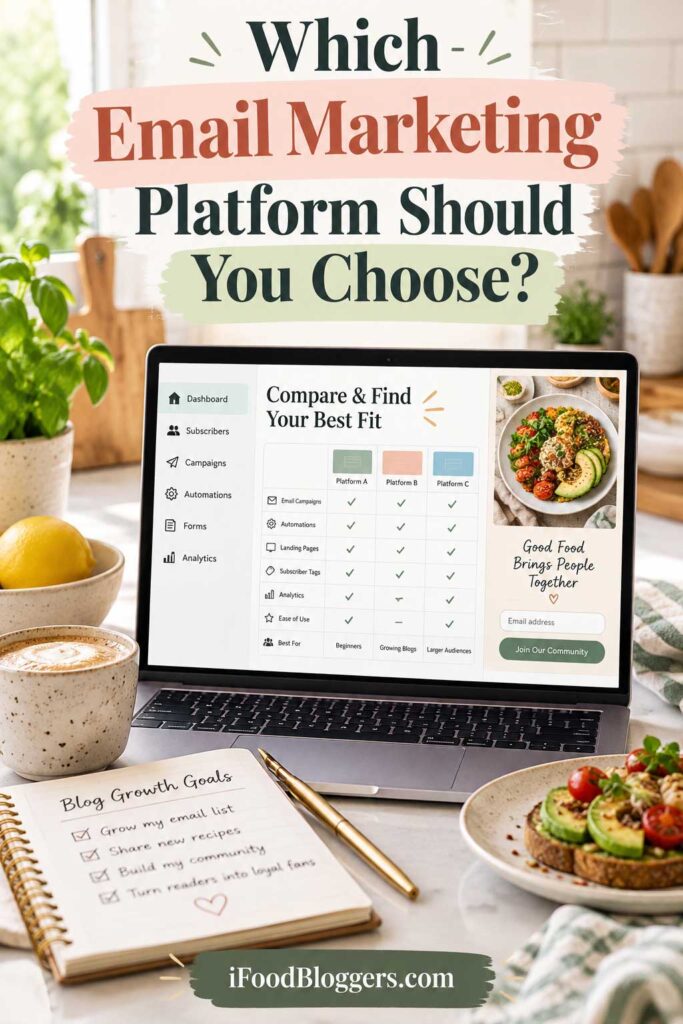
The best email marketing platform for your food blog depends on your audience size, budget, technical comfort level, and what you want email marketing to do for your business.
After comparing all eight platforms, the easiest way to choose is to match each one to a specific use case.
There is no single winner among the email marketing platforms for food bloggers because the right choice depends on your audience, budget, and email strategy.
Choose Kit for Creator-Focused Growth
Choose Kit if you want a platform built around creators, lead magnets, subscriber tagging, automated sequences, and digital products. It is one of the strongest overall choices for food bloggers who expect email to become an important part of their business.
Choose MailerLite for Simplicity
Choose MailerLite if you want something easy to learn for newsletters, forms, lead magnets, and straightforward automation without a complicated dashboard.
Choose Brevo for Email and SMS
Choose Brevo if your food business may eventually use both email and SMS, especially for events, ecommerce, classes, or local promotions.
Choose GetResponse for Funnels and Digital Products
GetResponse is worth considering if your email list is part of a larger sales strategy.
Its combination of email marketing, landing pages, automation, funnels, webinars, and digital-product tools can work well for bloggers selling courses, ebooks, meal plans, memberships, or other products.
Choose ActiveCampaign for Advanced Automation
ActiveCampaign is best suited to established food blogs with more sophisticated email strategies.
If you want different subscribers to receive different content based on what they click, purchase, read, or show interest in, its automation and segmentation tools provide a high level of control.
For a brand-new food blog, however, it may be more advanced than necessary.
Choose Mailchimp if You Already Use It
Mailchimp remains a capable platform with a large integration ecosystem.
If your food blog is already using Mailchimp successfully, there may be little reason to move simply because another service has become more popular.
New users should still compare its pricing and plan limits with alternatives before committing long term.
Choose AWeber for Straightforward Email Marketing
AWeber is a practical choice if you want traditional email marketing without too many additional layers.
It handles newsletters, forms, landing pages, subscriber management, and automation while remaining relatively easy to understand.
Choose Constant Contact if Support Matters Most
Constant Contact can be a good fit for bloggers and small food businesses that value customer support and broader marketing tools.
It is especially relevant for businesses connected to cooking classes, catering, local events, physical products, or other services.
Our Recommendation for Most Food Bloggers
For most food bloggers starting from scratch, Kit and MailerLite are the two options we would compare first.
Kit is the stronger choice if you want creator-focused tools, segmentation, automation, and room to monetize your audience over time.
MailerLite is a better fit if simplicity is your main priority and you want to get started without learning a more advanced system.
Established food blogs with complex automation needs may be better served by ActiveCampaign, while bloggers building funnels, courses, or digital products may prefer GetResponse.
The most important thing is not finding a perfect platform.
Choose one that fits your current needs, create a useful reason for readers to subscribe, and start building your email list. Over time, that list can become one of the most valuable audience assets your food blog owns.
Common Mistakes to Avoid When Choosing an Email Marketing Platform
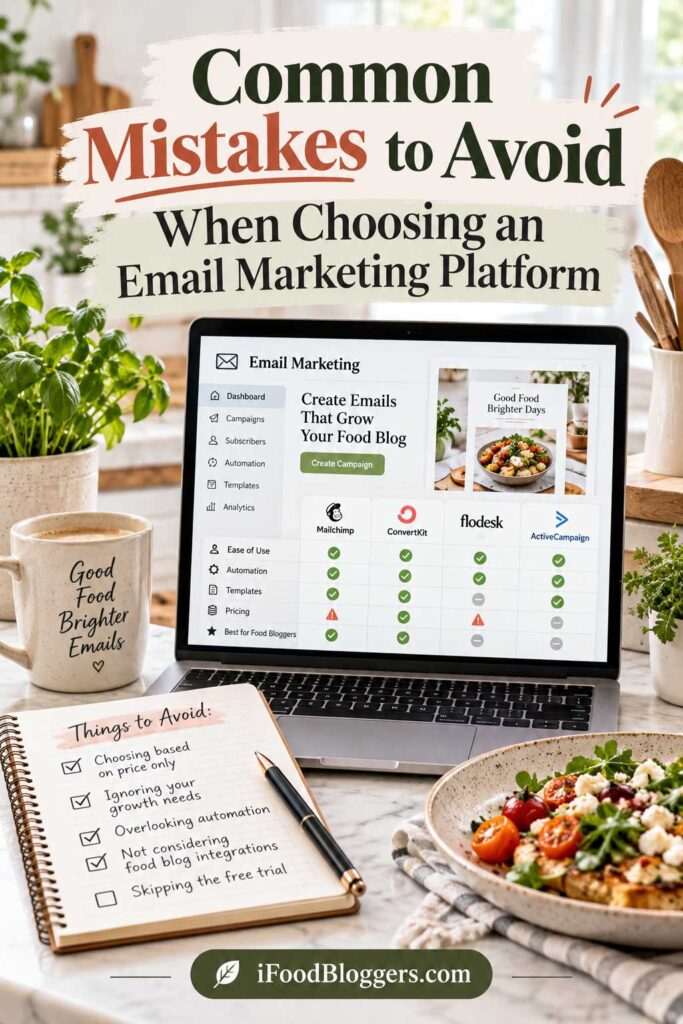
Choosing an email marketing platform is easier when you know what to avoid. Many bloggers focus too heavily on price or popularity and overlook the features that will matter once their audience grows.
One of the biggest mistakes when comparing email marketing platforms for food bloggers is focusing only on the free plan or introductory price.
Choosing Based Only on the Free Plan
A generous free plan can be useful when you are starting out, but it should not be the only reason you choose a platform.
Look at what happens after you reach 1,000, 5,000, or 10,000 subscribers. A service that looks inexpensive today may become much more costly as your list grows.
Also check which important features are locked behind paid plans, especially automation, segmentation, advanced reporting, and landing pages.
Ignoring Long-Term Pricing
Email marketing costs often increase with subscriber count, email volume, or both.
Before committing to a platform, estimate what you would pay at several future list sizes. This can help you avoid moving your entire list later simply because the pricing no longer makes sense.
For a growing food blog, long-term scalability matters more than the cheapest introductory price.
Choosing a Platform With More Features Than You Need
More features do not automatically make a platform better.
If you only need newsletters, signup forms, and a simple welcome sequence, a highly advanced CRM and automation system may create unnecessary complexity.
Choose a platform that fits your current strategy while still giving you enough room to grow.
Overlooking Automation
Some bloggers choose an email service based mainly on the newsletter editor and forget to check the automation tools.
That can become a problem later when you want to create welcome sequences, lead magnet delivery, product funnels, or interest-based campaigns.
Even if you do not need advanced automation today, it is worth understanding what the platform can support in the future.
Ignoring Segmentation and Tagging
Sending every email to every subscriber is rarely the best long-term strategy.
A reader interested in baking may not want the same content as someone who mainly reads healthy dinner recipes.
Make sure the platform gives you a practical way to organize subscribers using tags, groups, or segments.
Not Checking WordPress Integrations
If your food blog runs on WordPress, make sure the email platform works smoothly with your existing setup.
Check whether it integrates with your form plugin, ecommerce tools, landing pages, and other marketing software.
A platform may look excellent on its own but become frustrating if connecting it to your website requires constant workarounds.
Focusing Too Much on Email Templates
Attractive templates are useful, especially for food blogs, but they should not be the main reason you choose a platform.
A beautiful newsletter does not help much if the service has weak automation, poor list management, limited integrations, or pricing that becomes difficult to justify.
Design matters, but functionality matters more.
Forgetting About Deliverability
Features and pricing are important, but your emails still need to reach subscribers.
Pay attention to whether the platform supports proper domain authentication and gives you tools for managing list quality and engagement.
Deliverability also depends on your own practices, so avoid buying email lists and regularly remove invalid or consistently unengaged contacts.
Not Thinking About Migration Until It Becomes a Problem
It is possible to move from one email marketing platform to another, but migrations can become time-consuming once you have thousands of subscribers, tags, forms, and automated sequences.
You do not need to choose a platform for life, but switching becomes more complicated once your account is full of forms, tags, automations, and years of subscriber data.
It simply means you should think beyond your first few months and choose a service that has a reasonable chance of supporting your next stage of growth.
Choosing Based Only on Popularity
A platform can be popular and still be the wrong fit for your food blog.
Mailchimp, Kit, ActiveCampaign, Brevo, and the other services in this guide are designed for somewhat different types of users.
Instead of asking which platform is the most famous, ask which one best matches how you actually plan to use email marketing.
Frequently Asked Questions About Email Marketing for Food Bloggers
Do Food Bloggers Need an Email List?
An email list is not required to run a food blog, but it can become one of your most valuable audience-building tools.
Search engines and social platforms can change their algorithms at any time. Email gives you a more direct way to reach readers who have already chosen to hear from you.
You can use that audience to promote new recipes, seasonal content, ebooks, meal plans, affiliate recommendations, courses, and other products.
What Is the Best Email Marketing Platform for Food Bloggers?
Among the email marketing platforms for food bloggers we compared, Kit and MailerLite are two of the strongest starting points for most creators.
Kit is especially useful for creators who want tagging, segmentation, lead magnets, automation, and digital-product tools. MailerLite is a better fit if you prefer a simpler interface for newsletters, forms, landing pages, and basic automation.
The best email marketing for food bloggers depends on your subscriber count, budget, and how advanced you want your email strategy to become.
What Is the Best Free Email Marketing Platform for Food Bloggers?
Several email marketing platforms offer free plans, including Kit, MailerLite, and Brevo. Others provide free trials instead.
The important thing is to compare the limits carefully. Some platforms restrict the number of subscribers, while others limit how many emails you can send.
It is also worth looking at what the platform will cost once your list grows. Moving thousands of subscribers later can be more work than choosing a scalable option from the beginning.
How Can a Food Blogger Grow an Email List?
One of the most effective strategies is to give readers a useful reason to subscribe.
Instead of relying only on a generic “Join our newsletter” form, offer something that solves a specific problem or saves the reader time.
Good lead magnet ideas for a food blog include:
- Recipe ebooks
- Weekly meal plans
- Grocery lists
- Printable recipe collections
- Holiday cooking guides
- Baking conversion charts
- Pantry checklists
- 30-minute dinner guides
Place signup opportunities naturally throughout your website, including popular posts, category pages, your homepage, and relevant recipe content.
How Often Should Food Bloggers Send Emails?
For many food blogs, once a week is a practical starting point.
A weekly newsletter gives you enough opportunities to bring readers back without overwhelming them.
Some publishers send more often, while others send less frequently. What matters most is choosing a schedule you can maintain with useful content.
Consistency is generally more important than sending as often as possible.
What Should a Food Blogger Send in a Newsletter?
You do not need to create completely new content for every email.
A newsletter can feature your latest recipe, an older seasonal post, cooking tips, product recommendations, or a short personal note.
A simple format might include one featured recipe, a few additional links, a quick kitchen tip, and one useful recommendation or resource.
The goal is to give subscribers a reason to open the email and return to your website.
Can Food Bloggers Make Money From Email Marketing?
Yes. An email list can become an important revenue channel for a food blog.
You can use newsletters to bring readers back to ad-supported content, promote affiliate products, sell recipe ebooks or meal plans, advertise courses, and promote your own products or services. If affiliate marketing is part of your strategy, our Food Blogger Affiliate Programs Guide compares programs that can work particularly well with recipe and food-related content.
Email can also strengthen sponsored campaigns by giving you another way to reach an engaged audience.
Is Kit Better Than Mailchimp for Food Bloggers?
For many creator-focused food blogs, Kit may be the better fit.
Kit is built around creators and includes strong tools for subscriber tagging, segmentation, lead magnets, automation, and digital products.
Mailchimp offers broader small-business and ecommerce marketing features and integrates with a large ecosystem of third-party tools.
If you are building a creator business around content, Kit may feel more natural. If you already use Mailchimp successfully and depend on its integrations, switching may not be necessary.
When Should I Start Building an Email List?
Ideally, as early as possible.
You do not need thousands of monthly visitors before starting. Even a small amount of traffic can begin generating subscribers.
A list that grows steadily over several years can become a major source of repeat traffic and revenue.
Starting early also gives you more time to learn which recipes, lead magnets, subject lines, and offers your audience responds to best.
Final Thoughts: Best Email Marketing Platforms for Food Bloggers in 2026
Choosing the right email marketing platform matters, but the platform itself is only one part of the strategy.
What matters more is building your list consistently, giving readers a clear reason to subscribe, and sending useful emails that bring them back to your food blog.
For most food bloggers, Kit and MailerLite are the easiest places to start. More advanced businesses may eventually prefer tools such as ActiveCampaign or GetResponse, while platforms such as Brevo, Mailchimp, AWeber, and Constant Contact can make sense for specific needs.
For more advanced automation, ActiveCampaign is one of the strongest options. Bloggers building funnels, courses, or digital products may prefer GetResponse, while Mailchimp, AWeber, and Constant Contact remain solid choices depending on your existing setup and business needs.
The best email marketing platforms for food bloggers are the ones that fit your current needs while giving your list room to grow.
You also do not need a huge audience before getting started.
Even a small email list can help generate repeat traffic, promote seasonal recipes, strengthen relationships with readers, and create new monetization opportunities.
Choose the platform that fits your needs today, create a useful lead magnet, and start collecting subscribers. As your food blog grows, your email list can grow with it—and become one of the most valuable assets behind your site.
More Resources for Growing Your Food Blog
Email marketing works best when it is part of a broader strategy for growing traffic, improving your website, and building a recognizable food brand.
If you are working on your site right now, you may also want to read our guide to Best Hosting for Food Bloggers to compare hosting options for speed, reliability, and future growth.
You can also explore the Best WordPress Recipe Plugins if you want to improve recipe presentation, usability, and structured data on your site.
For content planning and SEO, our guide to the Best Free Keyword Tools for Food Bloggers can help you find recipe ideas and supporting topics people are already searching for.
As your site grows, combining SEO, email marketing, strong recipe content, and smart monetization can give you a much more stable growth strategy than relying on a single traffic source.