

Starting a food blog begins with one important decision: choosing the right domain name and a reliable company to register it with.
Your domain is the address readers will use to find your recipes, remember your brand, share your content, and return to your website. Once your blog starts gaining traffic and building authority, changing that domain becomes much more complicated, so it pays to choose carefully from the start.
Finding the right name is only part of the process. You also need to choose a domain registrar — the company responsible for registering and managing your domain.
There are dozens of options available, and the cheapest introductory offer is not always the best long-term deal. Some registrars advertise very low first-year prices but charge considerably more when the domain renews. Others include useful features such as WHOIS privacy, DNS management, security tools, and email forwarding at no additional cost.
When comparing the best domain registrars for food bloggers, look beyond the first-year price and consider:
- Domain renewal costs
- Free WHOIS privacy
- Easy DNS management
- Account and domain security
- Customer support
- Domain transfer policies
- Automatic renewal options
- Ease of connecting your domain to WordPress and your web host
Whether you’re launching your first recipe blog or managing several food websites, choosing the right registrar can make domain management much easier over the long term.
In this guide, we’ll compare some of the best domain registrars for food bloggers, explain their main advantages and drawbacks, and show you what to check before registering your domain.
What Is a Domain Registrar?
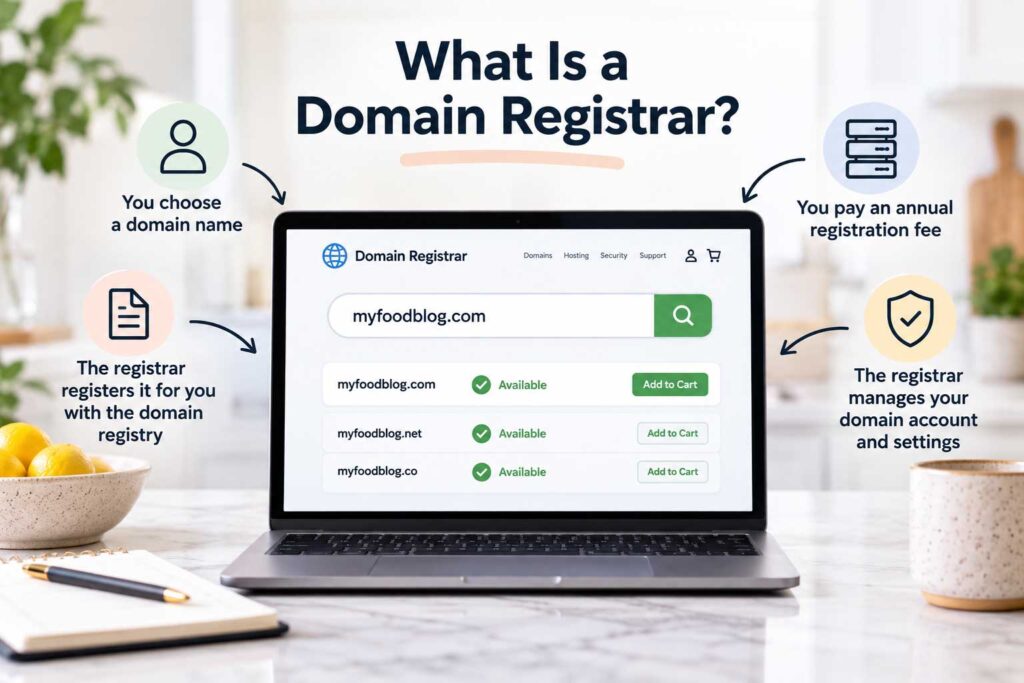
A domain registrar is a company that lets you register and manage a domain name, such as yourfoodblog.com.
When you register a domain, you are not buying it permanently. Instead, you register it for a set period, usually one year at a time. As long as you continue renewing it, the domain stays under your control.
A registrar typically handles tasks such as:
- Registering new domain names
- Renewing existing domains
- Managing domain contact information
- Updating nameservers and DNS records
- Transferring domains between registrars
- Enabling domain locking and other security features
- Providing WHOIS privacy where available
Many registrars also offer extra services such as web hosting, business email, SSL certificates, website builders, and premium DNS.
You do not have to buy your domain and web hosting from the same company.
For example, you could register your domain with Namecheap or Cloudflare and connect it to a completely different WordPress hosting provider.
Keeping your domain and hosting separate can also make things easier later if you decide to move your website to a new host. Your domain can stay with the same registrar while you simply update the DNS settings to point to the new hosting company.
Registrar vs. Web Host: What Is the Difference?
A domain registrar manages your domain name, while a web hosting company stores the files, images, database, and other content that make up your website.
A simple way to think about it is:
Your domain name is your website’s address.
Your web hosting is where the website itself lives.
Some companies offer both services, which can be convenient when you’re building your first food blog. But domain registration and hosting are still two separate parts of running a website.
When comparing the best domain registrars for food bloggers, look beyond the first-year promotional price. Renewal costs, privacy protection, DNS controls, security, and ease of management can matter much more over the life of your blog.
What to Look for When Choosing a Domain Registrar
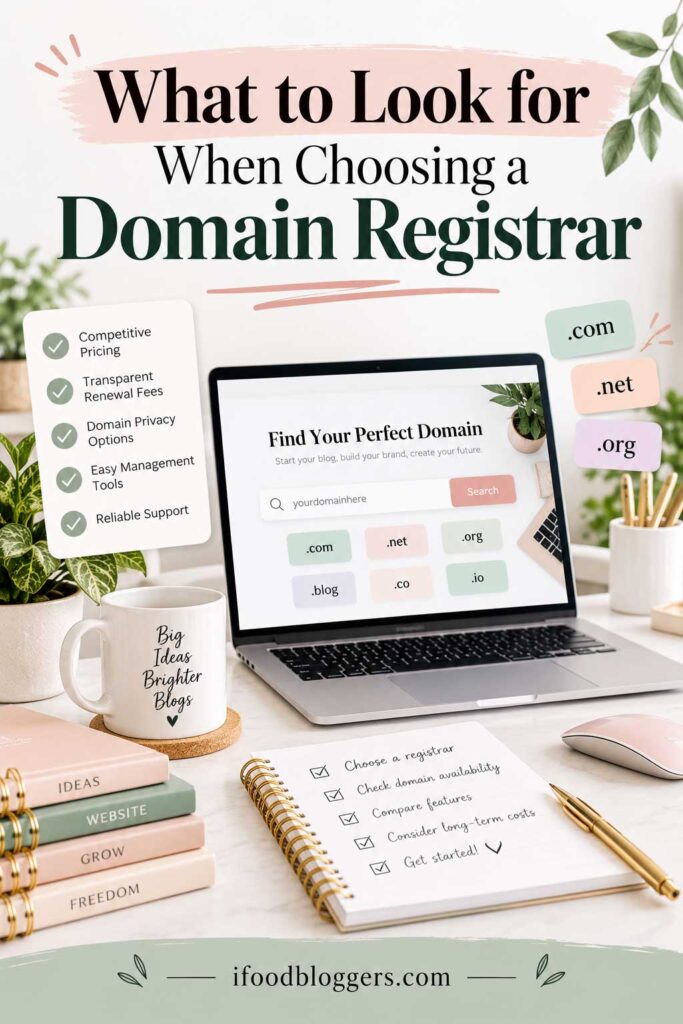
Not all domain registrars are the same. Some compete with very low introductory prices, while others focus on simpler pricing, better privacy, stronger security, or easier domain management.
Before registering your food blog domain, compare these factors.
Renewal Pricing
A cheap first-year price can be misleading.
A domain might cost only a few dollars initially and then renew at a much higher rate the following year. Since you may keep your food blog domain for many years, the renewal price often matters more than the introductory offer.
Always check both prices before registering.
WHOIS Privacy
When you register a domain, contact information is attached to the registration record.
Many registrars include WHOIS privacy, which helps prevent personal contact details from being displayed publicly where privacy protection is supported.
For individual bloggers, free privacy is a useful feature and can save you from paying for another add-on.
Easy DNS Management
DNS settings connect your domain to services such as:
- Your web host
- Business email
- Content delivery networks
- Verification tools
- Analytics and marketing platforms
You may not need to change these settings often, but when you do, a clear dashboard makes the process much easier.
Domain Security
Your domain is one of your website’s most important assets, so account security should not be overlooked.
Look for features such as:
- Domain locking
- Two-factor authentication
- Login alerts
- Transfer protection
- DNSSEC support
These features can help prevent unauthorized changes or transfers.
Customer Support
Domain issues do not happen every day, but reliable support is valuable when something goes wrong.
You may need help when:
- Transferring a domain
- Changing nameservers
- Updating DNS records
- Connecting a domain to a new host
- Fixing a renewal or account issue
If you are less comfortable with technical settings, live chat or phone support may be especially helpful.
Simple Domain Transfers
You are not permanently locked into the registrar you choose.
Most domains can be transferred to another company later, although certain timing and registry restrictions may apply.
A good registrar should make the process clear and give you easy access to settings such as domain unlocking and transfer authorization codes.
Auto-Renewal and Expiration Protection
An expired domain can take your website offline and create unnecessary problems.
Most registrars allow you to enable automatic renewal, which is a good idea for any domain connected to an active food blog.
Keep your payment method current and make sure renewal notices go to an email address you check regularly.
Avoid Unnecessary Upsells
Some registrars offer a long list of extras during checkout, including:
- Hosting
- Business email
- Security packages
- Website builders
- Premium DNS
- Advanced domain protection
Some of these can be useful, but you probably do not need all of them.
Review your cart carefully and make sure every add-on serves a real purpose.
Ease of Use
A simple dashboard becomes more important as you add more websites.
Ideally, you should be able to find renewals, DNS settings, security options, contact information, and transfer tools without digging through multiple menus.
For most food bloggers, the best domain registrar is not simply the one with the cheapest first-year promotion. Look for a combination of reasonable renewal pricing, privacy, security, easy management, and dependable support.
Best Domain Registrars for Food Bloggers: Quick Comparison
There are plenty of companies where you can register a domain, but they are not all equally useful for bloggers.
Some focus on keeping long-term costs low, while others stand out for simple management, strong security features, or convenient domain-and-hosting bundles.
Here is a quick comparison of the domain registrars covered in this guide.
| Domain Registrar | Best For | WHOIS Privacy | Main Advantage |
|---|---|---|---|
| Namecheap | Most food bloggers | Free for eligible domains | Easy management and strong all-around features |
| Porkbun | Keeping domain costs low | Free for supported domains | Competitive pricing with many useful extras included |
| Cloudflare Registrar | Existing Cloudflare users | Free WHOIS redaction where supported | Domains sold without a traditional registrar markup |
| Squarespace Domains | Simple domain management | Free for most supported domains | Clean interface and straightforward management |
| GoDaddy | Beginners who prefer a large provider | Included for eligible domains | Large selection of domains and website services |
| Bluehost | Bloggers who also need WordPress hosting | Depends on domain and plan | Convenient WordPress hosting and domain setup |
| Hostinger | Affordable hosting + domain bundle | Free for supported domains | Hosting, WordPress, SSL, and domain management in one account |
| Dynadot | Managing multiple domains | Free for eligible domains | Strong portfolio and bulk domain-management tools |
Domain pricing can change, and promotional first-year offers should not be confused with regular renewal prices. Always check both the registration price and the renewal price before purchasing.
Not Sure Which Domain Registrar to Choose?
Not sure where to start? Namecheap and Porkbun are straightforward choices if you only need a domain. Cloudflare Registrar is worth considering if you already use Cloudflare, while Bluehost and Hostinger are more convenient when you also need WordPress hosting. We break down each option in detail below.
1. Namecheap
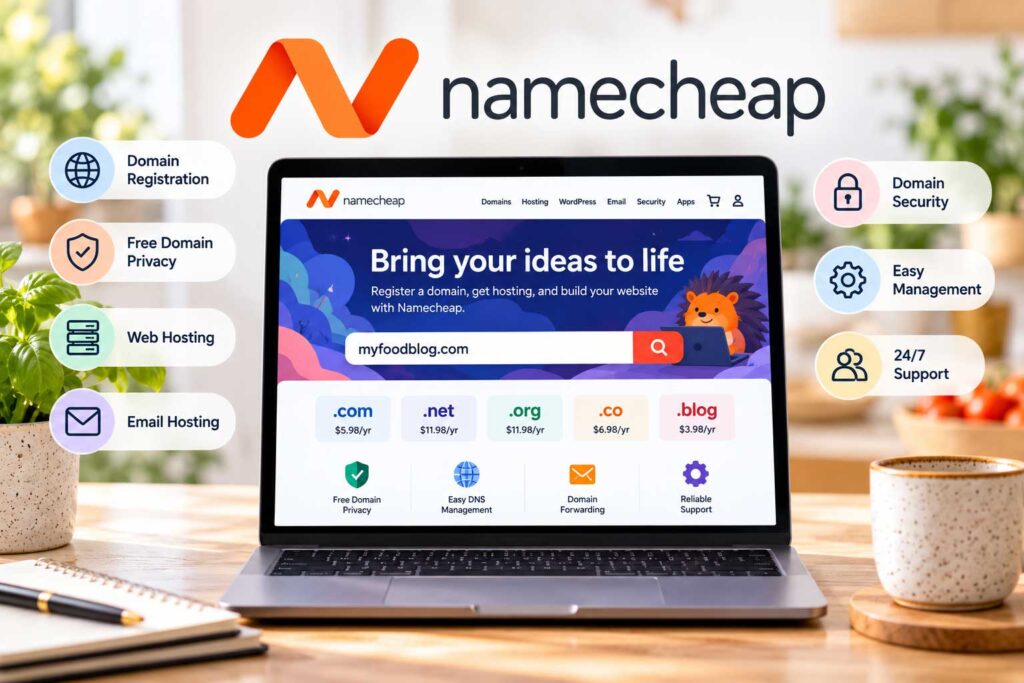
Best overall domain registrar for most food bloggers
Namecheap works well for bloggers who want a reliable domain registrar, an easy-to-use dashboard, and useful privacy and security features without having to buy web hosting at the same time.
For food bloggers, one of its biggest advantages is flexibility. You can register your domain with Namecheap and connect it to almost any WordPress hosting provider you choose.
If you decide to change hosts later, your domain can stay exactly where it is.
Why We Like Namecheap for Food Bloggers
Namecheap keeps domain management relatively straightforward, even if you eventually own several websites.
From the same dashboard, you can manage:
- Domain renewals
- Nameservers
- DNS records
- Domain forwarding
- Contact information
- Auto-renewal
- Domain transfers
- Security settings
Namecheap also includes free domain privacy for life with eligible domains, including qualifying registrations and transfers.
For individual bloggers, that is a valuable feature because it helps keep personal registration details out of publicly accessible WHOIS records where privacy is supported.
Namecheap .com Pricing
At the time of writing, Namecheap lists the regular price of a .com registration at $14.98 per year, with a current promotional price of $11.28 for the first year. New customers may also see a separate introductory promotion.
The current .com renewal price is $18.48 per year. Namecheap also notes that a small ICANN fee may be added to certain registrations, renewals, and transfers.
Because promotions change frequently, always compare the current registration price with the regular renewal cost before purchasing.
Features Included With Namecheap Domains
Depending on the domain extension and DNS setup, Namecheap offers features such as:
- Free domain privacy for eligible domains
- DNS management
- DNSSEC support for eligible domains
- URL forwarding
- Email forwarding
- Registrar lock
- Auto-renewal
- Two-factor authentication
- Domain transfer tools
Namecheap also sells hosting, business email, SSL certificates, PremiumDNS, and other website services, but you do not need to purchase any of them to use Namecheap as your registrar.
| Pros | Cons |
|---|---|
| Free privacy protection for eligible domains | Renewal pricing is not always the lowest |
| Easy-to-use domain dashboard | First-year promotional pricing can be much lower than renewal pricing |
| Competitive first-year pricing | Additional hosting, email, SSL, and other services may be promoted |
| Good tools for managing multiple domains | |
| Easy to connect with third-party hosting providers | |
| DNSSEC available for eligible domains | |
| No hosting purchase required |
Is Namecheap Good for Food Bloggers?
Yes. Namecheap is a very practical choice for food bloggers who want to keep domain registration separate from web hosting.
It is especially useful if you expect to build more than one website because you can manage several domains from one account while still choosing a different hosting provider for each project.
For a new food blogger looking for simple management, free privacy, reasonable pricing, and flexibility, Namecheap is one of the strongest options to consider.
2. Porkbun
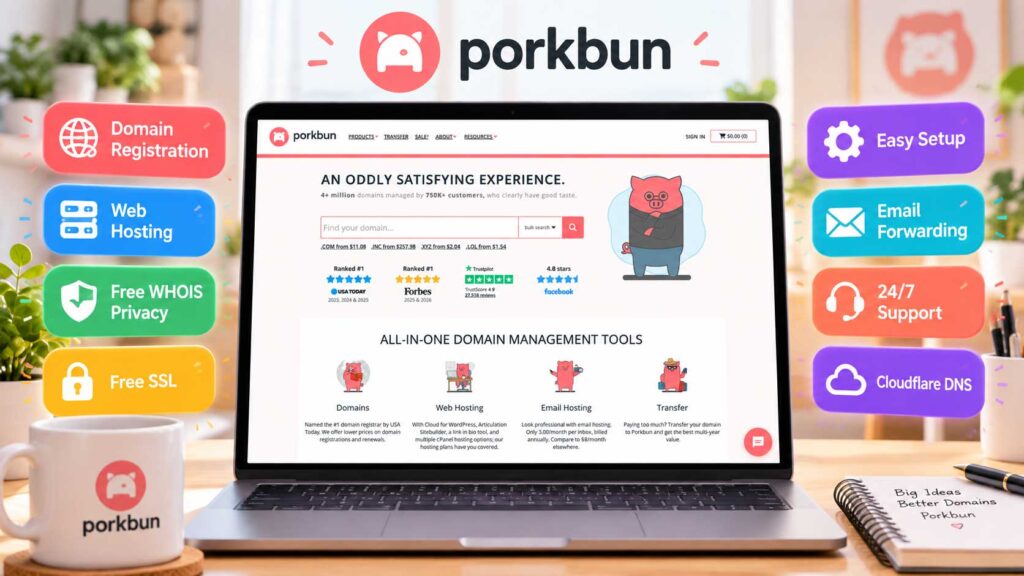
Best for low-cost domain registration and renewals
Porkbun stands out for its competitive pricing and the number of useful features included with domain registration.
It is a particularly good fit for bloggers who want straightforward pricing without paying separately for basic domain-management tools.
For food bloggers, one of its biggest advantages is value. Porkbun keeps its domain pricing competitive while including several features that other registrars may charge for separately.
Why We Like Porkbun for Food Bloggers
Porkbun works especially well if you want to keep your domain separate from your web hosting.
You can register your food blog domain with Porkbun and connect it to almost any hosting provider, website builder, or other third-party service later.
Its domain dashboard includes tools for:
- Managing DNS records
- Changing nameservers
- Domain forwarding
- Email forwarding
- Domain transfers
- Auto-renewal
- Account security
- Managing multiple domains
Porkbun also includes free WHOIS privacy with domain extensions that support it.
Porkbun .com Pricing
Porkbun is known for keeping its domain prices relatively close to the underlying registration cost.
It also displays registration and renewal prices side by side, making it easier to see what a domain will cost after the first year instead of focusing only on an introductory promotion.
Domain prices can change as registry and ICANN costs change, so always check the current registration and renewal rates before purchasing.
For bloggers who plan to keep the same domain for many years, the regular renewal cost matters much more than saving a few dollars during the first year.
Features Included With Porkbun Domains
Porkbun includes several useful features with supported domains at no additional charge:
- Free WHOIS privacy
- Free SSL certificates
- Free DNS management powered by Cloudflare
- Free URL forwarding
- Up to 20 free email forwards
- Domain transfer tools
- Two-factor authentication
- WebAuthn security
- Login notifications
Its DNS service also supports tools such as DNSSEC, API access, and bulk management.
These included features make Porkbun particularly attractive for bloggers who do not want to pay separately for basic domain-management tools.
| Pros | Cons |
|---|---|
| Competitive registration and renewal pricing | Less familiar to some first-time website owners |
| Registration and renewal costs displayed clearly | More focused on domains than all-in-one website services |
| Free WHOIS privacy for supported domains | Hosting and marketing tools are not the main strength |
| Free DNS management and SSL certificates | |
| Up to 20 free email forwards | |
| Strong account-security features | |
| Easy to connect with third-party WordPress hosts |
Customer Support
Porkbun offers support through email, live chat, and phone.
Email support is available around the clock, while phone and live chat support are available daily during published Pacific Time support hours.
Is Porkbun Good for Food Bloggers?
Yes. Porkbun is an excellent option for food bloggers who want to keep domain costs reasonable without giving up useful features.
It becomes even more attractive if you eventually manage several websites, because small differences in annual renewal costs can add up across a larger domain portfolio.
For bloggers looking for transparent pricing, free privacy, solid DNS tools, and fewer paid add-ons, Porkbun is one of the strongest registrars to consider.
3. Cloudflare Registrar
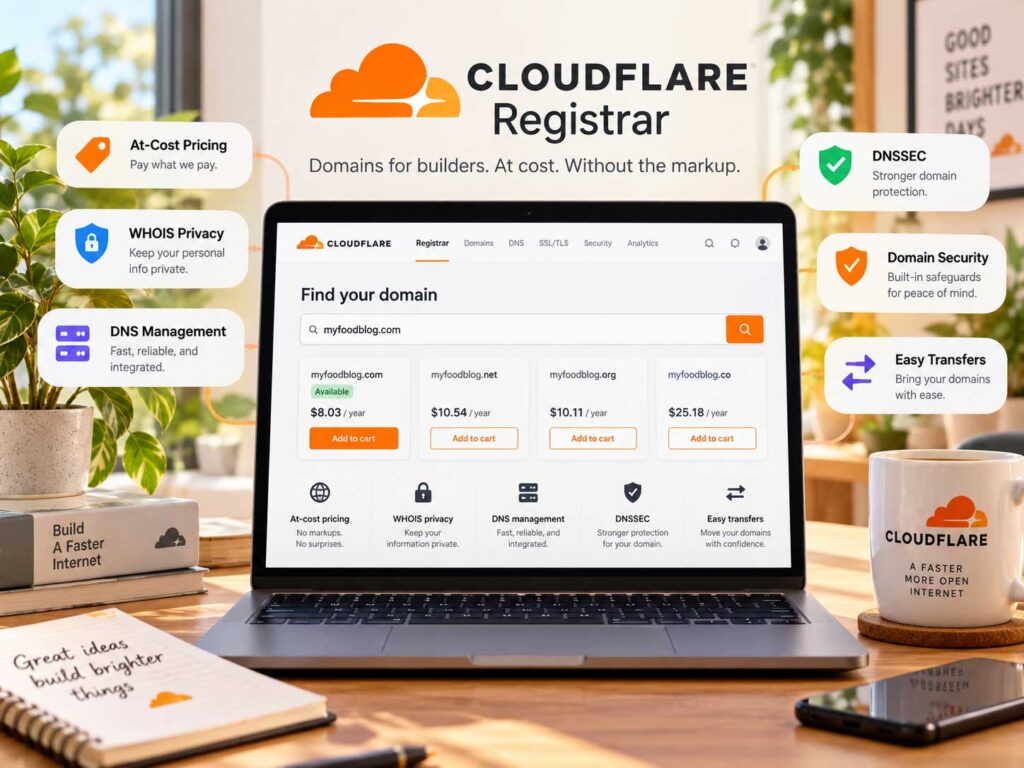
Best for low long-term costs and advanced DNS management
Cloudflare Registrar takes a different approach from most companies on this list.
It is especially useful for bloggers who want straightforward domain pricing and already use—or plan to use—Cloudflare for DNS, security, or performance.
Unlike many registrars that add a markup to registration and renewal prices, Cloudflare says it charges the registry and ICANN cost without adding a traditional registrar markup.
That makes it especially appealing for bloggers who expect to keep the same domain for many years.
Why We Like Cloudflare Registrar for Food Bloggers
Cloudflare combines domain registration with the same ecosystem many website owners already use for DNS, security, SSL, caching, and performance.
With Cloudflare Registrar, you can manage your domain and DNS from the same dashboard instead of relying on separate services.
Cloudflare currently supports hundreds of top-level domains, including popular extensions such as .com, .net, and .org.
Cloudflare Domain Pricing
Cloudflare’s biggest selling point is its pricing model.
Cloudflare states that domain registrations and renewals are offered at the amount charged by the underlying registry and ICANN, without an additional registrar markup.
The exact price therefore depends on the domain extension and current wholesale registry cost.
Instead of relying on temporary first-year promotions, Cloudflare focuses on keeping registration and renewal pricing close to wholesale cost.
Features Included With Cloudflare Registrar
Cloudflare includes several useful features with its registrar service:
- WHOIS privacy redaction where permitted
- Free DNS management
- One-click DNSSEC
- Domain locking
- Automatic renewal
- Domain transfer tools
- Integration with Cloudflare’s CDN
- Free Universal SSL/TLS
- Management through the Cloudflare dashboard
WHOIS redaction is included at no additional cost where permitted by the registry, helping keep personal contact details from appearing publicly in domain records.
Domains are also locked by default, and DNSSEC can be enabled from the dashboard.
Pros and Cons
| Pros | Cons |
|---|---|
| No traditional registrar markup | Less beginner-friendly than Namecheap or Porkbun |
| Competitive long-term renewal costs | Dashboard includes many technical DNS and security tools |
| Free WHOIS redaction where supported | Domains must use Cloudflare’s authoritative nameservers |
| Free DNSSEC | Less flexible if you want to use another DNS provider |
| Excellent DNS management | Registrations and renewals are generally non-refundable |
| Domain locking enabled by default | |
| Strong security and performance integration | |
| Good for managing multiple websites |
Is Cloudflare Registrar Good for Food Bloggers?
Yes, especially for bloggers who are comfortable managing DNS or already use Cloudflare.
For a brand-new blogger who simply wants to register a domain with minimal technical setup, Namecheap or Porkbun may feel easier.
For an established food blogger managing several websites, however, Cloudflare Registrar can be very attractive because of its at-cost pricing, strong DNS infrastructure, built-in security, and predictable renewal model.
It is particularly useful if you already rely on Cloudflare for DNS, caching, CDN, or website security.
4. Squarespace Domains

Best for simple domain management and beginners
Squarespace Domains is a good option for food bloggers who want a clean dashboard, straightforward domain management, and fewer technical complications.
You do not need to build your website with Squarespace to register a domain there. A Squarespace-managed domain can be connected to WordPress, another website builder, or a third-party hosting provider.
Why We Like Squarespace Domains for Food Bloggers
Squarespace keeps most domain-management tools in one centralized dashboard.
From there, you can manage billing, DNS records, domain ownership, renewals, and other important settings without navigating through an overly technical interface.
Squarespace currently supports more than 400 domain extensions, giving bloggers plenty of choices if their preferred .com is unavailable.
For most food blogs, however, we would still try to secure a short and memorable .com whenever possible.
Squarespace Domain Pricing
Squarespace currently lists common extensions such as .com and .org at $20 per year.
Other extensions can cost more. For example, Squarespace lists some TLDs at $30 or $50 per year depending on the extension.
If you build your website with Squarespace, eligible annual website plans include one custom domain free for the first year.
The pricing structure is relatively easy to understand, which may appeal to beginners who do not want to compare several introductory offers and renewal rates.
Free WHOIS Privacy
Squarespace includes free WHOIS privacy automatically with most eligible domains.
This helps prevent personal registration information from being displayed publicly where privacy protection is supported.
Some country-code domains follow different registry rules and may not allow WHOIS privacy, so availability depends on the extension you register.
Features Included With Squarespace Domains
Squarespace offers domain-management features such as:
- Free WHOIS privacy for eligible domains
- DNS management
- Domain locking
- Two-factor authentication options
- Free SSL/TLS certificates
- Domain forwarding
- Automatic renewals
- Domain transfer tools
- Centralized domain management
Squarespace also provides free SSL/TLS certificates for its domain users and includes security features such as two-factor authentication options.
Pros and Cons
| Pros | Cons |
|---|---|
| Clean, beginner-friendly interface | Usually more expensive than low-cost registrars |
| Free WHOIS privacy for most eligible domains | Around $20/year for common extensions such as .com |
| Straightforward annual pricing | Costs can add up if you manage many domains |
| More than 400 supported domain extensions | Fewer advanced domain-management tools than some dedicated registrars |
| Can be used without a Squarespace website | |
| DNS management included | |
| Easy billing and renewal management | |
| Free SSL/TLS certificates |
Is Squarespace Domains Good for Food Bloggers?
Yes, particularly for beginners who value simplicity more than finding the absolute lowest renewal price.
It can also be convenient if you already use Squarespace for another project or prefer keeping your domains in a clean, centralized dashboard.
If you expect to manage a larger portfolio of websites, lower-cost registrars such as Porkbun or Cloudflare Registrar may offer better long-term value.
Overall, Squarespace Domains is a solid choice if you want simple management, free domain privacy, predictable pricing, and the flexibility to connect your domain to WordPress or another platform.
5. GoDaddy

Best for beginners who want a well-known, all-in-one provider
GoDaddy is one of the largest and most recognizable domain registrars in the world. In addition to domain registration, it offers web hosting, business email, website builders, security tools, and other services for website owners.
For food bloggers who prefer keeping several website services under one company, that convenience can be appealing.
The main thing to watch is pricing. GoDaddy frequently runs aggressive first-year promotions, so it is important to compare the promotional price with the regular renewal cost before registering.
Why Food Bloggers Consider GoDaddy
The appeal of GoDaddy is having almost everything under one account.
You can manage domains, hosting, email, security products, renewals, and other website services from one account.
Its domain dashboard also gives you access to tools such as:
- DNS records
- Nameservers
- Domain forwarding
- Auto-renewal
- Domain transfers
- Domain locking
- Contact information
- Privacy settings
- Portfolio management
GoDaddy also offers a large selection of domain extensions, which can be useful if your preferred .com is unavailable.
GoDaddy Domain Pricing
GoDaddy frequently advertises very low introductory prices on popular extensions such as .com.
At the time of writing, its standard .com renewal price is $22.99 per year, plus the applicable ICANN fee.
Some promotions also require a multi-year purchase, so check the full cart total rather than focusing only on the first-year price.
For long-term website owners, the renewal rate is usually more important than the initial discount.
Domain Privacy
GoDaddy includes free domain privacy with domain registrations.
It also offers additional paid Domain Protection options for users who want extra verification around sensitive account or domain changes.
For many bloggers, the standard privacy and security features may be enough, so review what is already included before purchasing an upgrade.
Features Available With GoDaddy Domains
Depending on the domain and account setup, GoDaddy offers features such as:
- Free domain privacy
- DNS management
- Domain locking
- Domain forwarding
- Auto-renewal
- Two-step verification
- Domain transfer tools
- Domain portfolio management
- 24/7 phone and chat support
GoDaddy also makes it easy to add hosting, email, web design, and marketing services if you prefer managing several parts of your website from one provider.
Pros and Cons
| Pros | Cons |
|---|---|
| Large and well-established registrar | Standard renewal pricing is higher than some lower-cost registrars |
| Beginner-friendly domain management | Very low introductory offers can make the long-term cost less obvious |
| Free domain privacy included | Some promotions require a multi-year purchase |
| Large selection of domain extensions | Additional products and upgrades are frequently offered |
| 24/7 phone and chat support | Can be more expensive if you manage many domains |
| Domains, hosting, email, and other services available in one account | |
| Useful portfolio-management tools |
Is GoDaddy Good for Food Bloggers?
Yes, particularly for beginners who value convenience, familiar support options, and having several website services available from one provider.
It is less attractive if your main goal is minimizing domain renewal costs.
For one food blog, the difference of a few dollars each year may not matter much. But if you eventually manage several websites, higher renewal prices can become more noticeable.
Overall, GoDaddy is best suited to food bloggers who prioritize convenience, broad support, and an all-in-one website ecosystem over the lowest possible long-term domain cost.
6. Bluehost
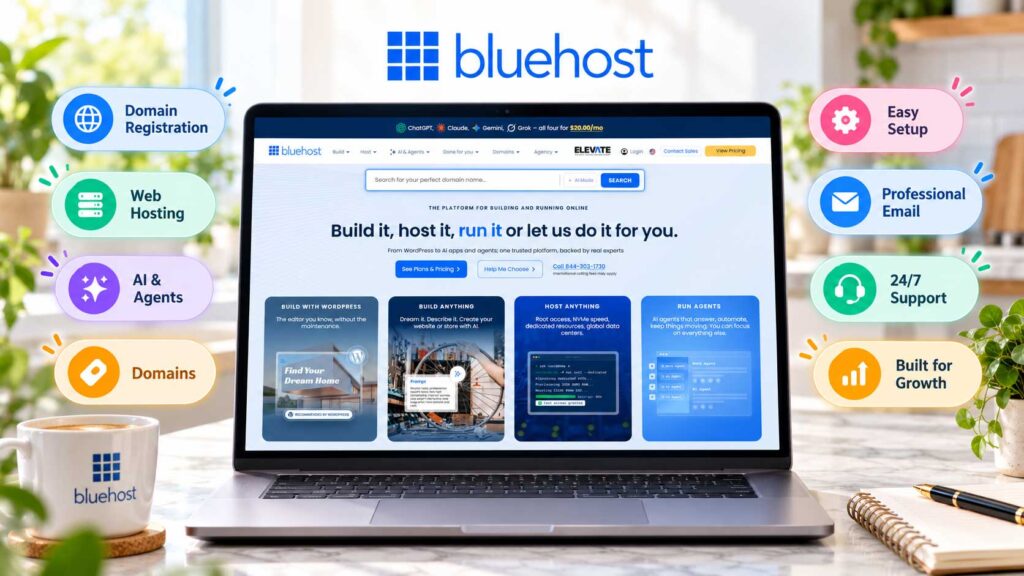
Best for beginners who need a domain and WordPress hosting together
Bluehost is better known as a web hosting company than as a dedicated domain registrar, but it can still make sense for new food bloggers who need both services at the same time.
Instead of buying a domain from one company and hosting from another, Bluehost lets you manage both from the same account.
For someone launching a first food blog, that can make the initial setup simpler.
Why Food Bloggers Consider Bluehost
Bluehost is built heavily around WordPress, so connecting a domain to a new WordPress site is straightforward.
Depending on the hosting plan and current promotion, Bluehost may also include a domain free for the first year with an eligible hosting package.
That can reduce your startup cost if you already planned to purchase hosting.
From the Bluehost dashboard, you can manage:
- Domains
- DNS settings
- WordPress installations
- Hosting
- SSL certificates
- Business email
- Renewals
- Website backups and security features
Keeping everything together can be convenient for beginners who do not want to manage several separate accounts.
Bluehost Domain Pricing
At the time of writing, Bluehost lists a .com domain at approximately $12.99 for the first year, with renewal around $23.99 per year.
Promotional hosting plans may also include the first year of domain registration at no additional cost.
Because the renewal price is noticeably higher than the introductory price, it is worth comparing Bluehost’s long-term cost with dedicated registrars before deciding where to keep your domain.
Domain Privacy
Domain privacy is available through Bluehost, but it may not be included with every domain registration or hosting plan.
That is an important difference compared with registrars such as Namecheap and Porkbun, which include privacy with many eligible domains.
If privacy is important to you, check exactly what is included in your Bluehost plan before completing the purchase.
Features Available With Bluehost Domains
Depending on your plan, Bluehost provides access to features such as:
- DNS management
- Domain locking
- Automatic renewal
- Domain transfers
- SSL certificates
- WordPress integration
- Hosting management
- Customer support
- Email services
Bluehost’s biggest advantage is not its standalone domain-management feature set. It is the convenience of managing your domain, hosting, and WordPress website from one provider.
Pros and Cons
| Pros | Cons |
|---|---|
| Easy WordPress integration | Higher renewal pricing than some dedicated registrars |
| Convenient for first-time bloggers | Domain privacy may cost extra depending on the plan |
| Domain may be included with eligible hosting plans | Less flexible if you prefer keeping domains and hosting separate |
| Hosting and domain managed from one account | Not primarily focused on advanced domain management |
| SSL available with hosting | Long-term domain costs can be higher |
| Customer support available | |
| Good option for an all-in-one setup |
Is Bluehost Good for Food Bloggers?
Yes, but mainly in a specific situation.
Bluehost makes the most sense for a new food blogger who needs WordPress hosting and a domain at the same time and wants the simplest possible setup.
If you already have hosting or expect to manage several websites, a dedicated registrar such as Namecheap, Porkbun, or Cloudflare may give you more flexibility and potentially lower long-term costs.
Overall, Bluehost is a convenient choice for beginners who value simplicity and bundled WordPress hosting, but it is not necessarily the best place to keep a domain for many years if low renewal pricing is your priority.
7. Hostinger

Best for affordable hosting and a domain in one place
Hostinger is primarily known as a web hosting company, but it also offers domain registration and can be a convenient option for new food bloggers who want to manage their domain and hosting from the same account.
For beginners, that can simplify the setup process because there is no need to connect a domain from a separate registrar before launching the website.
Why Food Bloggers Consider Hostinger
Hostinger combines domain registration with WordPress hosting, website-building tools, email services, SSL, and other website features.
From the same dashboard, you can manage:
- Domains
- DNS records
- Nameservers
- Auto-renewal
- Domain transfers
- WHOIS privacy
- WordPress hosting
- SSL certificates
- Business email
- Website security settings
Hostinger currently supports more than 500 domain extensions, giving bloggers a wide range of options when searching for a new domain.
Hostinger Domain Pricing
Hostinger frequently runs aggressive introductory promotions.
At the time of writing, it advertises .com registration for as little as $0.01 for the first year when purchasing a three-year term, while showing a standard .com price of $19.99. Standard renewal rates apply after the promotional period.
That is why it is important to check the full multi-year price and renewal cost rather than focusing only on the advertised first-year offer.
Eligible Hostinger hosting plans may also include a free domain for the first year, which can make the overall package more attractive for someone who needs hosting anyway.
Free WHOIS Privacy
Hostinger includes free WHOIS privacy protection with supported domain extensions.
The privacy option is available both when purchasing a new domain and when claiming an eligible free domain through a hosting plan.
This helps keep personal contact information from being displayed publicly where privacy protection is supported.
Features Available With Hostinger Domains
Depending on the domain extension and plan, Hostinger offers features such as:
- Free WHOIS privacy for supported domains
- DNS management
- Domain transfers
- Auto-renewal
- Domain portfolio management
- Security settings
- WordPress hosting integration
- Free SSL with hosting
- Email services
- Customer support
Hostinger also automatically enables domain renewal by default, although users can switch to manual renewal if they prefer.
Pros and Cons
| Pros | Cons |
|---|---|
| Convenient domain + hosting setup | Best promotional prices may require multi-year commitments |
| Free WHOIS privacy for supported domains | Renewal pricing can be much higher than the introductory offer |
| More than 500 supported domain extensions | Primarily a hosting company rather than a dedicated registrar |
| Easy WordPress integration | Less appealing if you already have hosting elsewhere |
| Free domain available with eligible hosting plans | Promotional pricing can make long-term cost less obvious |
| SSL and other website tools available in the same account | |
| Good option for first-time bloggers |
Is Hostinger Good for Food Bloggers?
Yes, particularly for a new food blogger who still needs web hosting.
Hostinger is easiest to justify when you need hosting anyway.
If you want to purchase WordPress hosting and a domain together, keeping both in the same Hostinger account can make setup and ongoing management simpler.
If you already have hosting or are mainly looking for the lowest possible long-term domain renewal cost, a dedicated registrar such as Porkbun, Namecheap, Cloudflare Registrar, or Dynadot may be a better fit.
For beginners looking for affordable hosting, an easy WordPress setup, free privacy on supported domains, and the convenience of keeping everything together, Hostinger is definitely worth considering.
8. Dynadot
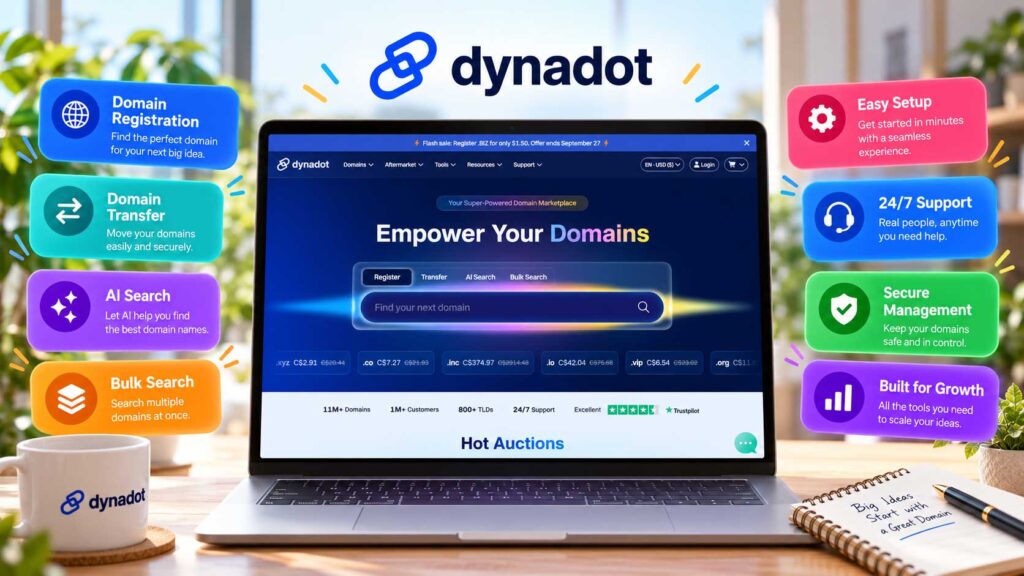
Best for bloggers managing multiple domains
Dynadot is a dedicated domain registrar with competitive pricing and a strong set of tools for managing several domains from one account.
Dynadot may not be the first registrar a new blogger recognizes, but its strengths become clearer once you start managing several domains.
For food bloggers, Dynadot offers a good balance of reasonable pricing, free privacy, strong security features, and flexible domain management.
Why We Like Dynadot for Food Bloggers
Dynadot focuses heavily on domain registration and management rather than trying to bundle every possible website service into the checkout process.
Its dashboard allows you to manage:
- Domain renewals
- DNS records
- Nameservers
- Domain forwarding
- Domain transfers
- Auto-renewal
- WHOIS privacy
- Security settings
- Multiple domains from one account
This can be especially useful if you eventually operate several recipe, food, or niche websites.
Dynadot Domain Pricing
Dynadot publishes separate registration, renewal, and transfer prices for its supported domain extensions, which makes it easier to compare the true long-term cost.
The company also runs occasional first-year promotions, but those offers can change.
As with any registrar, we recommend paying more attention to the regular renewal price than to a temporary introductory discount.
Domain prices can also change when the underlying registry raises its wholesale rates, so check the current pricing before registering.
Free Domain Privacy
Dynadot offers free domain privacy with eligible domain registrations and transfers.
Depending on the extension, you may be able to choose between partial and full privacy.
Full privacy can help hide personal details such as your:
- Name
- Email address
- Mailing address
- Phone number
Not every domain extension allows WHOIS privacy, so availability depends on the TLD you register.
Domain Security
Dynadot also includes several tools designed to help protect your domains.
Depending on the setup, these can include:
- Domain locking
- Two-factor authentication
- Account security settings
- DNSSEC support
- Transfer protection
These features become increasingly important as your website grows because losing control of a domain can take an entire site offline.
Features Available With Dynadot Domains
Depending on the domain extension and configuration, Dynadot offers:
- Free WHOIS privacy
- DNS management
- Domain locking
- Auto-renewal
- Domain forwarding
- Domain transfer tools
- DNSSEC support
- Two-factor authentication
- Bulk domain management
- Portfolio management tools
Dynadot also provides tools aimed at users managing larger numbers of domains, which can be useful if your website portfolio grows over time.
Pros and Cons
| Pros | Cons |
|---|---|
| Competitive domain pricing | Interface can feel more technical than beginner-focused providers |
| Free privacy for eligible domains | Some tools are aimed more at domain investors and large portfolios |
| Transparent registration, renewal, and transfer pricing | May be more than a first-time blogger needs |
| Strong tools for managing multiple domains | Promotional prices can change frequently |
| Good domain security features | |
| DNSSEC support | |
| Bulk-management tools | |
| Less emphasis on unnecessary add-ons |
Is Dynadot Good for Food Bloggers?
Yes, especially if you already own several websites or expect your food-blogging business to grow beyond a single domain.
A beginner with one food blog may find Namecheap or Porkbun slightly simpler, but Dynadot becomes more useful as the number of domains you manage grows.
For bloggers looking for competitive pricing, free privacy, solid security, and strong multi-domain management tools, Dynadot is a very good option to consider.
Which Domain Registrar Is Best for You?
The best domain registrar depends on how you plan to build and manage your food blog.
If you are launching your first website, simplicity may matter more than saving a few dollars per year. If you already manage several blogs, renewal pricing, security, and multi-domain management become more important.
Here is an easy way to narrow down your options.
Choose Namecheap If You Want the Best All-Around Option
Namecheap is a strong choice for most food bloggers because it offers a good balance of usability, privacy, security, and pricing.
It is especially useful if you want to keep your domain separate from your hosting provider while still having a dashboard that is easy to understand.
Choose Porkbun If You Want to Keep Costs Low
Porkbun is one of the most attractive options for bloggers who care about long-term domain costs.
Its pricing is competitive, and useful features such as WHOIS privacy, DNS management, SSL certificates, and email forwarding are included with eligible domains.
This can be particularly valuable if you eventually own several websites.
Choose Cloudflare Registrar If You Already Use Cloudflare
Cloudflare Registrar makes the most sense for bloggers who are comfortable with DNS settings and already use—or plan to use—Cloudflare.
Its at-cost pricing model can help keep renewal costs low, while its DNS, DNSSEC, security, caching, and performance tools are especially useful for more experienced website owners.
Choose Squarespace Domains If You Want Simplicity
Squarespace Domains is a good option if you want a clean interface and straightforward domain management without dealing with too many technical settings.
You can also connect a Squarespace-managed domain to WordPress or another hosting provider, so you are not required to build your website with Squarespace.
Choose GoDaddy If You Prefer a Large, Familiar Provider
GoDaddy may appeal to beginners who prefer working with a large, well-known company and want access to domains, hosting, email, security products, and other website services from one account.
Just make sure you compare renewal pricing carefully and review optional add-ons before completing your purchase.
Choose Bluehost If You Want a Simple WordPress Hosting Bundle
Bluehost makes the most sense when you are starting a new WordPress food blog and want your hosting and domain managed together.
Bundling the two can make the initial setup easier, especially for someone building a first website.
If you already have hosting, however, a dedicated registrar may give you more flexibility and lower long-term domain costs.
Choose Hostinger If You Want Affordable Hosting and a Domain Together
Hostinger is another strong option for beginners who need both WordPress hosting and a domain.
It is particularly appealing if you want a lower-cost hosting package, a free domain with an eligible plan, and an easy way to manage hosting, DNS, SSL, email, and your domain from the same account.
As with Bluehost, Hostinger makes the most sense when you actually need hosting. If you only need a domain, a dedicated registrar may be a better fit.
Choose Dynadot If You Manage Multiple Websites
Dynadot is particularly useful for bloggers building a larger portfolio of websites.
Its domain-management tools, privacy features, security options, and bulk-management features make it easier to control multiple domains from one account.
Our Approach for Food Bloggers
For most food bloggers, we generally prefer keeping the domain registrar separate from the web hosting company.
This gives you more flexibility if you decide to change hosting providers later and lets you choose each service based on its own strengths.
For example, you could register your domain with Namecheap, Porkbun, Dynadot, or Cloudflare and then connect it to whichever WordPress hosting provider works best for your site.
That approach requires one extra setup step in the beginning, but it can make moving your website or changing hosting providers much easier later.
If simplicity matters more than keeping the services separate, a bundled option such as Bluehost or Hostinger can still be a perfectly practical choice for a new food blog.
Should You Buy Your Domain and Hosting From the Same Company?
You can buy your domain and web hosting from the same company, but you do not have to.
Both approaches can work well. The better choice depends on whether you value simplicity or flexibility more.
Buying Your Domain and Hosting Together
For a first-time food blogger, buying both services from the same company can make setup easier.
Your domain may connect automatically to your hosting account, and you can usually manage billing, WordPress, DNS settings, and renewals from one dashboard.
Some hosting companies also include a free domain for the first year with eligible plans, which can reduce your initial startup cost.
This approach can make sense if you:
- Are building your first website
- Want the simplest possible setup
- Do not want to manage multiple accounts
- Prefer keeping hosting and domain billing together
Providers such as Bluehost and Hostinger allow you to manage WordPress hosting and domain registration from the same account.
Keeping Your Domain and Hosting Separate
More experienced bloggers often prefer registering their domain with one company and purchasing hosting from another.
For example, you might register your domain with Porkbun, Namecheap, Dynadot, or Cloudflare and host your WordPress site somewhere completely different.
The main advantage is flexibility.
If you decide to change hosting providers later, your domain can stay exactly where it is. You simply update the DNS records or nameservers to point the domain to your new host.
Keeping the services separate can also make it easier to manage your domain independently from your hosting account.
Which Setup Is Better for Food Bloggers?
If you are launching your first food blog and want everything to be as simple as possible, purchasing your domain and hosting together can be a perfectly reasonable choice.
If you expect to build multiple websites, switch hosting providers, or manage a larger portfolio over time, keeping your domains and hosting separate may give you more flexibility.
There is no requirement to use the same company for both.
Whichever setup you choose, make sure you keep control of your registrar account, use an email address you check regularly, enable two-factor authentication where available, keep your payment information current, and turn on auto-renewal for important domains.
How Much Does a Domain Name Cost?
The cost of a domain name depends on the extension, the registrar you choose, and whether the domain is a standard registration or a premium name.
For a typical food blog using a .com, a realistic budget is usually around $10 to $25 per year after any introductory promotion.
The important thing is to separate the first-year price from the renewal price.
First-Year Registration Price
Many registrars discount the first year to attract new customers.
You may see a .com advertised for $1, $5, or $10, but that does not mean you will continue paying that amount every year.
Some promotions also require a multi-year purchase.
A discounted first year can still be a good deal, but always check what the domain will cost when it renews.
Domain Renewal Price
The renewal price is what you pay to keep your domain after the initial registration period ends.
For most bloggers, this is the number that matters more over the long term.
For example, current .com renewal prices vary considerably between registrars. Lower-cost providers such as Porkbun and Dynadot are around the $11 range, while Namecheap is currently $18.48 and GoDaddy is around $22.99.
A difference of $10 per year may not matter much for one food blog, but it becomes more noticeable if you eventually manage 10 or 20 domains.
Premium Domain Names
Some domains cost much more because they are classified as premium domains.
A premium domain may be:
- Very short
- Easy to remember
- Built around a valuable keyword
- Previously registered and listed for resale
- Considered especially valuable by the registry
Instead of costing $10 or $20, a premium domain may cost hundreds or thousands of dollars, and highly desirable names can cost considerably more.
For most new food bloggers, there is no need to spend heavily on a premium domain. A memorable, brandable name is usually more useful than paying a large amount for an exact-match keyword.
WHOIS Privacy
Some registrars include domain privacy for free, while others may charge extra depending on the extension or protection package.
Before registering, check whether WHOIS privacy is included.
Free privacy can help keep personal registration details from being displayed publicly where privacy protection is supported.
ICANN and Registry Fees
Your final domain price may also include fees charged by ICANN or the registry responsible for the extension.
Some registrars include these costs in the advertised price, while others display them separately during checkout.
That is why it is worth comparing the final checkout total, not just the promotional price shown on the landing page.
Domain Transfer Costs
Moving a domain to another registrar can also involve a fee.
For many common extensions, the transfer price includes an additional year of registration, although the exact rules depend on the registrar and domain extension.
If another registrar offers significantly better renewal pricing, features, or domain-management tools, transferring your domain may make sense.
Watch for Extra Add-Ons
The domain itself may be inexpensive, but optional services can increase the total cost.
During checkout, you may see offers for:
- Business email
- Web hosting
- SSL certificates
- Premium DNS
- Website builders
- Security packages
- Advanced domain protection
Some of these services can be useful, but you do not need to add everything offered at checkout.
For most food bloggers, the priorities are a reliable registrar, secure account access, privacy where available, straightforward DNS management, and a reasonable renewal price.
What Should a Food Blogger Expect to Pay?
For a standard .com, budgeting roughly $10 to $25 per year is realistic for most food bloggers, depending on the registrar.
That is a relatively small expense compared with hosting, plugins, photography equipment, email marketing tools, and other costs involved in growing a food blog.
Because your domain becomes part of your brand, it is usually better to choose a registrar based on long-term pricing, security, reliability, and ease of management rather than saving a few dollars during the first year.
How to Choose a Good Domain Name for Your Food Blog
Choosing the right registrar matters, but the domain name itself is even more important.
Your domain becomes part of your food blog’s identity. Ideally, it should be easy to remember, simple to spell, and broad enough to still make sense as your website grows.
Keep It Short and Memorable
Shorter domain names are generally easier to remember, type, and share.
You do not need to force your name into one or two words, but avoid making it unnecessarily long.
For example:
FreshTableKitchen.com
is much easier to remember than:
MyFavoriteHealthyFamilyDinnerRecipes.com
Aim for something that sounds like a recognizable brand rather than a description of everything you plan to publish.
Make It Easy to Spell
Imagine someone hearing the name of your food blog on a podcast, YouTube video, or in conversation.
Would they know how to spell it without asking?
Creative names can work, but unusual spellings may cause readers to type the wrong address or struggle to find you again later.
When possible, choose a name people can hear once and type correctly.
Try to Get the .com
For most food blogs, .com is still the first domain extension we would look for.
It is familiar, widely recognized, and easy for readers to remember.
Other extensions can work, but if the .com version of your preferred brand is available at a reasonable price, it is usually worth considering first.
Avoid Hyphens and Numbers When Possible
Hyphens and numbers can make a domain harder to remember and explain.
Take a name such as:
5-minute-meals.com
If you say it aloud, someone may wonder whether you mean 5 or five and whether the words contain hyphens.
A simpler domain avoids that confusion.
Give Yourself Room to Grow
Try not to choose a name that locks you into an extremely narrow topic.
Maybe you plan to begin with air fryer chicken recipes. A few years later, you might also publish desserts, meal plans, kitchen guides, or restaurant recommendations.
A broader brand name gives you room to expand without making your domain feel disconnected from your content.
Consider Your Food Blog Niche
Your domain does not have to contain words such as “food,” “recipe,” or “kitchen.”
It should, however, feel appropriate for the type of brand you want to build.
Your blog might focus on:
- Quick family meals
- Baking
- Healthy recipes
- Mediterranean food
- Vegan cooking
- Budget meals
- Desserts
- Regional cuisine
- Meal prep
- Outdoor cooking
- Restaurant and food travel
A strong brandable name can often be more memorable than a domain packed with exact-match keywords.
Check Social Media Availability
Before registering the domain, check whether the same or a similar username is available on the social platforms you expect to use.
That may include:
- TikTok
- YouTube
Your usernames do not need to match perfectly, but keeping them reasonably consistent makes your brand easier to recognize across platforms.
Check Existing Brands and Trademarks
A domain being available does not necessarily mean the name is safe to build a business around.
Search Google, social media, and the USPTO trademark database to see whether another company or established website is already using the same or a very similar name.
This becomes even more important if you eventually plan to publish cookbooks, launch products, sell courses, or create merchandise under the brand.
Registering a domain does not automatically give you trademark rights to the name.
Say the Name Out Loud
Before registering, actually say the name aloud.
Imagine telling someone:
“Visit my website at…”
Then ask yourself:
- Does it sound natural?
- Is it easy to pronounce?
- Would someone know how to spell it?
- Is it easy to remember?
If you have to explain the name every time you say it, a simpler option may work better.
Think Beyond Your First Few Recipes
A good food blog domain should still make sense several years from now.
Your audience, content strategy, and monetization plans may change considerably as the site grows.
Instead of choosing a name based only on the first 10 recipes you plan to publish, think about whether it could comfortably sit above hundreds of articles and eventually become a recognizable food brand.
Once you find a domain that is memorable, easy to spell, available, and flexible enough to grow with you, you are ready to register it with one of the domain registrars above.
Common Domain Registration Mistakes to Avoid
Registering a domain is easy, but a few small mistakes can create bigger problems later.
Before buying a domain for your food blog, watch out for these common issues.
Choosing Based Only on the First-Year Price
A cheap introductory offer can look attractive, but the renewal price may be much higher.
Always compare the regular renewal cost before deciding where to register your domain.
A $5 first year is not necessarily a better deal if the domain renews at $25 every year afterward.
Forgetting to Turn On Auto-Renewal
Allowing an important domain to expire can take your website offline and create unnecessary stress.
For an active food blog, auto-renewal is usually worth enabling.
Just make sure the payment method connected to your registrar account stays current.
Using an Email Address You May Lose
Your registrar account should use an email address you expect to control for the long term.
Avoid relying on an address connected to a temporary job, school, or another account you may stop using.
Registrars may send renewal notices, security alerts, login warnings, and transfer confirmations to this address, so keeping access to it matters.
Ignoring Account Security
Your registrar account controls one of your website’s most valuable assets.
Use a strong, unique password and enable two-factor authentication whenever it is available.
You should also keep the domain locked unless you are actively preparing to transfer it.
Paying for Add-Ons You Do Not Need
Domain checkout pages may offer extra services such as:
- Business email
- Premium DNS
- SSL certificates
- Website builders
- Security packages
- Advanced domain protection
- Web hosting
Some of these can be useful, but others may duplicate features already included with your hosting provider or registrar.
Review every add-on before paying for it.
Registering Too Many Domain Extensions
When you find a name you like, some registrars encourage you to purchase the .com, .net, .org, .co, .blog, and several other versions.
Most new food bloggers do not need all of them.
Buying the main domain you plan to use is usually enough unless you have a specific branding or trademark reason to protect additional extensions.
Every extra domain also creates another annual renewal expense.
Letting Someone Else Control the Domain
If a developer, designer, agency, or friend is helping you build the site, make sure the domain is registered in an account you control.
You should have access to:
- The registrar login
- The account email
- Two-factor authentication
- Billing information
- Domain contact information
- DNS and transfer settings
Your domain is part of your business, so you should always know where it is registered and how to access it.
Not Keeping Contact and Payment Information Updated
Old billing details and outdated contact information can create problems when renewal time arrives.
If a credit card expires or renewal notices go to an abandoned email address, you may not realize there is a problem until the domain is close to expiration.
Review your registrar account periodically and keep those details current.
Collecting Domains You Never Use
It is easy to register new domains whenever you have a website idea.
The problem is that $10, $15, or $20 renewals can quietly turn into hundreds of dollars per year when you accumulate names you never develop.
Review your domain portfolio before renewal and keep the domains that still have a realistic purpose.
For most bloggers, a few strong, active domains are more valuable than dozens of unused ideas.
Frequently Asked Questions About Domain Registrars
What is the best domain registrar for food bloggers?
There is no single best choice for everyone.
Namecheap is a strong all-around option, Porkbun is attractive for lower-cost renewals, Cloudflare Registrar works well for users already in the Cloudflare ecosystem, and Hostinger or Bluehost can make sense if you also need WordPress hosting.
The best choice depends on whether you prioritize price, simplicity, privacy, technical control, or bundled hosting.
Can I buy a domain without buying hosting?
Yes.
You can register a domain without purchasing hosting at the same time.
Many bloggers register their domain with one company and choose a separate WordPress host later.
Does the domain registrar affect SEO?
Your choice of registrar does not directly determine how well your food blog ranks in search results.
SEO depends much more on factors such as content quality, site structure, page speed, backlinks, technical SEO, and user experience.
A reliable registrar can still help you avoid problems with DNS, security, or domain expiration.
Can I transfer my domain to another registrar later?
Yes.
Most domains can be transferred to another registrar, although timing restrictions and registry rules may apply.
You will usually need to unlock the domain and obtain a transfer authorization code from your current registrar.
Should a food blog use a .com domain?
A .com is usually the first extension we would consider for a food blog when a good one is available.
It is widely recognized and easy for readers to remember.
Other extensions can work, but .com is still a strong choice for a long-term brand.
Should I register my domain and hosting with the same company?
You can, but it is not required.
Using the same company can make setup easier for beginners, especially with providers such as Bluehost or Hostinger.
Keeping the services separate can give you more flexibility if you change hosting providers later.
Is WHOIS privacy important?
For many bloggers, yes.
WHOIS privacy can help prevent personal registration details from being displayed publicly where privacy protection is supported.
Many registrars now include it at no additional cost with eligible domains.
Can I change my domain name later?
Yes, but changing the domain of an established website can be a significant project.
It may require redirects, Search Console updates, internal-link changes, email updates, branding changes, and careful SEO monitoring.
That is one reason it is worth choosing a domain that gives your food blog room to grow from the beginning.
Is it better to register a domain for multiple years?
It can be convenient, but it is not necessary.
Registering for several years reduces the number of times you need to renew manually, while auto-renewal can provide similar protection against accidental expiration.
The better option depends on your budget and how certain you are that you will keep the domain long term.
Can I use any registrar with WordPress?
In most cases, yes.
Your domain registrar and WordPress hosting provider do not need to be the same company.
You simply connect the domain to your hosting provider using DNS records or nameservers.
What happens if I forget to renew my domain?
The domain may stop pointing to your website, and your site can become unavailable.
Most registrars provide an expiration and recovery period, but the exact rules and fees vary.
For important domains, enabling auto-renewal and keeping your payment details current is the safest approach.
Quick Recommendations
If you want the short version, here is how the domain registrars in this guide compare for different types of food bloggers.
| Best For | Domain Registrar | Why It Stands Out |
|---|---|---|
| Best Overall | Namecheap | Easy management, free privacy for eligible domains, and strong all-around features |
| Best for Low Costs | Porkbun | Competitive registration and renewal pricing with useful extras included |
| Best for Cloudflare Users | Cloudflare Registrar | At-cost pricing model with excellent DNS and security tools |
| Best for Simplicity | Squarespace Domains | Clean interface and straightforward domain management |
| Best All-in-One Provider | GoDaddy | Domains, hosting, email, and other website services under one account |
| Best for WordPress Hosting + Domain | Bluehost | Convenient setup for beginners who want hosting and a domain together |
| Best Affordable Hosting + Domain Option | Hostinger | Competitive hosting packages with domain management in the same account |
| Best for Multiple Domains | Dynadot | Strong portfolio, bulk-management, and security tools |
Whichever registrar you choose, compare renewal prices, check which privacy and security features are included, and avoid deciding based solely on a temporary first-year promotion.
More Food Blogging Guides to Help You Build and Grow Your Site
Choosing the right domain is only one part of building a successful food blog. These guides can help you set up your site, avoid common mistakes, choose better tools, and start growing your traffic.
- Domain Name Mistakes Food Bloggers Should Avoid – Avoid common naming, branding, and registration mistakes before committing to a domain.
- Best Blogging Platforms for Food Bloggers: Free & Paid – Compare the major blogging platforms and decide which one makes the most sense for your food website.
- Best Tools for Food Bloggers: 25+ Essential Blogging Tools – Explore useful tools for SEO, content creation, analytics, email marketing, photography, and running your blog.
- Best SEO Tools for Food Bloggers – Find tools for keyword research, competitor analysis, rankings, backlinks, and content optimization.
- Best WordPress SEO Plugins for Food Bloggers – Compare WordPress SEO plugins that can help with metadata, sitemaps, schema, and on-page optimization.
- 15 Food Blogging Mistakes Beginners Should Avoid – Learn which early blogging mistakes can slow your growth and how to avoid them.
- WordPress Mistakes New Food Bloggers Should Avoid – Avoid common WordPress setup, security, speed, and organization problems.
- 30 Ways to Get Traffic to Your Food Blog – Discover practical strategies for growing traffic through SEO, Pinterest, email, social media, and other channels.
Final Thoughts on Choosing a Domain Registrar
Choosing a domain registrar is one of those decisions that seems small at first but matters more as your food blog grows.
The cheapest introductory price is not always the best long-term deal. Renewal costs, privacy, security, DNS management, and ease of use can make a much bigger difference over time.
For most food bloggers, dedicated registrars such as Namecheap, Porkbun, Cloudflare Registrar, and Dynadot offer a good balance of flexibility and domain-management features.
If you also need hosting, Bluehost and Hostinger can be convenient because they let you manage your domain and WordPress hosting from the same account.
Whichever registrar you choose, make sure you:
- Check the renewal price before registering
- Enable two-factor authentication
- Turn on auto-renewal for important domains
- Keep your billing and contact information current
- Make sure the registrar account remains under your control
Your domain may stay with your food blog for many years, so it is worth choosing both the name and the registrar carefully from the beginning.
Once the domain is registered, you can move on to hosting, WordPress setup, branding, content, and growing the site.