

If you want more people to discover your recipes through Google, Pinterest, and other search platforms, keyword research should be one of the first steps in your content process.
The good news is that you do not need an expensive SEO subscription to uncover useful keyword opportunities.
There are plenty of free keyword research tools for food bloggers that can help you discover what people are searching for, find long-tail recipe keywords, spot seasonal trends, uncover common questions, and identify topics your blog may already have a realistic chance to rank for.
For example, instead of targeting a broad phrase such as chicken pasta, keyword research might reveal more specific searches like:
- creamy garlic chicken pasta
- chicken pasta without cream
- one-pot chicken pasta
- chicken pasta with spinach
- easy chicken pasta for dinner
These more specific searches often tell you much more about what the reader actually wants.
Keyword research can also help you decide whether a recipe idea is worth pursuing, how to structure the article, which questions to answer, and which related recipes could become part of a larger content cluster.
In this guide, we will look at some of the best free keyword research tools for food bloggers, including Google Search Console, Google Keyword Planner, Google Trends, Ahrefs, Semrush, AnswerThePublic, Ubersuggest, KeywordTool.io, Bing Webmaster Tools, and useful Google search features you can use without paying for another platform.
More importantly, you will learn how to use these tools specifically for recipe keyword research and food blog SEO, rather than simply collecting a list of phrases and hoping they rank.
By the end, you should have a practical system for finding recipe topics, long-tail keywords, seasonal opportunities, and content ideas that can help grow your food blog’s organic traffic.
Quick Comparison: Best Free Keyword Research Tools for Food Bloggers
Before diving into each platform, here is a quick comparison of the best free keyword research tools for food bloggers and what each one is most useful for.
| Keyword Tool | Best For | Free Access | Search Volume Data | Keyword Difficulty | Best Use for Food Bloggers |
|---|---|---|---|---|---|
| Google Search Console | ConsoleFinding queries your pages already appear for | Yes | No traditional search-volume metric | No | Finding existing search opportunities and improving recipes already receiving impressions |
| Google Keyword Planner | Keyword ideas and search demand | Yes | Yes | Ad competition only, not organic SEO difficulty | Researching recipe topics and comparing keyword demand |
| Google Trends | Seasonal and rising searches | Yes | Relative interest rather than exact volume | No | Planning seasonal recipes, holiday content, and emerging food topics |
| Ahrefs Free Keyword Generator | Fast keyword discovery | Limited free access | Limited keyword metrics | Limited | Finding long-tail recipe ideas and related searches |
| Semrush Keyword Tool | Keywords, intent, and related terms | Limited free access | Yes | Yes | Comparing keywords and finding related content opportunities |
| AnswerThePublic | Questions and long-tail topics | Limited free access | Varies by feature | No traditional SEO difficulty score | Finding questions about recipes, ingredients, substitutions, and cooking |
| Ubersuggest | Beginner-friendly keyword research | Limited free access | Yes | Yes | Finding keyword ideas and comparing potential opportunities |
| KeywordTool.io | Autocomplete keyword ideas | Limited free results | Detailed metrics generally require paid access | No | Discovering long-tail phrases based on search suggestions |
| Bing Webmaster Tools | Additional search-performance data | Yes | Performance data from your site | No | Finding queries and pages already appearing in Bing |
| Google Search Features | Completely free manual research | Yes | No | No | Using Autocomplete, People Also Ask, and Related Searches to uncover real search patterns |
No single tool gives you everything.
For most food bloggers, the better approach is to combine several tools and use each one for what it does best.
For example, you might use Google Trends to see whether a recipe is seasonal, Google Keyword Planner to compare search demand, Ahrefs or Semrush to uncover related long-tail keywords, and Google Search Console to improve the article once it begins receiving impressions.
That gives you a much clearer picture than relying on a single search-volume estimate or keyword difficulty score.
It also helps you avoid one of the most common keyword research mistakes: choosing a topic simply because a tool shows a large number next to it.
A better question is:
Can I create a recipe or food article that closely matches what the searcher actually wants?
That is the approach we will use throughout this guide.
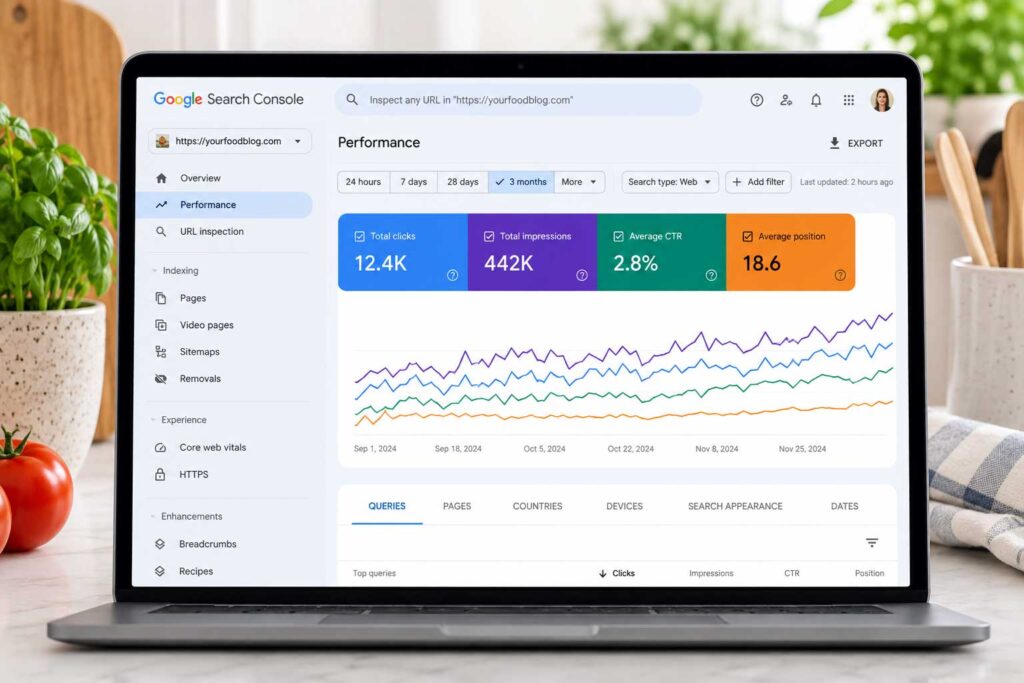
1. Google Search Console – Best for Queries Your Site Already Appears For
Google Search Console is one of the most useful free keyword research tools for food bloggers because it shows the search queries that are already generating impressions and clicks for your site.
Unlike traditional keyword tools, Search Console is based on your own performance data.
That makes it especially valuable once your food blog has enough published content to appear regularly in Google Search.
What Google Search Console Can Show You
Inside the Performance report, you can review:
- Search queries
- Clicks
- Impressions
- Average click-through rate
- Average position
- Pages appearing in Google Search
For food bloggers, this data can reveal keyword opportunities you may never have intentionally targeted.
For example, imagine you published a recipe for:
Creamy Chicken Pasta
A few months later, Search Console might show impressions for searches such as:
- creamy chicken pasta without heavy cream
- easy creamy chicken pasta
- chicken pasta with garlic
- creamy chicken pasta with spinach
- quick chicken pasta dinner
These queries can help you improve the existing recipe rather than immediately creating another post.
Look for Queries With Visibility but Room to Improve
One useful way to use Search Console is to find queries where your page is already appearing but is not yet getting as much visibility or traffic as you would like.
For example, you might find a query with:
2,500 impressions
Average position: 14
20 clicks
That suggests Google is already showing the page for that search, but there may still be room to improve it.
You could strengthen the article by:
- expanding a section related to that query
- adding a more useful subheading
- answering a related question
- improving the introduction
- adding internal links from relevant posts
- refreshing outdated information
- improving the SEO title and meta description
Updating an existing page with real search data can often be more efficient than starting from scratch.
Find High-Impression Keywords With Low CTR
Another useful opportunity is finding queries that generate plenty of impressions but relatively few clicks.
For example:
| Query | Impressions | Clicks | Average Position |
|---|---|---|---|
| easy strawberry smoothie | 4,200 | 58 | 6.8 |
| strawberry banana smoothie | 3,100 | 143 | 4.9 |
| strawberry smoothie without yogurt | 1,900 | 21 | 8.2 |
The third query may deserve a closer look.
You could add a section such as:
Can You Make This Strawberry Smoothie Without Yogurt?
Then explain which ingredients can replace yogurt and how the texture or flavor may change.
If the search intent is clearly different from the original recipe, the query could also inspire a separate post.
Use the Pages Report to Find Recipes With Growth Potential
You do not have to begin with keywords.
Another useful workflow is:
Performance → Search Results → Pages
Choose a recipe that is already receiving impressions, then review the Queries connected to that page.
This can help you uncover long-tail recipe keywords based on actual searches that already triggered your content.
Use Search Console for Content Refreshes
Search Console is also useful when updating older food content.
Compare performance across different date ranges and look for meaningful changes in:
- impressions
- clicks
- click-through rate
- average position
Google specifically recommends looking at trends in clicks and impressions rather than focusing too heavily on position alone.
Then review whether the article needs:
- clearer instructions
- updated photos
- better ingredient notes
- stronger substitutions
- more useful FAQs
- improved internal links
- refreshed structured data
- better troubleshooting information
This makes Search Console useful for both keyword research and ongoing content optimization.
Best Google Search Console Workflow for Food Bloggers
A simple process is:
- Open the Performance report.
- Review the last three to six months.
- Sort queries by impressions.
- Look for relevant searches where your page already appears.
- Identify pages with strong impressions but weak clicks or declining performance.
- Improve the article around the searcher’s intent.
- Add internal links from closely related posts.
- Compare performance again after the update has been indexed.
Best For
Food blogs with published content that already receives impressions in Google Search.
If your site is brand new, Search Console may not have enough data to be very useful yet.
In that case, use tools such as Google Keyword Planner, Google Trends, Ahrefs, or Semrush to research new topics before publishing.
Once your site starts appearing regularly in search results, Search Console should become one of the first places you check for new keyword opportunities.
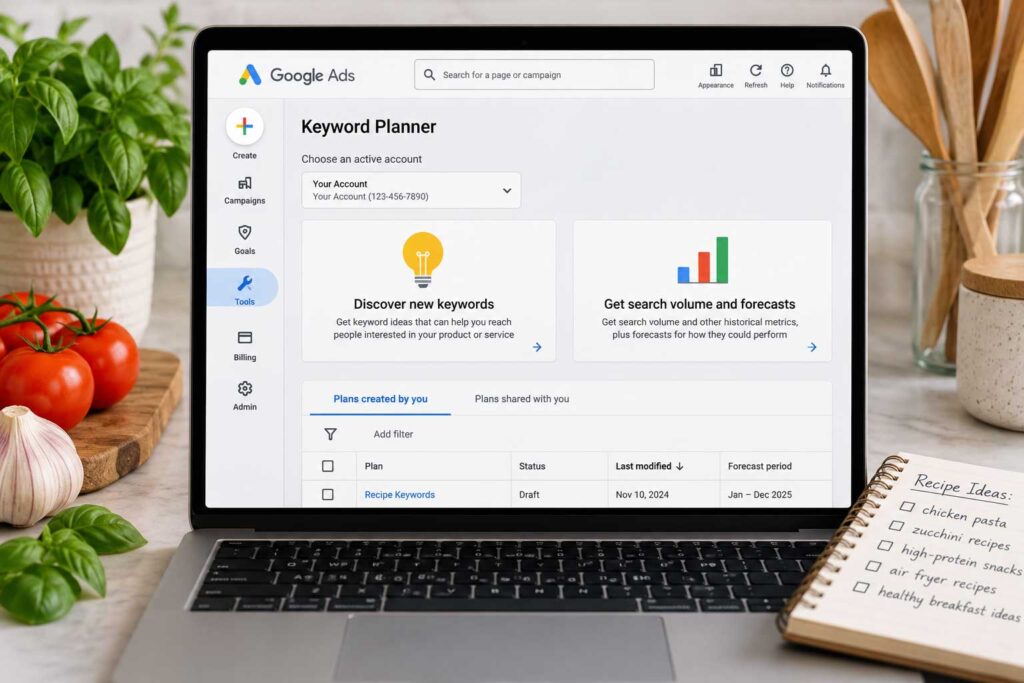
2. Google Keyword Planner – Best for Free Keyword Ideas and Search Demand
Google Keyword Planner is a practical place to start when you already have a broad recipe idea and want to see how people search around it.
Although the tool was created for Google Ads, its keyword suggestions and search-demand estimates can also be useful when planning food content.
is a practical place to start when you already have a broad recipe idea and want to see how people search around it.
Although the tool was created for Google Ads, its keyword suggestions and search-demand estimates can also be useful when planning food content.
Start with something broad such as chicken pasta, oatmeal, or air fryer chicken, then use the results to uncover more specific recipe angles.
One thing to know before using it: Google currently requires you to complete Google Ads account setup, including billing information, before you can access basic Keyword Planner features such as Discover new keywords.
How Food Bloggers Can Use Google Keyword Planner
Suppose you start with:
chicken pasta
Keyword Planner may surface related ideas such as:
- creamy chicken pasta
- chicken pasta recipes
- healthy chicken pasta
- chicken and spinach pasta
- garlic chicken pasta
- easy chicken pasta
- chicken pasta bake
- chicken pesto pasta
This can help you see whether one broad topic could support several separate recipes.
For example, instead of publishing only one generic chicken pasta recipe, you might eventually build a cluster around:
Creamy Chicken Pasta
Chicken Pesto Pasta
Chicken Pasta Bake
Healthy Chicken Pasta
Chicken and Spinach Pasta
That gives you a stronger group of related content and more natural internal-linking opportunities.
Use Keyword Planner to Compare Search Demand
One of the biggest advantages of Keyword Planner is that it can help you compare the relative popularity of different ideas.
Imagine you are deciding between:
mango smoothie
mango protein smoothie
mango smoothie without yogurt
Keyword Planner can show estimated average monthly searches, which can help you compare the overall demand around those topics. Google bases these estimates on historical search trends rather than treating them as exact future traffic numbers.
That does not mean you should automatically choose the largest keyword.
A lower-volume phrase may have clearer intent and be a better fit for your site.
For example:
smoothie
is extremely broad.
But:
mango smoothie without yogurt
tells you exactly what the searcher wants.
That specificity can make the second keyword much easier to turn into a focused recipe.
Pay Attention to Search Intent
Search demand is useful, but intent matters just as much.
Compare:
chicken
chicken recipes
easy chicken recipes for dinner
30-minute chicken breast recipes
The last two give you much clearer direction.
For food bloggers, specific searches often reveal:
- the ingredient
- cooking method
- dietary preference
- meal type
- cooking time
- equipment
- occasion
- desired result
A keyword such as:
crispy air fryer potatoes without oil
already tells you most of what the searcher expects from the recipe.
Use Filters to Find Better Keyword Opportunities
Keyword Planner can return a large number of ideas.
Instead of reviewing everything, narrow the results using keyword text, average monthly searches, competition, bid estimates, and the available category filters.
For food bloggers, you can also look for useful modifiers such as:
- easy
- healthy
- quick
- air fryer
- slow cooker
- gluten free
- vegan
- high protein
- without
- homemade
This can help you uncover more focused long-tail opportunities.
For example, starting with:
oatmeal
you might find ideas around:
high protein oatmeal
overnight oatmeal without yogurt
oatmeal with chia seeds
healthy oatmeal for breakfast
Each one points to a more specific search intent.
Don’t Confuse Ad Competition With SEO Difficulty
This is one of the most important things to understand about Keyword Planner.
The Competition metric in Keyword Planner reflects competition among advertisers bidding on that keyword in Google Ads.
It does not tell you how difficult the keyword will be to rank for organically.
A keyword marked Low can still be highly competitive in organic search.
Likewise, a keyword with strong advertiser competition may still be a realistic SEO opportunity.
For organic research, always check the actual search results before deciding whether to target a keyword.
Look at the Search Results Before Publishing
Once you find an interesting keyword, search it manually.
Ask:
- Are the results mostly large recipe sites?
- Are smaller food blogs ranking?
- Do the top results match the keyword closely?
- Are there weak or outdated pages?
- Is Google showing recipes, videos, forums, or informational pages?
- Is there something important the current results fail to explain clearly?
This quick SERP review can tell you things a keyword tool cannot.
Use Keyword Planner for Recipe Clusters
Keyword Planner becomes even more useful when you stop thinking about one keyword at a time.
For example, researching:
air fryer chicken
might reveal ideas such as:
- air fryer chicken breast
- air fryer chicken thighs
- air fryer chicken tenders
- air fryer chicken wings
- air fryer frozen chicken
- air fryer chicken without breading
Those can become part of a larger air fryer chicken cluster rather than isolated articles.
You might have a broader hub such as:
Best Air Fryer Chicken Recipes
and link to the individual recipes underneath it.
Best Google Keyword Planner Workflow for Food Bloggers
A simple process is:
- Start with one broad recipe, ingredient, or cooking topic.
- Use Discover New Keywords.
- Review related ideas.
- Look for more specific long-tail variations.
- Compare estimated search demand.
- Group similar keywords by intent.
- Check promising keywords manually in Google.
- Choose topics where you can create genuinely useful content.
- Build related ideas into clusters instead of publishing them randomly.
Best For
Finding new recipe ideas, comparing search demand, and expanding broad food topics into more specific keyword opportunities.
Google Keyword Planner works best when you combine it with other tools.
Use it to compare demand, then use Google Trends to understand seasonality and Google Search Console later to see how the published article actually performs.
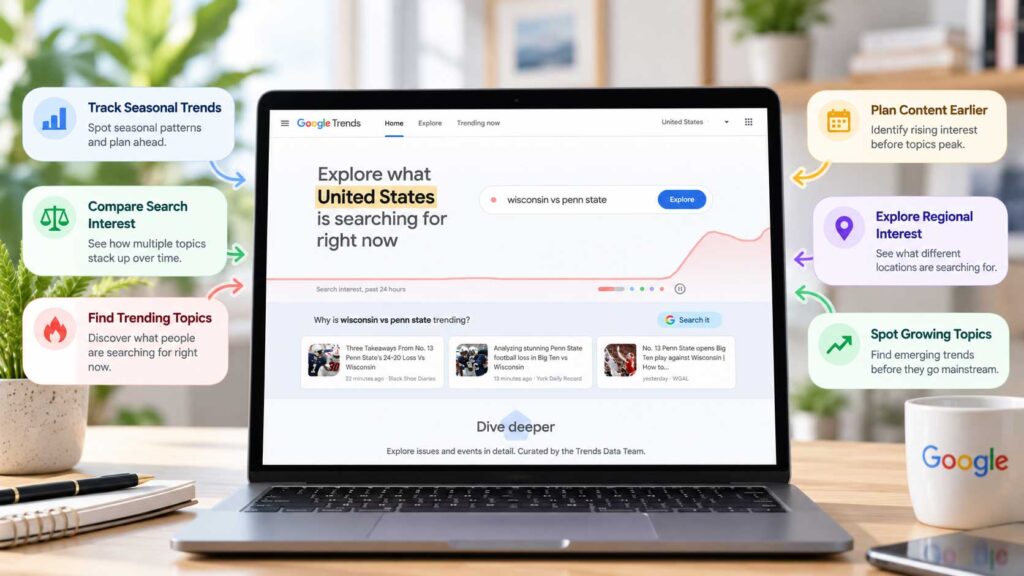
3. Google Trends — Best for Seasonal Recipes and Rising Food Topics
Google Trends is one of the most useful free tools for understanding when people search for certain recipes, ingredients, diets, and cooking ideas.
That makes it especially valuable for food bloggers because food search behavior is often highly seasonal.
People do not search for pumpkin bread, Christmas cookies, summer salads, and Thanksgiving side dishes at the same level throughout the year.
Google Trends helps you see when interest starts rising so you can publish or update content before demand peaks.
Why Seasonality Matters for Food Bloggers
A common mistake is publishing seasonal content when everyone is already searching for it.
By then, competing sites may already have updated their recipes, refreshed internal links, and started gaining visibility.
A better approach is to publish or refresh seasonal content several weeks before peak interest.
For example, searches around topics such as:
- pumpkin recipes
- apple desserts
- Thanksgiving side dishes
- Christmas cookies
- healthy January meals
- Valentine’s Day desserts
- summer pasta salads
- strawberry recipes
often follow predictable yearly patterns.
Google Trends lets you see those patterns over time.
Compare Similar Recipe Ideas
One of the most useful features is the ability to compare search interest between topics.
For example, you could compare:
pumpkin bread
and
pumpkin muffins
Or:
strawberry smoothie
and
mango smoothie
Google Trends does not show exact monthly search volume. Instead, it shows normalized relative search interest over time on a scale from 0 to 100.
A value of 100 represents the highest point of relative popularity within the selected term, location, and time range—not a specific number of searches.
That makes the tool especially useful for comparing:
- similar recipe ideas
- seasonal demand
- rising and declining topics
- ingredient trends
- regional food interests
Use a Longer Time Range
Do not judge a seasonal food keyword based only on the last 30 or 90 days.
For seasonal recipes, switch the date range to something longer, such as:
Past 5 years
This can help you see whether a topic consistently peaks around the same time each year.
For example, a recipe may look weak in June but become much more popular every November.
Without looking at historical trends, you could easily dismiss a valuable seasonal keyword at the wrong time of year.
Find Rising Food Trends
Google Trends can also help you discover topics that are gaining momentum.
After searching for a food-related term, review:
Related topics
and
Related queries
These sections can reveal emerging ingredients, recipe styles, cooking methods, and dietary trends.
You may spot growing interest around topics such as:
- high-protein recipes
- cottage cheese recipes
- air fryer meals
- high-fiber foods
- mocktails
- protein desserts
- Mediterranean-style recipes
- new kitchen appliances
Google defines rising searches as terms that saw the strongest growth during the selected period, which makes them useful for spotting topics gaining momentum.
Look at Regional Interest
Food preferences often vary by location.
Google Trends can show where a topic is relatively more popular by country, state, and sometimes metro area.
This can be useful if your food blog targets a specific audience or regional cuisine.
You may discover stronger relative interest in topics such as:
- cheese curds
- crawfish recipes
- key lime pie
- green chile recipes
- regional barbecue styles
- traditional holiday foods
Keep in mind that regional scores are normalized to the total number of searches in that location, so they should not be treated as raw search-volume numbers.
Example: Planning Pumpkin Content
Suppose you want to build more content around pumpkin recipes.
Instead of publishing several pumpkin articles at random, compare topics such as:
pumpkin bread
pumpkin muffins
pumpkin pancakes
pumpkin soup
pumpkin cookies
Then look at:
- which term shows stronger relative interest
- when interest starts rising
- when the yearly peak occurs
- how quickly interest drops afterward
- whether the pattern repeats each year
You can then build your content calendar around that information.
If interest consistently starts climbing in late summer, you may want the content updated, internally linked, and indexed before the strongest seasonal demand begins.
Use Google Trends With Pinterest Planning
Seasonal research is useful beyond Google SEO.
People often use Pinterest to plan recipes and holiday ideas before they actually need them.
That means a seasonal article may benefit from promotion well before the Google search peak.
For example:
September: Refresh the recipe and create new pins.
October: Increase Pinterest distribution.
November: Push the strongest seasonal content while interest is highest.
This creates a more coordinated content strategy instead of reacting after the trend has already peaked.
Don’t Use Google Trends as a Search Volume Tool
Google Trends does not tell you that a keyword gets 5,000 or 20,000 searches per month.
Its data is relative and normalized.
That means it works best alongside another keyword research tool.
A simple workflow could look like this:
Google Keyword Planner: Is there meaningful search demand?
Google Trends: When is interest strongest?
Google Search: What type of content currently ranks?
Google Search Console: How does the published article perform?
Each tool answers a different question.
Best Google Trends Workflow for Food Bloggers
Use this process when planning seasonal content:
- Enter your main recipe keyword.
- Set the target country or region.
- Choose a longer historical range.
- Look for repeatable seasonal patterns.
- Compare related recipe ideas.
- Review rising related searches.
- Identify when interest begins increasing.
- Publish or refresh the content before the peak.
- Coordinate SEO and Pinterest promotion around the same seasonal window.
Best For
Seasonal recipe planning, comparing food trends, identifying rising topics, and deciding when to publish or update content.
For recipe content, timing matters. Knowing that a topic is popular is useful, but knowing when interest begins to rise can help you publish, update, and promote the article before demand peaks.
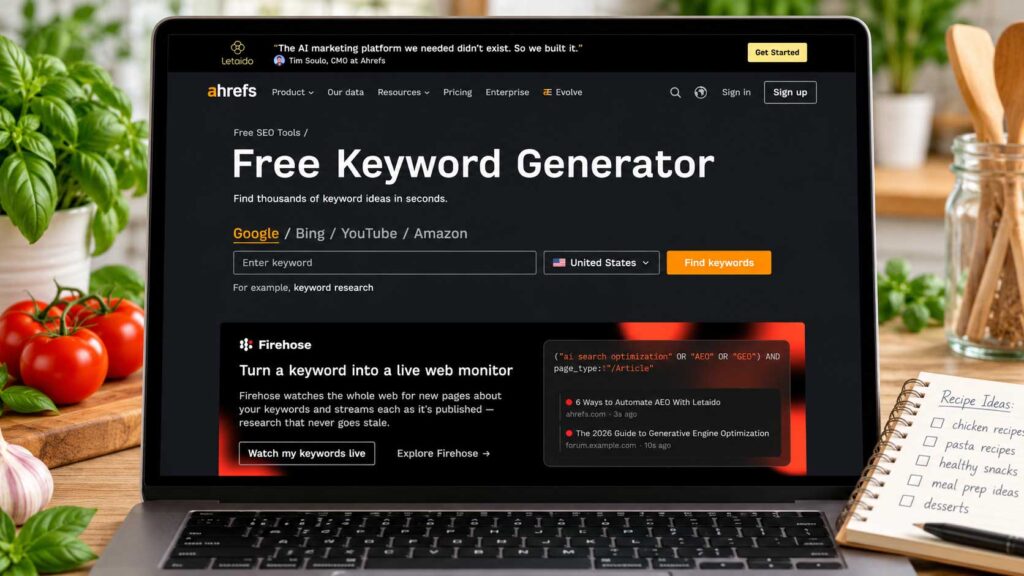
4. Ahrefs Free Keyword Generator — Best for Fast Long-Tail Keyword Discovery
Ahrefs Free Keyword Generator is a quick way to turn one broad food topic into a list of more specific search ideas.
That becomes especially handy with broad recipe terms that can branch into dozens of different variations.
Start with a seed keyword such as:
salmon recipes
and the tool can help you uncover related phrases, search suggestions, and question-based keywords around that topic. Ahrefs also provides estimated monthly search volume and other SEO metrics alongside many keyword ideas.
Turn Broad Topics Into Specific Recipe Ideas
Suppose you start with:
air fryer salmon
You may find related ideas such as:
- air fryer salmon bites
- air fryer frozen salmon
- air fryer salmon with skin
- air fryer salmon temperature
- air fryer salmon without oil
- how long to cook salmon in air fryer
These searches are much more specific than simply targeting:
salmon
or:
salmon recipes
That makes it easier to understand what kind of content the searcher is looking for.
Look for Long-Tail Keywords
Long-tail keywords can be especially useful for newer or smaller food blogs because they often have clearer intent.
Instead of immediately targeting:
chocolate cake
you might find more focused opportunities such as:
chocolate cake without eggs
chocolate cake with coffee
easy chocolate cake for beginners
small chocolate cake for two
These phrases can give you a much stronger angle for the recipe.
They are not automatically easy to rank for, but they are usually easier to evaluate because the search intent is more specific.
Use Question Keywords for Supporting Content
Ahrefs includes a Questions report, which can help you find searches related to ingredients, cooking techniques, storage, and substitutions.
For example, around:
avocado
you might find searches such as:
- can you freeze avocado
- how long does avocado last
- how to keep avocado from turning brown
- can you cook avocado
- how to ripen avocado faster
These questions can work well as:
- standalone informational posts
- FAQ sections
- supporting articles
- internal-link opportunities
For a food blog, this type of content can strengthen the broader topic around an ingredient.
Build Recipe Clusters From Keyword Ideas
One of the best ways to use Ahrefs is to group related keywords instead of treating every phrase as a separate idea.
For example, if you research:
overnight oats
you may uncover searches around:
- overnight oats with yogurt
- overnight oats without yogurt
- high protein overnight oats
- overnight oats with chia seeds
- chocolate overnight oats
- strawberry overnight oats
These could become part of a larger overnight oats cluster.
You might have a broader guide such as:
How to Make Overnight Oats
and then link to more specific recipes underneath it.
That creates a stronger site structure than publishing isolated posts with no connection between them.
Use Search Volume as a Guide, Not a Decision
Ahrefs provides estimated local and global monthly search volume, but search volume should not decide what you publish by itself.
A lower-volume keyword may still be valuable if:
- the intent is very clear
- the topic fits your niche
- the search results are not overly competitive
- the article supports an existing content cluster
- the page could rank for many related variations
For example:
red lentil soup without coconut milk
may have lower search volume than:
lentil soup
but it could be a better opportunity if the search intent is specific and the competing results are weaker.
Check the Actual Google Results
After finding a promising keyword, search it manually.
Look at the first page and ask:
- Are the results dominated by major publishers?
- Are independent food blogs ranking?
- Do the top pages match the keyword closely?
- Are some results outdated or incomplete?
- Is the intent clearly recipe-focused or informational?
- Do the current results leave an important question unanswered?
No keyword metric can completely replace this step.
Ahrefs also has a separate free SERP Checker if you want another way to inspect the top-ranking pages and SEO metrics.
Use Ahrefs for Supporting Content Too
Keyword research does not have to focus only on recipes.
You may also uncover topics such as:
how to store fresh basil
how long does cooked rice last
what to serve with salmon
can you freeze soup
best substitute for buttermilk
These informational articles can bring in search traffic and link naturally to related recipes.
For example, an article about:
What to Serve With Salmon
could link to several salmon recipes already on your site.
Best Ahrefs Workflow for Food Bloggers
A simple process is:
- Enter a broad recipe, ingredient, or cooking topic.
- Review related keywords, search suggestions, and questions.
- Look for more specific long-tail variations.
- Compare estimated search volume and available SEO metrics.
- Group similar keywords by search intent.
- Separate recipe ideas from informational topics.
- Check promising keywords manually in Google.
- Add the strongest ideas to existing content clusters.
- Build internal links between related articles.
Best For
Finding long-tail recipe keywords, ingredient questions, supporting content ideas, and new topics to expand an existing food category.
Ahrefs is most useful when you already know the broad topic you want to cover and need help finding more specific keyword opportunities around it.
The free tools are intentionally limited compared with a paid Ahrefs account, but they are still useful for initial keyword discovery and quick research.
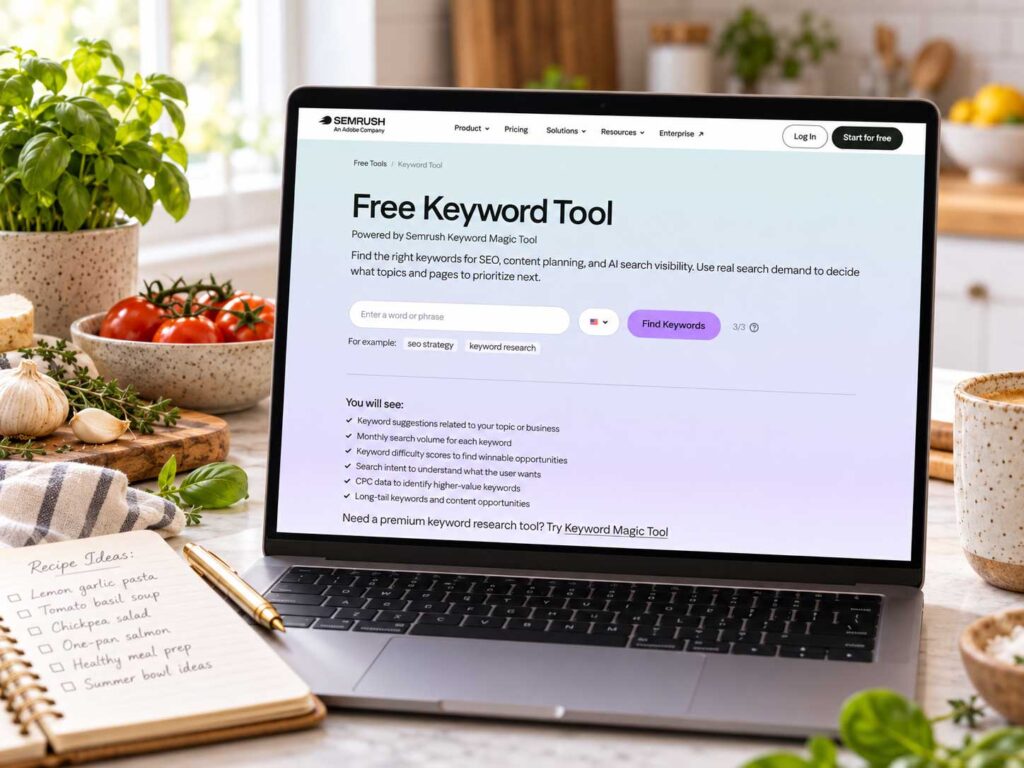
5. Semrush Keyword Magic Tool — Best for Keyword Clusters and Content Expansion
Semrush Keyword Magic Tool goes further than a basic keyword generator by organizing related searches, long-tail variations, questions, and subtopics around one seed keyword.
That structure is particularly helpful when you are planning a group of related recipes instead of researching one keyword at a time.
You can start with a seed keyword such as:
chicken soup
and Semrush can organize related searches into topic-based groups while also showing metrics such as search volume, keyword difficulty, intent, and CPC.
Turn One Recipe Idea Into a Larger Content Cluster
Suppose you begin with:
chicken soup
You may uncover related searches such as:
- chicken noodle soup
- creamy chicken soup
- chicken rice soup
- chicken soup with vegetables
- slow cooker chicken soup
- Instant Pot chicken soup
- chicken soup without noodles
- gluten-free chicken soup
Instead of treating these as unrelated keywords, you can organize them into a broader content cluster.
For example:
Main Topic: Chicken Soup Recipes
Supporting recipes:
- Homemade Chicken Noodle Soup
- Creamy Chicken Soup
- Chicken and Rice Soup
- Slow Cooker Chicken Soup
- Instant Pot Chicken Soup
- Gluten-Free Chicken Soup
This gives your site deeper coverage of the topic and creates natural internal-linking opportunities.
Use Keyword Groups to Find Related Topics
One useful feature of Keyword Magic Tool is its topic grouping.
Semrush organizes related keywords into groups and subgroups, which can make it easier to see how a broad topic breaks into smaller content ideas.
For a food blogger, that can help separate:
- recipe variations
- cooking methods
- ingredient substitutions
- dietary versions
- informational questions
Instead of working from one long list of keywords, you can start seeing how those searches fit together.
Use Keyword Modifiers to Find Better Ideas
You can also narrow your research with modifiers that reveal what the searcher actually wants.
Useful modifiers include:
- easy
- healthy
- quick
- homemade
- high protein
- low carb
- gluten free
- dairy free
- without
- with
- air fryer
- slow cooker
- Instant Pot
- oven
- for beginners
For example, a broad keyword such as:
pancakes
can become:
healthy pancakes
pancakes without milk
high-protein pancakes
banana pancakes without flour
easy pancakes for beginners
These phrases give you a much clearer idea of the recipe or content angle.
Pay Attention to Search Intent
Semrush labels keywords by search intent, which can help you understand what type of content a searcher is likely looking for.
For food blogs, common intent types include:
Recipe or informational intent
Example:
easy homemade tomato soup
The searcher likely wants a recipe.
Informational intent
Example:
easy homemade tomato soup
The searcher likely wants a recipe or instructions for making tomato soup.
Another informational query might be:
how long does tomato soup last in the fridge
Here, the searcher wants a direct answer rather than a full recipe.
Commercial intent
Example:
best blender for soup
The searcher is likely comparing products before buying.
Semrush also uses navigational and transactional intent labels, although those are usually less important for traditional recipe content.
Find Content Gaps Within Existing Topics
Semrush can also help you see where an existing content cluster is incomplete.
Imagine your food blog already has:
- classic hummus
- roasted red pepper hummus
- garlic hummus
Keyword research may reveal additional ideas such as:
- hummus without tahini
- spicy hummus
- avocado hummus
- beet hummus
- hummus with Greek yogurt
Now you have a clearer roadmap for expanding that topic instead of publishing random recipes.
Use Question Keywords for Supporting Content
Keyword Magic Tool includes a question filter, which makes it easier to isolate searches written as questions.
For example, research around:
rice
may uncover questions such as:
- how long does cooked rice last
- can you freeze cooked rice
- how much water for one cup of rice
- why is my rice sticky
- how to reheat rice
Some of these may deserve standalone posts.
Others may fit naturally into an existing guide or FAQ section.
For example:
How Long Does Cooked Rice Last?
could link naturally to recipes such as:
Chicken Fried Rice
Rice Pudding
Mediterranean Rice Bowls
That creates a stronger internal-linking structure around the topic.
Check SERP Features Too
Semrush can also show which search-result features appear for a keyword, including features such as People Also Ask, videos, and AI Overviews.
That can help you understand what the search results actually look like before you decide to target a phrase.
For food bloggers, this can be useful when a keyword triggers:
- recipe-rich results
- video-heavy results
- People Also Ask boxes
- image-heavy SERPs
It gives you another layer of context beyond search volume and difficulty.
Don’t Rely Too Heavily on Keyword Difficulty
Semrush provides keyword difficulty scores, which can be useful for comparing opportunities.
But a difficulty score should not make the final decision for you.
Always check the actual search results.
A keyword with a moderate score may still be dominated by:
- major recipe publishers
- large media companies
- authoritative health websites
- established food brands
On the other hand, a keyword with modest search volume may have several smaller blogs ranking on page one.
That can sometimes be a more realistic opportunity.
Example: Building a Strawberry Content Cluster
Start with:
strawberry recipes
You might eventually build:
Recipes
- Strawberry Smoothie
- Strawberry Banana Smoothie
- Strawberry Muffins
- Strawberry Cake
- Strawberry Cheesecake
- Strawberry Salad
Supporting Content
- How to Store Strawberries
- How to Freeze Strawberries
- How to Keep Strawberries Fresh Longer
- What to Make With Overripe Strawberries
Now the keyword research is helping you build an entire section of your site rather than just one article.
Best Semrush Workflow for Food Bloggers
A simple process is:
- Enter a broad recipe, ingredient, or cooking topic.
- Review keyword groups and subgroups.
- Look for long-tail variations.
- Filter ideas using modifiers such as easy, healthy, without, or specific cooking methods.
- Compare search volume, intent, and keyword difficulty.
- Review question-based searches.
- Check relevant SERP features.
- Group related keywords into content clusters.
- Check the actual Google results for your strongest candidates.
- Add internal links between related recipes and guides.
Free Access Limits
Semrush currently allows limited Keyword Magic Tool use without the full SEO Toolkit.
According to Semrush, users without the SEO Toolkit can run up to 10 reports per day, with 10 results displayed per report. Exporting results and some advanced features are reserved for paid plans.
That is enough for quick research, but larger food blogs will run into the limits fairly quickly.
Best For
Building recipe clusters, expanding existing categories, finding long-tail keywords, and discovering supporting informational content.
Semrush is most useful when you use it to understand how related keywords fit together rather than simply choosing whichever phrase shows the largest search volume.

6. AnswerThePublic – Best for Questions and Long-Tail Food Blog Topics
AnswerThePublic takes a different approach from a traditional keyword tool. Instead of starting with a long spreadsheet of metrics, it helps uncover the questions, comparisons, and specific searches people make around food topics.
For food bloggers, that makes it a strong brainstorming tool when you already know the broad topic but want to understand the smaller questions surrounding it.
Start with a simple term such as:
avocado
and you may uncover searches around:
- how to ripen avocado
- how to store avocado
- can you freeze avocado
- how to keep avocado from turning brown
- can you cook avocado
AnswerThePublic currently organizes ideas into sections such as Questions, Comparisons, Prepositions, Alphabeticals, Numbers, and Related searches, which makes it easier to explore a topic from several angles.
Why Question Keywords Matter
A recipe page often has to answer more than just:
How do I make this?
Someone looking for a guacamole recipe may also want to know:
- how long guacamole lasts
- whether guacamole can be frozen
- how to keep guacamole green
- what to serve with guacamole
- whether it can be made ahead of time
Answering those questions can make the article more useful and help you cover more of the searcher’s intent.
Use Questions to Improve Existing Recipes
Suppose you already have a recipe for:
Greek Yogurt Pancakes
Question research may reveal topics such as:
- can you make pancakes with Greek yogurt
- can you freeze Greek yogurt pancakes
- why are my pancakes dense
- what can I substitute for Greek yogurt
- can I make the batter ahead of time
You do not necessarily need a separate article for every question.
Some belong naturally inside the existing recipe.
Others may be broad enough to justify their own supporting post.
Look for “Without” and Substitution Keywords
Food searches often include missing ingredients, dietary needs, or substitution problems.
Examples include:
- pancakes without milk
- banana bread without eggs
- smoothie without yogurt
- cookies without brown sugar
- pesto without pine nuts
These searches can be valuable because the reader has a very specific problem to solve.
A useful article should explain not only what substitute works, but also what changes in:
- texture
- flavor
- consistency
- cooking time
- storage
That can make the content more helpful than a recipe that simply swaps one ingredient and moves on.
Find Comparison Topics
AnswerThePublic also has a Comparisons section, which can surface searches built around terms such as vs, versus, and or.
For food bloggers, that can lead to topics such as:
Greek yogurt vs regular yogurt
baking soda vs baking powder
olive oil vs avocado oil
air fryer vs oven
These can work well as supporting informational posts.
For example, an article about:
Baking Soda vs Baking Powder
could link naturally to several baking recipes that explain when each ingredient is used.
Use Prepositions to Find More Specific Ideas
The Prepositions section can also reveal useful long-tail variations built around words such as:
with
without
for
to
For food bloggers, some of the most useful combinations are:
with
Example: oatmeal with Greek yogurt
without
Example: banana bread without butter
for
Example: healthy breakfast for kids
These modifiers can reveal much more specific content ideas than the original broad keyword.
Check Related and Alphabetical Ideas Too
Do not stop at the question section.
AnswerThePublic also surfaces Related and Alphabetical ideas, which can help you find keyword variations you may not think of manually.
For example, starting with:
basil
you might discover ideas around:
- storing basil
- freezing basil
- basil substitutions
- basil recipes
- basil with pasta
- basil for pesto
Some may become full articles, while others may fit better as sections within existing posts.
Build FAQ Sections Carefully
Question keywords are useful, but that does not mean every article needs a huge FAQ section.
Only include questions that genuinely help the reader.
For example, a soup recipe might reasonably answer:
- How long will it keep?
- Can it be frozen?
- Can I make it ahead?
- What can I use instead of cream?
Unrelated questions added only for SEO can make the page feel bloated.
The goal is to improve the article, not just add more words.
Example: Turning One Ingredient Into Multiple Articles
Start with:
basil
Question research might lead to ideas such as:
How to Store Fresh Basil
Can You Freeze Basil?
How to Dry Basil at Home
What Can You Substitute for Basil?
Why Is My Basil Turning Black?
What to Make With Fresh Basil
Those articles can then link to related recipes such as:
- basil pesto
- tomato basil soup
- Caprese salad
- basil pasta
- basil dressing
That creates a stronger topic cluster around the ingredient.
Free Access Limits
AnswerThePublic still offers free research, but daily searches are limited.
Its paid plans add features such as more daily searches, historical comparisons, saved keyword lists, alerts, and CSV exports.
For occasional brainstorming, the free version can be enough.
If you are researching large content clusters or managing several sites, you may run into the free limits fairly quickly.
Best AnswerThePublic Workflow for Food Bloggers
A simple process is:
- Enter a broad recipe, ingredient, or cooking topic.
- Review the Questions section first.
- Check Comparisons, Prepositions, and Related ideas.
- Look for searches using how, can, what, why, with, and without.
- Separate recipe ideas from informational questions.
- Add genuinely useful questions to existing posts.
- Turn broader questions into standalone supporting articles.
- Validate the strongest ideas with Google Search or another keyword tool.
- Link related informational posts back to your main recipes.
Best For
Finding food-related questions, substitution searches, comparison topics, FAQ ideas, and supporting informational content.
AnswerThePublic is most useful when you already know your main topic and want to understand the questions and variations surrounding it.
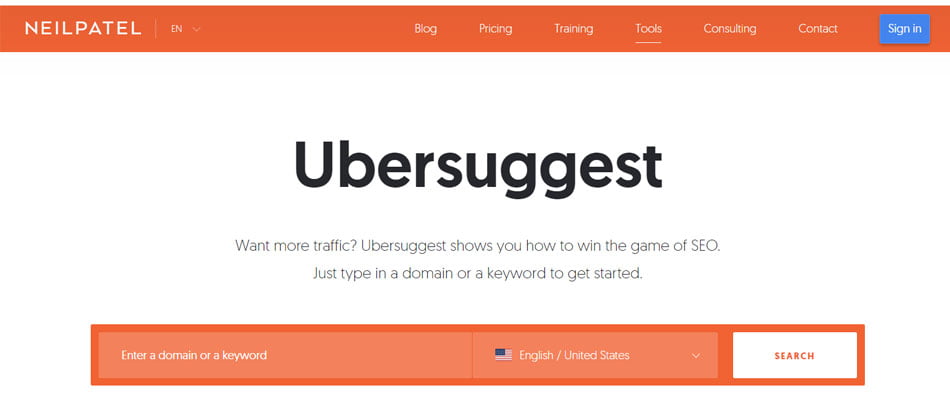
7. Ubersuggest — Best Beginner-Friendly All-in-One Keyword Tool
Ubersuggest brings several basic SEO research features into one relatively simple interface, including keyword ideas, estimated search demand, SEO difficulty, search intent, and competitor data.
It is useful if you want one platform that combines several keyword research and competitor-analysis features without feeling as complex as some larger SEO suites.
Start With a Broad Recipe Keyword
Suppose you enter:
healthy breakfast
Ubersuggest may surface more specific ideas such as:
- healthy breakfast ideas
- healthy breakfast without eggs
- high-protein breakfast
- healthy breakfast meal prep
- easy healthy breakfast
- healthy breakfast for kids
These variations can help you move from a broad topic to more focused content ideas.
Ubersuggest’s keyword tools currently include areas such as Autocomplete, Related, Questions, Prepositions, Comparisons, search volume, intent, SEO difficulty, and CPC, which gives you several ways to expand one seed topic.
Use Long-Tail Keywords to Clarify Search Intent
Broad keywords can look attractive because they often have higher search volume.
But they can also be vague and highly competitive.
For example:
smoothie
could mean almost anything.
A more specific phrase such as:
high-protein strawberry smoothie without banana
tells you much more about what the reader is looking for.
That makes it easier to create a recipe that closely matches the search intent.
Compare Search Volume, Trends, and SEO Difficulty
Ubersuggest provides estimated search volume, SEO difficulty, and trend data that can help you compare several keyword ideas quickly.
For example, you might research:
lentil soup
and compare variations such as:
- red lentil soup
- Mediterranean lentil soup
- lentil soup with spinach
- lentil soup without tomatoes
- slow cooker lentil soup
Search volume can help you understand demand, while SEO difficulty can give you a rough sense of how competitive a keyword may be.
Neither metric should make the decision by itself.
A lower-volume keyword may still be more useful if it has clearer intent, weaker competition, and stronger relevance to your existing content.
Check Search Intent
Ubersuggest now includes search-intent data, which can help you understand whether a query is more likely to be informational, commercial, navigational, or transactional.
For food bloggers, that can help separate:
Recipe intent
Example: easy lentil soup
Informational intent
Example: how long does lentil soup last
Commercial intent
Example: best Dutch oven for soup
Understanding intent helps you decide whether a keyword should become a recipe, informational guide, or affiliate-focused article.
Check the Actual Search Results
Ubersuggest’s difficulty score can be a helpful starting point, but always inspect Google manually before publishing.
Look at:
- which sites are ranking
- whether smaller food blogs appear
- whether the top pages closely match the query
- whether the SERP is dominated by major publishers
- whether the existing content looks outdated or incomplete
Ubersuggest also provides SERP-related data, but looking at the live search results yourself gives you useful context that a single difficulty number cannot.
Use Competitor Research for Content Ideas
Ubersuggest can also help you explore the keywords and pages driving traffic to competing websites.
Its current competitor tools can show estimated visits, ranking positions, search volume, SEO difficulty, and keyword coverage for a domain or page.
That can reveal topics you may have overlooked.
For example, you might notice that competing food blogs are getting traffic from topics such as:
- air fryer vegetables
- cottage cheese recipes
- high-protein smoothies
- freezer-friendly meals
- easy meal-prep lunches
The goal is not to copy another site’s content.
Instead, competitor research can help you identify broader topics that are already attracting search demand and decide whether they also make sense for your audience.
Find Supporting Content Around Ingredients
Ubersuggest can also help you uncover informational keywords that support your recipes.
Suppose you publish several zucchini recipes.
You might find opportunities such as:
how to freeze zucchini
how long does zucchini last
how to store zucchini
can you eat zucchini raw
how to tell if zucchini is bad
These articles can bring in informational traffic while also linking naturally to your zucchini recipes.
That helps strengthen the topic as a whole.
Use Ubersuggest for Content Refreshes
Keyword research can also help improve posts you already have.
Imagine you published:
Easy Homemade Hummus
and later discover searches such as:
- hummus without tahini
- hummus with canned chickpeas
- how to make hummus creamy
- why is my hummus bitter
- how long does homemade hummus last
You may not need a separate article for every query.
Some of these could strengthen the existing recipe through substitutions, troubleshooting, storage tips, and FAQs.
Example: Researching a Smoothie Cluster
Start with:
protein smoothie
You might uncover opportunities around:
- strawberry protein smoothie
- chocolate protein smoothie
- banana protein smoothie
- protein smoothie without protein powder
- high-protein smoothie for breakfast
- protein smoothie without banana
- Greek yogurt protein smoothie
Some of these may deserve individual recipes.
You could also create a broader hub such as:
Best High-Protein Smoothie Recipes
and link to the individual recipes underneath it.
Free Access Limits
Ubersuggest still offers free access, but it is limited.
The current interface states that unregistered users get a very small number of searches, while creating a free account provides 3 daily searches along with additional keyword suggestions and some tracking features.
That can be enough for occasional keyword research, but if you are researching several food sites or large content clusters, you will likely reach the free limits quickly.
Best Ubersuggest Workflow for Food Bloggers
A simple process is:
- Enter a broad recipe, ingredient, or meal keyword.
- Review autocomplete, related, and question-based ideas.
- Compare estimated search volume and trends.
- Look for long-tail variations with clear intent.
- Use SEO difficulty as a rough comparison, not a final answer.
- Check the actual Google search results.
- Explore competitor keywords and pages for content gaps.
- Group related ideas into recipe clusters.
- Use supporting informational posts to strengthen those clusters.
Best For
Beginner food bloggers who want keyword ideas, basic competition data, search intent, and competitor research in one relatively simple platform.
Ubersuggest works best as a discovery and comparison tool. Use it to generate ideas and identify patterns, then validate the strongest keywords with Google Search and your own content strategy.

8. Keyword Tool — Best for Autocomplete and Long-Tail Recipe Keywords
Keyword Tool is strongest at one thing: taking a seed phrase and expanding it into a large collection of autocomplete-based searches.
It works well when you already know the main topic but want to uncover the different ways people phrase more specific searches around it.
Start with a keyword such as:
banana bread
and you may uncover variations around:
- banana bread without butter
- banana bread without eggs
- banana bread with yogurt
- banana bread with chocolate chips
- banana bread with two bananas
- banana bread in air fryer
- banana bread without baking soda
These ideas can reveal specific recipe angles that may be easier to build useful content around than the broad parent keyword.
Why Autocomplete Keywords Are Useful
Autocomplete-style keywords can reveal very specific search needs.
Compare:
banana bread
with:
banana bread without butter
The second phrase tells you much more about what the searcher expects.
The same pattern appears across food blogging:
smoothie
becomes
smoothie without banana
pasta recipe
becomes
creamy pasta without heavy cream
cookies
becomes
chocolate chip cookies without brown sugar
Specific searches like these can help you create content that matches search intent more closely.
Use It to Expand Broad Topics
KeywordTool.io can take one broad seed keyword and generate hundreds of related suggestions from autocomplete data. Its current free Google tool can return up to hundreds of suggestions without requiring a paid account.
For example, if you start with:
chicken soup
you may find searches built around:
- chicken soup with rice
- chicken soup without noodles
- chicken soup in slow cooker
- chicken soup with vegetables
- chicken soup with potatoes
This makes it useful when you have already covered the obvious recipe ideas and want more specific angles.
Look for “Without” Keywords
Food bloggers should pay special attention to searches containing without.
These often represent a clear problem the reader needs solved.
Examples include:
- brownies without eggs
- pancakes without milk
- pesto without pine nuts
- cheesecake without sour cream
- smoothie without yogurt
- banana bread without butter
These can be strong recipe opportunities because the searcher is usually looking for a workable substitution.
A useful article should explain:
- what ingredient replaces the original
- how the texture changes
- whether the flavor changes
- whether cooking time needs adjustment
- whether storage changes
That makes the article more useful than simply swapping one ingredient.
Find “With” Keywords Too
The opposite can also uncover useful ideas.
Examples include:
oatmeal with Greek yogurt
chicken with spinach
pasta with cottage cheese
smoothie with chia seeds
salmon with honey
These searches can reveal ingredient combinations that deserve standalone recipes or supporting sections inside existing posts.
Use Alphabetical Variations for More Ideas
KeywordTool.io generates long-tail suggestions partly by adding letters and numbers around your seed phrase and collecting autocomplete results.
That means you do not have to manually type:
chicken pasta a
chicken pasta b
chicken pasta c
one by one.
You can still use the same logic when reviewing results by looking for useful modifiers such as:
- easy
- healthy
- quick
- with
- without
- for
- air fryer
- slow cooker
- high protein
- gluten free
This can quickly turn one seed keyword into a much larger pool of content ideas.
Research More Than Google
One of the strongest features of KeywordTool.io is that it is not limited to Google.
It currently supports keyword research across 16 platforms, including:
- YouTube
- Bing
- TikTok
- Amazon
- Perplexity
- X
- Etsy
and several others.
For food bloggers, Pinterest, YouTube, TikTok, and Google can be especially useful because the same recipe may have different search behavior on each platform.
For example, a keyword that looks modest in Google may still be useful for:
- Pinterest pins
- recipe videos
- short-form social content
- YouTube tutorials
That makes KeywordTool.io useful for broader content planning, not just traditional SEO.
Use KeywordTool.io to Expand Existing Recipes
You do not always need to create a new article for every phrase you find.
Suppose you already have:
Classic Tomato Soup
Keyword research might uncover:
- tomato soup with fresh tomatoes
- tomato soup without cream
- tomato soup with basil
- tomato soup with canned tomatoes
- tomato soup with grilled cheese
Some of these may fit naturally into the existing recipe as:
- substitutions
- variations
- serving suggestions
- FAQs
Others may represent sufficiently different intent to justify separate posts.
Avoid Keyword Cannibalization
Autocomplete tools can generate many phrases that look different but mean almost the same thing.
For example:
banana smoothie without yogurt
and
banana smoothie no yogurt
probably do not need separate articles.
They likely represent the same search intent.
Before creating multiple posts, ask:
Would the searcher expect meaningfully different content for these two phrases?
If the answer is no, they probably belong on the same page.
Free vs Paid Access
The free version is strongest for keyword idea generation.
Keyword Tool Pro adds more complete data such as:
- search volume
- CPC
- advertising competition
- historical trends
- bulk analysis
- exports
The company also offers partial search-volume data to free users in some tools, but full metrics require Pro access.
That means you can use the free version to discover ideas and then validate the strongest ones with:
- Google Keyword Planner
- Google Trends
- Google Search
- Google Search Console
Example: Building a Pasta Keyword Cluster
Start with:
pasta
Then expand the topic into several directions.
Cooking method
- one-pot pasta
- baked pasta
- slow cooker pasta
Ingredient
- pasta with spinach
- pasta with chicken
- pasta with mushrooms
Restriction
- pasta without cream
- pasta without cheese
- gluten-free pasta recipe
Need or occasion
- quick pasta dinner
- pasta for meal prep
- pasta for a crowd
Now you have the beginnings of a structured pasta content cluster rather than a random collection of posts.
Best KeywordTool.io Workflow for Food Bloggers
A simple process is:
- Enter a broad recipe or ingredient keyword.
- Review autocomplete-style variations.
- Pay attention to modifiers such as with, without, easy, and cooking methods.
- Check other relevant platforms such as Pinterest or YouTube.
- Save phrases with clearly different intent.
- Group near-duplicate keywords together.
- Decide which ideas deserve standalone recipes.
- Use smaller variations as headings, FAQs, or recipe variations.
- Validate the strongest ideas with Google Search, Trends, or another keyword tool.
Best For
Finding autocomplete-based keyword ideas, long-tail recipe variations, substitution searches, and content ideas across multiple search platforms.
KeywordTool.io is especially useful when you already know the broad topic and need help uncovering the many different ways people may search for it.
9. Bing Webmaster Tools — Best for Additional First-Party Search Data
Bing Webmaster Tools tends to get far less attention than Google Search Console, but it provides another source of first-party search data worth checking.
Like Google Search Console, it can show which queries and pages are generating impressions and clicks. Bing’s Search Performance report also includes visibility from Web and Chat, along with metrics such as clicks, impressions, CTR, average position, crawl requests, crawl errors, and indexed pages.
It will not replace Google Search Console, but it can add another layer of information when you are researching keywords or deciding which older posts to improve.
Why Food Bloggers Should Check Bing Too
Most food bloggers focus heavily on Google, which makes sense because Google is usually the primary search engine they optimize for.
But Bing has its own search audience, and your content may perform differently there.
A recipe that has modest visibility in Google could perform better in Bing, or vice versa.
That makes Bing Webmaster Tools useful for spotting additional opportunities you might otherwise miss.
Find Queries You Already Appear For
One of the best uses of Bing Webmaster Tools is finding searches where your content is already appearing.
Its Search Performance report shows organic keywords along with metrics such as:
- impressions
- clicks
- average CTR
- average position
You can also click a keyword to see which pages from your site appeared for it, or start with a page and see the associated queries.
Suppose you have a recipe for:
Easy Broccoli Cheddar Soup
You may discover related queries such as:
- broccoli cheddar soup without flour
- broccoli cheese soup with milk
- homemade broccoli cheddar soup
- easy broccoli soup
- broccoli cheddar soup for two
Those searches can help you improve the existing article.
You might add:
- ingredient substitutions
- serving-size notes
- storage instructions
- freezing tips
- troubleshooting
- related internal links
You may also discover a query that deserves its own article if the search intent is clearly different.
Compare Bing and Google Search Data
A useful strategy is to compare what you see in:
Google Search Console
and
Bing Webmaster Tools
The same article may perform differently across the two search engines.
For example:
| Recipe | Bing | |
|---|---|---|
| Air Fryer Chicken Breast | Strong visibility | Moderate visibility |
| Old-Fashioned Apple Cake | Moderate visibility | Strong visibility |
| Strawberry Smoothie | Strong visibility | Strong visibility |
| Lentil Soup | Limited visibility | Moderate visibility |
You do not need separate content for each search engine.
Instead, those differences can help you identify pages with broader search potential or content that may deserve another look.
Use Bing Data for Content Refreshes
Bing Webmaster Tools can also help you decide which older recipes deserve attention.
Look for pages that:
- receive impressions but few clicks
- appear for useful long-tail queries
- have lost visibility
- rank for topics that are only partially covered
Then review whether the page needs:
- a clearer title
- stronger recipe instructions
- better ingredient notes
- updated photos
- improved internal links
- better storage information
- more complete FAQs
This gives you another source of real search data for content updates.
Use the Keyword Research Tool
Bing Webmaster Tools includes a dedicated Keyword Research feature.
You can enter a root keyword and see:
- related keywords
- question keywords
- search volume
- search trends
- newly discovered terms
- country, language, and device filters
Bing also shows the top URLs appearing for the keyword and associated topics, which can help you understand what already ranks and discover additional ideas.
For a food blogger, that can be useful when researching:
- recipe topics
- ingredients
- long-tail keywords
- seasonal ideas
- cooking questions
It gives you another dataset to compare with Google Keyword Planner, Trends, and other SEO tools.
Check AI Search Visibility Too
Bing Webmaster Tools now also includes an AI Performance report.
This report can show which pages from your site are cited in AI-generated answers across supported Microsoft experiences, including Microsoft Copilot and AI-generated summaries in Bing. It also provides information about the queries associated with those citations.
For food bloggers, that adds another reason to create clear, useful supporting content around topics such as:
- ingredient substitutions
- cooking questions
- storage
- comparisons
- troubleshooting
Those types of pages may have value beyond traditional search-result clicks.
Check Technical SEO at the Same Time
Bing Webmaster Tools is not only a keyword research platform.
It also provides features related to:
- crawl and indexing data
- sitemaps
- backlinks
- SEO reports
- URL submission
- site scanning
The Site Scan tool can crawl your site and flag common technical SEO issues, while SEO Reports provide page-level recommendations.
That matters because strong keyword research will not help much if search engines cannot crawl or index your pages properly.
Use Bing Data to Expand Content Clusters
Suppose your food blog already has several potato recipes.
Bing may surface related searches around:
- crispy roasted potatoes
- mashed potatoes without milk
- air fryer potato wedges
- garlic potatoes
- baked potato toppings
- how to store cooked potatoes
Those ideas can help you decide whether to create:
- new recipes
- informational guides
- supporting cluster content
- FAQ sections
The value is not just the individual keyword. It is how that keyword fits into the larger topic you are building.
Best Bing Webmaster Tools Workflow for Food Bloggers
A simple process is:
- Add and verify your food blog.
- Submit your sitemap.
- Review Search Performance.
- Look for queries with impressions but weak clicks.
- Identify pages with room to improve.
- Compare Bing data with Google Search Console.
- Use Keyword Research to find related terms and questions.
- Check AI Performance for pages appearing in supported AI answers.
- Improve existing posts before creating unnecessary new ones.
- Review crawl, indexing, and Site Scan reports while you are there.
Best For
Food bloggers who want another source of first-party search data, keyword ideas, AI-search visibility, and content-refresh opportunities beyond Google.
Bing Webmaster Tools is not a replacement for Google Search Console, but it is a useful companion tool and can reveal search and content opportunities that may be less obvious in your Google data.
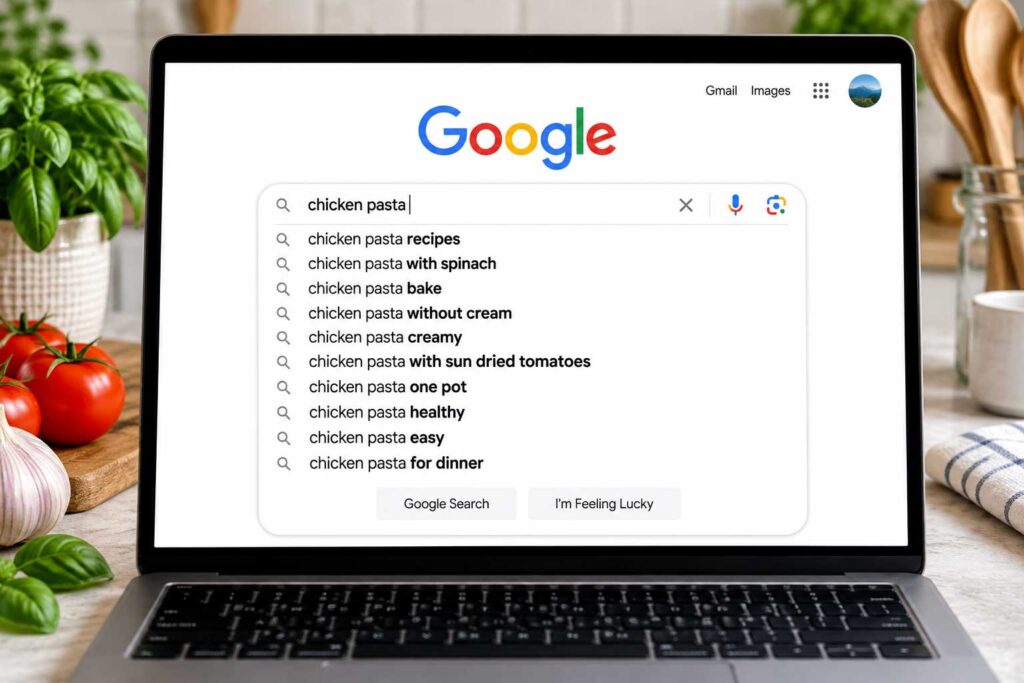
10. Google Autocomplete, People Also Ask & Related Searches — Best Completely Free Manual Keyword Research Method
Some of the most useful keyword research can be done directly inside Google without opening another SEO platform.
Google itself can be one of the most useful free keyword research tools for food bloggers because it shows how people phrase searches, what related questions appear around a topic, and which variations Google connects with the same general subject.
Three especially useful features are:
- Google Autocomplete
- People Also Ask
- Related Searches
Used together, they can uncover recipe ideas, long-tail keywords, FAQs, substitutions, and supporting content without requiring a paid SEO subscription.
Start With Google Autocomplete
Autocomplete is the list of suggested searches that appears while you type into Google.
For example, start typing:
banana bread
and you may see suggestions around:
- banana bread with chocolate chips
- banana bread without butter
- banana bread without eggs
- moist banana bread
- banana bread with two bananas
These suggestions can help you see how people refine a broad food topic.
Google says Autocomplete predictions are based partly on real searches, while also considering factors such as language, location, trending interest, and sometimes previous search activity.
That means Autocomplete is useful for idea generation, but it should not be treated as an exact ranking of the most popular keywords.
You can also add modifiers such as:
banana bread without
banana bread with
banana bread healthy
banana bread easy
banana bread air fryer
This can quickly turn one broad topic into several more specific content ideas.
Use the Alphabet Method
Another simple technique is to add letters after your seed keyword.
For example:
chicken pasta a
chicken pasta b
chicken pasta c
Different letters may surface different autocomplete suggestions.
You can also place modifiers before the main phrase:
easy chicken pasta
healthy chicken pasta
creamy chicken pasta
quick chicken pasta
high-protein chicken pasta
It is a simple way to expand a topic without opening another keyword tool.
Check People Also Ask
The People Also Ask section can reveal questions related to your main search.
For a topic such as:
how to make hummus
you may see questions around:
- how long homemade hummus lasts
- whether hummus can be frozen
- how to make hummus smoother
- whether tahini is necessary
- why hummus can taste bitter
These questions can help you understand what readers may want to know beyond the basic recipe.
Google can display featured snippets inside People Also Ask when it considers a short answer from a webpage useful for the question.
That makes People Also Ask a useful source of content ideas, but the presence of a question there does not necessarily mean it has high search volume.
Use People Also Ask to Improve Existing Recipes
Suppose you already have:
Homemade Tomato Soup
Relevant questions may include:
- Can tomato soup be frozen?
- How long does tomato soup last?
- Can tomato soup be made without cream?
- Why is my tomato soup acidic?
- What should I serve with tomato soup?
Those questions can become useful sections such as:
How to Store Tomato Soup
Can You Freeze It?
How to Reduce Acidity
What to Serve With Tomato Soup
That can make the article more useful without adding unrelated content just for SEO.
Review Related Searches
Google may also show related searches connected to your original query.
For example, searching:
air fryer chicken breast
might lead to related searches around:
- air fryer chicken thighs
- air fryer chicken tenders
- air fryer chicken without breading
- air fryer chicken temperature
- air fryer chicken cooking time
These ideas can help you decide whether a topic belongs inside one article or should become part of a larger recipe cluster.
Keep in mind that search results and related suggestions can vary based on factors such as location, language, and personalization.
Study the Search Results, Not Just the Keyword
One of the biggest advantages of manual Google research is that you can see the actual search results.
Before targeting a keyword, look at:
- what type of content ranks
- whether the results are recipes, guides, videos, or forums
- whether independent food blogs appear
- how closely the top pages match the query
- whether the results look outdated or incomplete
This can tell you far more than a single keyword difficulty score.
Google also uses related terms and concepts when matching pages to searches, so a strong page does not need to repeat the exact keyword everywhere to be relevant.
Look for Gaps in Existing Results
Suppose you search:
pancakes without milk
and notice that several top results:
- do not explain the best substitutes
- barely discuss texture changes
- have weak troubleshooting advice
- do not explain storage
- skip common mistakes
That does not guarantee you will rank.
But it does show you how you could create a more useful page.
You might include:
- which milk substitutes work best
- whether water can be used
- how substitutions affect flavor
- how to keep the pancakes soft
- how to store leftovers
That gives the reader something more complete than simply repeating what already exists.
Use Search Operators for Extra Research
Google search operators can also help with keyword and content planning.
For example:
intitle:"banana bread without butter"
can help you find pages that use that exact phrase in the title.
You can also search:
site:yourfoodblog.com banana
to find pages on your own site that already cover a similar topic.
That can help you avoid publishing overlapping content.
Use Google as the Final Validation Step
Google works best when combined with the other tools in this guide.
A simple process might look like this:
Step 1: Find a promising keyword with Ahrefs, Semrush, Ubersuggest, or KeywordTool.io.
Step 2: Check seasonality in Google Trends.
Step 3: Search the keyword manually.
Step 4: Review Autocomplete, People Also Ask, and Related Searches.
Step 5: Study the first-page results.
Now you are not choosing a keyword based on one metric.
You are looking at the full search landscape.
Example: Free Keyword Research for a Smoothie Article
Start with:
mango smoothie
Autocomplete may reveal:
- mango smoothie with yogurt
- mango smoothie without banana
- mango smoothie with milk
- mango protein smoothie
People Also Ask may surface questions around:
- whether frozen mango works
- what liquid is best
- how to make the smoothie thicker
- whether mango smoothies can be stored
Related Searches may point toward:
- mango banana smoothie
- mango pineapple smoothie
- healthy mango smoothie
- mango smoothie bowl
From one simple search, you now have:
- recipe variations
- FAQ ideas
- supporting content
- internal-link opportunities
- possible future articles
Best Google Keyword Research Workflow for Food Bloggers
A simple process is:
- Search your main recipe keyword.
- Record useful Autocomplete suggestions.
- Review People Also Ask.
- Check Related Searches.
- Study the top-ranking pages.
- Look for gaps in the existing content.
- Group similar keywords by intent.
- Decide whether each idea belongs in the current article or needs a separate page.
- Repeat the process with your strongest long-tail keywords.
Best For
Food bloggers who want completely free keyword ideas, FAQ opportunities, SERP research, and long-tail variations without paying for an SEO tool.
Even if you use a paid platform such as Ahrefs or Semrush, manual Google research is still worth doing because it shows you the actual search results your readers may be seeing.
How to Find Low-Competition Keywords for a Food Blog
Finding low-competition keywords is not about chasing phrases with the smallest search volume.
A better goal is to find searches with clear intent, realistic competition, and a natural fit with the content you already publish.
The strongest opportunities are often topics where the current results answer the basic question but still leave room for clearer instructions, better explanations, or a more specific recipe.
For food bloggers, these opportunities often appear in long-tail searches.
Compare:
chicken recipe
with:
creamy garlic chicken without heavy cream
The second phrase is much more specific.
It tells you:
- the main ingredient
- the flavor profile
- the type of dish
- an ingredient restriction
That makes it easier to create a recipe that closely matches what the searcher wants.
Look for Specific Recipe Modifiers
One of the easiest ways to find more focused opportunities is to combine a broad food keyword with a modifier.
Useful modifiers include:
Without
- banana bread without butter
- pancakes without milk
- pesto without pine nuts
With
- oatmeal with Greek yogurt
- pasta with cottage cheese
- chicken with spinach
Cooking method
- air fryer chicken thighs
- slow cooker lentil soup
- baked salmon in foil
Diet
- gluten-free banana muffins
- dairy-free mashed potatoes
- high-protein pancakes
Time
- 15-minute pasta dinner
- 30-minute chicken recipe
- quick breakfast before work
Serving size
- chocolate cake for two
- soup for one
- small-batch cookies
Occasion
- Christmas brunch ideas
- Easter side dishes
- summer picnic recipes
These modifiers often create clearer search intent than the broad parent keyword.
Search for Problems People Need Solved
Problem-based keywords can also be useful.
Examples include:
- why is my banana bread dry
- how to thicken soup without flour
- how to keep avocado from turning brown
- why is my hummus bitter
- how to make pancakes fluffy
- how to fix salty soup
These searches may have lower volume than major recipe keywords, but the reader usually has a very specific need.
They can also support your main recipe content through internal links.
Check Who Is Ranking
Before targeting a keyword, search it on Google.
Do not rely only on a keyword difficulty score.
Look at the actual pages ranking on page one.
Potentially encouraging signs include:
- smaller niche blogs appearing alongside larger publishers
- forum discussions ranking for part of the query
- thin or outdated pages
- results that only partly match the search intent
- weak instructions or missing details
More competitive SERPs may include:
- several major recipe publishers
- large media companies
- established food brands
- multiple strong pages that closely match the query
Seeing smaller sites in the results can be encouraging, but it does not automatically mean a keyword is easy.
The goal is to understand the overall strength and relevance of the pages already ranking.
Look for Search Intent Gaps
Sometimes the keyword itself looks competitive, but the current results do not fully satisfy the search.
Suppose you search:
protein smoothie without banana
and several top-ranking pages still rely on banana or barely address the restriction.
That may indicate an opportunity to create something more focused.
You could build the page around:
High-Protein Smoothie Without Banana
and include:
- thickening options
- protein choices
- flavor variations
- dairy-free substitutions
- storage tips
- common mistakes
That gives the searcher a page centered on the exact problem they are trying to solve.
Use Search Console to Find Existing Opportunities
If your site already receives impressions, Google Search Console can reveal keywords where your content is already appearing.
Look for queries where:
- your page already appears regularly
- impressions are growing
- clicks are still relatively low
- the query closely matches the page topic
Search Console does not tell you whether a keyword is objectively easy or difficult, but it can show where Google is already associating your content with a search.
Those queries are often worth reviewing before creating an entirely new post.
You may be able to strengthen an existing article by adding:
- a better section
- a clearer heading
- a more useful answer
- stronger internal links
Do Not Obsess Over Search Volume
A keyword with 100 searches per month can still be valuable.
One page rarely ranks for only one exact phrase.
For example, a post targeting:
banana bread without butter
may also appear for searches such as:
- no butter banana bread
- banana bread with oil
- easy banana bread without butter
- moist banana bread with oil
- what can replace butter in banana bread
The total traffic potential can be much larger than the volume shown for one keyword.
Prioritize Topical Relevance
A lower-competition keyword is usually more useful when it strengthens a topic you already cover.
If your site already has several smoothie recipes, then:
strawberry smoothie without banana
may be more strategically useful than an unrelated keyword about barbecue equipment.
The smoothie article can:
- link to existing smoothie recipes
- receive internal links from related posts
- strengthen your smoothie category
- match what your regular audience already expects
That makes topical relevance an important part of keyword selection.
Use a Simple Low-Competition Keyword Checklist
Before creating a new article, ask:
- Is the keyword specific?
- Is the search intent clear?
- Does the topic fit my existing content?
- Are some of the current results incomplete, outdated, or only partly relevant?
- Can I add clearer instructions, better examples, original experience, or information that is currently missing?
- Can the article link naturally to related posts?
- Does the keyword have useful long-tail variations?
- Is there enough demand to justify the work?
You do not need a perfect answer to every question.
The goal is to find a good balance between demand, intent, competition, and relevance.
Broad vs More Targeted Keywords
Instead of:
salmon recipe
consider:
air fryer salmon with skin
Instead of:
cookies
consider:
small-batch chocolate chip cookies without brown sugar
Instead of:
smoothie
consider:
high-protein strawberry smoothie without banana
Instead of:
soup
consider:
creamy tomato soup without heavy cream
More specific keywords often give you a clearer content angle and make it easier to match what the searcher actually wants.
How to Research a Recipe Keyword Step by Step
The easiest way to make keyword research useful is to turn it into a repeatable process.
Instead of opening several SEO tools and collecting hundreds of random phrases, start with one recipe idea and work through a few focused checks.
Here is an example using:
banana bread
Step 1: Start With the Broad Topic
Begin with your main idea:
banana bread
At this stage, do not worry about choosing the final keyword.
The goal is simply to understand the different ways people search around the topic.
Step 2: Check Google Autocomplete
Type the keyword into Google and look at the suggestions.
You may see ideas such as:
- banana bread without butter
- banana bread with chocolate chips
- banana bread with yogurt
- banana bread without eggs
- banana bread with two bananas
You can also test modifiers such as:
banana bread without
banana bread with
banana bread healthy
banana bread easy
banana bread air fryer
This quickly expands one broad topic into several possible angles.
Step 3: Check Search Demand
Next, use one of the keyword tools from this guide, such as:
- Google Keyword Planner
- Ahrefs Free Keyword Generator
- Semrush
- Ubersuggest
Compare the different variations.
You are not necessarily looking for the biggest number.
Instead, look for a balance between:
- meaningful demand
- clear intent
- relevance to your site
- realistic competition
For example:
banana bread
may have much higher search demand, but it is also broad and likely to attract stronger competition.
A phrase such as:
banana bread without butter
may have lower volume but gives you a much clearer recipe angle.
Step 4: Check Google Trends
Now look at how interest changes over time.
Search:
banana bread
and compare it with related topics such as:
pumpkin bread
or:
zucchini bread
This can help you understand whether the topic has fairly steady interest or stronger seasonal peaks.
For seasonal recipes, look at several years of history instead of only recent weeks.
Step 5: Study the Actual Search Results
Search your strongest keyword manually.
Suppose you are considering:
banana bread without butter
Look closely at the first page.
Ask:
- Are the results mostly recipes?
- Are smaller food blogs appearing?
- Do the top pages match the query closely?
- Are there outdated or incomplete results?
- Do the recipes explain substitutions clearly?
- Is the SERP dominated by videos, forums, or large publishers?
This helps you understand what type of content is currently satisfying that search and where there may be room to offer something more useful.
Step 6: Review People Also Ask
Look at the related questions around the topic.
For a banana bread recipe, you may see questions about:
- what can replace butter
- whether oil works instead
- why banana bread turns out dry
- how ripe the bananas should be
- how long banana bread lasts
These questions can help you plan useful sections before you start writing.
Not every question needs its own heading, but the most relevant ones can help make the finished recipe more complete.
Step 7: Decide Whether Similar Keywords Need Separate Posts
This is where food blogs can accidentally create unnecessary overlap.
Imagine your research finds:
banana bread without butter
banana bread with oil
no butter banana bread
These phrases may represent essentially the same search need.
In that case, one strong article can usually cover all three naturally.
However:
banana bread without eggs
may require a meaningfully different recipe and could deserve its own page.
A useful question to ask is:
Would someone searching these phrases expect substantially different content?
If yes, separate articles may make sense.
If no, they are usually better handled on the same page.
Step 8: Choose the Primary Keyword
After reviewing demand, intent, trends, and competition, choose one primary keyword.
For example:
banana bread without butter
Then identify a few closely related variations, such as:
- no butter banana bread
- banana bread with oil
- moist banana bread without butter
- easy banana bread without butter
You do not need to force every variation into the article.
Use them naturally where they fit.
Step 9: Build the Article Around What the Reader Needs
For:
banana bread without butter
you might include:
- why oil works as a butter substitute
- which oils work best
- exact substitution amounts
- how to keep the loaf moist
- common mistakes
- storage instructions
- freezing instructions
- optional add-ins
That is far more useful than simply repeating the target keyword throughout the page.
Step 10: Add Internal Links
Before publishing, identify related content on your site.
For a banana bread article, you might link to:
- chocolate chip banana bread
- banana muffins
- healthy banana recipes
- how to freeze bananas
- breakfast recipes
You should also add links from relevant older posts back to the new article where it makes sense.
This helps readers move between related content and strengthens the connection between those pages.
Step 11: Publish, Then Use Search Console
Keyword research does not end when the article goes live.
Once the page starts receiving impressions, use Google Search Console to see which queries are triggering it.
You may discover unexpected searches such as:
- banana bread with vegetable oil
- banana bread no butter no milk
- banana bread using olive oil
- moist banana bread with two bananas
Those queries can help you decide whether the article needs:
- a new subsection
- a clearer answer
- stronger internal links
- an improved title
- a future supporting post
A Simple Recipe Keyword Research Workflow
Your full process can look like this:
Idea
→ Google Autocomplete
→ Keyword Tool
→ Google Trends
→ SERP Review
→ People Also Ask
→ Choose Primary Keyword
→ Build Around Reader Intent
→ Add Internal Links
→ Publish
→ Review Search Console Data
This process is simple enough to repeat for almost every recipe you plan to publish.
More importantly, it helps you choose topics using actual search behavior instead of guessing what people might want.
What Keyword Metrics Should Food Bloggers Actually Look At?
Keyword tools can show dozens of metrics, but food bloggers do not need to obsess over every number.
The most useful metrics are the ones that help answer a few practical questions:
Do people search for this?
Does the keyword match what I want to publish?
Can my site realistically compete?
Is the topic seasonal, growing, or declining?
Does it fit my existing content?
Here are the metrics that matter most.
Search Volume
Search volume estimates how often people search for a keyword during a typical month.
For example:
chicken recipes
may have much higher search volume than:
creamy garlic chicken without heavy cream
That does not automatically make the broader keyword better.
High-volume keywords are often:
- broader
- more competitive
- less specific
- harder to satisfy with one focused page
Long-tail keywords usually have lower volume but clearer intent.
That can be extremely useful for food bloggers.
A recipe targeting one specific phrase may also rank for many related searches, so the search volume attached to the primary keyword does not represent the page’s full traffic potential.
Keyword Difficulty
SEO platforms such as Ahrefs, Semrush, and Ubersuggest use their own keyword difficulty metrics to estimate how competitive a search may be.
These scores can be useful for comparing opportunities inside the same tool.
But treat them as a guide, not a rule.
Different platforms calculate difficulty differently, so a score of 30 in one tool is not necessarily comparable with a 30 in another.
Difficulty scores also cannot fully account for factors such as:
- your existing topical coverage
- your internal links
- the quality of your content
- the strength of competing pages
- how closely your article matches the query
Always combine a difficulty score with a manual review of the actual search results.
Search Intent
Search intent describes what the person behind the query is trying to find.
For example:
chicken Alfredo recipe
likely has recipe intent.
how long does chicken Alfredo last
has informational intent.
best pan for chicken Alfredo
has commercial intent.
Those searches should not all lead to the same type of page.
Before creating content, ask:
What would someone searching this phrase expect to find?
Then build the page around that need.
SERP Competition
The actual search engine results page can tell you things a difficulty score cannot.
Search the keyword manually and look at:
- the types of pages ranking
- whether smaller food blogs appear
- whether the top results closely match the query
- whether forums or videos are taking prominent positions
- whether some results look outdated or incomplete
If the first page contains several strong pages that match the query closely, the keyword may be harder to compete for.
If the results are mixed, incomplete, or only partly satisfy the search, there may be more room for a focused article.
Topical Relevance
A keyword should also make sense within the rest of your site.
Imagine your food blog already has a strong smoothie section with:
- strawberry smoothie
- mango smoothie
- protein smoothie
- green smoothie
- banana smoothie
Publishing:
pineapple smoothie without banana
would strengthen an existing topic.
Publishing an unrelated article about:
how to smoke brisket
may be less useful strategically, even if the keyword looks attractive.
Topical relevance can help you build deeper content clusters and stronger internal links.
Seasonality
Food searches are heavily affected by time of year.
Examples include:
pumpkin pie
Christmas cookies
Thanksgiving turkey
summer pasta salad
Valentine’s Day desserts
A keyword may look weak simply because you are researching it during the wrong season.
Use Google Trends to see whether interest:
- stays fairly steady throughout the year
- rises during a particular season
- spikes around a holiday
- appears to be growing or declining over time
This can influence both what you publish and when you publish it.
Click-Through Potential
Ranking does not automatically guarantee clicks.
Search-result pages can include:
- videos
- image results
- recipe features
- People Also Ask
- featured snippets
- shopping results
- AI-generated answers
These features can affect how much traffic reaches traditional organic listings.
For pages you already own, Google Search Console can help you compare:
- impressions
- clicks
- click-through rate
- average position
A page with strong visibility but weak CTR may deserve a closer look at its title, description, or how it appears in the search results.
Business Value
Not every keyword has the same value to your food blog.
For example:
how long does parsley last
may bring useful informational traffic.
But:
best blender for smoothies
may also support affiliate revenue.
Likewise, a recipe keyword may contribute to:
- display ad revenue
- email signups
- affiliate clicks
- related recipe traffic
- repeat visitors
Think beyond traffic alone.
Ask how the keyword supports the broader goals of the site.
Content Cluster Value
Some keywords are valuable because they strengthen an entire section of your blog.
For example:
how to freeze strawberries
may not be your highest-traffic keyword.
But it can support and link to:
- strawberry smoothie
- strawberry cake
- strawberry muffins
- strawberry jam
- strawberry desserts
That can make the article strategically useful even if the individual keyword is modest.
Trend Direction
Some food topics grow quickly because of:
- social media trends
- new kitchen appliances
- viral recipes
- changing dietary preferences
- emerging ingredients
A keyword that is gaining interest may be worth watching even if its current search volume is still relatively small.
Google Trends can help you spot that movement.
Which Metrics Matter Most?
For most food bloggers, the most useful factors are:
- Search intent
- SERP competition
- Topical relevance
- Search demand
- Seasonality or trend direction
- Keyword difficulty
- Business value
You do not need to treat this as a rigid ranking.
The main point is that search volume should never be the only metric driving your decision.
A Better Way to Evaluate Keywords
Instead of asking:
Which keyword has the highest search volume?
ask:
Which keyword gives me the best combination of demand, clear intent, realistic competition, and relevance to my site?
That question usually leads to much better content decisions.
Free vs. Paid Keyword Research Tools for Food Bloggers
Free keyword research tools are enough to build a solid SEO process, especially when your food blog is still growing.
You can get surprisingly far with a combination of:
- Google Search Console
- Google Keyword Planner
- Google Trends
- Google Autocomplete
- People Also Ask
- Bing Webmaster Tools
- limited free access from tools such as Ahrefs, Semrush, Ubersuggest, and AnswerThePublic
The main limitation is not that free tools are weak. It is that they can become slower and more fragmented when you need to research large numbers of keywords, analyze competitors, track rankings, or manage several sites.
When Free Tools Are Enough
You may not need a paid SEO platform if:
- your food blog is new
- you publish only a few articles each month
- you are still building your first content clusters
- you mainly need keyword ideas and basic validation
- you are comfortable combining several free tools
For example, you could research a new recipe using:
Google Autocomplete for long-tail ideas
Google Keyword Planner for search demand
Google Trends for seasonality
Google Search for SERP competition
Google Search Console for optimization after publishing
That is already a capable keyword research workflow.
When Paid Keyword Tools Start Making Sense
Paid tools become more useful as your content operation grows.
You may benefit from one if you are:
- publishing several articles every week
- managing multiple food blogs
- researching hundreds of keywords
- monitoring competitors
- building large content clusters
- tracking rankings
- running regular content audits
- researching backlinks
- trying to reduce the time spent moving between several free tools
At that point, you are often paying as much for speed and organization as you are for additional data.
Semrush
Semrush is a broad SEO platform that combines keyword research with competitor analysis, rank tracking, site audits, and other SEO tools.
Food bloggers can use it for:
- keyword research
- competitor research
- keyword grouping
- search intent
- rank tracking
- backlink analysis
- site audits
- content-gap research
Semrush currently offers a free plan with limited usage, including up to 10 reports per day across key tools. Its paid SEO plans add much larger research limits, tracking, competitor tools, and AI-search visibility features.
It can be especially useful when you want to see what competing food blogs rank for and where your own content coverage may be thin.
Ahrefs
Ahrefs is another powerful option for deeper keyword, competitor, and backlink research.
Its Keywords Explorer includes metrics such as:
- keyword difficulty
- search volume
- traffic potential
- parent topic
- keyword clustering
- SERP data
Ahrefs also now has several levels of access.
Its free account is mainly useful for your own verified sites and includes tools such as Site Explorer and Site Audit. For broader keyword research, Ahrefs offers a Starter plan at $29 per month, while its larger Lite plan starts at a much higher price.
That makes the Starter plan worth knowing about if you want more than the standalone free tools but do not yet need the full platform.
Ubersuggest
Ubersuggest is generally simpler than larger SEO suites and can be easier for beginners to navigate.
It can provide:
- keyword ideas
- search volume
- SEO difficulty
- trend data
- search intent
- competitor insights
- content ideas
- rank tracking
- backlink data
For bloggers who want a relatively straightforward interface without jumping immediately into a larger SEO suite, it can be a practical option.
KeySearch
KeySearch has traditionally been popular with bloggers who mainly want keyword research and competition analysis without paying for a larger enterprise-style SEO platform.
Depending on the current plan, features may include:
- keyword research
- keyword difficulty
- rank tracking
- competitor analysis
- related keyword ideas
If you are considering it, check the current pricing and feature limits before subscribing, since plans and included features can change.
RankIQ and Aided
RankIQ deserves an update in a 2026 article.
The company now says RankIQ has evolved into Aided, with existing RankIQ users receiving access to both platforms. Its current offering combines RankIQ’s keyword research and content optimization features with a broader AI content platform.
The original RankIQ workflow was built heavily around bloggers, with tools designed to identify lower-competition keyword opportunities and optimize posts around them.
For food bloggers who prefer a guided content workflow instead of manually analyzing dozens of SEO metrics, that approach may still be appealing.
Just make sure you evaluate the current Aided + RankIQ offering rather than relying on older reviews of RankIQ as a standalone tool.
Do You Need More Than One Paid SEO Tool?
Usually not.
Most independent food bloggers do not need subscriptions to:
Semrush + Ahrefs + Ubersuggest + KeySearch + RankIQ/Aided
at the same time.
There is substantial overlap between them.
A better approach is to choose one tool that solves your main bottleneck and continue using free tools such as Google Trends and Search Console alongside it.
For example:
Need deeper competitor research?
Look at Semrush or Ahrefs.
Need a lower-cost step up from free research?
Ahrefs Starter or another lightweight keyword tool may be enough.
Want a simpler interface?
Ubersuggest may feel easier to manage.
Prefer a guided blogger-focused workflow?
RankIQ/Aided may be worth comparing.
Start Free Before Paying
For a new food blog, it usually makes sense to start with free tools.
Learn how to:
- understand search intent
- evaluate the SERP
- recognize seasonal demand
- build content clusters
- use Search Console data
- identify where your current workflow is actually slowing you down
Then pay for a tool that solves that specific problem.
A paid platform will not automatically make your food blog rank.
The bigger gains still come from choosing useful topics, creating strong content, building internal links, and improving older articles over time.
Best Approach for Most Food Bloggers
A practical progression looks like this:
New blog:
Start with free tools.
Growing blog:
Add one paid keyword tool if research limits or manual work are slowing you down.
Established blog or multiple sites:
Consider a broader platform if you need deeper competitor research, rank tracking, site audits, and larger keyword datasets.
The goal is not to use the most expensive software.
The goal is to make better content decisions faster.
Food-Blog-Specific Keyword Strategy
Food blogging gives you plenty of ways to expand one broad topic into more specific searches.
A single ingredient or recipe can branch into cooking methods, substitutions, dietary variations, seasonal ideas, storage questions, equipment searches, and problem-solving content.
Looking at keywords this way makes it much easier to build related groups of content instead of choosing every new article in isolation.
Ingredient Keywords
These focus on a specific ingredient.
Examples:
- chicken breast recipes
- zucchini recipes
- strawberry recipes
- lentil recipes
- avocado recipes
Ingredient keywords are especially useful for building content clusters.
For example, a strawberry cluster might include:
- strawberry smoothie
- strawberry muffins
- strawberry cake
- strawberry salad
- how to freeze strawberries
- how to store strawberries
This creates stronger topical depth and more natural internal-linking opportunities.
Cooking Method Keywords
Many searchers already know what they want to cook but care most about the method.
Examples include:
- air fryer chicken breast
- slow cooker beef stew
- Instant Pot lentils
- baked salmon
- grilled zucchini
- oven-roasted potatoes
Cooking-method keywords can be valuable because they often have clear intent.
If your site has enough content, you can build larger sections around topics such as:
Air Fryer Recipes
Slow Cooker Recipes
Instant Pot Recipes
Sheet Pan Dinners
“Without” Keywords
These are some of the most useful long-tail keywords for food bloggers.
Examples include:
- banana bread without butter
- pancakes without milk
- cookies without brown sugar
- hummus without tahini
- smoothie without yogurt
- Alfredo sauce without cream
These searches are useful because the reader has a specific problem to solve.
A strong article should explain not only what replacement works, but also how the change may affect:
- texture
- flavor
- consistency
- cooking time
- storage
“With” Keywords
Ingredient-combination searches can also uncover useful recipe ideas.
Examples include:
- pasta with cottage cheese
- chicken with spinach
- oatmeal with Greek yogurt
- smoothie with chia seeds
- salmon with honey
These searches can help you understand which ingredient combinations people are actively looking for.
Diet and Nutrition Keywords
Diet-related searches can be very specific.
Examples include:
- high-protein breakfast
- gluten-free muffins
- dairy-free soup
- low-carb chicken dinner
- vegan pasta
- high-fiber smoothie
These keywords can help you organize content around dietary preferences and specific reader needs.
Be careful with health and nutrition claims, especially when discussing outcomes such as weight loss, disease prevention, or medical benefits.
Time-Based Keywords
People often search based on how quickly they need food ready.
Examples include:
- 15-minute dinner
- 30-minute chicken recipe
- quick breakfast ideas
- easy weeknight meals
- fast lunch recipes
These keywords can work especially well for readers looking for convenient meals.
Occasion Keywords
Food searches often increase around holidays, events, and special occasions.
Examples include:
- Christmas appetizers
- Thanksgiving side dishes
- Easter brunch ideas
- Valentine’s Day desserts
- Super Bowl snacks
- summer picnic recipes
- birthday party food ideas
These can generate strong seasonal traffic when planned and published early enough.
Seasonal Keywords
Seasonal ingredients and flavors can create additional opportunities.
Spring
- asparagus recipes
- strawberry desserts
Summer
- zucchini recipes
- tomato salad
- grilled recipes
Fall
- pumpkin bread
- apple desserts
- butternut squash recipes
Winter
- soup recipes
- Christmas cookies
- comfort food
Google Trends can help you see when interest begins rising and when seasonal topics usually peak.
Equipment Keywords
Cooking equipment creates another useful category.
Examples include:
- air fryer recipes
- Instant Pot recipes
- blender recipes
- Dutch oven recipes
- sheet pan meals
- slow cooker recipes
These topics can also connect naturally with commercial content.
For example, a smoothie cluster might include:
Strawberry Smoothie
and:
Best Blenders for Smoothies
That creates a logical connection between recipe content and affiliate-focused content.
Problem-Solving Keywords
Some of the best supporting content starts with a problem.
Examples include:
- why is my banana bread dry
- why are my pancakes flat
- how to thicken soup
- how to fix salty soup
- why is my hummus bitter
- how to keep avocado green
These posts can attract informational traffic and link naturally to related recipes.
Storage and Food Safety Keywords
Storage questions are common and often fit naturally around recipe content.
Examples include:
- how long does cooked chicken last
- can you freeze soup
- how long does hummus last
- how to store strawberries
- can you freeze banana bread
These can become standalone guides or useful sections inside recipe posts.
For food safety topics, make sure the guidance is accurate and based on reliable sources rather than guesswork.
“What to Serve With” Keywords
These can be especially useful for internal linking.
Examples include:
- what to serve with salmon
- what goes with meatballs
- what to serve with soup
- side dishes for chicken
- what to eat with hummus
A single article can link to several relevant recipes, which makes these topics useful for both readers and site structure.
Comparison Keywords
Comparison searches can work well as supporting informational content.
Examples include:
- baking soda vs baking powder
- olive oil vs avocado oil
- Greek yogurt vs sour cream
- air fryer vs convection oven
- fresh garlic vs garlic powder
These topics can help strengthen ingredient and cooking-method clusters.
Affiliate and Product Keywords
Food blogs can also target commercial searches that support affiliate revenue.
Examples include:
- best blender for smoothies
- best air fryer for a family
- best food processor for hummus
- best kitchen scale for baking
- best Dutch oven for bread
- best containers for meal prep
These articles work best when they connect naturally with the recipes and topics already covered on your site.
A Simple Food Blog Keyword Framework
When researching a topic, combine the main ingredient with several angles.
For example, start with:
Chicken
Then expand it into:
- Method: air fryer chicken
- Diet: high-protein chicken dinner
- Restriction: chicken without dairy
- Time: 30-minute chicken dinner
- Occasion: chicken dinner for guests
- Equipment: slow cooker chicken
- Problem: how to keep chicken breast moist
- Commercial intent: best meat thermometer for chicken
This approach can turn one broad topic into a much deeper content plan.
Why This Matters
Building several useful pages around a related topic can make your site easier to organize and gives you more natural opportunities for internal linking.
If your site already performs well around smoothies, adding carefully chosen smoothie recipes, storage guides, ingredient explainers, and blender-related content may make more sense than jumping into an unrelated topic simply because the keyword looks attractive.
Keyword research works best when it helps you expand areas that already make sense for your site and audience.
Common Keyword Research Mistakes Food Bloggers Should Avoid
Keyword research can help a food blog grow, but it is easy to misuse the data.
Some of the most common mistakes happen when bloggers focus too heavily on one metric, create overlapping content, or chase topics that do not fit the rest of the site.
Here are the biggest problems to avoid.
Chasing Only High-Volume Keywords
A keyword with huge search volume can look exciting, but it may also be extremely competitive and too broad to target well.
For example:
chicken recipes
is much broader than:
easy Mediterranean chicken with olives
The second phrase may attract fewer searches, but it gives you a much clearer recipe angle.
For a growing food blog, specific long-tail keywords are often more practical than immediately competing for the biggest terms in the niche.
Assuming Low Search Volume Means No Traffic
Do not automatically reject a keyword because a tool shows only 50 or 100 searches per month.
Keyword tools provide estimates, and one article may rank for many related phrases.
A page targeting:
banana bread without butter
might also appear for:
- no butter banana bread
- banana bread with oil
- easy banana bread without butter
- moist banana bread with oil
The combined traffic potential can be much larger than the estimate attached to one keyword.
Treating Keyword Difficulty as a Rule
Keyword difficulty scores can be useful, but they should not make the decision for you.
A tool may label a keyword relatively easy while the actual search results are dominated by strong publishers.
Another keyword may show a higher difficulty score even though several smaller niche sites are ranking.
Always inspect the real search results before deciding whether a topic is worth pursuing.
Creating Separate Posts for Every Keyword Variation
This can create unnecessary overlap between pages.
For example:
banana smoothie without yogurt
and:
banana smoothie no yogurt
probably do not need separate recipes.
They represent essentially the same search need.
Publishing multiple pages around nearly identical intent can make your site harder to organize and may leave several posts competing for the same group of searches.
If the reader would expect essentially the same answer, combine the variations into one stronger page.
Ignoring Search Intent
A keyword can look attractive until you check what Google actually ranks.
For example:
best olive oil
may return mostly buying guides, product comparisons, and retailer pages.
If you publish a recipe article around that phrase, it probably will not match what the searcher expects.
Before creating content, ask:
What type of page would best satisfy this search?
Then build that type of page.
Publishing Random Topics With No Content Strategy
A food blog can cover many subjects, but completely random publishing makes it harder to build depth.
If your site already has a strong smoothie section, you may get more value from adding:
- protein smoothies
- smoothie bowls
- smoothie ingredient guides
- blender recommendations
than jumping into an unrelated topic simply because one keyword looks attractive.
Use keyword research to deepen useful topic areas, not just to chase isolated traffic opportunities.
Ignoring Seasonality
A keyword can look weak simply because you are researching it at the wrong time of year.
Examples include:
- pumpkin pie
- Christmas cookies
- Thanksgiving stuffing
- summer pasta salad
Use Google Trends to check whether interest follows a seasonal pattern before deciding that a topic has little potential.
Publishing Seasonal Content Too Late
Finding a seasonal keyword is only half the job.
If demand peaks in November, publishing the article at the end of November gives you very little time to get the page indexed, add internal links, create supporting content, and promote it before interest starts falling.
Try to prepare seasonal content before demand reaches its highest point.
Stuffing the Exact Keyword Everywhere
You do not need to repeat the exact focus keyword in every paragraph.
Use the main phrase naturally in important places such as:
- the SEO title
- the H1
- the introduction
- relevant headings
- the meta description
- image alt text when it genuinely describes the image
Then use natural language and closely related terms throughout the rest of the page.
Writing for SEO Tools Instead of Readers
A green score inside an SEO plugin does not automatically mean the article is useful.
Avoid awkward sentences created only to satisfy keyword-density recommendations.
For example, repeating:
best free keyword research tools for food bloggers
over and over would make the article sound unnatural.
The goal is to make the topic clear without sacrificing readability.
Ignoring Existing Content
Before publishing a new recipe or guide, search your own site.
You may already have a page covering the same topic.
A search such as:
site:yourfoodblog.com "banana bread"
can help you find related pages and decide whether you should:
- update an existing article
- merge overlapping content
- create a genuinely different recipe
- strengthen internal links
Sometimes improving what you already have is more useful than creating another page.
Failing to Revisit Old Keyword Research
Search behavior changes.
New appliances become popular, ingredients trend, diets shift, and search-result features evolve.
A recipe researched several years ago may now have different related searches or better content opportunities.
Periodically revisit older content using:
- Google Search Console
- Google Trends
- current search results
- fresh keyword research
This can uncover new opportunities without requiring an entirely new post.
Ignoring Internal Linking
Finding a good keyword is only part of the process.
Once you publish the article, link to it from relevant existing pages.
For example, a new:
Air Fryer Chicken Thighs
recipe could receive links from:
- air fryer recipes
- chicken dinner ideas
- easy weeknight meals
- other chicken recipes
Internal links help readers discover related content and reinforce the connection between those pages.
Focusing Only on Google Traffic
Keyword research can also support:
- YouTube
- short-form video
- email content
- affiliate content
For example:
high-protein strawberry smoothie
could become:
- a Google-optimized recipe
- several Pinterest pins
- a short video
- a YouTube tutorial
- an email feature
That gives one researched topic more value across your overall content strategy.
Forgetting the Business Goal
Traffic is useful, but it should support the larger goals of the blog.
A keyword can contribute to:
- display ad revenue
- affiliate clicks
- email subscribers
- product sales
- repeat visitors
A lower-traffic keyword with strong business or audience value may be more useful than a broad keyword that brings visitors who never explore the rest of your site.
The Biggest Mistake: Publishing and Forgetting
A weak process looks like this:
Find keyword → Write article → Publish → Forget it
A better process is:
Research
→ Validate intent
→ Check competition
→ Create useful content
→ Add internal links
→ Promote
→ Monitor Search Console
→ Update based on real data
Keyword research should guide the full life of your content, not just the title you choose before publishing.
Frequently Asked Questions About Keyword Research for Food Bloggers
What Is the Best Free Keyword Research Tool for Food Bloggers?
There is no single best tool for every situation.
For most food bloggers, a useful free combination is:
- Google Search Console for queries your pages already appear for
- Google Keyword Planner for keyword ideas and search demand
- Google Trends for seasonality
- Google Autocomplete and People Also Ask for long-tail ideas and questions
Using several tools together usually gives you a more complete picture than relying on one platform.
Can I Do Keyword Research for Free?
Yes.
You can build a capable keyword research workflow without paying for SEO software.
Start with Google Search, Google Trends, Google Keyword Planner, Search Console, and Bing Webmaster Tools.
Free or limited-access versions of Ahrefs, Semrush, Ubersuggest, AnswerThePublic, and KeywordTool.io can help you expand your research further.
How Many Keywords Should I Target in One Recipe Post?
Most recipe posts should focus on one main search intent.
You can also naturally cover closely related keyword variations.
For example, a recipe targeting:
banana bread without butter
might also be relevant for:
- no butter banana bread
- banana bread with oil
- moist banana bread without butter
You usually do not need a separate article for every small wording variation.
If the reader would expect essentially the same recipe or answer, those phrases can usually be covered on one page.
Should Food Bloggers Target Low-Volume Keywords?
Yes, when the keyword has clear intent and fits your content strategy.
A lower-volume long-tail keyword can still be useful because one strong page may rank for many related searches.
Specific keywords can also make it easier to create content around a clear reader need rather than a broad topic.
What Is a Good Keyword Difficulty Score for a New Food Blog?
There is no universal number.
Different SEO tools calculate keyword difficulty differently, so a score in Ahrefs cannot be compared directly with the same number in Semrush or Ubersuggest.
Use difficulty as a guide, then check the actual search results.
Look at:
- which sites are ranking
- how closely the results match the query
- whether smaller niche blogs appear
- whether some pages are outdated or incomplete
That gives you a better picture than relying on one score.
How Do I Find Recipe Keywords?
Start with a broad ingredient, dish, or cooking method.
Then expand it using modifiers such as:
- easy
- healthy
- with
- without
- air fryer
- slow cooker
- high protein
- gluten free
- quick
- for two
You can then validate the strongest ideas with keyword tools, Google Trends, and a manual review of the search results.
How Do I Find Search Queries My Food Blog Already Appears For?
Use Google Search Console.
Open the Performance report and review the Queries connected to your pages.
Look especially for searches with:
- strong impressions
- relatively few clicks
- growing visibility
- close relevance to the page topic
These can reveal useful opportunities for improving existing content.
Should Food Bloggers Target Seasonal Keywords?
Yes, especially when the topic fits your audience.
Recipes around holidays, seasonal ingredients, and events can attract strong interest at certain times of year.
Examples include:
- pumpkin recipes
- Thanksgiving side dishes
- Christmas cookies
- summer salads
- Valentine’s Day desserts
Use Google Trends to understand when interest usually starts rising and prepare the content before the seasonal peak.
How Often Should I Do Keyword Research?
Do keyword research when planning new content, but revisit it when updating older articles too.
As your site grows, some of your best ideas may come from:
- Search Console data
- seasonal trends
- competitor gaps
- changing search behavior
- questions readers are already asking
Keyword research should be an ongoing part of your content process rather than something you do once and forget.
Are Paid Keyword Tools Worth It for Food Bloggers?
They can be, but they are not required when you are starting.
Paid tools become more useful when you publish frequently, manage several sites, track competitors, or research large numbers of keywords.
For many food bloggers, free tools are enough until research limits or manual work start slowing down the content process.
More SEO and Blogging Resources for Food Bloggers
Want to keep improving your food blog? These guides can help you strengthen your SEO, WordPress setup, and recipe content.
- Best SEO Tools for Food Bloggers – Compare useful SEO tools for keyword research, technical checks, rankings, performance, and content optimization.
- 10 Best WordPress Recipe Plugins for Food Blogs – Compare recipe plugins for structured data, recipe cards, customization, and SEO.
- Best WordPress Security Plugins for Food Bloggers – Protect your recipes, traffic, WordPress files, and growing food blog from common security threats.
Final Thoughts on Free Keyword Research Tools for Food Bloggers
The best keyword research strategy for a food blog does not depend on finding one perfect tool.
It comes from combining several sources of information and using them to make better content decisions.
Start with free tools such as Google Search Console, Google Keyword Planner, Google Trends, Google Autocomplete, People Also Ask, and Bing Webmaster Tools. Then add tools such as Ahrefs, Semrush, Ubersuggest, KeywordTool.io, or AnswerThePublic when you need more ideas or deeper research.
More importantly, do not choose keywords based only on search volume.
Look at:
- search intent
- the actual search results
- topical relevance
- seasonality
- long-tail variations
- internal-linking opportunities
- business value
A specific phrase such as:
creamy tomato soup without heavy cream
may be much more useful for a growing food blog than immediately trying to compete for:
tomato soup
The goal is to find topics where you can create something that closely matches what the reader wants and fits naturally with the rest of your site.
As your blog grows, your own search data becomes increasingly useful.
Google Search Console can show which pages are already gaining impressions, which unexpected queries are triggering them, and where an existing article may have room to improve.
That means keyword research should not stop when you hit publish.
A simple long-term workflow is:
Research → Publish → Measure → Improve
Used consistently, that process can help you build stronger recipe clusters, improve older content, find new opportunities, and make smarter decisions about what to publish next.
And you do not need an expensive SEO subscription to get started.
The free keyword research tools for food bloggers in this guide are enough to help you uncover better recipe ideas, long-tail opportunities, seasonal trends, and content gaps worth exploring.