

SEO mistakes food bloggers should avoid can make it harder for even a great recipe to get found in Google.
You can spend hours developing a recipe, photographing every step, editing images, and writing the post, only to discover months later that barely anyone is finding it through search.
And the problem is not always the recipe itself.
Small SEO mistakes can make it harder for search engines to understand your content, crawl your pages, index them properly, or know when they should appear in search results.
Food blogging is highly competitive, too. Thousands of sites are publishing recipes for everything from chicken breast and chocolate chip cookies to smoothies and sourdough bread.
Publishing a good recipe is only part of the job. How you structure, optimize, connect, and maintain that content can make a real difference in whether people actually find it.
Fortunately, many of the most common SEO problems are fixable. Here are 20 mistakes worth checking on your own food blog.
Why SEO Mistakes Matter for Food Bloggers
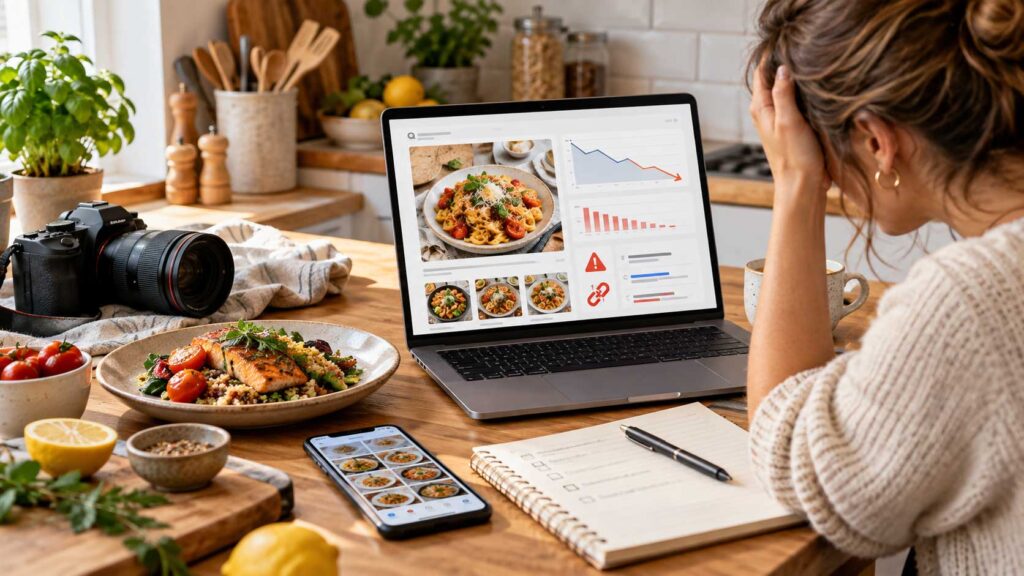
Understanding the most common SEO mistakes food bloggers should avoid can help you spot problems before they affect traffic, rankings, or the overall usability of your site.
Food blog SEO is not just about adding keywords to a recipe post. Search engines look at many signals, including how useful the content is, how easy the page is to crawl, how quickly it loads, how well it works on mobile devices, and how clearly the topic is organized.
A few small problems may not seem serious on their own, but they can add up. Poor keyword targeting, oversized images, weak internal linking, missing recipe schema, or confusing page titles can all make it harder for a strong recipe to perform as well as it should.
The goal is not to make every post “perfect for Google.” It is to make your content easier for both readers and search engines to understand and use.
With that in mind, here are the SEO mistakes food bloggers should watch for most closely.
1. Targeting Keywords Without Understanding Search Intent
One of the most common SEO mistakes food bloggers make is choosing a keyword mainly because it has a high search volume.
A keyword with thousands of monthly searches may look like a great opportunity, but search volume alone does not tell you whether your recipe is a good match for what people actually want or whether your site has a realistic chance of ranking.
That is where search intent comes in.
Search intent is simply the reason behind a search. Two people can search for similar recipes but expect very different results.
For example, someone searching for:
- “chicken pasta recipe”
- “creamy chicken pasta without cream”
- “30-minute chicken pasta”
- “high-protein chicken pasta”
- “chicken pasta for meal prep”
is interested in the same general dish, but each search has a slightly different purpose.
If your recipe closely matches one of those specific needs, targeting the more focused phrase may be far more useful than competing for the broadest possible keyword.
Before writing a new post, search your main topic and study the results already appearing on Google.
You can also use SEO tools for food bloggers to research keywords, compare competing pages, and uncover related search opportunities.
Pay attention to:
- The types of pages that rank
- How specific the recipes are
- Common ingredients or cooking methods
- The format of the top results
- Questions people are asking
- Related searches
- Whether Google is favoring recipes, guides, videos, or another type of content
You are not looking for a perfect keyword that guarantees traffic.
What matters is understanding what people are actually trying to find and creating a page that answers that need clearly.

2. Going After Extremely Competitive Recipe Keywords Too Early
A common mistake for newer food bloggers is trying to rank immediately for broad, highly competitive keywords such as:
- “chocolate chip cookies”
- “banana bread”
- “chicken breast recipes”
- “pancakes”
- “lasagna”
These search results are often filled with major recipe sites that have been publishing for years, have earned links from other websites, and already rank for thousands of food-related searches.
That does not mean you should avoid popular recipes altogether.
The better strategy is often to narrow the angle and target a more specific version of the recipe.
For example:
Instead of: Chocolate Chip Cookies
Try: Small Batch Chocolate Chip Cookies Without Brown Sugar
Instead of: Chicken Breast Recipe
Try: Garlic Parmesan Chicken Breast in the Air Fryer
Instead of: Smoothie Recipe
Try: High-Protein Strawberry Banana Smoothie Without Protein Powder
More specific searches usually have clearer intent, and they can give a newer blog a better opportunity to compete.
Over time, as your site builds more content, links, and authority around a topic, you can begin targeting broader and more competitive keywords too.
3. Publishing Thin Recipe Posts
A recipe post does not need to be several thousand words long just to have a chance of ranking.
In fact, adding filler simply to make an article longer can make the page less useful.
What matters is whether the post gives readers enough information to understand the recipe, prepare it successfully, and solve the most common questions they may have along the way.
Depending on the recipe, useful information might include:
- Why the recipe works
- Important ingredients
- Ingredient substitutions
- Preparation tips
- Step-by-step instructions
- Cooking times and temperatures
- Common mistakes to avoid
- Storage instructions
- Reheating tips
- Freezing instructions
- Serving suggestions
- Frequently asked questions
Not every recipe needs every one of these sections.
A simple three-ingredient dip may only need a few short notes, while a sourdough recipe or layered cake may require much more explanation.
There is no ideal word count every recipe needs to reach.
What matters is including the information someone genuinely needs before, during, and after making the recipe.
That makes the page more useful to readers and helps your food blog stand out from thin recipe posts that offer little beyond an ingredient list and basic instructions.
4. Writing for Search Engines Instead of People
Older SEO advice often encouraged bloggers to repeat the same keyword again and again throughout a post.
That can lead to awkward sentences like:
“If you’re looking for the best chicken pasta recipe, this chicken pasta recipe is one of the easiest chicken pasta recipes you can make.”
It may contain the keyword several times, but it does not sound natural.
A better approach is to write for the person who actually wants to make the recipe.
Use your main topic naturally in important places such as:
- The page title
- The main heading
- The introduction
- Relevant subheadings
- The recipe card
- Image descriptions when they genuinely describe the photo
Then write the rest of the article in normal language.
If you explain the recipe thoroughly, related terms and phrases will usually appear naturally without forcing them into every paragraph.
Forget about hitting a specific keyword count. What matters is whether the page reads naturally and clearly explains the topic.
5. Using Weak or Confusing Page Titles
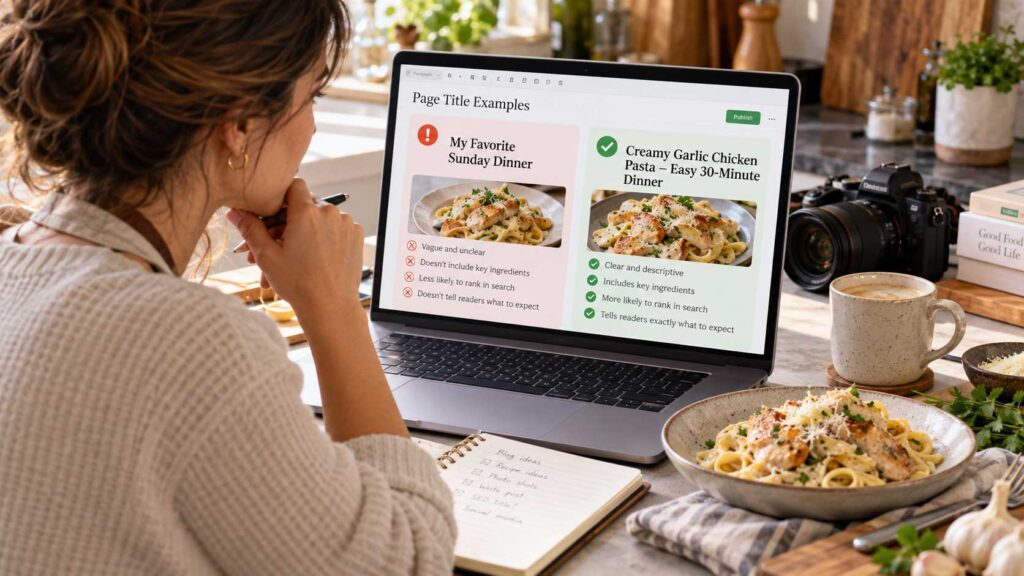
Your page title is one of the clearest signals telling readers and search engines what a recipe is about.
A vague title such as:
My Favorite Sunday Dinner
may sound personal, but it gives very little context about the actual dish.
A more descriptive title is much stronger:
Creamy Garlic Chicken Pasta – Easy 30-Minute Dinner
That title immediately tells the reader:
- What the dish is
- An important characteristic
- How quickly it can be prepared
At the same time, avoid trying to squeeze every keyword variation into the title.
For example:
Chicken Pasta Recipe | Easy Chicken Pasta | Creamy Pasta | Best Chicken Dinner
looks cluttered and unnatural.
A strong title should be specific enough to describe the recipe clearly while still sounding like something a real person would want to click.
In most cases, focus on the main dish and one or two useful details, such as cooking method, key ingredient, dietary feature, or preparation time.
Clear titles help readers understand what they are getting before they click, and they also give search engines better context about the page.
6. Ignoring Meta Descriptions
Meta descriptions do not directly control rankings, but they can influence whether someone chooses to click your result.
Think of them as a short preview of the page rather than another place to repeat keywords.
A good meta description should quickly explain what the recipe is and what makes it appealing.
For example:
Make this creamy garlic chicken pasta in about 30 minutes with tender chicken, Parmesan, garlic, and a simple homemade sauce.
That is far more useful than:
Chicken pasta recipe best chicken pasta creamy chicken pasta easy chicken pasta recipe.
The first version gives the reader a reason to click. The second simply repeats keywords without adding much information.
Google may sometimes generate its own search snippet instead of using the description you wrote, but it is still worth creating a clear, accurate description for every important post.
For recipe content, focus on details that may matter to the reader, such as cooking time, key ingredients, dietary features, preparation method, or what makes the dish different from similar recipes.
7. Uploading Huge Food Photos
High-quality food photography can make a recipe far more appealing, but oversized image files can slow down the entire page.
Uploading several 4–10 MB photos straight from a camera is usually unnecessary for a blog post, especially when those images will be displayed much smaller on the screen.
Before uploading, optimize your photos so they still look sharp without carrying more file size than needed.
Focus on:
- Using appropriate image dimensions
- Compressing large files
- Using modern image formats when supported
- Allowing WordPress to serve responsive image sizes
- Lazy loading images that appear farther down the page
- Removing images that do not add anything useful
The goal is not to sacrifice image quality.
It is to find a balance between beautiful food photography and fast page loading.
This matters even more on mobile, where visitors may be using slower connections while searching for a recipe in the grocery store or cooking in the kitchen.
Large images are only one part of site performance, but they are one of the easiest problems for food bloggers to control.

8. Ignoring Image SEO
Food bloggers have a natural advantage when it comes to visual search because recipes are highly image-driven.
Someone searching for:
- “strawberry cheesecake”
- “charcuterie board ideas”
- “Christmas cookies”
- “healthy smoothie recipes”
may browse Google Images before ever clicking a traditional search result.
That makes image optimization especially important for recipe websites.
Start with clear, descriptive filenames.
Instead of:
IMG_4837.jpg
use something like:
creamy-garlic-chicken-pasta.jpg
You should also add helpful alt text that describes what is actually shown in the image.
For example:
Creamy garlic chicken pasta topped with Parmesan and chopped parsley
Alt text is primarily an accessibility feature, so write it for people first. Do not turn it into a string of keywords or repeat the same phrase across every photo in the post.
If a page includes several images, describe each one based on what it shows, such as the finished dish, a preparation step, an ingredient close-up, or the final serving.
Good image SEO is not about forcing keywords into every field. It is about helping both users and search engines understand the visual content on the page.
9. Forgetting Recipe Structured Data
Recipe structured data is especially important for food bloggers because it helps search engines understand the key details of a recipe page.
Depending on the recipe, that information may include:
- Recipe name
- Featured image
- Author
- Prep time
- Cook time
- Total time
- Ingredients
- Instructions
- Cuisine
- Recipe category
- Calories
- Ratings
When Recipe schema is implemented correctly, your content may become eligible for enhanced appearances in Google Search and Google Images.
Many WordPress recipe plugins can generate this structured data automatically, which makes setup much easier.
Your WordPress SEO plugin may also handle other types of structured data, sitemaps, titles, and technical SEO settings.
But do not assume that installing a recipe plugin means everything is working perfectly.
Check your important recipe pages with Google’s Rich Results Test and monitor Search Console for structured-data warnings or errors.
Most importantly, the structured data should match what visitors can actually see on the page.
For example, do not mark up ratings, cooking times, or nutrition information that are not genuinely present in the recipe.
Accurate schema helps search engines understand the content more clearly and reduces the risk of confusing or invalid markup.
10. Having a Poor Internal Linking Strategy
Internal links help readers discover related recipes and give search engines a clearer picture of how your content is connected.
A common mistake is publishing dozens or even hundreds of posts without linking them together in a useful way.
For example, imagine you have content about:
- Homemade pizza dough
- Pizza sauce
- Margherita pizza
- Pepperoni pizza
- Pizza baking temperatures
- Best flour for pizza
- How to store pizza dough
Those pages should naturally connect to one another where it makes sense.
A pizza dough recipe could link to your pizza sauce, baking temperature guide, and storage instructions. Your Margherita pizza post could link back to the dough and sauce recipes.
Over time, those connections create a useful content cluster around pizza.
Whenever you publish a new post, ask:
Which existing articles would genuinely help someone reading this page?
Then add those links naturally within the content.
It is also worth going back to older posts and adding links to newer recipes where they are relevant.
Avoid adding internal links just to increase the number on the page. A good internal link should help the reader take the next useful step, while also making it easier for search engines to discover and understand related content.
11. Publishing Multiple Articles Targeting Essentially the Same Search
As a food blog grows, it is easy to end up with several posts that target nearly the same search.
For example:
- Easy banana smoothie
- Best banana smoothie
- Simple banana smoothie
- Homemade banana smoothie
- Quick banana smoothie
If those recipes are nearly identical, Google may have little reason to treat them as separate useful results, and readers may not understand why both pages exist.
In that situation, one stronger, more complete page may be better than several weak or repetitive ones.
Separate articles make more sense when each recipe serves a clearly different need.
For example:
- Banana smoothie without yogurt
- Banana peanut butter smoothie
- Banana protein smoothie
- Strawberry banana smoothie
- Banana smoothie for kids
Each of those searches has a distinct angle, so each page has a clearer reason to exist.
Before publishing a new article, check whether you already have a post that answers the same question or targets nearly the same keyword.
If you do, improving the existing article may be more useful than creating another URL.
The goal is not to publish as many similar posts as possible. It is to build a collection of pages where each one has a clear purpose and targets a distinct search.
Many of these SEO mistakes food bloggers should avoid are surprisingly easy to fix once you know what to look for.
12. Ignoring Broken Links and Broken Images
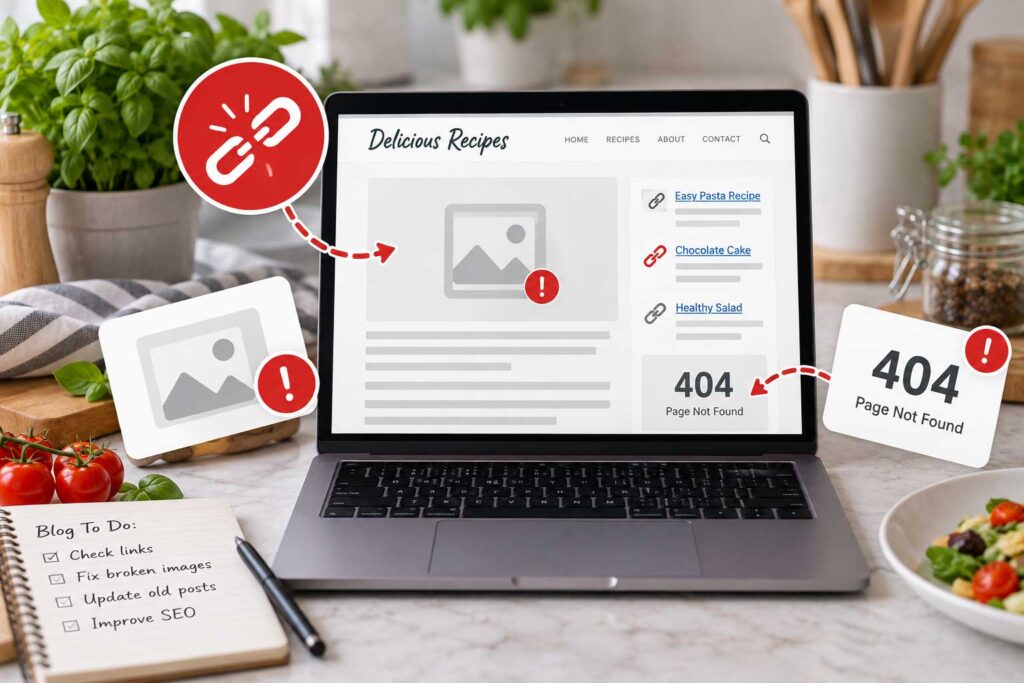
A few broken links will not ruin a food blog, but a large number of them can make the site feel neglected and frustrating to use.
Over time, older posts may end up with missing images, outdated affiliate links, deleted recipes, or internal links pointing to pages that no longer exist.
Check your site regularly for:
- Broken internal links
- Missing images
- Deleted or moved recipes
- Incorrect redirects
- Affiliate links that no longer work
- External resources that have disappeared
- Navigation links pointing to outdated URLs
Broken internal links are especially worth fixing because they can stop readers from reaching related content and make it harder for search engines to crawl the site efficiently.
If you change the URL of an existing post, redirect the old address to the most relevant new destination instead of leaving visitors on a 404 page.
A well-maintained site is easier for readers to navigate, easier for search engines to crawl, and far less likely to accumulate technical SEO problems over time.
Broken links are only one maintenance issue to watch for. Our guide to WordPress mistakes new food bloggers should avoid covers several other problems that can hurt usability and site performance.
13. Changing URLs Every Time You Update an Article
Updating an old post does not mean you need to change its URL.
This mistake often happens when food bloggers redesign their site, rewrite older recipes, or improve SEO titles.
For example, imagine your existing post uses:
example.com/easy-lasagna-recipe/
and you later change the title to:
The Best Homemade Lasagna Recipe
There is usually no reason to change the URL just because the title changed.
The original URL can stay:
/easy-lasagna-recipe/
Changing established URLs too often can create unnecessary redirects, broken internal links, lost backlinks, and extra indexing work for search engines.
If a page already has traffic, links, or search visibility, keeping the existing URL is often the safer choice.
Change a URL only when there is a clear reason, such as fixing a badly structured slug, merging duplicate content, or correcting something that is genuinely misleading.
When you do change one, make sure the old URL redirects to the new page.
14. Ignoring Mobile Visitors
A recipe can look great on a desktop computer and still be frustrating to use on a phone.
That matters a lot for food blogs because many readers are viewing recipes while they are shopping, cooking, or planning meals.
People may open a recipe on their phone while:
- Grocery shopping
- Cooking in the kitchen
- Planning meals
- Looking for ingredient substitutions
- Comparing several recipes
- Checking cooking times or measurements
That means mobile usability should be part of your regular site checks, not an afterthought.
Pay attention to:
- Font size and readability
- Navigation
- Recipe cards
- Buttons and links
- Popups
- Advertising
- Image sizes
- Tables
- Ingredient lists
- Jump-to-recipe buttons
- Sticky elements
The main question is simple: can someone comfortably use the recipe on a small screen without constantly zooming, closing popups, or hunting for the information they need?
A strong mobile experience makes the page easier to use and supports better overall site performance in search.
15. Overloading Pages With Ads and Popups
Ads can be an important source of income for food bloggers, but too many interruptions can quickly make a recipe frustrating to use.
Imagine opening a recipe and immediately seeing:
- A cookie banner
- A newsletter popup
- A video ad
- A sticky footer ad
- A full-screen interstitial
- Several display ads before the recipe even begins
Google also recommends avoiding intrusive interstitials that make the main content difficult to access.
At that point, the visitor is spending more time closing distractions than reading the content.
Monetization should support the site, not overwhelm it.
Pay special attention to mobile devices, where a popup or sticky ad can cover a large percentage of the screen and make the recipe difficult to navigate.
Keep the main content easy to reach, and make sure ads, signup forms, and promotional elements do not block important information.
You can still monetize aggressively, but the reader should be able to find the recipe, scroll through the instructions, and use the page without constantly fighting the interface.
A cleaner experience is better for visitors and supports stronger overall page quality.
16. Creating Recipes With No Original Value
One of the easiest ways for a recipe post to feel forgettable is to repeat the same information that already appears on dozens of other websites.
Give readers something they cannot get from a generic rewrite.
That could include:
- Your own recipe testing
- Original photography
- Specific cooking tips
- Ingredient experiments
- Substitution testing
- Troubleshooting advice
- Cultural background
- Family techniques
- Cost comparisons
- Storage tests
- Equipment comparisons
- Step-by-step photos
First-hand experience can make a recipe much more useful.
For example, instead of simply writing:
You can substitute Greek yogurt.
explain what happened when you actually tested it.
Did the texture change?
Did you use the same amount?
Did the flavor become more tangy?
Did the cooking time need to change?
Those details help readers make better decisions and give the post a reason to exist beyond simply repeating what is already available elsewhere.
You do not have to reinvent the recipe in every paragraph. What matters is adding experience and details that genuinely help someone make it successfully.
17. Ignoring Your Older Recipes
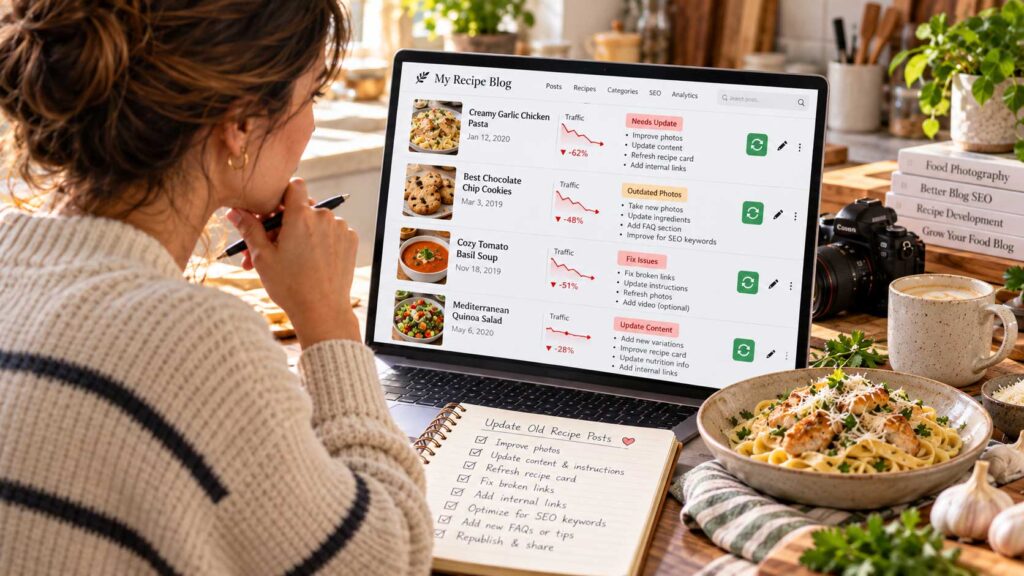
SEO work does not end when you publish a recipe.
In many cases, some of your best opportunities are already sitting in your WordPress dashboard.
Older posts may have started ranking, lost traffic over time, or simply need stronger content and better optimization.
Review them regularly and look for pages that:
- Rank on page two
- Get impressions but very few clicks
- Have declining traffic
- Contain outdated information
- Use weak or dated photography
- Need better internal links
- Have incomplete recipe cards
- Contain broken links
- Have weak introductions or titles
- Overlap with another article
These are often easier wins than starting from scratch with a completely new post.
For example, if a recipe is already appearing regularly in search but is not attracting many clicks, that is often worth investigating before you create another post on the same topic.
Just avoid changing a post only so you can update the publication date.
A refresh should include real improvements that make the page more useful, accurate, and complete.
Updating existing posts is also one of several ways to get more traffic to your food blog without relying entirely on publishing new recipes.
18. Publishing Random Topics Without Building Topical Depth
A food blog can cover a wide range of recipes, but publishing completely unrelated topics all the time can make it harder to build depth around any one subject.
Imagine a new blog publishing:
- Monday: vegan smoothie
- Tuesday: smoked brisket
- Wednesday: French macarons
- Thursday: Korean barbecue
- Friday: gluten-free bread
- Saturday: cocktails
There is nothing wrong with variety, especially on a general food blog.
The problem is when every post stands alone and the site never develops a meaningful group of related content.
Instead, build groups of related content around the topics that matter most to your audience.
For example, if smoothies are an important category, you might create content around:
- Protein smoothies
- Green smoothies
- Breakfast smoothies
- Fruit smoothies
- Smoothie ingredients
- Smoothie equipment
- Smoothie storage
- Smoothie troubleshooting
Those articles can then link to one another naturally and create a much stronger resource around smoothies.
Once you have good coverage of one topic, you can repeat the same process with another important category.
You can still cover plenty of different foods and cuisines. Just make sure your most important categories grow into useful collections rather than isolated posts.
19. Ignoring Google Search Console
Google Search Console is one of the most useful free tools a food blogger can use to understand how their content is performing in search.
It can help you see:
- Which search queries are generating impressions
- Which pages are receiving clicks
- Average search positions
- Indexing problems
- Sitemap status
- Structured-data issues
- Core Web Vitals reports
- Pages Google has discovered or indexed
One of the best ways to use Search Console is to look for pages that are already getting plenty of impressions but are sitting just outside the strongest search positions.
For example, you may find a recipe getting thousands of impressions for searches you had never specifically targeted. That can reveal opportunities to improve the page around topics Google already associates with it.
Instead of immediately publishing another article on the same topic, review the existing post first.
You may be able to improve it with:
- A clearer title
- A stronger introduction
- Better internal links
- More useful recipe tips
- Updated photos
- Improved structured data
- Answers to related questions people are searching for
Search Console can also alert you to indexing and structured-data problems that may otherwise go unnoticed.
Checking it regularly gives you real information about how Google is seeing your site, which is far more useful than guessing which recipes need attention.
20. Expecting SEO Results Too Quickly
SEO usually takes time, especially for a newer food blog.
A site with 15 recipes should not expect the same search visibility as an established publisher with thousands of posts, years of history, strong backlinks, and a large returning audience.
That does not mean a new food blog cannot grow.
It means the focus should be on steady improvement rather than expecting one post, one plugin, or one optimization trick to suddenly change everything.
Keep working on the fundamentals:
- Publish genuinely useful recipes
- Improve older posts
- Strengthen internal links
- Upgrade weak photography
- Fix technical problems
- Monitor Google Search Console
- Study which topics are gaining impressions
- Pay attention to what readers actually need
SEO growth is usually the result of many small improvements building on one another over time.
The blogs that perform well long term are often the ones that keep refining their content, fixing problems, and expanding useful topic areas instead of chasing quick wins.
SEO is only one part of building a successful site. If you’re still developing your blog, these food blogging mistakes beginners should avoid are worth checking too.
Learning which SEO mistakes food bloggers should avoid gives you a much stronger foundation for improving older recipes and publishing better-optimized content going forward.
Frequently Asked Questions About Food Blog SEO
What is the biggest SEO mistake food bloggers make?
One of the biggest mistakes is publishing content without understanding what people are actually searching for. Choosing keywords based only on search volume can lead to posts that are too competitive or do not match search intent.
How many keywords should I target in one recipe post?
Focus on one main topic rather than trying to rank for several unrelated keywords in the same post. Related phrases and variations can appear naturally throughout the article, but the page should have one clear purpose.
Do recipe posts need to be long to rank on Google?
No. A recipe post does not need thousands of words simply to rank. It should be long enough to answer the questions readers may have about ingredients, substitutions, preparation, cooking, storage, and serving without adding unnecessary filler.
Does Google care about recipe schema?
Recipe structured data can help Google understand important details about a recipe and may make the page eligible for enhanced search appearances. Food bloggers should make sure their recipe schema is accurate and test important pages for errors.
How important is alt text for recipe images?
Alt text is important primarily for accessibility and should describe what the image shows. It can also give search engines more context about an image, but it should not be used to repeat the same target keyword across every photo.
How often should food bloggers update old posts?
There is no fixed schedule. Review older posts when traffic drops, rankings decline, information becomes outdated, links break, photography needs improvement, or Search Console shows that a page is getting impressions but not enough clicks.
Should I change the URL when I update an old recipe?
Usually not. If the existing URL is already indexed or has backlinks, it is often better to keep it unless there is a strong reason to change it. If you do change the URL, redirect the old address to the new one.
Is internal linking important for food blogs?
Yes. Internal links help readers discover related recipes and guides while also helping search engines understand how your content is connected. Relevant internal links are especially useful when building clusters around topics such as smoothies, baking, air fryer recipes, or meal prep.
How long does SEO take for a new food blog?
There is no guaranteed timeline. Newer blogs often need time to build a larger content library, stronger internal linking, backlinks, topical depth, and search visibility. The best approach is to keep publishing useful content while improving older pages and monitoring Google Search Console.
Keep Improving Your Food Blog SEO
Fixing these SEO mistakes is a strong start, but there is much more you can do to improve your food blog’s visibility, traffic, and overall performance.
Continue with these iFoodBloggers guides:
- Best SEO Tools for Food Bloggers – Compare useful tools for keyword research, competitor analysis, technical SEO, rankings, and content optimization.
- Best WordPress SEO Plugins for Food Bloggers – Explore WordPress plugins that can help with titles, metadata, sitemaps, schema, redirects, and other SEO tasks.
- 15 Food Blogging Mistakes Beginners Should Avoid – Avoid common mistakes that can slow down the growth of a new food blog.
- 30 Ways to Get Traffic to Your Food Blog – Discover more ways to attract visitors through search, Pinterest, email, social media, internal linking, and other channels.
- Domain Name Mistakes Food Bloggers Should Avoid – Learn what to avoid when choosing or evaluating a domain name for a food blogging business.
- WordPress Mistakes New Food Bloggers Should Avoid – Fix common WordPress problems involving plugins, updates, speed, backups, security, categories, and site setup.
Build Better SEO Habits for Long-Term Growth
SEO for food bloggers is not about discovering one trick that suddenly sends thousands of people to your recipes. Most of the time, progress comes from doing the basics well and continuing to improve them.
You do not need to fix your entire site in one weekend. Start with posts that already receive impressions or traffic, then work through older recipes, broken links, weak internal linking, slow pages, and outdated content as you find them.
Above all, think about the person using the recipe. Can they find what they need quickly? Does the page work well on their phone? Are the instructions clear? Do your photos and tips actually help them cook the dish?
Get those things right consistently, and you will have a much stronger food blog—not just for search engines, but for the people you want to come back.