
Domain name mistakes can cause unnecessary branding, marketing, and usability problems for food bloggers, especially when a blog is just getting started.
Choosing a domain name is one of the first major decisions you’ll make when starting a food blog. Your domain becomes part of your brand and may appear on social media profiles, Pinterest pins, business cards, email addresses, and search results for many years.
Changing it later can be much more complicated than simply choosing a different blog title, which is why it’s worth avoiding common domain name mistakes from the beginning.
The good news is that you don’t need the perfect domain name. You need one that is memorable, easy to type, easy to share, and flexible enough to grow with your food blog.
Before registering your new website, take a look at the most common domain name mistakes food bloggers should avoid—and how to choose a name you’ll still be happy with years from now.
Why Choosing the Right Domain Name Matters
Your domain name is more than just the address people type into a browser. It becomes part of your food blog’s identity and often shapes a reader’s first impression of your brand.
If you’re still at the beginning of the process, our guide to starting a food blog can help you plan the rest of your setup.
A good domain should be easy to remember, easy to spell, and flexible enough to grow with your website. This is especially important for food bloggers because your site may eventually expand beyond recipes into cookbooks, affiliate products, email marketing, social media, courses, or other areas of your business.
Choosing carefully from the beginning can also save you from the hassle of rebranding later. Changing a domain after your site has grown can mean updating redirects, social profiles, email addresses, backlinks, Pinterest graphics, and other parts of your online presence.
That is why it helps to understand the most common problems before registering a new website. Avoiding a few simple issues early can give your food blog a much stronger foundation for long-term growth.
Common Domain Name Mistakes Food Bloggers Should Avoid
A domain name can look great at first and still create problems later. Some names are difficult to spell or remember, while others are too restrictive, too similar to an existing brand, or unnecessarily complicated.
For food bloggers, these problems can become more noticeable as the website grows. Your domain may eventually appear across hundreds of recipes, Pinterest pins, social media accounts, newsletters, affiliate partnerships, and other marketing channels. Rebranding all of those assets later can take considerable time and effort.
Most domain name mistakes are easier to avoid before registration than to fix afterward. Before purchasing a domain for your food blog, review the common mistakes below and make sure the name you’re considering can support both your current content and your future plans.
1. Choosing a Domain Extension Just for SEO
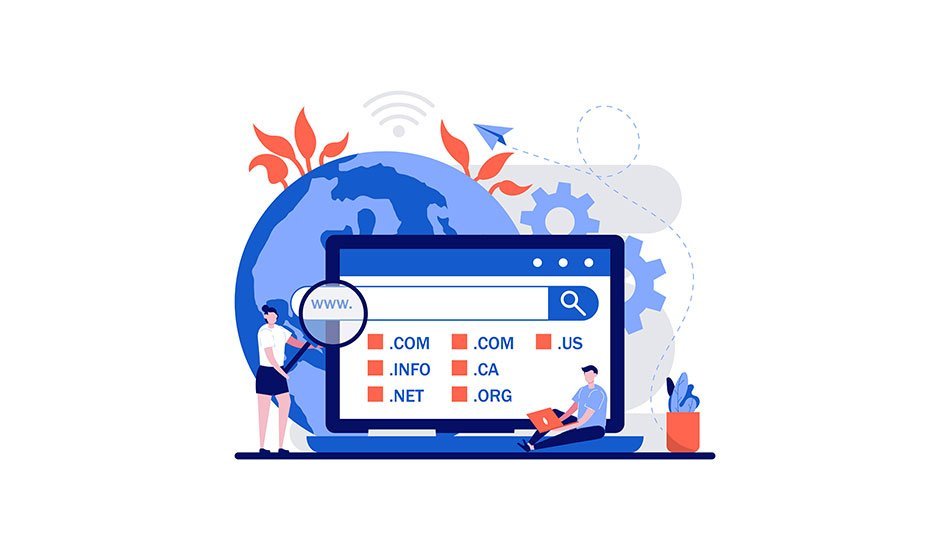
One of the first choices you’ll make when registering a domain is which extension to use. Before registering one, compare the best domain registrars for food bloggers and look at renewal pricing, security, and domain-management features. Common options include .com, .net, .org, .co, and newer alternatives such as .blog or .food.
For most food bloggers, .com is still a strong first choice because it is familiar, easy to recognize, and simple for readers to remember. However, choosing a .com domain does not automatically give your website an SEO advantage.
The same applies to newer domain extensions. You should not choose an extension simply because you think Google will rank it higher.
Instead, focus on whether the full domain sounds trustworthy, memorable, and natural for your brand.
For example:
Better:FreshForkKitchen.com
Less appealing:Best-Easy-Healthy-Recipes-Online.com
If your ideal .com is unavailable, it may be better to adjust the brand name slightly rather than force an awkward, overly long domain just to get the extension you want.
The goal is to choose a domain that readers can remember and confidently associate with your food blog.
2. Choosing a Domain That’s Difficult to Spell
A domain name should be easy to spell after someone hears it once.
If people regularly have to ask, “How do you spell that?” the name may be more complicated than it needs to be.
Food bloggers rely heavily on people discovering and sharing their content through Google, Pinterest, Instagram, YouTube, newsletters, and word of mouth. A domain that’s difficult to spell can make it harder for readers to return to your site or recommend it to someone else.
Try to avoid:
- Unusual or confusing spellings
- Unnecessary abbreviations
- Words that can be spelled in several different ways
- Difficult terms unless they’re important to your brand
- Intentionally misspelled words that aren’t immediately obvious
A simple test is to say the domain out loud to someone who hasn’t seen it before.
If they can type it correctly without asking questions, that’s a good sign. If they have to guess between two or three different spellings, it may be worth choosing a simpler name.
3. Choosing a Domain That’s Hard to Remember
A domain name doesn’t need to explain everything your food blog is about. Trying to fit your entire niche into the name can actually make it harder for readers to remember.
Compare these two approaches:
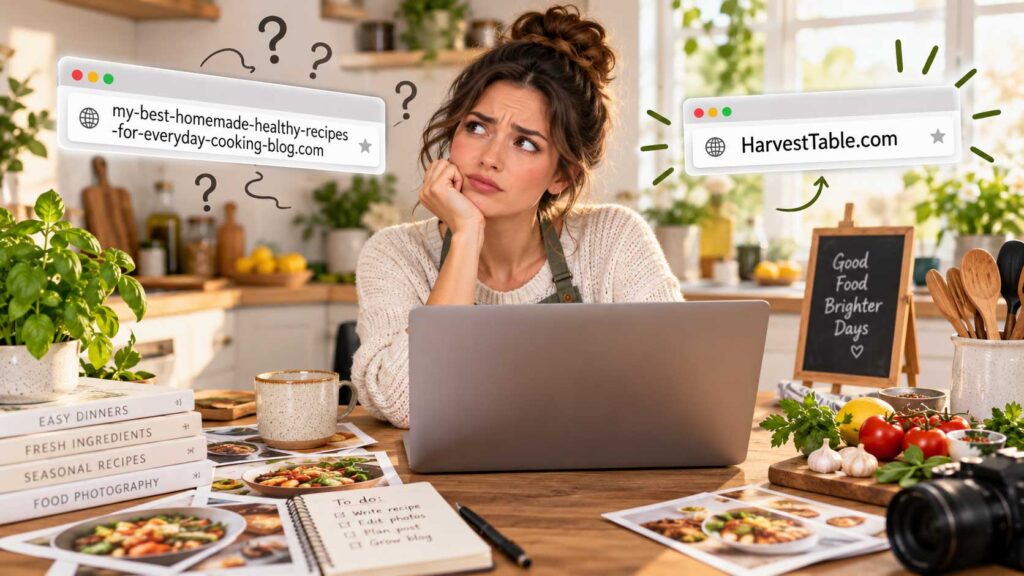
Simple and memorable:HarvestTable.com
Too descriptive:HealthyQuickFamilyDinnerRecipes.com
The first is much easier to say, type, share, and recognize on social media or Pinterest graphics.
A strong food blog domain should ideally be:
- Distinctive
- Easy to pronounce
- Easy to spell
- Relatively short
- Relevant to your brand
- Flexible enough to grow with your content
Think about how the name sounds outside your website. Could someone remember it after hearing it in a podcast, seeing it briefly on Pinterest, or finding one of your recipes through Google?
A useful test is simple: if someone visits your food blog today, would they remember its name a week from now?
A name readers can actually remember is far more useful than a domain packed with keywords.
4. Stuffing Keywords Into the Domain
Using a keyword in your domain can help readers understand what your site is about, but adding too many keywords can make the name feel awkward, generic, or difficult to remember.
Years ago, bloggers often chose domains such as:
BestChickenRecipes.com
EasyHealthyRecipes.com
BestFoodBlogRecipes.com
There is nothing wrong with a descriptive domain, but you shouldn’t choose one simply because you expect the keywords themselves to improve your Google rankings.
Google’s ranking systems are designed so exact-match domains don’t receive excessive credit simply because their domain closely matches a search query.
Domain keywords are only one tiny part of search optimization; these SEO mistakes food bloggers should avoid can have a much bigger impact on your site.
A better approach is to use keywords only when they fit naturally with the brand.
For example:
theSmoothieRecipes.com
is clear, simple, and easy to understand.
Something like:
BestHealthySmoothieRecipesForWeightLoss.com
is much longer, harder to remember, and feels more like a search phrase than a brand.
When choosing a domain, aim for a name that sounds natural when you say it out loud and still leaves room for the website to grow.
Think brand first, keywords second.

5. Using Too Many Hyphens or Numbers
Hyphens and numbers can make a domain name harder to remember, type, and explain to someone else.
Imagine telling a friend that your website is:
Healthy-Dinner-Recipes.com
You would have to explain where each hyphen goes, and there is always a chance they will forget one when typing the address.
Numbers can create the same kind of confusion. If your blog is called:
Recipes4You.com
someone hearing the name might assume the address is:
RecipesForYou.com
That creates an unnecessary barrier between your brand and your readers.
Whenever possible, choose a domain made from simple words and standard letters. One hyphen or number is not automatically a problem, but the name should still be easy to say and understand without extra explanation.
Also check whether the cleaner version of the domain belongs to another established website. If it does, choosing a noticeably different name may help you avoid brand confusion later.
6. Choosing a Domain That’s Too Long
A long domain name isn’t automatically a bad choice, but every extra word gives readers another chance to forget, mistype, or shorten it incorrectly.
Shorter domains are usually easier to work with across the rest of your brand too. They fit more naturally on:
- Pinterest graphics
- Recipe cards
- Instagram profiles
- YouTube descriptions
- Email signatures
- Product packaging
- Cookbooks
- Business cards
You don’t need to chase a specific character count. Instead, look for words that aren’t adding much value and see whether the name still makes sense without them.
For example:
MyFavoriteDeliciousFamilyRecipes.com
could potentially become:
FamilyTableRecipes.com
The shorter version communicates a similar idea while being easier to remember, type, and share.
When comparing options, ask yourself whether every word in the domain really needs to be there. A cleaner name is often easier to turn into a recognizable food brand.
7. Choosing a Name That’s Too Similar to Another Food Blog
Before registering a domain, take time to search the name online and see whether another food blog or brand is already using something very similar.
This matters because food blogging is a crowded space, and many sites use overlapping words such as kitchen, table, bites, recipes, baker, or foodie.
For example, imagine choosing:
TheCozyKitchenTable.com
only to discover an established recipe brand already using a very similar name such as:
CozyKitchen.com
Readers could easily mix the two up, especially when searching on Google, Pinterest, Instagram, or YouTube.
A similar name can create problems with:
- Brand recognition
- Social media usernames
- Email addresses
- Search results
- Word-of-mouth referrals
- Trademark conflicts
Before committing to a domain, search Google, Pinterest, Instagram, YouTube, and major domain registrars. If you plan to turn the food blog into a serious business, it is also worth checking the USPTO trademark database for similar registered or pending trademarks.
One important thing to remember is that an available domain does not automatically mean the name is free to use as a brand.
Choosing something more distinctive now can make branding much easier and reduce the chance of confusion later.
8. Making the Domain Too Narrow
A domain can fit your first few months of content perfectly and still become limiting later.
Imagine starting a site called:
AirFryerChickenRecipes.com
At first, the name makes sense. But over time, you may want to add:
- Desserts
- Slow cooker recipes
- Salads
- Drinks
- Kitchen guides
- Restaurant recommendations
- Cookbooks
At that point, the domain may no longer reflect what the website has become.
A tightly focused domain can work well if you’re intentionally building a small niche site around one topic. But if your goal is to grow a broader food brand, choose a name that gives you more flexibility.
Think beyond your launch content. Ask yourself whether the domain would still make sense if the site expanded into new recipe categories, products, or other food-related topics.
A good domain should still make sense even if your food blog looks very different three or five years from now.
9. Forgetting to Check Social Media Availability
Your domain is only one part of your brand. Before registering it, check whether a similar username is also available on the social platforms you expect to use.
For food bloggers, that often includes:
- YouTube
- TikTok
You do not need the exact same username everywhere, but keeping them reasonably consistent makes your brand easier to recognize.
For example, you might register:
FreshForkKitchen.com
only to discover that @FreshForkKitchen is already taken on every major platform. You could end up using something much less memorable, such as:
@FreshForkKitchenBlog123
That can make your branding feel inconsistent and harder for readers to find.
Before buying a domain, do a quick username check across the platforms that matter most to you. If the exact handle is unavailable, see whether a simple variation still looks clean and professional.
It is much easier to solve this before launch than after your website, Pinterest account, and social profiles are already established.
10. Ignoring the Domain’s Previous History
An available domain is not always a brand-new domain.
Someone may have owned and used it years ago, and that history can matter.
A previously registered domain might have hosted:
- A legitimate business
- An old blog
- Spam
- Adult content
- Gambling content
- Malware
- Link schemes
- Completely unrelated material
Before buying an expired or previously owned domain, take a few minutes to research where it has been used before.
Useful checks include:
- Searching the domain name in Google
- Reviewing its backlink profile
- Looking at archived versions of the website
- Checking whether other sites still link to it
- Reviewing available registration information
You can also use the Wayback Machine to see how a previously owned domain looked in the past.
Historical website tools can help you see what the domain used to contain, while backlink tools can reveal whether it has links from suspicious or irrelevant websites.
You can use some of the best SEO tools for food bloggers to review backlinks and investigate a domain before purchasing it.
Registration data is also worth checking. ICANN’s RDAP system provides access to domain registration information and replaced WHOIS as the primary protocol for generic top-level domain registration data in 2025.
A used domain is not automatically a bad choice. Many previously registered domains have completely normal histories.
The important thing is to know what you’re buying before attaching your food blog and brand to it.
11. Registering the Domain Through Someone Else’s Account
Letting a web designer, developer, friend, or agency register your domain may seem convenient, but it can create major problems if the account is not actually under your control.
Your domain is one of the most important assets connected to your food blog. If someone else owns the registrar account, they may technically control the domain even if you paid for the website.
Domain ownership is only one part of setting up your site correctly; these WordPress mistakes new food bloggers should avoid cover several other problems that are easier to prevent early.
Make sure you know:
- Which registrar holds the domain
- Which account controls it
- Which email address receives renewal notices
- How to log in to the registrar
- When the domain expires
- Which payment method is attached to the account
If someone else helps you register the domain, the safest setup is for the account to be created in your name and with your own email address, while giving them temporary access only when needed.
You should never have to contact a former developer or agency just to renew, transfer, or update your own domain.
For a food blog you plan to grow into a real business, you should always keep direct control of the domain registration account.
12. Choosing the Cheapest Registrar Without Checking Renewal Costs

A low introductory price can make a domain registrar look like a great deal, but the first-year cost is only part of the picture.
Some registrars offer very cheap initial registration and then charge much more when the domain renews. Others may add extra fees for services that are included elsewhere.
Before purchasing, check:
- Initial registration price
- Annual renewal cost
- Domain transfer fees
- Privacy protection
- Customer support
- DNS management
- Two-factor authentication
- Domain lock features
Our domain registrar comparison for food bloggers looks at these factors in more detail.
Also review the registrar’s renewal and transfer policies so you know what to expect before the domain becomes important to your business.
Saving a few dollars in the first year is rarely worth choosing a registrar with weak security, poor support, or unexpectedly high renewal fees.
Reliable domain management is worth far more than saving a few dollars during the first year.
13. Forgetting to Enable Auto-Renewal
Losing a domain because of a missed renewal is one of the easiest problems to prevent.
A missed renewal can create a serious problem, especially once your food blog has traffic, backlinks, email subscribers, and an established brand.
To reduce that risk, enable automatic renewal and make sure:
- Your payment method is current
- Your contact email is active
- Registrar emails are not going to spam
- You know the domain’s expiration date
- Your registrar account has up-to-date recovery information
Some bloggers also register important domains for several years at a time, especially when they know they plan to keep the brand long term.
Whatever setup you choose, don’t rely on memory alone. A simple renewal setting can help protect a domain you’ve spent years building into a valuable part of your food blog.
14. Ignoring Domain Security
Registering a domain is only the first step. You also need to protect the account that controls it.
At minimum, make sure your registrar account uses:
- Two-factor authentication
- A strong, unique password
- Domain or registrar lock
- Auto-renewal
- Updated recovery information
Many bloggers focus heavily on WordPress security and forget that the domain registrar is just as important.
If someone gains access to your registrar account, they may be able to change your DNS settings, redirect the domain, or interfere with your website even without logging in to WordPress.
That is why your registrar account should be treated like any other high-value business account.
Use a password you do not reuse anywhere else, keep your recovery email current, and turn on every reasonable security feature your registrar provides.
15. Waiting Too Long to Register a Name You Love
There is a difference between rushing into a domain purchase and waiting so long that a good name disappears.
You do not need to buy every domain idea that sounds interesting. But once you have done the basic research and feel confident about the brand, there is usually little reason to keep putting off the decision.
Before registering, make sure you have:
- Researched the name
- Checked for similar brands
- Reviewed possible trademark conflicts
- Checked social media availability
- Looked at the domain’s previous history
- Confirmed that the name fits your long-term plans
If everything looks good, securing the domain can save you from having to start the naming process all over again.
Good, simple domain names are limited, especially in popular niches such as food and recipes. A name that is available today may not still be available a few weeks or months from now.
The goal is not to create urgency for the sake of it. It is to do your homework first, then act once you have found a domain you would be happy to build your food blog around.
How to Choose a Good Domain Name for a Food Blog
After reviewing the most common domain name mistakes, choosing a name may feel more complicated than it really is.
You do not need a perfect domain. You need one that is clear, memorable, easy to type, and flexible enough to grow with your food blog. Once you’ve chosen the name, the next major decision is selecting one of the best blogging platforms for food bloggers.
Before registering a name, ask yourself:
- Is it easy to spell after hearing it once?
- Is it easy to pronounce?
- Is it short enough to remember?
- Does it sound like a real brand?
- Is it different from competing food blogs?
- Can the website grow beyond its first topic?
- Are reasonable social media usernames available?
- Does the domain have a clean history?
- Would I still be comfortable using this name five years from now?
It can also help to write the domain down, say it out loud, and imagine how it would look on a Pinterest pin, Instagram profile, cookbook cover, or email address.
If the name still feels clear and natural in all of those places, you are probably heading in the right direction.
The best food blog domains are usually the ones that feel simple from the start and do not require much explanation.
Should You Put a Keyword in Your Food Blog Domain?
You can include a keyword in your food blog domain, but it should fit naturally with the brand.
Words such as:
- Recipes
- Kitchen
- Food
- Table
- Baking
- Meals
- Cooking
can make it immediately clear what your website is about.
For example, a name like:
FamilyTableRecipes.com
tells readers what they can expect without sounding overly optimized.
The mistake is forcing several keywords into the domain just because you hope they will help with SEO.
A name like:
BestEasyHealthyFamilyRecipes.com
is much harder to remember and feels more like a search phrase than a brand.
Google does not give a major ranking advantage simply because your domain contains keywords, so there is no need to sacrifice readability or branding.
If a keyword makes the name clearer, use it. If it makes the domain longer, awkward, or generic, leave it out.
A memorable brand is usually more valuable than squeezing one more keyword into the URL.
Is .com Best for a Food Blog?
For most food bloggers, .com is still a strong first choice because it is familiar, widely recognized, and easy for readers to remember.
That does not mean a .com domain automatically performs better in Google.
Other extensions can work perfectly well, especially if they fit your brand. Depending on your audience and business, options such as .co, .blog, .net, or a country-specific extension may also make sense.
The bigger question is whether the full domain looks trustworthy and is easy to remember.
For example, if your ideal .com is taken, it may be better to slightly adjust the brand name rather than choose an awkward variation filled with extra words, numbers, or hyphens.
A good domain extension should support the brand, not make the name harder to use.
If a clean, memorable .com is available, it is usually an easy choice. But if it is not, focus on finding the strongest overall domain rather than forcing a poor name just to get .com.
Should You Change an Existing Food Blog Domain?
Usually, it is not worth changing an established domain just because you found a name you like a little better.
A domain change can affect many parts of your food blog, including:
- Existing URLs
- Internal links
- Backlinks
- Email addresses
- Social media profiles
- Pinterest graphics
- Analytics
- Google Search Console
- Brand recognition
If you’re also rebuilding or reorganizing the site, reviewing the best tools for food bloggers can help you plan the technical side of the move.
If the site already has traffic, rankings, backlinks, and returning readers, a domain move needs to be handled carefully.
There are situations where changing the domain can make sense, such as:
- The current name is difficult to spell
- The domain is too narrow for the direction of the site
- The brand is too similar to another business
- There is a legal or trademark concern
- The site is going through a major rebrand
- The old name no longer fits the business
If you do change domains, use proper redirects from the old URLs to the new ones and update your most important links and profiles as quickly as possible.
The best approach is to choose carefully at the beginning so you are less likely to need a domain change later.
Frequently Asked Questions About Domain Names for Food Blogs
What makes a good domain name for a food blog?
A good food blog domain should be easy to spell, easy to remember, simple to pronounce, and flexible enough to grow with your content. It should also be distinct from other food blogs and work well across social media, email, and branding.
Should my food blog domain include the word recipes?
It can, but it does not have to. Including a word such as recipes, kitchen, food, or baking can make the topic of your site clear, but a strong brand name can work just as well without an obvious food keyword.
Is .com better for a food blog?
A .com domain is often a good choice because it is familiar and easy for readers to recognize. However, it does not automatically rank better in Google. A memorable, trustworthy domain matters more than choosing .com at any cost.
Does having keywords in a domain help SEO?
Keywords in a domain can help readers understand what a website is about, but they are not a shortcut to better rankings. It is usually better to choose a natural, memorable brand than to fill a domain with several SEO keywords.
How long should a food blog domain name be?
There is no perfect length. In general, choose the shortest version that still sounds natural, clear, and memorable.
Should I use hyphens in my domain name?
Usually, no. Hyphens make domains harder to say and remember. If the clean version is already owned by another brand, consider choosing a different name.
How do I check whether a domain name was used before?
You can search the domain in Google, review archived versions of the site, check its backlink history, and look at available registration information. This can help you identify whether the domain was previously associated with spam, unrelated content, or another business.
Should I buy a domain as soon as I find one I like?
Do some basic research first. Check for similar brands, possible trademark conflicts, social media availability, and previous domain history. Once the name looks clean and fits your long-term plans, there is usually little benefit in waiting too long.
Can I change my food blog domain later?
Yes, but changing an established domain can require redirects, updated links, changes to social media profiles, Search Console updates, and other technical work. If your current domain is working well, a change should usually have a strong reason behind it.
Where should I register my food blog domain?
Choose a reputable domain registrar with transparent renewal pricing, strong security features, reliable customer support, and easy DNS management. Make sure the account is registered in your name and that you keep direct control of the login and recovery information.
Keep Building Your Food Blog
Choosing the right domain is only one part of building a successful food blog. Once your name is in place, the next steps are choosing the right platform, setting up WordPress properly, improving SEO, and building systems that can help your traffic grow over time.
Explore these guides next:
- Best Blogging Platforms for Food Bloggers: Free & Paid – Compare popular platforms and decide which one makes the most sense for your food blog.
- Best Domain Registrars for Food Bloggers – Compare domain providers, features, pricing, and security before registering your site.
- WordPress Mistakes New Food Bloggers Should Avoid – Avoid common setup mistakes that can create performance, security, and usability problems later.
- Best WordPress SEO Plugins for Food Bloggers – Compare SEO plugins that can help with metadata, sitemaps, schema, and on-page optimization.
- Best SEO Tools for Food Bloggers – Find tools for keyword research, competitor analysis, backlinks, and content optimization.
- SEO Mistakes Food Bloggers Should Avoid – Learn which SEO mistakes can hold back rankings and organic traffic.
- 30 Ways to Get Traffic to Your Food Blog – Explore practical ways to bring in traffic from Google, Pinterest, social media, email, and other channels.
- Best Tools for Food Bloggers: 25+ Essential Blogging Tools – Discover useful tools for content creation, SEO, email marketing, productivity, and site management.
Final Thoughts on Choosing a Domain Name
Choosing a domain name can feel like a small step when you’re starting a food blog, but it can shape your brand for years.
The best approach is to keep the name simple, memorable, easy to spell, and flexible enough to grow with your content. Avoid common domain name mistakes such as keyword stuffing, confusing spellings, overly long names, weak security, and choosing a domain that is too similar to another brand.
You do not need to find the perfect name. You need a name that feels natural, represents your brand well, and is easy for readers to remember.
Take the time to research the domain, check its history, review social media availability, and make sure you control the registration account.
A strong domain will not make a food blog successful on its own, but it gives you a much better foundation for building a recognizable brand.
After your site is established, these 30 ways to get traffic to your food blog can help you start building an audience.