
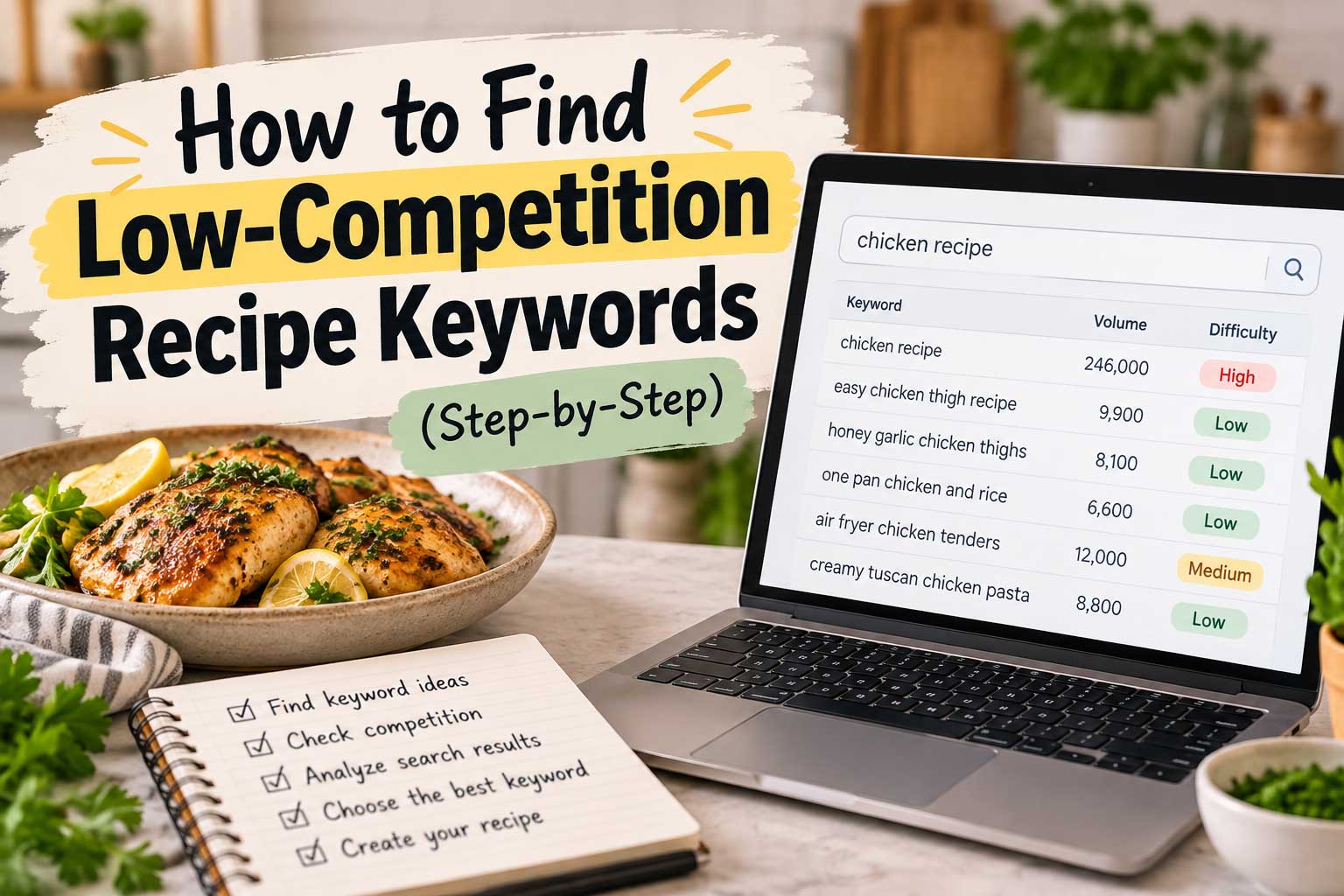
Publishing a great recipe does not automatically mean people will find it on Google.
You might spend hours testing a recipe, photographing every step, and writing detailed instructions, only to discover that your post is competing against some of the largest food websites on the internet.
That is where low competition recipe keywords can make a big difference.
Instead of targeting broad searches like “chicken recipes,” “pasta recipes,” or “chocolate cake,” you can look for more specific searches that people are actively typing into Google but that fewer established websites are targeting well.
For a newer or smaller food blog, these keywords can provide a much more realistic path to organic traffic.
The important part is knowing how to find them.
Keyword difficulty scores can help, but they do not tell the whole story. A keyword that a research tool labels “easy” may still have a search results page dominated by major publishers. At the same time, a keyword with modest search volume may be a great opportunity if the existing results are weak, outdated, or do not fully satisfy what the searcher wants.
In this guide, I’ll show you how to find low-competition keywords for recipes step by step, including how to discover long-tail searches, evaluate the websites already ranking, understand search intent, and decide whether a keyword is actually worth targeting.
You do not need an expensive SEO toolkit to get started, either. Many of these techniques can be done with Google and free keyword research tools.
By the end, you should be able to look at a recipe idea and answer a much more useful question than simply, “Does this keyword get searches?”
Do I realistically have a chance of ranking for it?
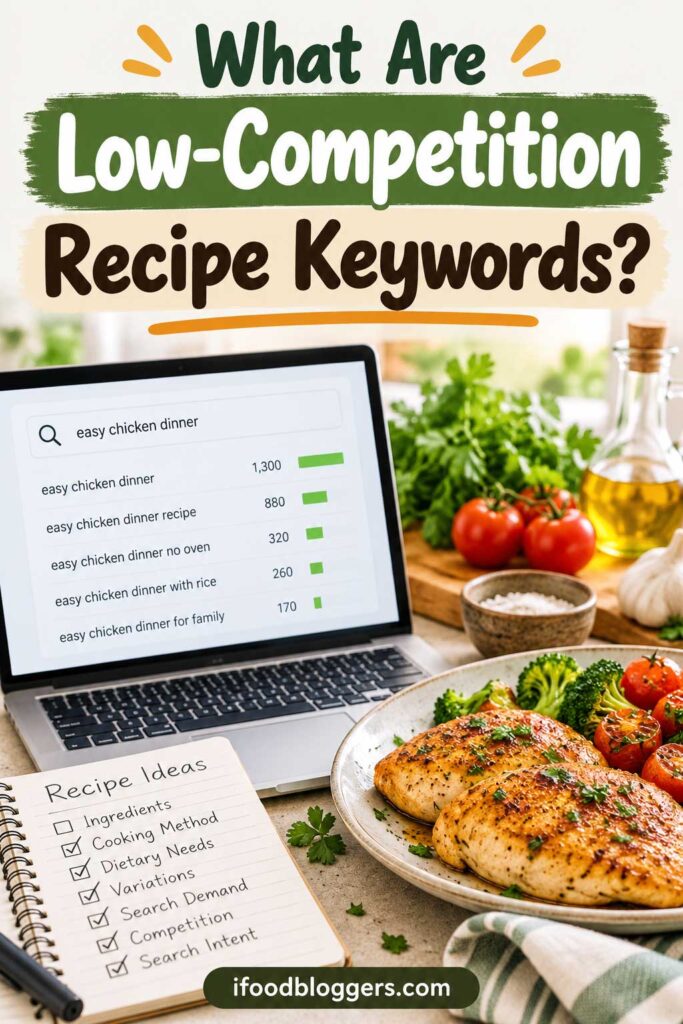
What Are Low-Competition Recipe Keywords?
Low competition recipe keywords are search terms that give your food blog a reasonable chance of appearing near the top of Google without having to compete directly against dozens of highly authoritative websites.
They are often more specific than the obvious keywords that first come to mind.
For example, imagine you have developed a chicken thigh recipe.
Trying to rank for “chicken recipes” would put your post into an extremely competitive search. Even “chicken thigh recipes” may be difficult because established recipe publishers have been targeting that phrase for years.
But your actual recipe may have characteristics that allow you to target something much more specific, such as:
- “crispy boneless chicken thighs in air fryer”
- “honey garlic chicken thighs without soy sauce”
- “one pan chicken thighs and rice no cream”
- “baked chicken thighs at 400 degrees”
- “chicken thigh recipe for two”
These searches are more specific, but that is exactly what can make them valuable.
Someone searching for “chicken recipes” could be looking for almost anything. Someone searching for “honey garlic chicken thighs without soy sauce” has a much clearer idea of what they want.
That specificity can benefit both SEO and the reader.
Low Competition Does Not Mean No Competition
One mistake new food bloggers make is assuming that a low-competition keyword should have almost no other websites targeting it.
That is not the goal.
You actually want evidence that people are interested in the topic. The opportunity appears when there is search demand but the existing results leave room for a better or more relevant page.
For example, you might search a potential recipe keyword and notice that Google is showing:
- older recipes that have not been updated in years
- forum discussions instead of strong recipe pages
- recipes that only partially match the search
- smaller food blogs ranking alongside large publishers
- pages with weak photography or limited instructions
- results targeting a slightly different variation of the recipe
Those can all be signs worth investigating.
The key question is not:
“Does this keyword have competition?”
Almost every worthwhile recipe keyword does.
A better question is:
“Can I create a page that deserves to compete with what Google is currently showing?”
Search Volume Is Only Part of the Opportunity
It is also easy to dismiss a keyword because a research tool reports only 50, 100, or 200 searches per month.
Recipe searches rarely exist in isolation.
A page optimized around one specific keyword can also appear for dozens—or eventually hundreds—of related searches.
For example, a recipe targeting “crispy air fryer chicken thighs without breading” might also receive impressions for variations involving cooking time, temperature, boneless thighs, skinless thighs, seasonings, and similar questions.
That is why I would not choose recipe topics based on search volume alone.
For a growing food blog, a smaller keyword with strong intent and realistic competition can be much more useful than a massive keyword where your recipe has little chance of reaching the first page.
The next step is learning how to recognize those opportunities before you spend hours developing and publishing the recipe.
Affiliate Disclosure: Some links in this article may be affiliate links. If you make a purchase or sign up through one of these links, iFoodBloggers may earn a commission at no extra cost to you.
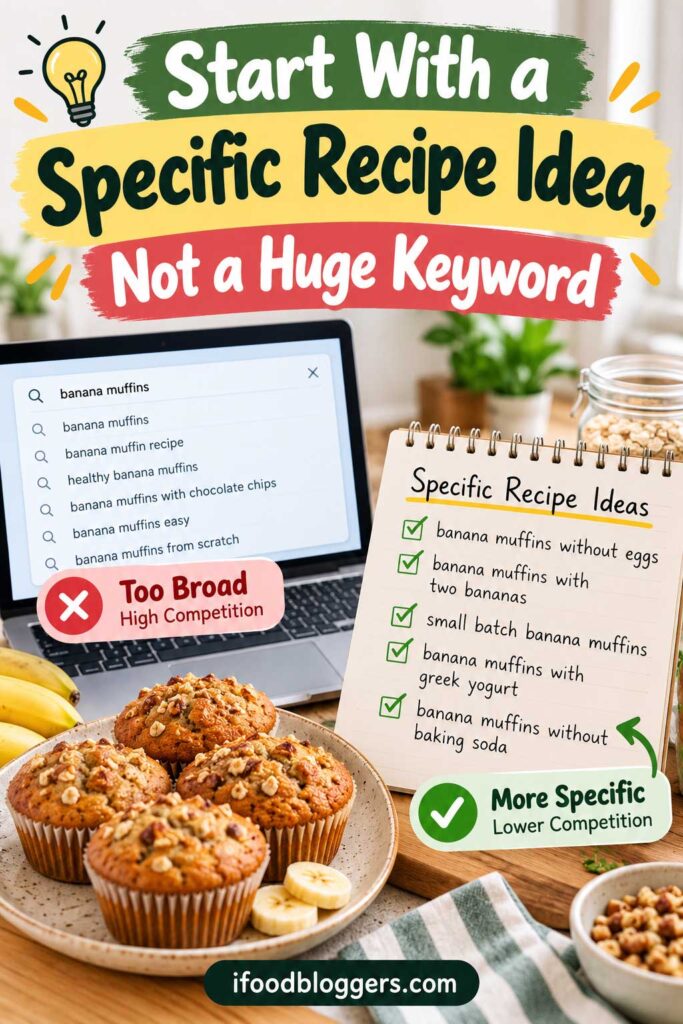
Start With a Specific Recipe Idea, Not a Huge Keyword
One of the easiest ways to make recipe keyword research harder than it needs to be is to start with an enormous keyword.
Terms like “chicken recipes,” “healthy recipes,” “desserts,” or “pasta recipes” may receive a lot of searches, but they are usually far too broad to be useful starting points for a smaller food blog.
Instead, begin with the actual recipe you plan to create.
Suppose you want to publish an air fryer chicken thigh recipe. Rather than treating “chicken” as your keyword, write down the characteristics that make your recipe different.
Think about things such as:
- cooking method
- main ingredient
- dietary restrictions
- ingredients included or excluded
- cooking time
- serving size
- cuisine
- texture
- equipment
- occasion
Your original idea might be:
Air fryer chicken thighs
But once you describe the recipe more precisely, you may uncover several possible keyword directions:
crispy air fryer chicken thighs
boneless air fryer chicken thighs
air fryer chicken thighs without breading
air fryer chicken thighs for two
air fryer chicken thighs no flour
You are not choosing the final keyword yet.
At this stage, you are simply turning one broad recipe idea into several specific ways a real person might search for it.
Think Like the Person Cooking the Recipe
Food bloggers sometimes describe recipes differently from the way readers search for them.
You may think of your recipe as:
“My Easy Weeknight Herb-Roasted Chicken”
That might sound appealing as a blog title, but very few people are likely to type that exact phrase into Google.
A searcher may instead type:
“roasted chicken thighs with herbs”
or:
“easy herb chicken thighs in oven”
The recipe can still have personality, but your keyword should reflect the language people actually use when searching.
This matters when you are looking for low-competition recipe keywords because even a small change in wording can produce a very different set of Google results.
Build a Seed Keyword
Before opening a keyword research tool, create what I call a seed keyword.
A seed keyword is simply the basic description of the recipe that you can expand during your research.
For example:
Recipe: Greek-style roasted potatoes
Seed keyword: Greek potatoes
From there, you might investigate searches such as:
Greek lemon potatoes
Greek potatoes with lemon and oregano
crispy Greek potatoes in oven
Greek potatoes without chicken broth
Greek roasted potatoes with garlic
Another example:
Recipe: Banana muffins made without eggs
Seed keyword: banana muffins
Possible variations could include:
banana muffins without eggs
eggless banana muffins
banana muffins without eggs or milk
easy banana muffins no egg
vegan banana muffins with two bananas
Notice what is happening here.
We are not inventing five separate recipes just to chase keywords. We are identifying different ways people might describe or search for the recipe we already intend to make.
That distinction matters.
Your recipe should genuinely satisfy the search query you eventually target. Do not add “gluten-free,” “vegan,” “30-minute,” or another modifier simply because a keyword looks easier if the recipe does not actually meet that description.
Once you have a seed keyword and several possible variations, you can start looking for evidence that people are actually searching for them.
And one of the best places to begin is completely free: Google itself.
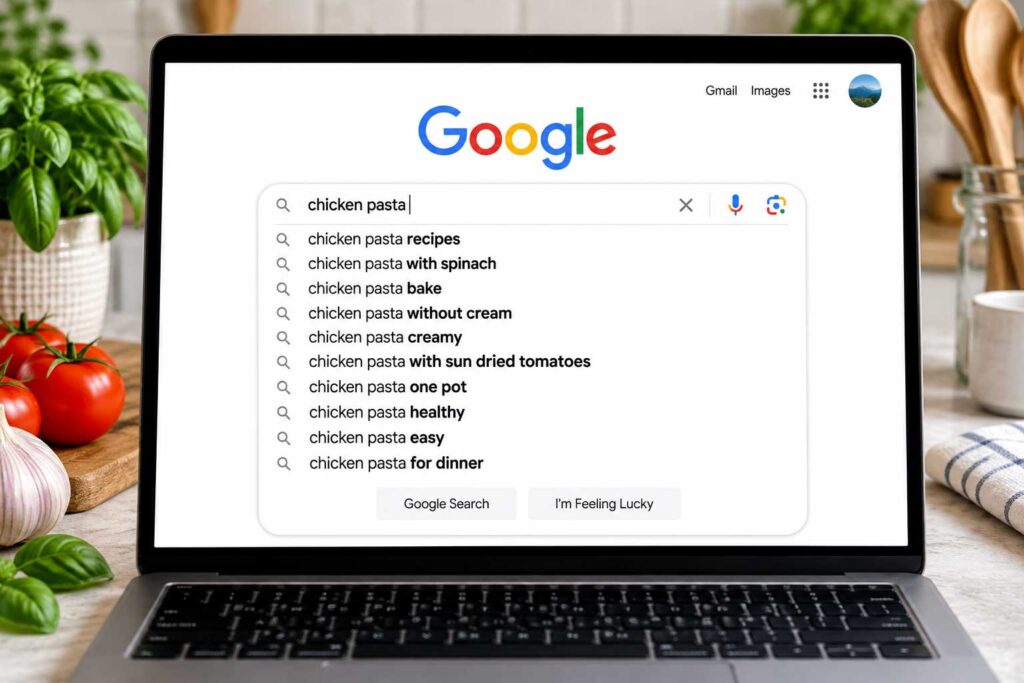
Use Google Autocomplete to Find Long-Tail Recipe Keywords
You do not need a paid SEO tool to start finding low competition recipe keywords.
Google can give you plenty of ideas for free.
One of the simplest methods is Google Autocomplete—the suggestions that appear when you begin typing a search into Google.
For example, start with:
air fryer chicken thighs
As you type, Google may suggest more specific searches related to your query. Those suggestions can help you understand the language people use around the topic and uncover variations you may not have considered.
Those suggestions can reveal useful long-tail keyword ideas that you may not have considered when planning your recipe.
Add Modifiers to Your Recipe Keyword
Instead of searching only for your main recipe, experiment with words that describe how people cook, modify, or serve it.
For example, you could start typing:
air fryer chicken thighs without…
or:
air fryer chicken thighs with…
or:
air fryer chicken thighs for…
Each variation can uncover a different type of search intent.
You can also experiment with modifiers such as:
without
with
easy
quick
healthy
crispy
boneless
skinless
frozen
for two
no flour
no sugar
no eggs
The useful modifiers will depend on the recipe.
If you are researching cookies, people may care about ingredients they can substitute or leave out. If you are researching chicken, cooking method and temperature may be more important. For soups, searches might focus on slow cookers, Instant Pots, freezing, or specific ingredients.
The goal is not to attach every possible modifier to your keyword.
You are looking for variations that genuinely describe the recipe you can create.
Use the Alphabet Method
Another simple technique is to place a letter after your seed keyword and see what Google suggests.
For example:
banana bread a…
banana bread b…
banana bread c…
You can also place letters or words before the keyword.
This can uncover searches that would be difficult to brainstorm manually.
I would not work through all 26 letters for every recipe. Try a handful first. If useful ideas keep appearing, continue. If the suggestions become irrelevant, move on.
Write down any suggestions that are relevant to the recipe you are planning.
Look at People Also Ask
After searching for your seed keyword, check whether Google displays a People Also Ask section.
These questions can tell you what readers want to know in addition to the basic recipe.
For an air fryer chicken recipe, you might find questions related to cooking temperature, cooking time, whether chicken should be flipped, or whether frozen chicken can be used.
Not every question needs to become a separate article.
Many are better used as supporting sections or FAQs within your main recipe.
For example, if your primary keyword is:
air fryer boneless chicken thighs
a related question about cooking time might become an H2 or H3 within the recipe rather than another competing post.
That helps you create a more complete resource while avoiding multiple pages targeting almost the same search intent.
Check Related Searches
Scroll toward the bottom of the Google results page and look for related searches when Google displays them.
These can reveal additional wording, ingredients, cooking methods, and variations connected to your original search.
Suppose you begin with:
Greek lemon potatoes
Related searches might point you toward variations involving crispy potatoes, oregano, chicken broth, roasting temperature, or traditional preparation methods.
Again, do not assume every suggestion is a good keyword simply because Google displays it.
At this point, we are collecting possibilities—not deciding what to target.
Google Suggestions Show Demand, Not Difficulty
This distinction is important.
If a phrase appears in Google Autocomplete, I treat it as a useful clue that the topic is worth investigating—not proof of a specific search volume or ranking opportunity.
A long keyword is not necessarily a low-competition keyword.
For example:
best chocolate chip cookie recipe without brown sugar
looks highly specific, but the search results could still be filled with established recipe websites.
That is why I would never choose a recipe keyword based on Autocomplete alone.
Use Google to discover how people phrase their searches. Then investigate the actual search results to determine whether your food blog has a realistic opportunity to compete.
That SERP analysis is where recipe keyword research becomes much more interesting.
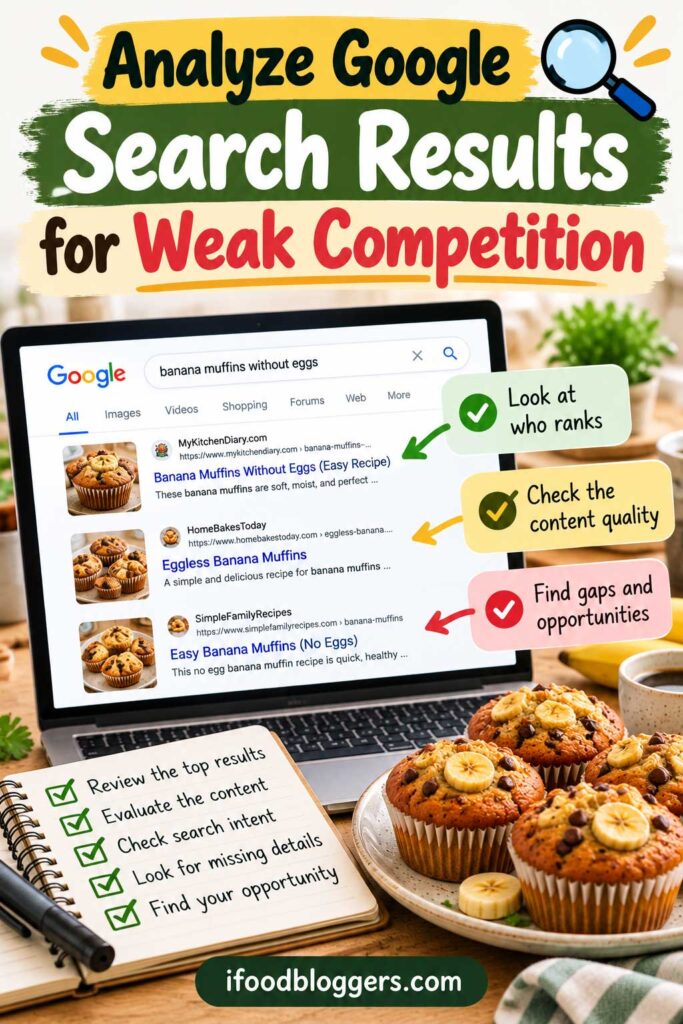
Analyze Google Search Results for Weak Competition
Finding a promising keyword is only the beginning.
Before deciding to create a recipe around it, search the exact phrase in Google and look carefully at the pages already ranking.
This is often more useful than relying on a keyword difficulty score alone.
SEO tools estimate competition using their own data and formulas. Google does not use those scores when deciding which page should rank.
The score is useful, but I still want to see the SERP for myself. Are the current results genuinely strong, or is there room for a recipe that matches the search more closely and helps the reader more?
Start With the First Page
Search your potential keyword and examine the first 10 results.
You are trying to understand who currently ranks and what type of content Google appears to prefer.
For example, suppose you are considering:
banana muffins without eggs
Look at the sites ranking on the first page.
Are they enormous recipe publishers with thousands of backlinks and years of authority?
Or do you see independent food blogs, smaller websites, forums, user-generated content, or pages that only partially answer the query?
A SERP containing several smaller food blogs can be an encouraging sign.
It does not guarantee that you will rank, but it suggests Google is willing to show pages from sites without enormous authority.
Look for Results That Do Not Match the Search Exactly
One signal I pay close attention to is an intent mismatch.
Imagine someone searches for:
banana muffins without eggs or milk
but several top-ranking recipes contain milk.
Those pages may be related to the query, but they do not perfectly satisfy it.
That creates an opportunity.
If you can publish a genuinely tested banana muffin recipe that contains neither eggs nor milk, your page may provide a closer match to what the searcher actually wants.
You may find similar opportunities when Google ranks:
general recipe collections instead of a specific recipe
forum discussions instead of detailed instructions
recipes using different ingredients
pages targeting a broader version of the keyword
articles that answer the question but do not provide the actual recipe
These are not automatic wins, but they are worth investigating.
Look for Smaller Websites Ranking
You do not need every result to come from a small food blog.
In fact, that would be unusual for many worthwhile recipe searches.
Instead, look for evidence that at least a few less-established sites are competing successfully.
If positions three, six, and eight are occupied by independent recipe blogs rather than major publishers, that tells you something important:
Google is not restricting the SERP to the biggest websites.
That can make the keyword much more interesting.
On the other hand, if every result comes from extremely authoritative food brands and every page closely matches the query, a newer blog may have better opportunities elsewhere.
Examine the Quality of the Ranking Recipes
Do not judge competition based only on domain size.
Open several of the ranking pages.
Ask yourself whether they actually provide a strong experience for someone trying to cook the recipe.
Look at things such as:
Does the recipe clearly answer the search intent?
Are the instructions easy to follow?
Are important cooking steps explained?
Does the author provide useful substitutions?
Are ingredient quantities clear?
Are there process photos where they would genuinely help?
Does the page answer obvious questions a cook might have?
Does the recipe appear to have been tested carefully?
A page does not become weak simply because you dislike its design or because it has a long introduction.
You are looking for meaningful ways to create something more useful.
Watch for Outdated or Thin Content
Older content is not automatically bad content.
A recipe published five years ago can still be excellent and rank perfectly well.
But sometimes older pages have obvious gaps.
They may contain minimal instructions, outdated information, broken images, unclear substitutions, or very little help for someone actually preparing the dish.
You might also find extremely thin pages that provide a recipe card but answer almost none of the questions surrounding the recipe.
That can give you room to create a more complete resource.
For example, your version might explain why an ingredient is used, what substitutions actually work, how to recognize when the food is done, how to store leftovers, and which common mistakes to avoid.
Add those sections because they help the cook—not because you are trying to make the article longer.
Do Not Assume Reddit or Forums Mean “Easy Keyword”
You will sometimes hear that seeing Reddit, Quora, or forums on page one automatically means you have found an easy keyword. I would not make that assumption.
Sometimes Google is showing discussions because that format is exactly what searchers want.
Google may rank a discussion because people genuinely prefer personal experiences or multiple opinions for that particular search.
However, forum-heavy results can still be worth investigating.
For a recipe query, ask why those discussions are ranking.
Maybe users are asking a question that existing recipe websites have not answered clearly.
That unanswered question can reveal the real content opportunity.
Search the Keyword Like a Reader
Try to temporarily forget that you are doing SEO research.
Imagine you actually wanted to cook the dish.
Search the keyword, open several results, and ask:
Would I be satisfied with these results?
If the answer is yes and the first page contains excellent recipes from strong websites that match the query perfectly, competing may be difficult.
If your reaction is:
“None of these quite gives me what I searched for,”
pay attention.
You may have found a content gap.
Use a Simple SERP Check Before Choosing the Keyword
Before targeting a recipe keyword, I like to answer five questions:
- Does the keyword accurately describe the recipe I can create?
- Are smaller or independent food blogs ranking?
- Do some results only partially match the search intent?
- Can I provide something genuinely more useful?
- Would this keyword attract the type of reader my food blog wants?
You do not need a “yes” to every question.
But the more positive signals you find, the more interesting the opportunity becomes.
This manual check also prevents one of the biggest mistakes in food blog keyword research: rejecting or targeting a keyword simply because an SEO tool gives it a particular difficulty score.
Next, we can use keyword research tools to add another layer of data to what we have already learned from Google.
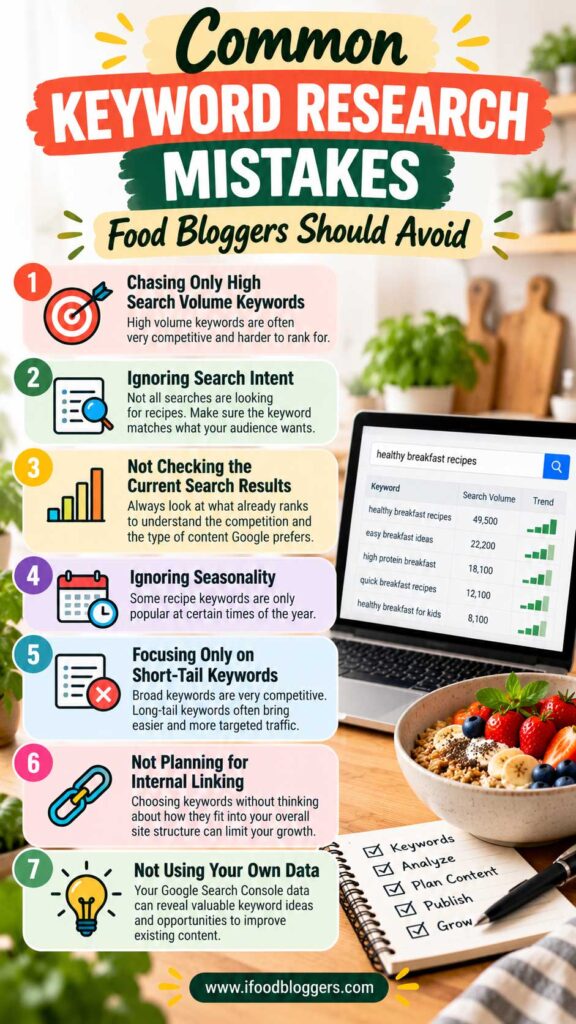
Use Keyword Research Tools to Validate Your Ideas
Once you have collected potential keywords from Google and manually checked the search results, keyword research tools can help you compare your options.
This is where metrics such as estimated search volume, keyword difficulty, related keywords, and competing pages become useful.
The key word is useful—not absolute.
No keyword tool has access to Google’s complete search data, and different platforms often report very different numbers for the same phrase. Treat the metrics as estimates that help you make decisions rather than exact measurements of how many people search for a recipe.
Check Estimated Search Volume
Search volume gives you an estimate of how frequently people search for a keyword.
For example, imagine your research produces three possible targets:
| Keyword | Estimated Monthly Searches |
|---|---|
| air fryer chicken thighs | 40,000 |
| boneless air fryer chicken thighs | 6,000 |
| air fryer chicken thighs without breading | 700 |
It may be tempting to automatically choose the first keyword because it has the highest search volume.
But that could be the hardest keyword on the list.
For a smaller food blog, the third keyword might provide a more realistic opportunity—especially if the first-page results are weaker and your recipe matches the search perfectly.
A smaller percentage of a reachable keyword can be much more valuable than zero traffic from an enormous keyword you cannot realistically rank for.
Compare Keyword Difficulty
Most SEO platforms provide some form of keyword difficulty or competition metric.
Depending on the tool, you may see a score such as:
KD 8 — Easy
KD 27 — Possible
KD 65 — Difficult
These scores can help you quickly sort through hundreds of ideas, but do not treat them as Google’s ranking scores.
A keyword showing a difficulty of 10 is not guaranteed to be easy.
Likewise, a keyword showing a difficulty of 35 is not automatically out of reach.
Different SEO tools calculate difficulty differently, often using factors such as backlinks and the authority of pages currently ranking.
That is why the manual SERP analysis we performed earlier matters so much.
Look Beyond the Main Keyword
One of the biggest benefits of keyword research tools is discovering related searches.
Enter your seed keyword and explore variations containing different:
ingredients, cooking methods, dietary needs, serving sizes, temperatures, substitutions, cuisines, and questions.
Suppose your seed keyword is:
potato soup
A keyword tool might uncover searches around:
potato soup without heavy cream
potato soup with frozen hash browns
easy potato soup for two
potato soup without flour
slow cooker potato soup without cream cheese
One of these more specific searches could be a much better fit for your recipe than the broad seed keyword.
Compare Several Keywords Side by Side
Do not research one keyword and immediately start writing.
Collect several realistic candidates first.
You might create a simple working table like this:
| Keyword | Volume | Difficulty | Search Intent Match | SERP Opportunity |
|---|---|---|---|---|
| potato soup | High | High | Strong | Weak |
| easy potato soup | High | High | Strong | Weak |
| potato soup without heavy cream | Medium | Medium | Strong | Moderate |
| potato soup without flour | Lower | Low | Strong | Good |
| potato soup for two | Lower | Low | Strong | Good |
The exact numbers are less important than the comparison.
You are trying to identify the intersection of:
real search demand + strong recipe match + manageable competition.
That combination is often more valuable than simply finding the keyword with the highest search volume.
Free Keyword Research Tools Can Be Enough
You do not necessarily need an expensive SEO subscription when you are starting a food blog.
Free tools and limited free versions can provide enough information to generate ideas and compare opportunities. If you are not ready to pay for an SEO platform, start with our guide to the best free keyword research tools for food bloggers.
Google itself can already give you Autocomplete suggestions, related searches, search results, and trend information.
You can then supplement that research with free or limited keyword tools when you want additional estimates.
Paid Tools Become More Useful as Your Site Grows
Platforms such as Semrush and Ahrefs can speed up the process when you are researching many recipes or managing a larger content strategy.
They can help you explore competitor keywords, filter large keyword databases, compare SERPs, examine backlinks, and find related searches much faster than researching everything manually.
Paid tools save time, but they do not make the decision for you. You still need to understand search intent, look at the actual results, and decide whether your recipe belongs there.
Do Not Chase a Magic Keyword Difficulty Number
There is no universal rule saying:
“Only target keywords below KD 20.”
A brand-new food blog and a five-year-old recipe website with hundreds of ranking pages should not necessarily use the same threshold.
Your ability to compete can change as your site earns links, builds topical depth, develops a stronger recipe library, and gains more organic visibility.
Use difficulty scores to narrow your research.
Then return to the actual Google results before making the final decision.
The best low-competition food keywords are not simply the ones with the lowest number next to them.
They are the searches where demand, relevance, competition, and the quality of your recipe all line up.
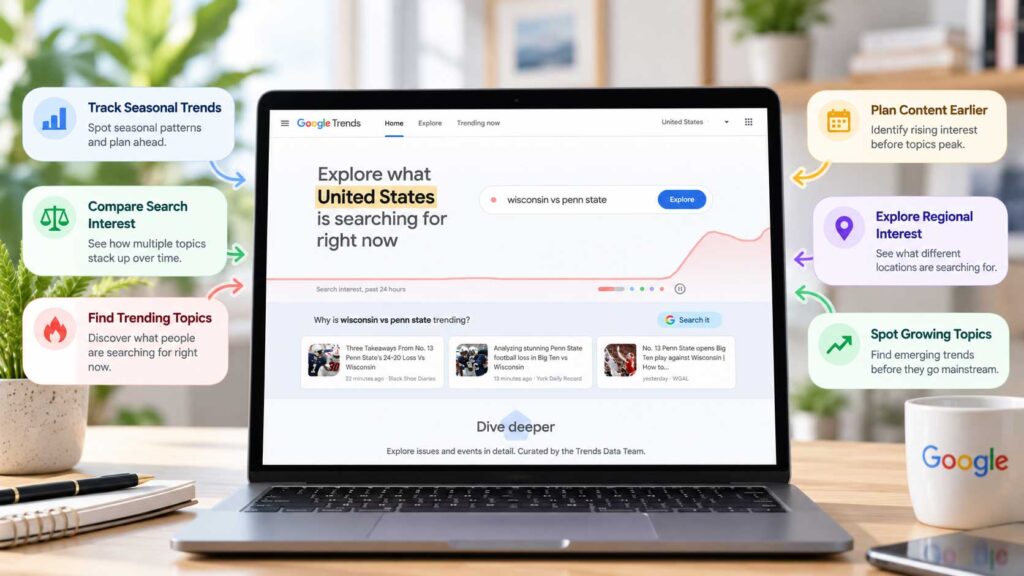
Use Google Trends to Check Seasonality and Growing Recipe Searches
Recipe searches can change dramatically throughout the year.
A keyword that looks quiet in April might explode in November. Another recipe may receive consistent interest throughout the year but experience a predictable spike every summer.
That is why search volume alone does not always tell you when a recipe is worth publishing.
Google Trends can help you understand when people become interested in a recipe and whether that interest appears to be growing, declining, or remaining relatively stable.
Check Whether the Recipe Is Seasonal
Enter your main recipe keyword into Google Trends and expand the date range beyond the last few weeks.
Start with at least the past 12 months. For strongly seasonal recipes, I also like to zoom out several years to see whether the same pattern repeats.
Recipes connected to holidays and seasons often produce very obvious spikes.
Think about searches involving:
pumpkin recipes
Thanksgiving side dishes
Christmas cookies
summer salads
Super Bowl appetizers
strawberry desserts
If interest rises around approximately the same period every year, you are probably looking at a seasonal keyword.
That does not make it a bad target.
It simply changes when you should publish and promote the recipe.
Publish Before the Search Peak
A common mistake is waiting until a holiday or season arrives before publishing seasonal content.
If searches for a recipe begin climbing in October and peak in November, publishing it at the end of November gives Google very little time to discover, crawl, index, and evaluate the page before much of the seasonal demand has passed.
I would rather have the recipe live well before the expected increase in searches.
That also gives you time to improve the page, build internal links to it, create Pinterest content, and make any necessary updates before the busiest period.
For major seasonal recipes, think ahead rather than publishing when everyone else is already searching.
Compare Similar Recipe Ideas
Google Trends becomes even more useful when you compare several terms.
Suppose you are deciding whether to create content around:
overnight oats
baked oats
chia pudding
Comparing them can help you see their relative search-interest patterns over time.
You might discover that one has steadier year-round interest while another experiences short bursts of popularity.
That information can help you decide which recipe deserves priority in your editorial calendar.
Just remember that Google Trends shows relative interest, not exact monthly search volume.
A value of 100 represents peak popularity for the selected query, location, and period. It does not mean the keyword received 100 searches.
Look at Related Topics and Queries
Scroll below the main trend chart and examine the related topics and related queries when they are available.
This is an underrated source of recipe keyword research ideas. Trends can also be useful during the earlier idea-generation stage. Our guide to content discovery tools for food bloggers covers additional ways to uncover topics, questions, and emerging content opportunities.
You may discover an ingredient, cooking method, dietary variation, or recipe style that is becoming more closely associated with your original topic.
Pay particular attention to searches marked as Rising.
They can sometimes reveal emerging recipe trends before they become obvious in traditional keyword databases.
However, do not create a recipe simply because a phrase is trending.
Ask whether it fits your food blog and whether you can produce something genuinely useful around it.
Distinguish a Trend From a Sustainable Topic
A sudden spike can look exciting.
But zoom out.
If a keyword appeared almost overnight because of a viral TikTok video and then quickly disappeared, it may offer only a short window of opportunity.
That does not mean you should avoid trends completely. Timely content can generate significant traffic.
But I would not build an entire food blog around temporary spikes.
A healthy content strategy usually combines evergreen recipes with seasonal opportunities and a smaller number of carefully chosen trends.
Use Trends Alongside Your Other Keyword Data
Google Trends should not make the keyword decision by itself.
Instead, combine what it tells you with the information you have already collected:
Does the keyword describe your recipe accurately?
Are people searching for it?
Can your site realistically compete with the current results?
Is interest stable, seasonal, growing, or declining?
When those pieces line up, you have much stronger evidence that the recipe is worth creating.
And if your food blog already receives impressions and clicks from Google, there is another source of keyword ideas that can be even more valuable than a third-party research tool: your own Google Search Console data.
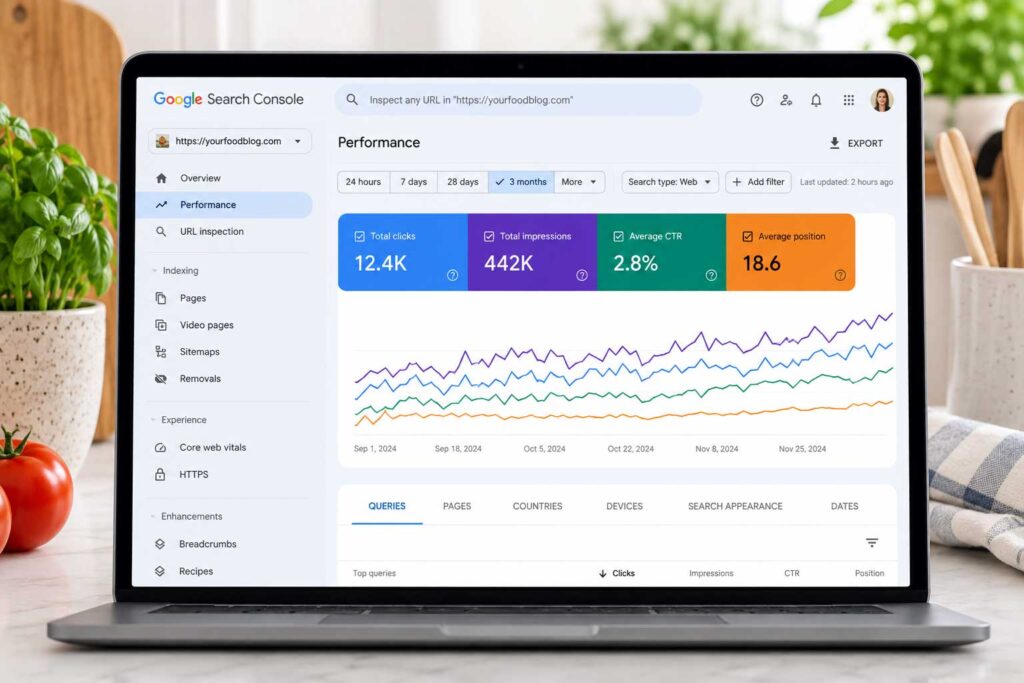
Find Low-Competition Opportunities in Google Search Console
Once your food blog has been online long enough to receive impressions from Google, your own search data can become one of your best sources of keyword ideas.
Google Search Console shows you actual queries for which Google has displayed your pages.
That makes it different from a traditional keyword research tool.
Instead of estimating what your audience might search for, Search Console can reveal searches where Google already considers your content relevant.
Start With the Performance Report
Open Google Search Console and go to your search performance report. Google’s Search Console Performance report documentation explains how to interpret metrics such as clicks, impressions, click-through rate, and average position.
Look at the queries generating:
clicks, impressions, average position, and click-through rate.
Do not focus only on the keywords bringing the most clicks.
Some of the most interesting opportunities may currently generate very little traffic.
For example, imagine one of your recipes appears for a query 1,500 times during the past few months but averages around position 12.
That means Google is already showing your page fairly prominently for the query, even though its position can vary from one search to another.
You are already in the conversation.
Improving that existing page may be easier than trying to rank a completely new article for an unrelated keyword.
Look for Keywords Ranking Just Outside the Top Results
One useful approach is to look for queries where your pages are receiving meaningful impressions but are not yet consistently ranking near the top.
You might discover something like:
| Search Query | Impressions | Average Position |
|---|---|---|
| easy Bulgarian banitsa recipe | 1,200 | 8.7 |
| banitsa with feta and filo | 680 | 11.4 |
| Bulgarian cheese pastry | 430 | 14.2 |
| how to reheat banitsa | 170 | 18.6 |
These numbers are only an example, but they illustrate what you are looking for.
The first three queries may indicate that Google already understands the page as relevant to several closely related searches.
Instead of creating three nearly identical articles, you might improve the existing recipe so it satisfies those searches more completely.
Find Unexpected Long-Tail Keywords
Search Console can also reveal phrases you never intentionally targeted.
This happens frequently with recipe content.
You may publish a recipe for:
creamy potato soup
and later discover impressions for:
how to thicken potato soup without flour
If your recipe already explains a flour-free thickening method, that query could deserve a clearer section within the article.
You might add an H2 such as:
How to Thicken Potato Soup Without Flour
Then answer the question directly and naturally.
You are not stuffing an extra keyword into the page.
You are improving the recipe based on something real readers are already searching for.
Filter Search Console by Individual Recipe
Looking at sitewide queries can become overwhelming, especially once your food blog contains hundreds of posts.
Instead, filter the report by a specific page.
Choose one recipe and examine all of the queries generating impressions for that URL.
This can reveal an entire cluster of searches surrounding a single recipe.
You may find variations involving:
ingredient substitutions
cooking temperatures
cooking times
storage
reheating
dietary modifications
different cooking equipment
Some belong in the existing recipe. Others may reveal opportunities for completely separate articles.
The difference comes down to search intent.
Do Not Create a New Post for Every Keyword
Suppose your chicken recipe receives impressions for:
air fryer chicken thighs
air fryer boneless chicken thighs
how long to air fry chicken thighs
air fryer chicken thigh temperature
You probably do not need four separate posts.
Those searches can often be satisfied by one comprehensive recipe.
Creating multiple nearly identical pages may leave your own content competing for the same audience and search intent.
But imagine Search Console reveals:
what to serve with air fryer chicken thighs
That could justify a separate supporting article because the searcher wants side-dish ideas rather than instructions for cooking the chicken itself.
The new article could then internally link back to your chicken recipe.
This is how keyword research can gradually turn individual recipes into useful content clusters.
Compare Different Time Periods
Do not look at only the last seven days.
Recipe traffic can be highly seasonal, and short periods can hide valuable patterns.
Compare longer ranges when possible and look at how queries change over time.
You may notice that a recipe begins gaining impressions before a holiday, loses visibility during the off-season, and starts climbing again the following year.
That information can help you decide when to update the recipe and when to begin promoting it again.
Search Console Can Reveal Your Easiest SEO Wins
For an established food blog, I would often look at Search Console before spending hours searching for completely new keywords.
Why?
Because Google may already be telling you where the opportunities are.
A query with growing impressions and an average position near the first page can represent a much easier SEO win than a brand-new keyword where your site has no existing relevance.
Third-party tools help you discover the market.
Search Console shows you where your own website is already gaining traction.
Once you begin combining that first-party data with Google suggestions, SERP analysis, keyword tools, and trend information, finding low-competition recipe keywords becomes much less about guessing and much more about recognizing the right signals.
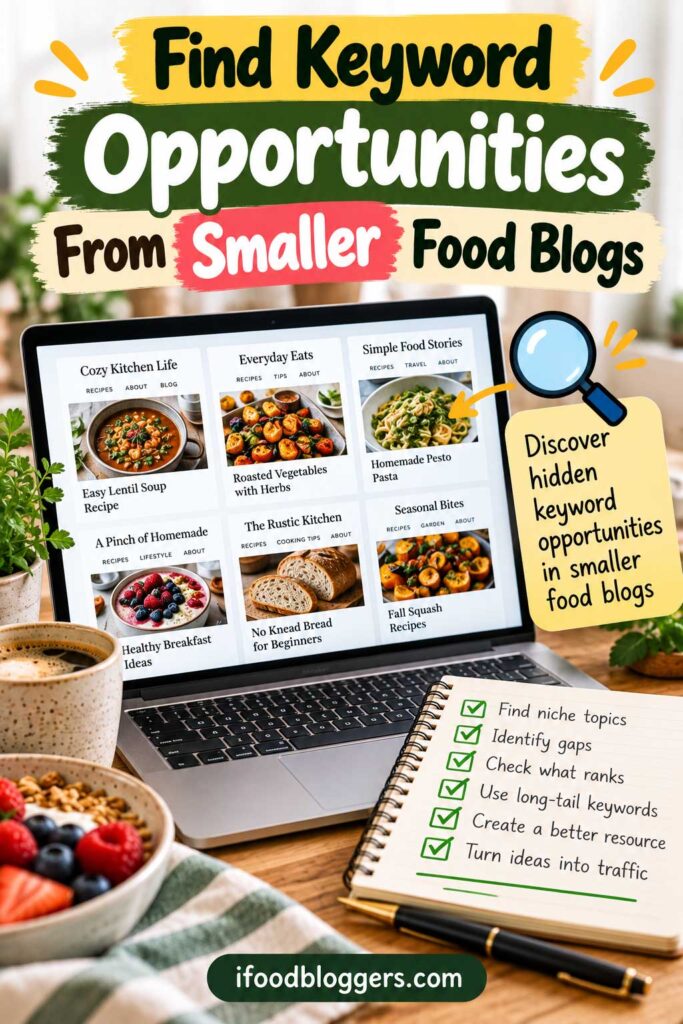
Find Keyword Opportunities From Smaller Food Blogs
Competitor research can be one of the fastest ways to discover low-competition recipe keywords, but only if you study the right competitors.
If your food blog is relatively new, comparing yourself with the largest recipe websites on the internet may not tell you much.
Those sites can rank for keywords that would be extremely difficult for a smaller blog to compete for.
Instead, look for food blogs that are closer to your own level—or slightly ahead of you.
If a smaller website can rank for a recipe keyword, that is often a much more interesting signal.
Find Smaller Blogs Already Ranking in Your Niche
Start with the recipe searches you discovered earlier.
As you examine Google results, pay attention to independent food blogs that appear repeatedly.
For example, if your site focuses on Balkan food, you might notice smaller blogs ranking for searches related to:
Bosnian recipes
Bulgarian desserts
Serbian breakfast recipes
Croatian soups
Balkan vegetarian dishes
Visit those sites and look at the types of recipes they publish.
The point is not to copy those sites. I am looking for patterns: Which kinds of recipes are smaller publishers actually ranking for, and where might there be similar opportunities for my own original content?
Look at Their Ranking Keywords
SEO platforms such as Semrush and Ahrefs can show estimates of the keywords a competing website ranks for.
Enter a smaller competitor and examine its organic keywords.
Then look for searches that meet several conditions:
The keyword is relevant to your food blog.
The competitor ranks reasonably well for it.
The search intent is clear.
You could create an original recipe that genuinely satisfies the query.
The first page is not completely dominated by major publishers.
This can uncover opportunities that traditional brainstorming misses.
Study Their Pages That Receive Search Traffic
Another approach is to look at a competitor’s pages rather than individual keywords.
Suppose a relatively small food blog receives significant organic visibility from recipes such as:
cabbage soup without tomatoes
small batch cornbread
chicken soup without celery
pancakes without baking powder
There may be a pattern.
Perhaps specific ingredient exclusions or smaller serving sizes perform well within that niche.
That does not mean you should recreate those exact articles.
Instead, ask:
What does this tell me about what people are searching for?
You might discover similar opportunities within recipes you already know how to make.
Look for Content Gaps, Not Content to Copy
There is an important difference between competitor research and competitor copying.
If another blogger ranks for:
banana bread without baking soda
you should not rewrite their recipe, copy their headings, imitate their photos, or reproduce their ingredient combination just because the keyword looks attractive.
Use competitor research to identify demand. Competitor research works best as one part of a broader traffic strategy. If organic growth is your main goal, see our guide on how to get more traffic to your food blog for additional ways to turn individual posts into sustainable traffic.
Then create your own recipe based on your own testing, experience, photography, and approach.
You might even decide that the keyword is not appropriate for your recipe at all.
That is perfectly fine.
SEO should help people discover useful original content. It should not determine the recipe before you have something worthwhile to publish.
Pay Attention to Weak Pages That Still Rank
Sometimes a smaller competitor ranks despite having a relatively basic page.
That can be particularly interesting.
Perhaps the recipe has limited instructions, few helpful photos, no substitution guidance, or does not answer obvious questions about the cooking process.
If the page still ranks well, the keyword may have less competition than you expected.
But do not simply make your article longer.
Instead, identify what would actually help someone cooking the dish.
Maybe your version can provide clearer instructions, tested substitutions, better process photography, troubleshooting advice, storage guidance, or a more precise explanation of when the food is done.
The goal is to produce the better recipe resource—not the article with the highest word count.
That approach also aligns with Google’s guidance to create helpful, reliable, people-first content rather than content made primarily to manipulate search rankings.
Check More Than One Competitor
Do not base your strategy on a single website.
Find several smaller or mid-sized food blogs in your niche and compare them.
You may notice certain topic patterns appearing across multiple sites.
For example, several successful smaller blogs might receive search visibility from:
recipes without a common ingredient
small-batch recipes
traditional regional dishes
air fryer versions of familiar foods
specific cooking-temperature questions
recipes designed for two people
Repeated patterns can help you understand where long-tail search demand exists.
From there, you can investigate individual keywords using the same process we have already covered: check Google, examine search intent, compare the SERP, and validate the opportunity with keyword data.
Competitors can show you where to look.
They should not make the final decision for you.
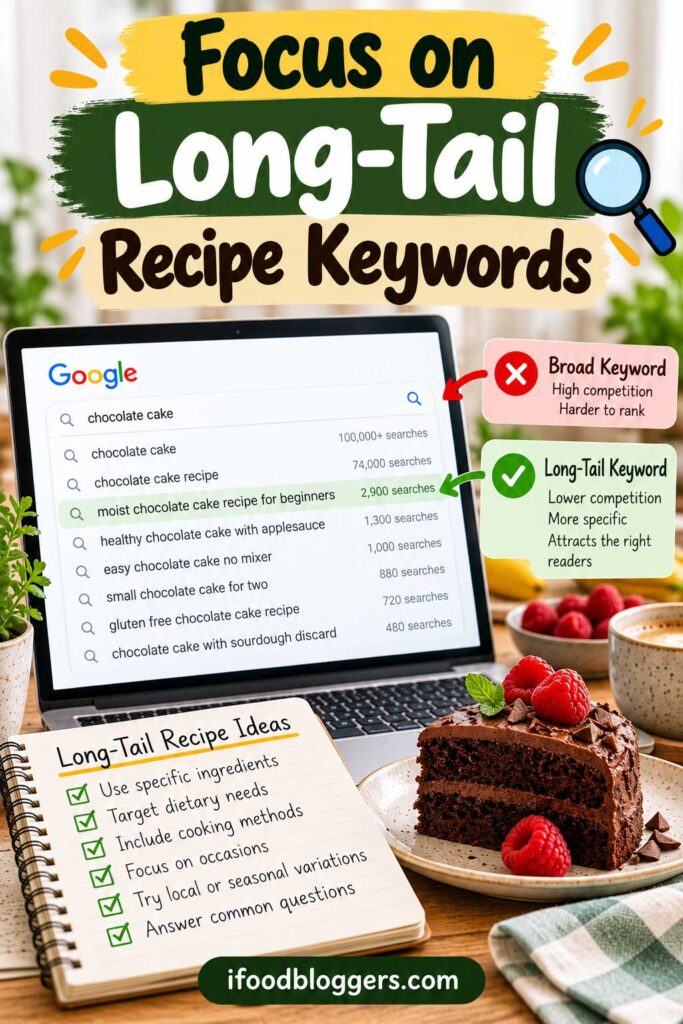
Focus on Long-Tail Recipe Keywords
For a newer food blog, some of the best opportunities are often found in long-tail recipe keywords.
Long-tail keywords are more specific searches that usually have narrower intent than broad recipe terms.
Instead of targeting:
chicken soup
you might discover:
chicken soup without celery
Instead of:
banana bread
you might target:
banana bread without baking soda
And instead of:
pasta salad
you might find an opportunity around:
pasta salad without mayo
These searches may individually receive less traffic than their broad alternatives, but they can give smaller food blogs a much more realistic way to compete.
Why Specific Recipe Searches Can Be Valuable
The more specific a recipe search becomes, the more you usually know about what the person wants.
Someone searching for:
cookies
has extremely broad intent.
They could want chocolate chip cookies, sugar cookies, Christmas cookies, healthy cookies, or simply photos of cookies.
Compare that with:
oatmeal cookies without brown sugar
Now the intent is much clearer.
The searcher wants a particular type of cookie and has a specific ingredient requirement.
If you have a tested oatmeal cookie recipe that does not require brown sugar, your page can closely match that need.
This is why more specific searches can be so useful for a growing food blog. You are not just looking for a lower difficulty score—you are looking for a query where the reader’s need is clearer and your recipe can match it closely.
Look for Ingredient Exclusions
Ingredient exclusions can create excellent long-tail searches.
People regularly discover that they are missing an ingredient after they have already decided what they want to cook.
That leads to searches such as:
pancakes without eggs
meatballs without breadcrumbs
banana bread without baking soda
potato soup without heavy cream
cookies without brown sugar
Some of these searches are still highly competitive, so you must check the SERP rather than assuming that “without” automatically means easy.
But the pattern is worth exploring.
If your recipe naturally works without a commonly used ingredient, research that variation.
Look for Ingredient Additions
The opposite can also work.
Searchers frequently want recipes that use an ingredient they already have.
For example:
banana bread with Greek yogurt
pasta salad with feta
chicken soup with rice
brownies with cocoa powder
oatmeal cookies with coconut
Again, the recipe needs to genuinely feature that ingredient.
Do not add an ingredient to your title simply because the keyword has attractive search volume.
Explore Cooking Methods and Equipment
Cooking equipment creates another large group of long-tail searches.
A broad recipe might become much more specific when combined with:
air fryer
slow cooker
Instant Pot
Dutch oven
sheet pan
grill
stovetop
For example:
chicken thighs
could become:
boneless chicken thighs in air fryer
or:
Dutch oven chicken thighs and potatoes
These searches often reveal very clear cooking intent.
Explore Serving Size
Serving size is easy to overlook during food blog keyword research.
Not everyone is cooking for a large family.
People search for:
pancakes for one
chicken dinner for two
small batch chocolate chip cookies
banana bread with one banana
small batch muffins
If your recipe was actually developed for a smaller quantity, this can give it a useful point of differentiation.
Look for Time and Convenience Searches
Readers also search based on how much time or effort they have available.
Examples include:
30 minute chicken dinner
quick soup without meat
easy dinner with ground beef
5 ingredient pasta
one pan chicken and rice
Convenience can be powerful search intent because it reflects a real problem the reader is trying to solve.
But be accurate.
Do not call something a 20-minute recipe if it takes 20 minutes to prepare and another 45 minutes to cook.
Explore Dietary Needs Carefully
Dietary modifiers can also produce specific keyword opportunities:
gluten-free
dairy-free
egg-free
vegan
vegetarian
low-sodium
However, these terms require more care than a simple SEO modifier.
If you describe a recipe as gluten-free, dairy-free, or suitable for another dietary requirement, the ingredients and preparation need to support that claim.
Accuracy is more important than keyword opportunity.
Combine Modifiers Naturally
Some of the most interesting keywords combine multiple characteristics.
For example:
banana muffins without eggs
could become:
banana muffins without eggs or milk
And:
air fryer chicken thighs
could become:
boneless skinless chicken thighs in air fryer
This is where long-tail research becomes powerful.
However, there is a point where specificity becomes unnatural.
You probably do not need to optimize a title around something like:
easy crispy boneless skinless air fryer chicken thighs without flour for two
even if several of those words appear in related searches.
Choose the phrase that best represents the primary search intent and incorporate relevant secondary variations naturally within the article.
Long-Tail Does Not Automatically Mean Low Competition
This is worth repeating.
A keyword containing six words can still be highly competitive.
Some long-tail recipe searches are targeted by dozens of established food websites because they generate valuable traffic.
Always check the actual search results.
Long-tail keywords help narrow your search for opportunities.
They do not eliminate the need for SERP analysis.
The ideal situation is finding a specific search that accurately describes your recipe, has demonstrated demand, and has a first page where your site has a realistic chance of competing.
That is much more valuable than simply finding the longest keyword possible.

Make Sure Your Recipe Matches Search Intent
You can find a keyword with decent search volume, low reported difficulty, and relatively weak competition—and still struggle to rank.
The problem may be search intent.
Search intent comes down to a simple question: What is this person hoping to find when they type the query into Google?
For recipe SEO, matching that intent is critical.
Look at What Google Is Already Ranking
One of the easiest ways to understand search intent is to search the keyword yourself.
Pay attention to the type of pages dominating the results.
Are they:
individual recipes?
recipe roundups?
how-to guides?
product pages?
videos?
informational articles?
Google’s current results provide useful clues about what searchers appear to find helpful for that query.
Suppose you want to target:
best vegetarian Balkan dishes
If the results are mostly lists featuring multiple dishes, publishing one vegetarian recipe probably would not satisfy the same intent.
A roundup such as:
15 Traditional Vegetarian Balkan Dishes to Try
would likely be a closer match.
Now compare that with:
Bulgarian shopska salad recipe
If Google primarily shows individual recipe pages, creating a broad article about Bulgarian salads would probably be less relevant than publishing a dedicated Shopska salad recipe.
Recipe Keyword vs. Informational Keyword
Not every food-related search should lead directly to a recipe card.
Consider:
how long to cook chicken thighs at 400
The searcher primarily wants a cooking-time answer.
You might answer that question within a chicken thigh recipe, or the query could support a dedicated informational guide if there is enough useful information to cover.
Now compare it with:
baked chicken thighs at 400 recipe
That phrase signals much stronger recipe intent.
Small wording differences can change what kind of page should be created.
Watch for Roundup Intent
Food bloggers sometimes try to rank individual recipes for searches where users clearly want options.
For example:
easy dinner recipes for two
Someone making this search probably does not want one dinner recipe.
They want ideas.
A useful page might feature several recipes and help the reader choose among them.
The same applies to searches such as:
Bulgarian breakfast ideas
healthy air fryer recipes
vegetarian Balkan dishes
easy summer desserts
These can become excellent supporting articles that internally link to individual recipes across your site.
Understand Ingredient-Substitution Intent
Some searches look like recipe keywords but are really substitution questions.
For example:
substitute for eggs in pancakes
The person may already have a pancake recipe. They simply need to know what can replace the eggs.
Compare that with:
pancakes without eggs
This search is more likely to indicate that the person wants a complete eggless pancake recipe.
Both keywords can be valuable, but they may require different content.
Understanding that distinction helps you avoid forcing every food keyword into the same article format.
Match the Promise of the Keyword
If you target:
potato soup without cream
the recipe should actually work without cream.
If the article begins by saying:
“You can technically make this without cream, but my favorite version uses one cup of heavy cream.”
you have not really satisfied the search.
Likewise, if your title promises:
30-minute chicken soup
the entire realistic cooking process should support that promise.
Search intent is not just an SEO concept.
It is an agreement with the reader.
Your title and keyword tell them what they are about to get.
The page should deliver it.
Do Not Force a Keyword Onto the Wrong Recipe
Sometimes keyword research reveals an attractive opportunity that simply does not fit the recipe you planned.
That is okay.
Imagine your tested recipe uses sour cream, but you discover strong interest in:
potato soup without dairy
Do not remove an important ingredient solely because the keyword looks easier.
You have two better choices.
Keep your original recipe and target the keyword that accurately describes it, or develop and properly test a separate dairy-free version later.
The recipe comes first.
The keyword helps the right people discover it.
Check Intent Before You Start Writing
Before committing to a keyword, search it and ask:
What would I expect to find if I typed this into Google?
Then compare that expectation with your planned page.
If someone wants one recipe, give them a strong individual recipe.
If they want choices, consider a roundup.
If they want an answer, answer the question clearly.
If they want a substitution, address the substitution directly.
Finding low-competition recipe keywords is valuable only when your content genuinely satisfies the people searching for them.
When the recipe and the search intent line up, you are ready to compare the keyword against your other options and decide whether it is worth targeting.
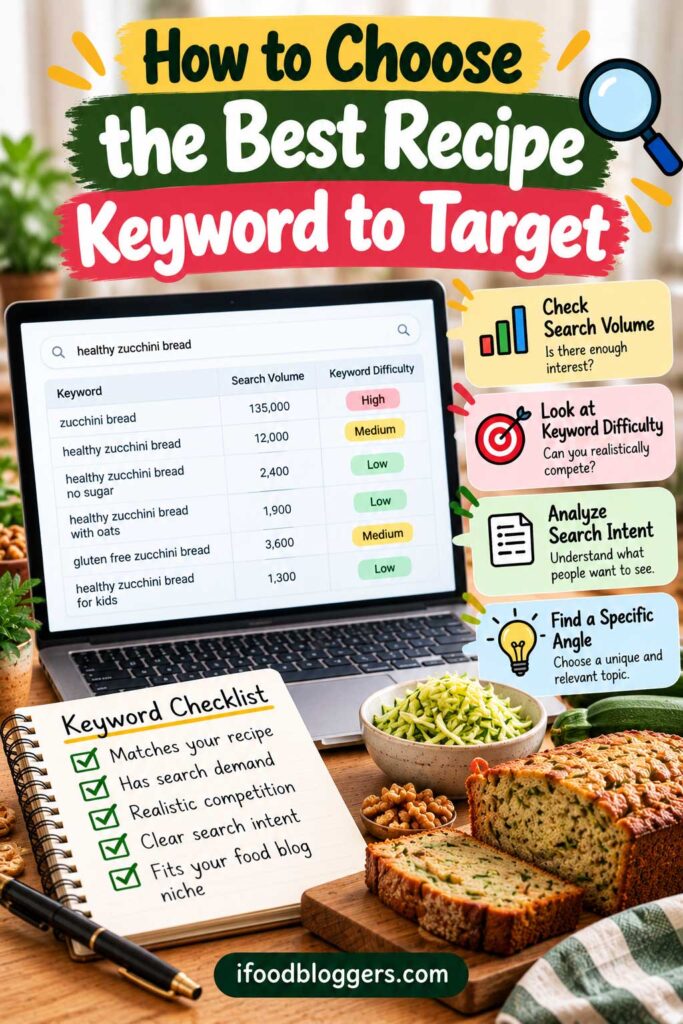
How to Choose the Best Recipe Keyword to Target
By this point, you may have a spreadsheet, notebook, or browser full of possible keywords.
The next challenge is deciding which one deserves to become the primary target for your recipe.
I would not choose based on a single metric.
Instead, look for the best combination of relevance, search demand, competition, search intent, and your ability to create a genuinely useful recipe.
1. Start With Recipe Relevance
The keyword should accurately describe what you are actually making.
This sounds obvious, but it is easy to get distracted by search volume.
Suppose you have developed a baked chicken thigh recipe with garlic, lemon, and oregano.
During your research, you find that:
Mediterranean chicken thighs
receives more searches than:
lemon oregano chicken thighs
That does not automatically make the broader keyword the better choice.
If your recipe closely matches what people expect from the second search, that relevance may be far more valuable.
Choose the keyword that fits the recipe—not the keyword you can somehow force into the title.
2. Confirm There Is Search Demand
Next, look for evidence that people actually search for the topic.
That evidence might come from:
Google Autocomplete
related searches
keyword research tools
Google Trends
Google Search Console
You do not necessarily need enormous monthly search volume.
For a newer food blog, a keyword with several hundred estimated monthly searches and realistic competition may be much more attractive than one with tens of thousands of searches dominated by powerful websites.
Also remember that your page can rank for more than its primary keyword.
A strong recipe may eventually receive traffic from many closely related searches.
3. Evaluate the First-Page Competition
Now return to Google.
This is the step I would never skip.
Look at the first page and ask:
Who is ranking?
How closely do those pages match the query?
Are smaller food blogs present?
Are some results weak, incomplete, or only loosely related?
Could my recipe provide something meaningfully better?
You are looking for an opening—not a completely empty SERP.
If Google is already showing independent food blogs alongside larger publishers, that can be a particularly useful signal.
4. Confirm Search Intent
Make sure your planned page matches what people appear to want.
If Google shows individual recipes, an individual recipe is probably appropriate.
If it shows roundups, consider whether the searcher wants multiple options.
If it shows quick informational answers, a 4,000-word recipe guide may not be necessary.
Your page format should make sense for the query.
5. Consider Your Website’s Current Strength
Keyword competition is relative.
A keyword that is unrealistic for a brand-new food blog might be perfectly reasonable for an established site with hundreds of ranking recipes.
Look at your own performance.
If your site already ranks for related topics, has strong internal content around the cuisine, and receives impressions for similar queries, you may be able to target more competitive searches.
If your site is new, starting with narrower opportunities can help you build topical relevance and organic visibility gradually.
6. Consider Business Value
Traffic is useful, but not every visitor has equal value to your food blog.
Imagine two keywords:
| Keyword | Search Volume | Competition | Relevance |
|---|---|---|---|
| chicken recipes | Very High | Very High | Broad |
| Bulgarian chicken kavarma recipe | Lower | Lower | Highly Specific |
If your website specializes in Bulgarian or Balkan recipes, the second keyword may be far more valuable to your audience even though its search volume is much smaller.
It strengthens the site’s topical focus and attracts exactly the type of reader you want.
The biggest keyword is not always the best keyword.
7. Think About Internal Linking Opportunities
A good recipe keyword can also strengthen other pages on your website.
Suppose you already have articles about:
traditional Bulgarian dishes
Bulgarian breakfast recipes
Bulgarian soups
Balkan comfort foods
Publishing a new Bulgarian recipe gives you natural opportunities to connect those pages.
Those internal links help readers discover related content and make the relationship between your articles clearer.
This is another reason I prefer building recipe clusters rather than publishing unrelated keywords simply because a research tool says they are easy.
Use a Simple Keyword Scorecard
If you are stuck between several options, score each one from 1 to 5.
| Factor | Keyword A | Keyword B | Keyword C |
|---|---|---|---|
| Recipe relevance | 5 | 4 | 5 |
| Search demand | 3 | 5 | 2 |
| Competition opportunity | 5 | 2 | 4 |
| Search intent match | 5 | 5 | 4 |
| Topical relevance to your blog | 5 | 3 | 5 |
| Total | 23 | 19 | 20 |
This is not a scientific ranking formula.
It is simply a way to stop one attractive metric—usually search volume—from controlling the entire decision.
The Best Keyword Is Usually a Balance
You are unlikely to find a keyword with massive search volume, almost no competition, perfect relevance, and weak search results.
If you do, great.
Most of the time, keyword selection involves tradeoffs.
For a growing food blog, I would generally prefer a keyword with:
clear search intent, strong relevance to the recipe, demonstrated demand, manageable SERP competition, and a natural connection to the rest of the website.
That is a much stronger foundation than simply sorting a keyword tool from lowest difficulty to highest and publishing whatever appears at the top.
Once you have chosen your primary keyword, the next step is using it correctly in the recipe post—without turning the article into awkward, repetitive SEO copy.
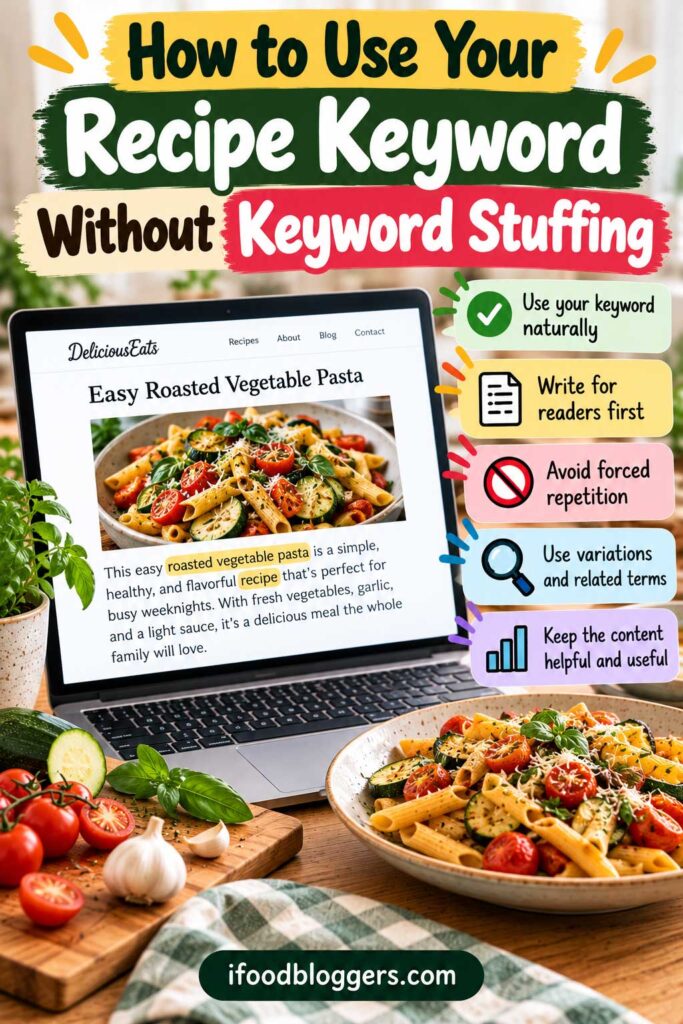
How to Use Your Recipe Keyword Without Keyword Stuffing
Once you have chosen your primary keyword, you do not need to repeat it in every paragraph.
In fact, doing that can make an otherwise useful recipe unpleasant to read. Google also lists keyword stuffing in its spam policies. More importantly for readers, forcing the same phrase into sentence after sentence makes a recipe harder and less pleasant to read.
Modern recipe SEO should focus on making the topic clear while writing naturally for the person who actually wants to cook the dish.
Use the Primary Keyword in the Important Places
If it reads naturally, include your primary recipe keyword in several prominent areas of the page.
The most useful places to consider include the SEO title, H1, URL, introduction, meta description, and a relevant subheading when the wording fits naturally.
For images, write alt text that describes what the image actually shows rather than trying to insert a keyword.
You may also use the phrase naturally throughout the recipe where it makes sense.
You do not need an exact-match keyword in every location.
For example, if your primary keyword is:
banana muffins without eggs
your title could be:
Easy Banana Muffins Without Eggs
Your introduction might say:
These banana muffins without eggs are soft, moist, and easy to make with simple pantry ingredients.
Later, you could naturally use variations such as:
eggless banana muffins
banana muffin recipe without eggs
how to make banana muffins without eggs
The reader understands that these phrases describe the same recipe. There is no need to mechanically repeat the exact keyword.
Use Secondary Keywords Where They Add Value
During your research, you probably discovered related searches.
Some may belong naturally within the recipe.
Suppose your primary keyword is:
potato soup without heavy cream
Related searches might involve:
how to make potato soup creamy without heavy cream
how to thicken potato soup without flour
can you freeze potato soup
how long does potato soup last in the fridge
These do not need to be forced into the opening paragraphs.
Instead, they can guide useful sections of the article.
For example:
How to Make Potato Soup Creamy Without Heavy Cream
or:
How to Store and Reheat Potato Soup
This creates a more complete resource while naturally covering related search intent.
Write Headings for Readers First
Avoid headings that exist only because you want another keyword on the page.
A heading such as:
Low Competition Potato Soup Recipe Keywords for Easy Potato Soup
would make no sense to someone trying to cook dinner.
Headings should help readers navigate the recipe.
Useful sections might include:
Ingredients You’ll Need
How to Make Potato Soup Without Heavy Cream
Tips for a Creamier Texture
Substitutions
How to Store Leftovers
Frequently Asked Questions
The SEO benefit comes from thoroughly covering the topic—not from turning every heading into a keyword container.
Do Not Stuff Keywords Into Image Alt Text
Food blogs often contain many images, which can lead to another common SEO mistake.
Alt text is primarily there to describe meaningful images for people who cannot see them.
If you have a photo showing finished banana muffins cooling on a wire rack, something like:
Eggless banana muffins cooling on a wire rack
could be perfectly appropriate.
You do not need:
banana muffins without eggs easy banana muffins eggless banana muffin recipe best banana muffins
That is not useful image description.
Describe what the image actually shows.
Do Not Chase a Keyword Density Percentage
SEO plugins may tell you that your focus keyword appears too few or too many times.
Treat those recommendations as editing prompts rather than absolute rules.
There is no universal percentage that every recipe needs to hit.
A natural article about banana muffins without eggs will probably mention banana muffins, eggs, ingredients, baking, texture, temperature, and related concepts without you deliberately calculating how often each phrase appears.
If the page clearly covers the recipe and answers the searcher’s questions, forcing another 15 exact-match mentions usually does not improve the article.
Avoid Writing for the SEO Plugin
SEO plugins can be useful checklists, especially when they are part of a well-organized blogging workflow. If you are still deciding which SEO, research, writing, and publishing tools you actually need, see our food blogging tech stack.
They can remind you that you forgot a meta description, missed your focus phrase in the title, or created an unusually long URL.
But a green score does not guarantee rankings.
Do not rewrite a natural sentence into something awkward simply because a plugin wants another exact-match keyword.
For example, this sounds forced:
If you are searching for low competition easy banana muffins without eggs recipe ideas, these banana muffins without eggs are the best banana muffins without eggs to make.
No reader wants that.
Write the sentence the way a human would actually say it.
Optimize the Recipe, Not Just the Text
For recipe content, useful optimization goes beyond keywords.
A strong page should make it easy for someone to successfully prepare the dish.
That may include:
clear ingredient quantities
accurate cooking times
useful process photos
specific temperatures
tested substitutions
storage and reheating instructions
troubleshooting tips
a well-structured recipe card
If someone arrives from Google and can confidently make the dish, you have done something much more valuable than hitting an arbitrary keyword-density target.
The purpose of recipe SEO keywords is to connect the right searcher with the right recipe.
Once that connection happens, the quality and usefulness of the recipe need to do the rest.
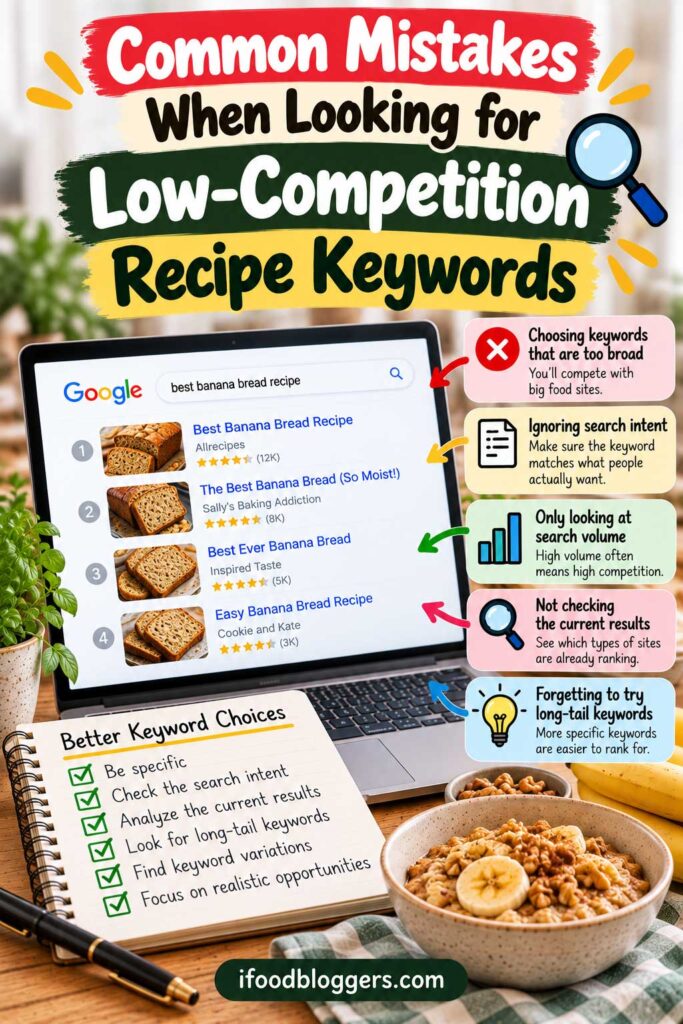
Common Mistakes When Looking for Low-Competition Recipe Keywords
Finding easier keywords does not mean searching for the lowest number in an SEO tool and publishing a recipe around it.
Some keyword opportunities look attractive at first but become much less appealing once you examine the search results, intent, or actual recipe fit.
These are the mistakes I see as the most likely to send the research in the wrong direction.
Choosing a Keyword Only Because the Difficulty Score Is Low
Keyword difficulty is useful for filtering ideas, but it should never make the decision by itself.
A tool might label a keyword as “easy” while Google shows a first page filled with highly relevant recipes from established food websites.
The opposite can happen too.
A keyword with a moderate difficulty score may have several smaller blogs ranking and an obvious gap you could fill.
Use difficulty as one signal.
Always check the actual search results before committing to the keyword.
Assuming Low Search Volume Means Low Competition
Search volume and competition are not the same thing.
A recipe keyword with only a few hundred estimated searches per month can still be highly competitive if established publishers have already created excellent content around it.
Likewise, a higher-volume query may occasionally have weaker results than expected.
Do not use search volume as a shortcut for judging difficulty.
Assuming Every Long-Tail Keyword Is Easy
A six-word search phrase can still be competitive.
For example, a specific variation of chocolate chip cookies may be targeted by dozens of major food blogs because the topic is commercially attractive and consistently popular.
Long-tail keywords are excellent places to look for opportunities, but they are not automatically low-competition food keywords.
Check the SERP.
Targeting Keywords That Do Not Match Your Recipe
This is one of the easiest ways to create a poor experience for readers.
If your recipe contains dairy, do not optimize it around a dairy-free keyword.
If it takes 75 minutes, do not target a “30-minute dinner” query.
If you use an oven, do not target an air fryer keyword simply because the search volume looks better.
The keyword should describe the recipe you actually tested.
Creating Separate Posts for Tiny Keyword Variations
Suppose you discover:
banana muffins without eggs
eggless banana muffins
banana muffin recipe no eggs
These may look like three keywords in a research tool, but they probably represent essentially the same search intent.
You usually do not need three nearly identical recipes.
A single strong page can naturally cover several variations.
Creating multiple pages around the same intent can leave you with thin, repetitive content and several URLs competing for very similar searches.
Ignoring the Sites Already Ranking
A keyword can look fantastic inside a spreadsheet until you search it.
Then you discover that the first page contains highly authoritative sites with excellent recipes that match the query perfectly.
This is why manual SERP analysis is so important.
Before spending hours testing, photographing, writing, and formatting a recipe, spend a few minutes examining what you would actually have to compete against.
Copying a Competitor’s Keyword Strategy Too Closely
Competitor research should point you toward opportunities, not give you a publishing calendar to duplicate. Another food blog may have different authority, expertise, backlinks, topical coverage, and readers.
Study what works, then do your own research and create something original that fits your site.
A competing food blog may have different authority, expertise, audience, backlinks, and topical coverage.
A keyword that works for them may not make sense for you.
More importantly, your goal should be to create original recipes and useful resources—not slightly different versions of whatever is already ranking.
Ignoring Search Intent
A low-difficulty keyword is not useful if you create the wrong type of page.
If someone searches for:
best side dishes for salmon
they probably want several ideas.
Publishing one roasted asparagus recipe may not satisfy that search.
If someone searches:
roasted asparagus recipe
an individual recipe makes much more sense.
Always look at what the searcher appears to want before deciding what to create.
Ignoring Seasonality
A recipe can appear to have very little interest simply because you research it at the wrong time of year.
Pumpkin recipes, Christmas cookies, summer salads, grilling recipes, and Thanksgiving side dishes can have dramatic seasonal patterns.
Check historical interest before dismissing a keyword.
And if you find a seasonal opportunity, try to publish before demand reaches its peak.
Picking Keywords With No Connection to Your Food Blog
It can be tempting to chase any keyword that looks easy.
But publishing random recipes purely because they have low competition can leave your site without a clear identity.
A Balkan recipe blog does not need to suddenly publish protein smoothies, dog treats, and viral air fryer desserts simply because an SEO tool identifies easy keywords.
Look for opportunities within the topics you genuinely want your website to become known for.
Over time, related content can support other recipes through internal linking and create a much more coherent resource for readers.
Forgetting About the Person Behind the Search
It is easy to reduce keyword research to numbers:
Volume: 900
Difficulty: 12
CPC: $0.40
But every search represents someone trying to accomplish something.
They may be trying to make dinner with ingredients already in the refrigerator.
They may have run out of eggs.
They may be cooking for two instead of six.
They may want to recreate a dish they remember from childhood.
Understanding that problem is often more useful than obsessing over another keyword metric.
The best keyword opportunities usually appear when you can identify a specific search need and create a recipe that genuinely solves it.
A Simple Recipe Keyword Research Workflow
Keyword research can become overwhelming when you have dozens of browser tabs, hundreds of suggestions, and several SEO tools giving you different numbers.
It does not need to be that complicated.
For most recipes, I would use a simple process that moves from the recipe itself to keyword discovery, validation, and finally publication.
Step 1: Start With the Recipe
Write down what you are actually planning to make.
Do not start with an SEO tool.
Describe the recipe in plain language, including its main ingredient, cooking method, important characteristics, and anything that genuinely makes it different.
For example:
Boneless chicken thighs cooked in an air fryer with garlic and lemon, without breading.
That description already gives you several possible directions for keyword research.
Step 2: Create a Seed Keyword
Reduce the recipe to its simplest searchable phrase.
In our example, that might be:
air fryer chicken thighs
This is your starting point—not necessarily the keyword you will ultimately target.
Step 3: Expand the Keyword
Use Google Autocomplete, related searches, People Also Ask, keyword tools, and your own brainstorming to find more specific variations.
You might discover:
boneless air fryer chicken thighs
air fryer chicken thighs without breading
lemon garlic air fryer chicken thighs
boneless skinless chicken thighs in air fryer
Save the relevant ideas.
Ignore variations that do not accurately describe your recipe.
Step 4: Check Search Demand
Use the available data to determine whether people appear to search for the topic.
Look at keyword-tool estimates, Google suggestions, Trends data, and Search Console when relevant.
You are not necessarily looking for thousands of monthly searches.
You simply want evidence that the query represents genuine interest.
Step 5: Search Each Serious Candidate in Google
Now perform the step that many people skip.
Search the keyword.
Look carefully at the first page.
Check whether the results include smaller food blogs, whether the pages match the query precisely, and whether you can identify meaningful gaps.
Do this for several of your strongest candidates.
A few minutes of SERP analysis can save you from spending hours creating a recipe around the wrong keyword.
Step 6: Confirm Search Intent
Ask what someone typing the keyword actually expects to find.
Do they want:
one recipe?
a collection of recipes?
a substitution?
a cooking-time answer?
instructions for a particular appliance?
Make sure your planned page matches that expectation.
Step 7: Compare Your Best Options
At this stage, narrow your list to two or three realistic keywords.
Compare them based on:
recipe relevance
search demand
SERP competition
search intent
topical relevance to your website
seasonality
You can use the simple scorecard from earlier if the decision is not obvious.
Step 8: Choose One Primary Keyword
Pick the phrase that best represents the recipe and gives you a realistic opportunity.
That becomes your primary keyword.
The other relevant variations do not disappear.
Some can naturally become secondary phrases, headings, FAQ questions, or supporting topics within the recipe.
You do not need a separate article for every variation.
Step 9: Create the Best Recipe You Can
Now SEO takes a supporting role.
Test the recipe.
Take useful photographs.
Write clear instructions.
Explain the parts that might confuse someone making it for the first time.
Include substitutions you have actually tested or can responsibly recommend.
Answer the questions that matter.
At this point, SEO takes a supporting role. Create the kind of recipe page you would have wanted to find when you first searched for the dish.
Step 10: Optimize and Publish
Before publishing, check the basics.
Make sure your primary keyword appears naturally in the title, URL, introduction, meta description, and other appropriate areas.
Add relevant internal links. Internal links should connect each new recipe or guide to genuinely related content, not to random posts for SEO.
Complete the recipe card.
Use descriptive image alt text where appropriate.
Preview the page on mobile.
Then publish it.
Step 11: Monitor What Google Actually Does
Keyword research does not end when you click Publish.
Once the page begins receiving impressions, check Google Search Console.
You may discover that Google associates your recipe with searches you never considered during the original research.
Some of those queries may suggest small improvements to the existing page.
Others may reveal entirely new content opportunities.
This creates a useful cycle:
Recipe idea → keyword research → SERP analysis → recipe creation → optimization → publication → Search Console data → improvement
The more content you publish, the more first-party data you have to guide the next round of research.
That is when finding low-competition recipe keywords becomes less about guessing and more about understanding what your own audience and website are already showing you.
Example: Finding a Low-Competition Recipe Keyword From Start to Finish
Let’s put the entire process together with a simple example.
Imagine you run a general food blog and want to publish a banana muffin recipe.
You could immediately target:
banana muffins
But before spending time developing the post, you decide to research whether there is a more specific opportunity.
Start With the Broad Recipe Idea
Your seed keyword is:
banana muffins
This accurately describes the recipe, but it is broad and likely to have substantial competition.
Instead of stopping there, start exploring how people search for different versions of banana muffins.
Find More Specific Variations
Google suggestions and keyword research tools might reveal variations such as:
banana muffins without eggs
banana muffins with two bananas
banana muffins without butter
small batch banana muffins
banana muffins with Greek yogurt
banana muffins without baking soda
Now you have several possible directions.
But these are only ideas.
You still need to determine whether any of them represent a realistic opportunity.
Remove Keywords That Do Not Match Your Recipe
Suppose the recipe you developed uses two ripe bananas, does not contain eggs, and uses melted butter.
That immediately eliminates some options.
You should not target banana muffins without butter because your recipe contains butter.
But these remain relevant:
banana muffins without eggs
banana muffins with two bananas
You may also find a more specific variation:
banana muffins with two bananas no eggs
Now the keyword research is starting to reflect the recipe you actually have.
Compare the Search Results
Next, search each serious candidate in Google.
Suppose the broad keyword banana muffins is dominated by major recipe publishers with highly established pages.
That does not mean your recipe could never rank, but it may not be the best primary target for a newer site.
Then you search:
banana muffins without eggs
Perhaps the results still contain some large publishers, but you also notice several independent food blogs ranking.
That is more interesting.
Next you search:
banana muffins with two bananas no eggs
The query may have lower estimated search volume, but perhaps several results do not match it precisely.
Now you may have found a stronger long-tail opportunity.
Check Search Intent
Look carefully at what Google displays.
If the results are primarily individual recipes, the intent is straightforward.
Someone searching for banana muffins without eggs wants a recipe they can make without eggs.
Your recipe fits.
If your muffins actually require no eggs and have been tested that way, you can satisfy the search directly.
Compare the Keyword Data
Your simplified research might look something like this:
| Keyword | Search Demand | Competition | Recipe Match | Opportunity |
|---|---|---|---|---|
| banana muffins | Very High | Very High | Strong | Low |
| banana muffins without eggs | Medium | Moderate | Excellent | Good |
| banana muffins with two bananas | Medium | Moderate | Excellent | Good |
| banana muffins with two bananas no eggs | Lower | Lower | Excellent | Potentially Strong |
These are illustrative rather than real keyword metrics, but they demonstrate how I would think about the decision.
Notice that the keyword with the most traffic potential is not automatically the winner.
Choose the Primary Keyword
After comparing the SERPs, suppose you determine that:
banana muffins without eggs
offers the best combination of search demand, competition, and relevance.
That becomes your primary keyword.
You might title the recipe:
Easy Banana Muffins Without Eggs
Then naturally explain that the recipe uses two ripe bananas.
This gives you the possibility of appearing for related searches without creating an awkward title such as:
Easy Banana Muffins Without Eggs With Two Bananas No Egg Recipe
Write for people.
Cover Related Questions Naturally
During your research, you may also discover questions such as:
What can replace eggs in banana muffins?
Can you make banana muffins with only two bananas?
How do you keep eggless muffins moist?
Can you freeze banana muffins?
These can guide useful sections within the recipe.
You do not need to repeat the primary keyword every time.
Answer the questions naturally.
Publish, Then Let Search Console Teach You More
After publication, the research continues.
A few months later, Search Console might show impressions for:
moist banana muffins without eggs
easy eggless banana muffins
banana muffins no egg two bananas
egg-free banana muffins
Some of those phrases may already be covered naturally.
Others may reveal a question or detail you could explain more clearly.
This is why I think of recipe keyword research as an ongoing process rather than something you do once before publishing.
You begin with the best information available.
Then actual search data helps you improve the page.
The important lesson from this example is simple:
Do not search for the keyword with the biggest number. Search for the best intersection between what people want, what your recipe genuinely provides, and what your website can realistically compete for.
FAQs About How to Find Low Competition Recipe Keywords
How Do I Find Low-Competition Keywords for a Food Blog?
Start with a recipe idea and create a basic seed keyword. Then use Google Autocomplete, related searches, keyword research tools, Google Trends, competitor research, and Google Search Console to discover more specific variations.
Once you find a promising keyword, search it in Google and examine the first-page results.
Look at who ranks, how well the existing pages match the search intent, and whether your recipe could provide something genuinely useful that is missing from the current results.
Are Long-Tail Recipe Keywords Easier to Rank For?
Sometimes, but not always.
Long-tail recipe keywords tend to have more specific search intent and may face less competition than broad recipe terms.
For example, “potato soup without heavy cream” is much more specific than “potato soup.”
However, long-tail does not automatically mean easy. Popular variations can still attract strong competition from established recipe websites.
Always check the search results before choosing the keyword.
How Much Search Volume Should a Recipe Keyword Have?
There is no minimum search volume that every food blogger should target.
A keyword with a few hundred estimated monthly searches may be valuable if it closely matches your recipe and you have a realistic chance of ranking.
Remember that a recipe page can also appear for many related searches, so the estimated volume of the primary keyword does not represent the page’s entire traffic potential.
What Is a Good Keyword Difficulty for a New Food Blog?
There is no universal keyword difficulty number that guarantees a ranking opportunity.
Difficulty scores vary between SEO tools, and each platform calculates them differently.
For a new food blog, lower-difficulty keywords can be useful places to start, but I would still manually examine Google’s first page.
Seeing smaller independent food blogs ranking can sometimes tell you more than the difficulty number itself.
Can I Find Recipe Keywords Without Paying for an SEO Tool?
Yes.
You can do a surprising amount of food blog keyword research using free resources.
Google Autocomplete, related searches, People Also Ask, Google Trends, and Google Search Console can all reveal useful opportunities.
Free and limited versions of keyword research tools can provide additional data when you need it.
Paid tools can make the process faster, but they are not required to understand search intent or evaluate a Google results page.
Should I Target More Than One Keyword in a Recipe Post?
It is usually helpful to have one clear primary keyword while naturally covering closely related searches.
For example, a recipe targeting “banana muffins without eggs” might also be relevant to searches for “eggless banana muffins” and “banana muffin recipe no eggs.”
You generally do not need separate posts for variations that represent the same intent.
Create one strong page that satisfies the topic thoroughly.
Should I Put the Exact Keyword in Every Heading?
No.
Use the primary keyword where it makes sense, particularly in important elements such as the title, introduction, and other relevant areas.
Your headings should primarily help readers understand and navigate the recipe.
Repeating an exact-match keyword in every H2 or H3 can make the article sound unnatural and does not automatically improve its ability to rank.
How Long Does It Take a Recipe to Rank on Google?
There is no fixed timeline.
A recipe may begin receiving impressions relatively quickly, while meaningful rankings can take considerably longer depending on the keyword, competition, website, internal linking, content quality, and many other factors.
Instead of expecting a particular ranking date, monitor the page in Google Search Console.
Growing impressions and appearances for relevant queries can show that Google is beginning to associate the page with the topic even before substantial clicks arrive.
Should I Update Recipe Keywords After Publishing?
Sometimes.
If Search Console shows that your recipe is gaining impressions for a relevant search you did not originally consider, you may be able to improve the page to address that intent more clearly.
That does not mean changing the primary keyword every few weeks.
Give the page time to collect useful data, then make improvements when the evidence supports them.
Keyword research should guide the recipe before publication, while real search performance can help you refine it afterward.
Low-Competition Recipe Keyword Checklist
Before you commit to a recipe keyword, run through this quick checklist:
- Does the keyword accurately describe the recipe I am creating?
- Is there evidence that people actually search for it?
- Does the Google results page match the type of content I plan to publish?
- Are smaller or independent food blogs ranking on the first page?
- Are any of the existing results incomplete or only partially relevant?
- Can I create a recipe that genuinely deserves to compete with the current results?
- Have I checked more than just the keyword difficulty score?
- Does the keyword fit the overall topic and audience of my food blog?
- Have I checked whether the search is seasonal?
- Am I targeting one primary intent instead of creating several nearly identical posts?
- Can this recipe naturally connect to other content on my site?
- Will I monitor the page in Google Search Console after publishing?
You do not need every answer to be perfect.
What you are looking for is enough evidence that search demand, recipe relevance, search intent, and realistic competition overlap.
When those pieces come together, you probably have a keyword worth pursuing.
Final Thoughts: Find Keywords You Can Realistically Compete For
Finding low competition recipe keywords is not about discovering a secret list of searches that nobody else knows about.
The real opportunity is where three things meet: people are searching for the recipe, your site has a reasonable chance to compete, and you can create something genuinely useful for the person cooking it.
Start with the recipe. Use Google to learn how people search for it, explore relevant long-tail variations, check the SERP, and validate the opportunity with the data available to you.
Use Google to learn how people search for it. Explore long-tail variations. Check keyword data, seasonality, and your own Search Console performance. Study the first page carefully before deciding that a keyword is easy simply because an SEO tool gives it a low difficulty score.
Most importantly, pay attention to search intent.
A smaller, highly specific keyword can be far more valuable to a growing food blog than a massive search term dominated by established publishers.
You do not need to win “chicken recipes” to build meaningful organic traffic.
You may have a much better opportunity with a specific cooking method, ingredient substitution, serving size, regional dish, or problem that existing results do not answer particularly well.
Then create the best resource you can around that search.
Test the recipe. Explain the difficult parts. Use helpful photos. Answer the questions a cook is likely to have. Connect the recipe to related content on your website.
And after publishing, watch what happens in Google Search Console.
The queries that begin generating impressions can tell you what Google associates with your page—and sometimes reveal your next keyword opportunity.
That creates a simple cycle:
Research → Create → Publish → Measure → Improve
The goal is not to find keywords with zero competition.
The goal is to find searches where your food blog has a realistic reason to compete—and then publish something worthy of the ranking.
Read Next: Keep Growing Your Food Blog
Finding the right keywords is only one part of building consistent search traffic. Once you know which recipe topics are worth targeting, the next step is creating useful content, optimizing your site, and developing a repeatable growth strategy.
Continue with these iFoodBloggers guides:
- Best Free Keyword Research Tools for Food Bloggers — Find free tools you can use to discover and evaluate new keyword opportunities.
- How to Get More Traffic to Your Food Blog — Explore practical ways to grow traffic through Google Search, Pinterest, email, video, internal linking, and other channels.
- Best Content Discovery Tools for Food Bloggers — Find new recipe ideas, trends, questions, and topics before planning your content calendar.
- Food Blogging Tech Stack: Essential Tools You Need — See the tools that can help you research, create, optimize, publish, and grow a food blog more efficiently.
Start with keyword research, choose topics your site can realistically compete for, and then connect those individual posts into a larger content strategy.