
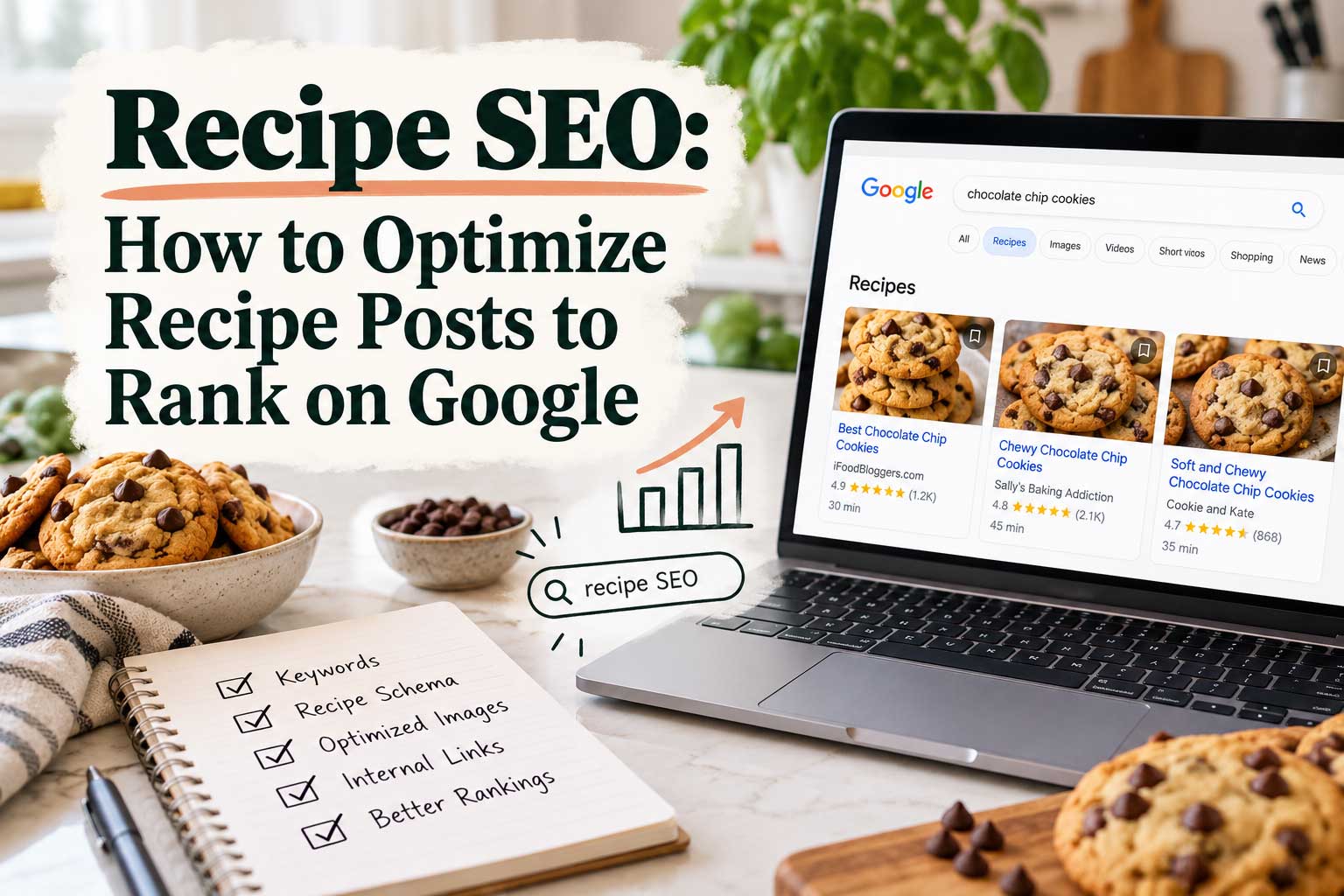
Publishing a delicious recipe doesn’t guarantee that anyone will find it on Google.
You might spend hours testing ingredients, photographing each step, and writing detailed instructions, only to discover that your recipe barely receives any search traffic.
That’s where recipe SEO comes in.
Recipe SEO helps search engines discover and understand your recipes while making them easier for people to find and follow. It combines keyword research, useful cooking instructions, recipe schema markup, optimized photographs, internal linking, and a website that works well on mobile devices.
But good recipe SEO isn’t about repeating keywords or writing unnecessarily long articles. It’s about understanding what people are searching for and providing a recipe that meets their expectations.
In this guide, you’ll learn how to optimize recipe posts for Google, from choosing the right keywords and writing SEO-friendly titles to improving recipe cards, images, and structured data. We’ll also cover common mistakes, updating older recipes, and tracking results in Google Search Console.
Whether you’re starting your first food blog or improving an established recipe collection, these techniques will help you build a stronger foundation for organic search traffic.
New to recipe SEO? Start with keyword research, search intent, a clear recipe title, accurate cooking instructions, and a properly configured recipe card. Once those fundamentals are in place, work through image optimization, internal linking, and Google Search Console. You don’t have to optimize everything in one day.
What Is Recipe SEO?
Recipe SEO (search engine optimization) is the process of improving recipe pages so search engines can understand their content and display them for relevant searches.
Imagine you’ve published a homemade chicken soup recipe with beautiful photographs and clear cooking instructions. However, you’ve titled the article My Favorite Soup for Cold Winter Days.
That title might appeal to regular readers, but it doesn’t clearly identify the dish for someone searching for a homemade chicken soup recipe.
A more descriptive title, such as Homemade Chicken Soup Recipe with Vegetables, immediately communicates what the page offers.
Of course, recipe SEO involves more than choosing the right title. Your recipe should include accurate ingredients, helpful instructions, appropriate structured data, and photographs that represent the finished dish.
Readers should also be able to find the recipe card quickly, understand the cooking process, and navigate your website without unnecessary distractions.
When these elements work together, your recipes become easier to discover and more useful to the people preparing them.
Affiliate Disclosure: Some links in this article may be affiliate links. If you make a purchase or sign up through one of these links, iFoodBloggers may earn a commission at no extra cost to you.
How Is Recipe SEO Different From Regular Blog SEO?
Recipe SEO shares many principles with traditional blog SEO, including keyword research, descriptive headings, internal linking, and mobile-friendly website design.
The biggest difference is that recipe pages contain specialized cooking information, including ingredients, preparation times, servings, and step-by-step instructions.
Search engines can interpret this information through Recipe structured data, also called recipe schema markup.
When implemented correctly, recipe schema can make eligible pages appear with enhanced features in Google Search, such as photographs, cooking times, or ratings. However, structured data doesn’t guarantee higher rankings or special search appearances.
For food bloggers, successful recipe SEO means combining traditional search optimization with accurate recipe information and a helpful cooking experience.
Why Recipe SEO Matters for Food Bloggers
Organic search can become one of the most valuable long-term traffic sources for a food blog.
Unlike social media posts that may receive attention for only a short period, a well-optimized recipe can continue attracting visitors from Google months or even years after publication.
Imagine publishing a traditional Greek tzatziki recipe. Sharing it on Pinterest, Facebook, or Instagram might generate an initial wave of visitors. But if the recipe also ranks for relevant Google searches, it can reach people who are actively looking for instructions to prepare that dish.
Those visitors arrive with a clear purpose, making them a valuable audience for your food blog.
Over time, a collection of useful recipes can help you build organic traffic, introduce readers to related dishes, grow your email list, and create opportunities for advertising or affiliate income.
However, recipe SEO is competitive, especially for popular dishes such as pancakes, lasagna, and chocolate chip cookies. Success depends on choosing relevant keywords, understanding search intent, and publishing recipes that genuinely help readers.
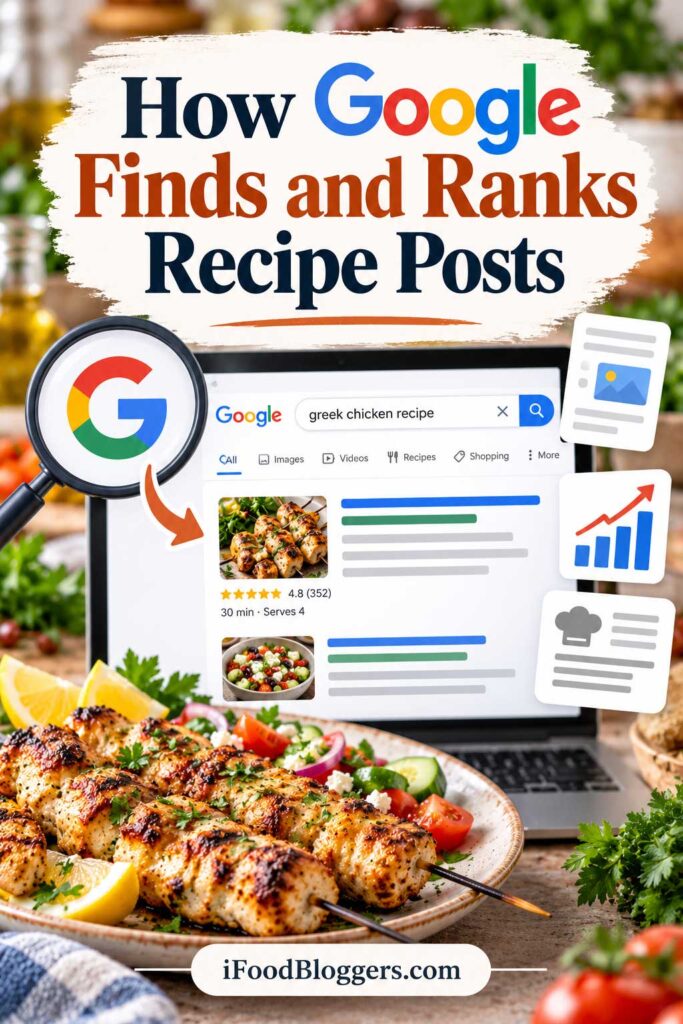
How Google Finds and Ranks Recipe Posts
Publishing a new recipe doesn’t mean it will immediately appear in Google’s search results.
Google first needs to discover your page, crawl its content, and determine whether to include it in its search index. Once indexed, the recipe may appear for relevant searches, but its position depends on factors such as search intent, content quality, and relevance.
Understanding this process helps you identify why a recipe might not appear in Google and which improvements are worth making.
Let’s look at the main stages.
1. Google Discovers Your Recipe Through Crawling
Google uses automated crawlers to discover pages through XML sitemaps, internal links, category pages, and links from other websites.
For example, if you publish a homemade Greek spinach pie recipe, linking to it from your Greek recipes category and a related article about traditional Greek dishes gives both readers and search engines additional ways to discover it.
This is why internal linking matters. Recipes buried deep within your website, with few or no internal links, can be harder to discover.
You can also use Google Search Console to inspect a new recipe URL and request indexing. However, requesting indexing doesn’t guarantee that Google will include the page in its search results.
2. Google Processes and Indexes Your Recipe
After crawling a recipe page, Google processes its content to understand what it’s about. This includes examining the title, headings, text, images, links, and structured data.
For food blogs, clearly identifying the dish, ingredients, cooking method, and instructions helps communicate what the recipe offers.
A properly configured recipe card, accurate measurements, original photographs, and helpful cooking tips also make the page more useful for readers.
However, more content doesn’t automatically mean better rankings. A concise, well-tested recipe can be more valuable than a lengthy post filled with unnecessary information.
If Google decides to index the page, it becomes eligible to appear in relevant search results. Indexing itself doesn’t guarantee visibility or high rankings.
3. Google Matches Recipes With Search Intent
Google aims to show recipes that match what people are actually searching for. This is called search intent.
For example, consider these searches:
- “Greek chicken soup recipe”
- “Greek chicken soup with lemon and egg”
- “Easy Greek chicken soup without eggs”
Although similar, each search suggests a different expectation.
Someone looking for traditional Greek avgolemono soup may expect the classic egg-and-lemon mixture, while someone searching for an egg-free version needs a different preparation method.
That’s why recipe SEO starts with understanding search intent, not simply adding keywords to your content.
Choose keywords that accurately describe the dish you’ve prepared, its ingredients, and its cooking method. Trying to rank one recipe for every possible variation usually makes the content less useful.
4. Google Evaluates the Quality and Usefulness of Your Content
Google’s ranking systems aim to reward helpful, reliable content that satisfies readers’ needs.
For food bloggers, that means publishing accurate, well-tested recipes with instructions people can confidently follow.
Your cooking experience can make a real difference. Knowing when a sauce has thickened, how to prevent batter from becoming too dense, or which ingredient substitutions actually work helps readers avoid common mistakes.
Instead of writing “cook until ready,” provide specific guidance:
“Simmer the sauce for 12–15 minutes, stirring occasionally, until it thickens enough to coat the back of a spoon.”
This gives readers both an estimated cooking time and a clear visual cue.
Include helpful troubleshooting tips, tested substitutions, and storage instructions when relevant. If a tip doesn’t help someone cook the dish, it probably doesn’t need to be there.
5. Google May Display Your Recipe in Special Search Features
Unlike ordinary blog posts, recipes may qualify for enhanced Google search appearances featuring food photographs, cooking times, ratings, and other recipe details.
Google uses Recipe structured data (schema markup) to better understand information such as ingredients, cooking instructions, preparation times, and images.
Adding valid Recipe schema can make your content eligible for supported rich results, but it doesn’t guarantee special placement or higher rankings.
Your recipe must still be relevant, helpful, and consistent with Google’s Recipe structured data guidelines.
We’ll cover schema implementation and testing in detail later in this guide.
6. Your Website’s Technical Health Also Matters
Even a well-written recipe can struggle if your website has technical problems, such as slow mobile performance, broken internal links, blocked resources, or an accidental noindex directive.
Food blogs are particularly vulnerable to performance issues because of large photographs, recipe plugins, advertising scripts, and other WordPress features.
You don’t need to remove every plugin or sacrifice useful functionality. Instead, focus on keeping your website fast, mobile-friendly, accessible, and easy for search engines to crawl.
Tools such as Google PageSpeed Insights can help identify performance issues worth addressing.
Does Google Prefer Long Recipe Posts?
Not necessarily. Google doesn’t require a specific word count for recipe pages.
A simple cucumber salad might only need accurate ingredients, clear instructions, and a few serving suggestions. A sourdough bread recipe, however, may benefit from detailed photographs, fermentation schedules, and troubleshooting advice.
The ideal length depends on the complexity of the dish and what readers need to prepare it successfully.
Focus on making your recipe genuinely useful, not unnecessarily long. A concise, well-tested recipe can be more valuable than thousands of words that don’t help someone cook.
Once you understand how Google discovers and evaluates recipes, the next step is choosing the right keywords to target.
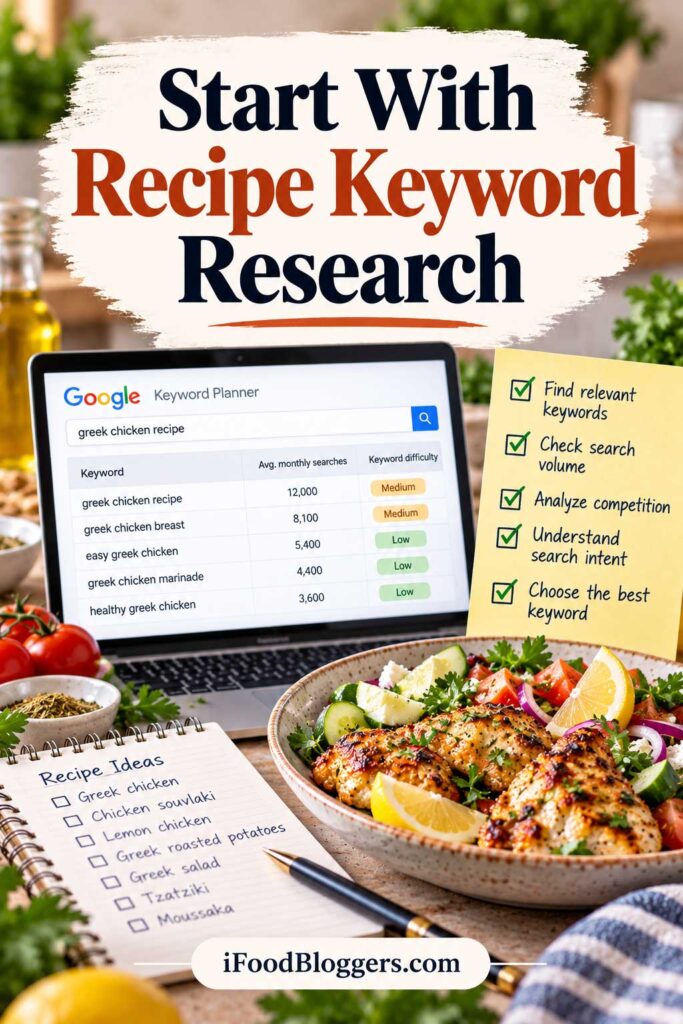
Start With Recipe Keyword Research
One of the most important steps in recipe SEO happens before you write your first paragraph: choosing the right keyword.
Imagine you’ve developed a traditional Bulgarian banitsa recipe. Should you target “Bulgarian banitsa recipe,” “Bulgarian cheese pastry,” or “traditional banitsa”?
Recipe keyword research helps you understand which phrases people search for, how competitive those searches may be, and whether they accurately describe your dish.
For food bloggers, the goal isn’t always to target the keyword with the highest search volume. A specific, relevant phrase may offer a better opportunity than a broad, highly competitive search such as “chicken recipes.”
Start with keywords that match your ingredients, cooking method, or regional variation. For a detailed walkthrough, see our guide to finding low-competition recipe keywords.
Start With the Recipe You’re Actually Making
Instead of choosing a popular keyword and forcing a recipe to match it, start with the dish you’ve actually prepared.
For example, if you’ve developed a traditional Bulgarian tarator soup with yogurt, cucumbers, garlic, dill, and walnuts, your primary keyword might be “tarator recipe.”
Related searches could include “Bulgarian cold cucumber soup,” “Bulgarian yogurt soup,” and “tarator soup recipe.”
Although these phrases describe a similar dish, they may attract different audiences. Someone searching for “tarator recipe” may already know Bulgarian cuisine, while another person searching for “Bulgarian cold cucumber soup” may be discovering it for the first time.
Choose a primary keyword that accurately describes your recipe, then incorporate relevant variations naturally.
You don’t need separate posts for every keyword variation. When searches share the same intent, one helpful recipe can often address them together.
Use Google Search Suggestions to Discover Recipe Keywords
Google itself is one of the easiest places to discover recipe keyword ideas.
Start typing your dish into Google Search and examine the autocomplete suggestions. For example, searching for “chicken soup recipe” may reveal variations involving specific ingredients, cooking methods, or dietary preferences.
You can also explore related searches and the questions Google displays to understand what people want to know about a dish.
These suggestions are useful for discovering new topics, but they don’t tell you how many people search for a keyword each month or how difficult it will be to rank.
Use Google suggestions to generate ideas, then evaluate their relevance and competition before choosing your primary keyword.
Find Long-Tail Recipe Keywords
Broad searches such as “pasta recipe” or “chicken dinner” can be highly competitive, particularly for newer food blogs.
Instead, consider more specific searches that accurately describe your dish.
For example, “Greek lemon chicken with potatoes” targets a clearer cooking intention than the broad keyword “chicken recipe.”
These specific searches are often called long-tail keywords. They commonly reflect particular ingredients, cooking methods, regional variations, or dietary requirements.
A recipe for crispy oven-baked zucchini fritters, for instance, may be a better match for a focused search than a general page about zucchini recipes.
The important thing is to choose keywords that genuinely describe your recipe. Don’t label a dish gluten-free, dairy-free, or suitable for another dietary restriction unless its ingredients and preparation support that description.
Analyze the Recipes Already Ranking on Google
Before targeting a recipe keyword, search for it on Google and examine the pages already ranking.
Look at the types of recipes appearing in the results. Are they traditional dishes, quick variations, or recipes using a specific cooking method? Pay attention to photographs, ingredient substitutions, and cooking instructions to understand what readers expect.
For example, if you’re targeting “easy homemade pita bread” but most leading results use yeast, your quick no-yeast version may be better suited to a more specific keyword.
Also notice whether smaller food blogs appear alongside established recipe websites. Their presence can provide useful context about competition, although it doesn’t guarantee your recipe will rank.
The goal isn’t to copy competing recipes. It’s to understand search intent and identify opportunities to make your own content more helpful, accurate, and practical.
Use Keyword Research Tools for Additional Insights
Google suggestions are useful for discovering recipe ideas, but dedicated SEO tools can help you evaluate search demand and competition.
Platforms such as Semrush, Ahrefs, and Moz provide estimated search volumes, related keywords, and difficulty metrics.
For established food blogs, Google Search Console is especially valuable because it shows actual searches generating impressions and clicks for your website.
For example, a Greek chicken recipe might already receive impressions for an ingredient combination you haven’t emphasized. That could reveal an opportunity to clarify your title or add a genuinely helpful cooking tip.
Remember that third-party search-volume estimates and keyword difficulty scores aren’t exact measurements. Use them to guide your research, not as guarantees of ranking success.
Choose One Primary Keyword for Each Recipe
After researching your options, choose one primary keyword that accurately describes your recipe.
For example, a post targeting “Greek lemon potatoes” might naturally include related phrases such as “roasted Greek potatoes” or “lemon garlic potatoes” when they accurately describe the dish.
Use your primary keyword in the recipe title and naturally near the beginning of your content. Descriptive headings, ingredient information, and cooking instructions can reinforce the topic without unnecessary repetition.
Avoid keyword stuffing. Your priority should be helping readers find, understand, and successfully prepare the recipe.
Avoid Targeting Multiple Recipes With the Same Keyword
Publishing several nearly identical recipes targeting the same search can create unnecessary competition between your own pages.
For example, “Easy Greek Tzatziki Recipe,” “Best Homemade Tzatziki Recipe,” and “Authentic Greek Tzatziki Recipe” may target similar searches if their ingredients and instructions are almost identical.
This overlap is commonly called keyword cannibalization, although related pages don’t automatically cause ranking problems.
A traditional tzatziki recipe, a dairy-free cucumber dip, and a thicker tzatziki variation for gyros can each justify a separate article when they offer genuinely different preparations.
Before publishing another variation, consider whether it provides something meaningfully new. Otherwise, updating your existing recipe may be the better choice.
Build a Recipe Keyword Strategy Around Your Food Blog
Recipe keyword research becomes more valuable when you plan content around related topics rather than individual posts.
For example, a food blog focused on Greek and Balkan cooking could build collections around traditional soups, grilled meats, savory pastries, vegetable dishes, and regional desserts.
Each recipe targets a specific search while strengthening a broader collection of related content.
A well-organized Greek recipes category also helps visitors discover more dishes and creates natural internal linking opportunities between relevant recipes.
This approach makes it easier to identify content gaps, plan future recipes, and avoid publishing multiple articles targeting the same search intent.
Before choosing your next keyword, check whether the recipes currently ranking on Google match the dish and cooking method you intend to share.
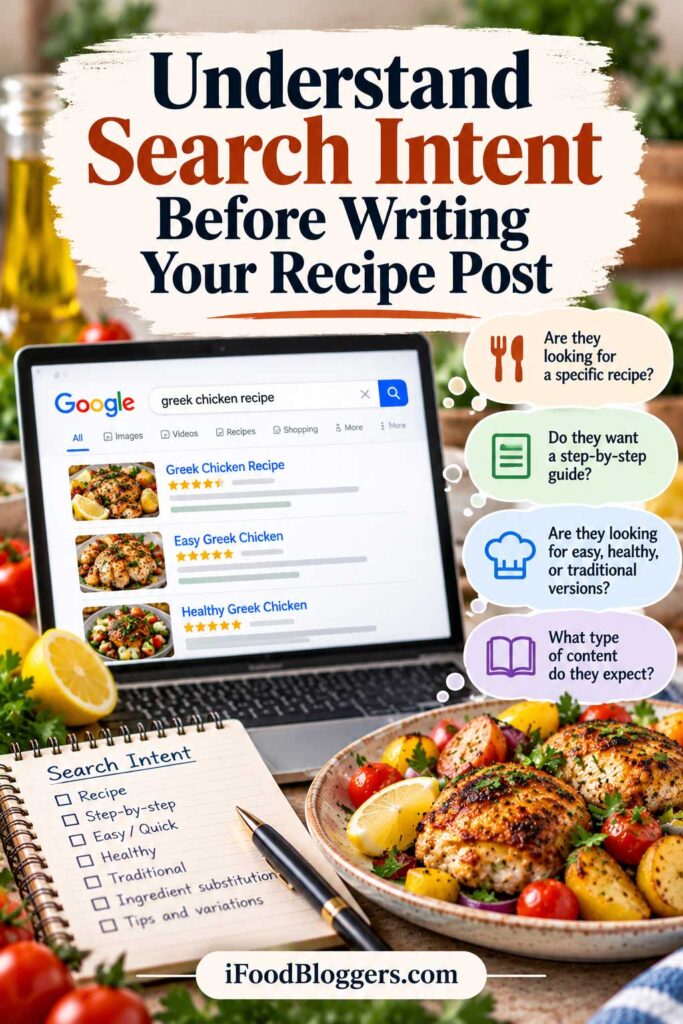
Understand Search Intent Before Writing Your Recipe Post
Choosing the right keyword isn’t just about search volume or competition. Your recipe also needs to match what people expect to find.
This is called search intent, and small differences in ingredients, cooking methods, or preparation times can change what someone wants.
For example, someone searching for “crispy oven-roasted potatoes” expects a different preparation method from someone looking for “air fryer potatoes.”
Similarly, “easy chicken dinner” suggests a convenient meal, while “traditional Greek chicken souvlaki” points to a specific dish featuring marinated chicken, typically cooked on skewers.
Both searches involve familiar ingredients, but their expectations are different.
Effective recipe SEO means choosing keywords that accurately reflect the dish you’ve prepared, rather than changing your recipe to fit a popular search term.
Identify What People Really Want From a Recipe
Most recipe searches have a practical goal, but the details reveal what readers expect.
Someone searching for “homemade pizza dough” may be comfortable waiting for the dough to rise, while “pizza dough without yeast” suggests a different preparation method.
Similarly, “traditional Bulgarian banitsa” emphasizes an authentic regional dish, while “easy banitsa with store-bought phyllo” focuses on convenience.
Consider whether your target audience expects a traditional recipe, quicker preparation, fewer ingredients, or a specific dietary variation.
Make sure your recipe delivers what its title promises. For example, don’t advertise “30-minute lasagna” if preparing and cooking it actually takes an hour.
Accurate descriptions help readers choose recipes that fit their needs.
Study Google’s Search Results for Clues
Google’s existing search results can help you understand what readers expect from a particular recipe keyword.
For example, searching for “crispy roasted potatoes” may reveal recipes emphasizing oven temperature, seasoning, and techniques for achieving a crispy texture.
If the results mainly feature air fryer recipes while yours uses a conventional oven, consider whether a more specific keyword would better describe your dish.
Look for recurring ingredients, cooking methods, preparation times, and questions addressed by competing recipes.
These patterns can reveal useful opportunities, but don’t change your recipe simply to imitate the highest-ranking pages.
Search results vary and change over time, so treat them as research rather than strict instructions.
Match Your Recipe Format to Search Intent
Search intent should influence not only your recipe title but also the information you include.
Someone searching for “easy homemade hummus” may want simple ingredients, quick blending instructions, and tips for achieving a smooth consistency. Explaining whether canned chickpeas work or how to fix overly thick hummus can make the recipe more helpful.
A traditional Greek moussaka recipe, however, may require detailed instructions for preparing eggplant, making meat sauce, assembling the layers, and achieving the right béchamel consistency.
Both recipes need clear instructions, but they don’t need identical article structures.
Let the complexity of the dish and your readers’ questions determine how much supporting information to include.
Don’t Confuse Informational Searches With Recipe Searches
Not every food-related search comes from someone who wants to cook.
For example, “what is tzatziki” suggests someone wants to learn about the dish, while “tzatziki recipe” indicates an interest in preparing it.
A recipe post can briefly explain the dish’s ingredients and origins, but its main purpose should remain helping readers make the recipe.
Broader topics may deserve separate informational articles. For example, a guide to traditional Greek sauces could explain different varieties and link to individual recipes.
This creates useful internal linking opportunities while allowing each article to satisfy a distinct search intent.
Use Search Intent to Make Your Recipe More Helpful
Understanding search intent helps you identify which cooking tips readers actually need.
For crispy baked chicken wings, that might mean explaining how to prevent soggy skin. For homemade bread, it could involve recognizing when the dough has risen enough. A traditional Balkan pastry recipe may benefit from guidance on choosing the right cheese or pastry sheets.
These practical details make recipes more valuable than simply listing ingredients and instructions.
You don’t need to answer every possible question about a dish. Focus on helping readers prepare, troubleshoot, and serve your particular recipe with confidence.
Search Intent Can Change With the Season
Recipe searches often follow seasonal patterns. Pumpkin desserts may attract more interest in autumn, while grilling recipes typically become more popular during warmer months.
Holiday searches can also reveal different expectations. Someone looking for “traditional Christmas cookies” may want culturally familiar recipes, while “easy Christmas cookies for kids” suggests simpler preparation.
Google Trends can help you explore seasonal search interest and compare related keywords.
Use these insights to plan when to publish or update relevant recipes, rather than changing a dish simply to attract seasonal traffic.
A Simple Search Intent Check Before Publishing
Before publishing, ask yourself:
If someone searched for my primary keyword and landed on this page, would they immediately recognize the recipe they wanted?
Your title, photographs, introduction, and recipe card should all match that expectation.
For example, a recipe advertised as an easy five-ingredient dinner shouldn’t require twelve ingredients and two hours of preparation. Similarly, if you describe a dish as traditional, explain what makes it authentic to that culinary tradition.
Matching search intent doesn’t mean copying competing recipes. Original photographs, tested cooking methods, and helpful explanations can make your content distinctive while still meeting readers’ expectations.
Looking for your next recipe idea? Explore our guide to content discovery tools for food bloggers to research seasonal interests, emerging trends, and new content opportunities.
Once you’ve confirmed that your recipe matches its target keyword, you’re ready to optimize its title and URL.
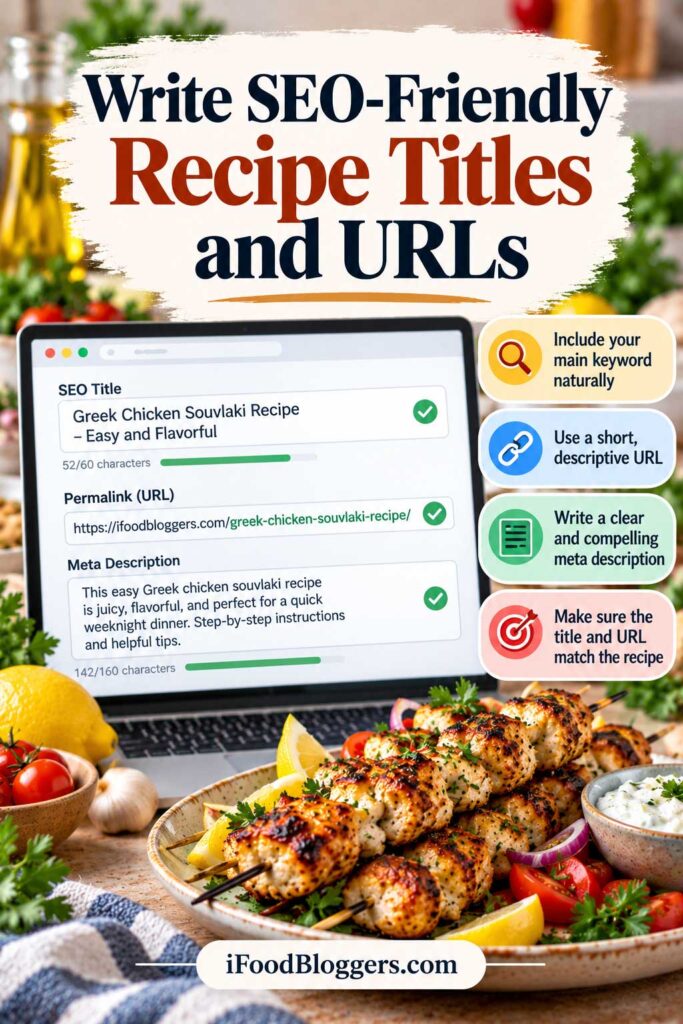
Write SEO-Friendly Recipe Titles and URLs
Your recipe title helps readers and search engines understand what you’re cooking. A strong title should clearly identify the dish, include your primary keyword naturally, and highlight a useful characteristic when appropriate.
Your URL should be equally descriptive, using a short, readable structure that reflects the recipe’s main topic.
Neither guarantees higher rankings, but both help communicate what readers can expect from your content.
Include Your Primary Keyword in the Recipe Title
Start with the name of the dish rather than a vague or overly creative description.
For example, “My Family’s Favorite Sunday Side Dish” doesn’t tell someone searching Google that you’ve prepared Greek lemon potatoes.
A clearer title would be:
Greek Lemon Potatoes Recipe (Crispy and Easy)
This identifies the dish while highlighting qualities readers may appreciate. “Traditional Greek Lemon Potatoes” could also work if the preparation genuinely reflects a traditional version.
Avoid adding descriptions such as “authentic,” “healthy,” “quick,” or “easy” unless they’re accurate.
The best recipe title describes what readers will actually make, without exaggerating or stuffing in extra keywords.
Understand the Difference Between Your H1 and SEO Title
WordPress SEO plugins such as Rank Math and Yoast SEO let you customize your SEO title separately from your visible article heading.
Your H1 is the main heading readers see on the page, while your SEO title (HTML title tag) is used by browsers and may appear in Google search results.
For example:
H1: Traditional Bulgarian Banitsa Recipe with Feta Cheese
SEO Title: Bulgarian Banitsa Recipe – Traditional Cheese Pastry
Both describe the same dish, but the SEO title helps readers unfamiliar with banitsa understand what they’re looking at.
You don’t need different titles for every recipe. If your H1 already describes the dish clearly, it may work perfectly well as your SEO title.
Google can also generate a different title link in search results, so accuracy and clarity matter more than creating two variations simply for SEO.
Keep Recipe Titles Clear and Easy to Read
Avoid overloading recipe titles with unnecessary adjectives or repeated keywords.
For example:
“Best Ever Amazing Easy Homemade Traditional Greek Lemon Chicken Recipe with Potatoes for Dinner”
A clearer alternative is:
Greek Lemon Chicken and Potatoes (Easy Oven Recipe)
The shorter version identifies the dish and cooking method without overwhelming readers.
Google doesn’t enforce a strict character limit for title tags, but long titles may be truncated in search results depending on the device and available display space.
Put the most important information first, and keep your title natural rather than forcing it into an arbitrary character count.
Use Descriptive Words Only When They Add Value
Words such as “oven-baked,” “no-yeast,” “one-pot,” and “air fryer” can help readers identify the cooking method or preparation style.
For example, “Crispy Baked Zucchini Fritters” tells readers more than “Zucchini Fritters Recipe” by describing both the texture and cooking method.
However, only use descriptions that accurately reflect your dish. Don’t call a recipe “baked” if it’s fried or “quick” if it requires hours of preparation.
Choose descriptive words that help readers understand your recipe, not simply make the title more appealing.
Create Short, Descriptive Recipe URLs
A recipe URL should clearly identify the dish without unnecessary words or complicated formatting.
For example:
Recommended URL:
Less helpful URL:
The shorter version is easier to read, remember, and share.
For new WordPress recipe posts, use lowercase words separated by hyphens. A simple slug based on the dish name is usually enough.
You generally don’t need publication dates, categories, or multiple keyword variations in the URL.
Important: If an existing recipe URL is already indexed and receiving traffic, don’t change it simply to make it shorter. If a URL change is necessary, implement a permanent 301 redirect from the old address to the new one.
Should You Include the Word “Recipe” in Your URL?
Including “recipe” in your URL is optional. Both /homemade-tzatziki/ and /homemade-tzatziki-recipe/ clearly describe the content.
Neither structure automatically provides a ranking advantage.
Use “recipe” when it improves clarity, but don’t add it simply to satisfy an SEO plugin’s focus keyword recommendation.
Choose a consistent URL structure that makes sense for your food blog.
Avoid Changing URLs That Already Perform Well
If an older recipe already receives Google traffic, don’t change its URL simply because you’re updating the content.
For example, improving your homemade baklava recipe with better photographs, clearer instructions, and additional cooking tips doesn’t require a new web address.
Changing an established URL can disrupt existing links and require search engines to process the new address.
If a change is necessary, implement a permanent 301 redirect, update internal links, and verify that the new page is accessible and indexable.
For most recipe updates, keeping the existing URL is the simpler approach.
Optimize Your Recipe Meta Description
A meta description summarizes your recipe for potential visitors. Although it isn’t a direct Google ranking factor, a clear description can make your search listing more appealing when Google displays it.
For example:
Recipe: Homemade Greek Tzatziki
Meta Description: Make creamy Greek tzatziki with yogurt, cucumber, garlic, and fresh dill. Follow this easy recipe for a refreshing Mediterranean dip.
This description identifies the dish, highlights its main ingredients, and gives readers a reason to visit.
Avoid keyword stuffing, exaggerated claims, or descriptions that don’t match the recipe.
Google may generate a different search snippet depending on the query, but writing a relevant meta description remains a useful publishing practice.
Keep Your Recipe Title, URL, and Content Consistent
Your SEO title, URL, and recipe instructions should accurately describe the same dish.
For example, a recipe titled “Vegan Chocolate Cake” shouldn’t require eggs or dairy ingredients. Similarly, a URL containing “air-fryer-chicken-wings” should lead to a recipe with air fryer instructions.
You can include alternative cooking methods or ingredient substitutions, but the main recipe must deliver what its title promises.
Consistency helps readers understand what they’re getting and builds trust in your food blog.
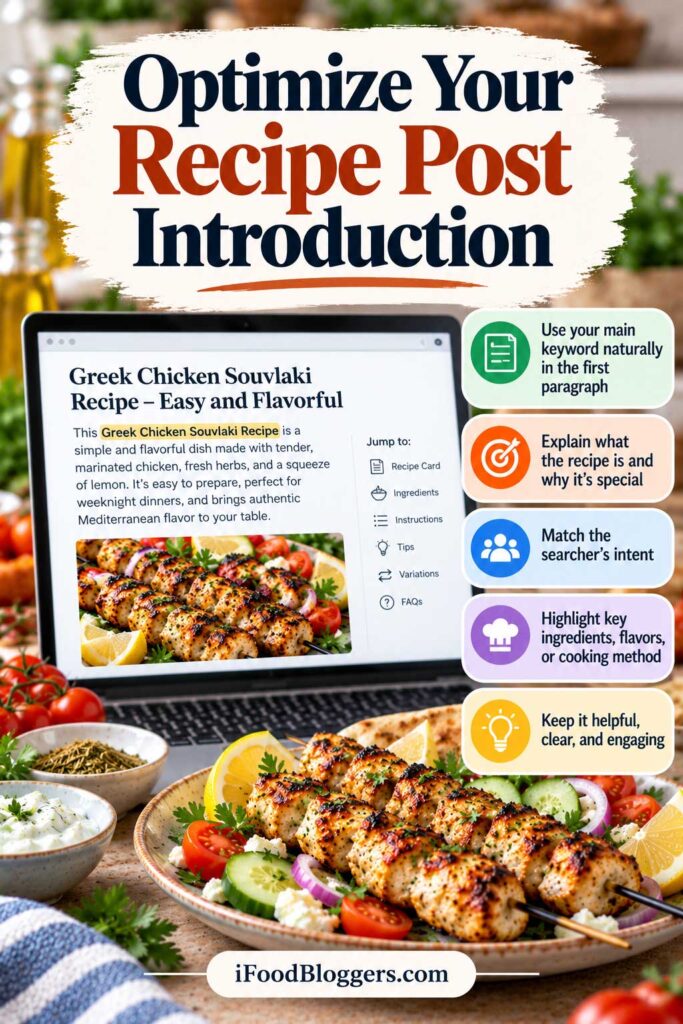
Optimize Your Recipe Post Introduction
Your recipe introduction should quickly tell readers what they’re making, why it’s worth trying, and what to expect.
It also helps search engines understand the dish when you naturally include relevant recipe terms.
Avoid lengthy personal stories that delay the actual recipe or generic introductions filled with repeated keywords.
A strong introduction answers one simple question: Is this the recipe I’m looking for?
Aim for a few useful paragraphs that describe the dish, highlight its main characteristics, and encourage readers to continue.
Mention Your Primary Recipe Keyword Naturally
Identify your dish clearly within the opening sentences rather than making readers guess what you’re preparing.
For example, an introduction targeting “Greek chicken souvlaki” might say:
“This Greek chicken souvlaki recipe combines tender chicken with olive oil, lemon juice, garlic, and oregano. The marinated chicken is threaded onto skewers and grilled until lightly charred and juicy.”
This introduction naturally includes the primary keyword while explaining the ingredients, cooking method, and expected result.
Compare that with a generic opening about loving Mediterranean food or enjoying summer gatherings. Although personal stories can add character, they shouldn’t prevent readers from immediately understanding the recipe.
Mention your primary keyword naturally, then focus on describing the dish rather than repeating the same phrase throughout the introduction.
Explain What Makes Your Recipe Worth Trying
After introducing the dish, briefly explain what makes your version appealing.
Perhaps you’ve developed a faster preparation method, improved the texture, or tested an ingredient combination that works particularly well.
For example, a homemade hummus recipe might highlight its smooth, creamy consistency, while a traditional Bulgarian banitsa recipe could emphasize the contrast between crisp phyllo pastry and a soft cheese filling.
These details help readers understand what to expect.
Avoid exaggerated claims such as “the world’s best recipe” or “guaranteed perfect results.” Specific details from your own cooking experience are more convincing than unsupported promises.
Keep Personal Stories Relevant to the Recipe
Personal stories can add character to a food blog, especially when they explain a traditional technique, family recipe, or ingredient choice.
For example, describing how a family member taught you to prepare homemade bread can provide useful context.
However, lengthy stories shouldn’t delay access to the ingredients and cooking instructions.
Introduce the dish first, then share personal details that genuinely contribute to the recipe. Longer stories can appear later in the article if they’re important to your readers.
Your personality makes your food blog distinctive, but the recipe should remain the main focus.
How Long Should a Recipe Introduction Be?
There’s no ideal word count for every recipe introduction.
A simple salad might need only two short paragraphs, while a traditional dish with unfamiliar ingredients may benefit from additional explanation.
As a practical guideline, 80–150 words is often enough for a straightforward recipe introduction, although Google doesn’t require a specific length.
Focus on answering three questions: What is the dish? What makes your version distinctive? What should readers expect when preparing it?
If your introduction answers those questions clearly, there’s usually no reason to make it longer.
Make Your Introduction Easy to Read on Mobile
Many readers access recipes on their phones while shopping or cooking, so introductions should be easy to scan.
Use short paragraphs, straightforward language, and minimal unnecessary formatting. There’s no need to bold every occurrence of your primary keyword.
Readers should be able to move easily from the introduction to the ingredients, instructions, and other useful recipe information.
Prioritize readability over keyword repetition or lengthy explanations.
Should You Add a Jump to Recipe Button?
A Jump to Recipe button lets readers go directly to the recipe card without scrolling through photographs, personal stories, or additional cooking tips.
It’s particularly useful for returning visitors who only need to check ingredients or cooking instructions.
Many WordPress recipe plugins offer this feature. Although a Jump to Recipe button isn’t a direct Google ranking factor, it can improve usability by making essential information easier to access.
For longer recipe posts, consider placing the button near the beginning of the article.
Readers can still explore your photographs, substitutions, and troubleshooting advice whenever they need more detail.
Example of an SEO-Friendly Recipe Introduction
Here’s how these principles work in practice.
Recipe Title: Greek Lemon Potatoes Recipe (Crispy Oven-Roasted Potatoes)
“These Greek lemon potatoes are roasted with olive oil, fresh lemon juice, garlic, and oregano until tender inside with golden, lightly crisp edges. They’re a flavorful Mediterranean side dish that pairs well with grilled chicken, fish, or roasted vegetables.
The potatoes cook in a lemony broth that adds flavor before the liquid reduces and the edges begin to brown. I’ll show you how to cut, season, and roast them for the best texture.”
This introduction works because it identifies the dish, describes its ingredients and cooking method, and explains what readers can expect.
It includes relevant keywords naturally without exaggerated claims or unnecessary background information.
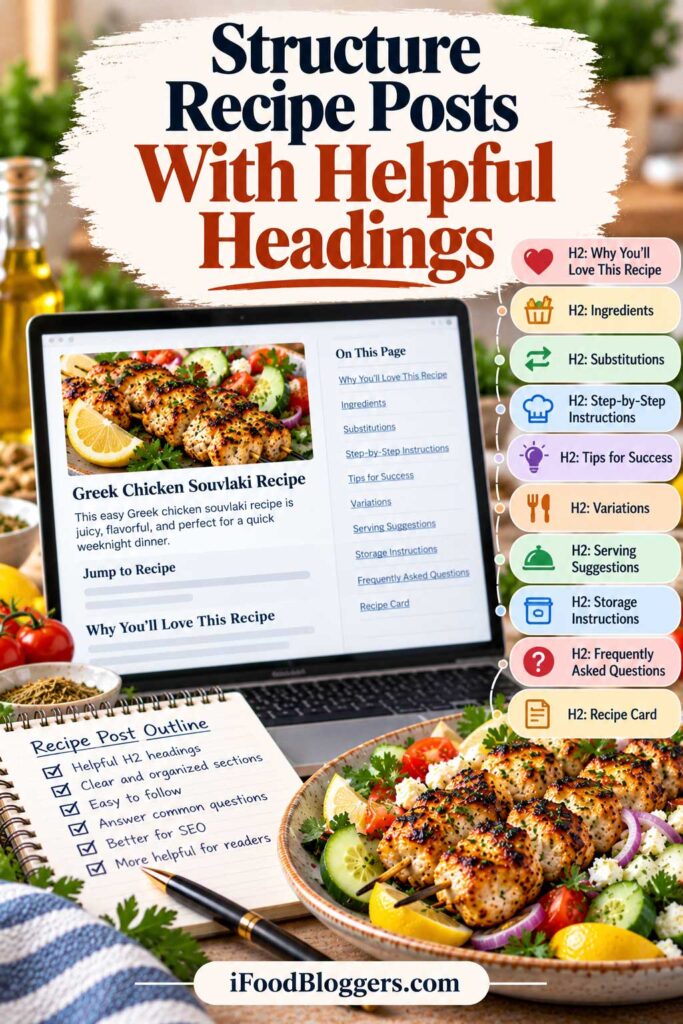
Structure Recipe Posts With Helpful Headings
A well-organized recipe post helps readers quickly find ingredients, cooking instructions, substitutions, and storage advice.
Clear headings also help search engines understand how your content is organized, making heading structure an important part of recipe SEO.
Use a logical hierarchy: one main H1 for the recipe title, H2s for major sections, and H3s when additional detail is helpful.
You don’t need headings for every paragraph. The goal is to make your recipe easier to navigate, not to add unnecessary SEO elements.
Use One Clear H1 for Your Recipe Title
Your H1 should clearly identify the dish readers are preparing.
For example:
H1: Traditional Greek Moussaka Recipe
Most WordPress themes automatically use the post title as the main H1, so you generally don’t need to add another one manually.
Use H2 and H3 headings for supporting content such as ingredients, cooking instructions, and preparation tips.
If you’re using a custom WordPress theme or page builder, check that your recipe title is marked up correctly and that the heading structure remains logical.
Organize Main Sections With H2 Headings
H2 headings divide your recipe into major sections, making it easier for readers to find the information they need.
For a traditional Greek moussaka recipe, useful H2s might include:
- Ingredients for Greek Moussaka
- How to Make Greek Moussaka
- Tips for the Best Moussaka
- Ingredient Substitutions and Variations
- What to Serve With Moussaka
- How to Store and Reheat Leftovers
- Frequently Asked Questions
Not every recipe needs all these sections. A simple cucumber salad may require only ingredients, instructions, and serving suggestions, while a layered casserole may benefit from additional preparation and storage guidance.
Choose headings based on the complexity of the dish and your readers’ needs.
Use H3 Headings for Detailed Cooking Steps
H3 headings help organize recipes with several preparation stages.
For example, under How to Make Greek Moussaka, you could use:
H3: Prepare the Eggplant — Explain how to slice and cook the eggplant.
H3: Make the Meat Sauce — Describe the cooking process and the desired sauce consistency.
H3: Prepare the Béchamel Sauce — Explain how to achieve a smooth sauce without lumps.
H3: Assemble and Bake the Moussaka — Walk readers through layering and baking the dish.
This structure works particularly well for recipes with multiple components. Simpler dishes rarely need separate headings for every cooking step.
Use H3s when they make instructions easier to follow, not simply to include more keywords.
Make Your Headings Descriptive, Not Repetitive
Avoid forcing your primary keyword into every heading.
For example, repeating “Greek Moussaka” in headings about ingredients, cooking instructions, tips, and storage can make your article feel unnatural.
Instead, combine descriptive headings such as “How to Make Greek Moussaka” with more specific ones like “Tips for a Creamy Béchamel Sauce.”
Search engines can understand related terms and context, so you don’t need to repeat the exact keyword throughout your article.
Write headings that help readers find information, not simply satisfy an SEO plugin.
Include an Ingredients Section That Explains Important Choices
Your recipe card should contain the complete ingredient list with accurate measurements, but a separate ingredients section can explain choices that affect the finished dish.
For example, a traditional Balkan cheese pastry may require white brined cheese. Readers unfamiliar with it may appreciate guidance on its flavor, texture, and suitable substitutions.
Similarly, a bread recipe might explain when to use bread flour instead of all-purpose flour.
Avoid duplicating the entire ingredient list simply to make your article longer.
Focus on ingredients that need clarification, influence the cooking process, or have useful substitutions.
Add Cooking Tips That Solve Real Problems
Helpful cooking tips explain how to avoid mistakes, not just how to follow instructions.
For example, a homemade falafel recipe might explain why the mixture falls apart, while a yogurt-based sauce recipe could show readers how to prevent excess moisture.
Use your own cooking experience to identify problems readers may encounter and provide practical solutions.
Original step-by-step photographs can be especially useful when demonstrating texture, consistency, or important preparation techniques.
Prioritize advice that helps readers successfully prepare the dish rather than adding generic tips to increase word count.
Include Substitutions and Variations When Appropriate
Ingredient substitutions help readers adapt recipes to what they have available, but recommendations should be accurate and preferably tested.
For example, dried herbs may require different quantities than fresh herbs, while gluten-free flour can significantly change the texture of baked goods.
If you haven’t tested a substitution, explain the uncertainty rather than promising identical results.
For traditional regional dishes, distinguish authentic preparation methods from modern variations so readers understand the original recipe while exploring alternatives.
Recommend substitutions that are genuinely useful, not simply additional ways to include keywords.
Add Storage and Reheating Instructions
Storage and reheating instructions help readers handle leftovers safely while preserving flavor and texture.
Explain whether a dish can be refrigerated or frozen, how to reheat it, and any important food safety considerations.
For example, soups may freeze well, while crisp pastries can lose their texture after refrigeration.
Avoid recommending identical storage durations for every recipe. Safe storage depends on the ingredients, preparation, and temperature.
For simple dishes, a short paragraph may be sufficient.
Use FAQs to Answer Questions Readers Actually Have
A recipe FAQ section can answer practical questions that don’t fit naturally into the main instructions.
For example, a homemade pita bread recipe might address freezing dough, cooking without a pizza stone, or troubleshooting bread that doesn’t puff.
Include questions that genuinely help readers, and avoid repeating answers already covered elsewhere in the article.
Don’t add FAQs solely to target keywords or search features. Google’s FAQ rich results are generally limited to well-known, authoritative government and health websites, so most food blogs shouldn’t expect them.
Focus on providing helpful answers rather than adding FAQ schema for a potential ranking advantage.
Keep Your Recipe Card Easy to Find
Your recipe card should be easy to locate and contain everything readers need to prepare the dish.
Include accurate ingredients and measurements, preparation and cooking times, servings, and clear step-by-step instructions. Add useful notes and nutrition information when appropriate and reliable.
For longer articles, a Jump to Recipe button can help readers access these details quickly.
The surrounding content should support the recipe card, not make it harder to find.
Don’t Use the Same Structure for Every Recipe
A five-minute smoothie doesn’t need the same explanation as homemade sourdough bread.
Traditional dishes may benefit from cultural background and ingredient explanations, while quick weeknight meals often need concise instructions and practical cooking tips.
Use a consistent overall layout, but adapt individual sections to the recipe.
If a section answers an important question or helps readers prepare the dish successfully, keep it. If it repeats information already covered, remove it.
The best recipe structure makes cooking easier, not the article longer.
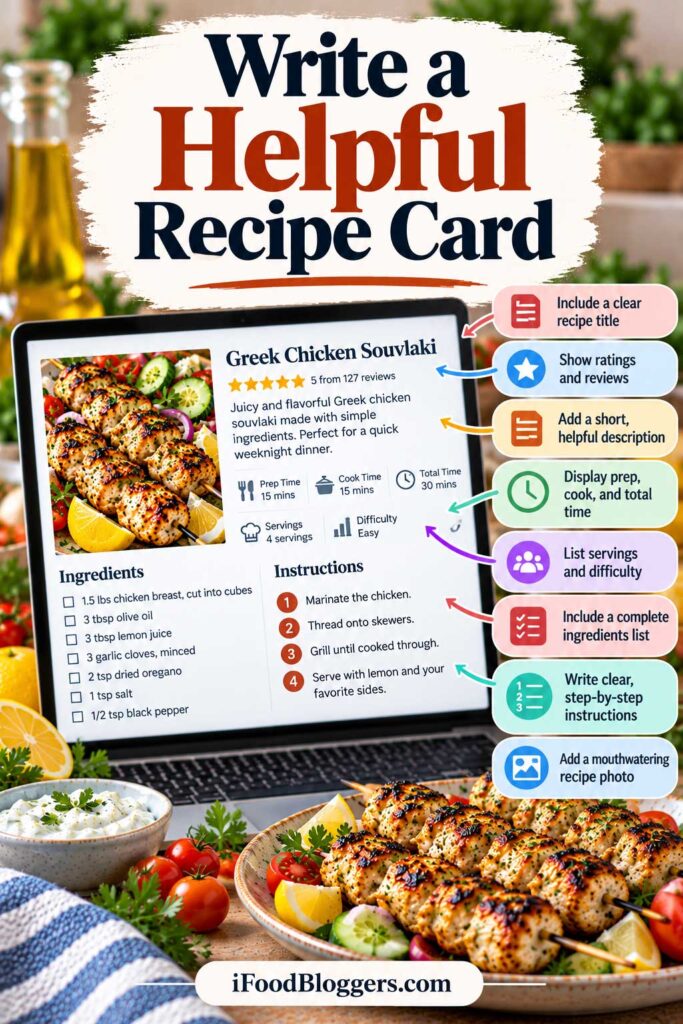
Write a Helpful Recipe Card
A recipe card should provide everything readers need to prepare your dish, including accurate ingredient measurements, cooking times, servings, and clear instructions.
Unlike the surrounding article, which may include photographs, personal stories, and additional tips, your recipe card should work independently.
Recipe cards also support recipe SEO. Many WordPress recipe plugins generate structured data from the information you enter, helping Google understand your recipe and potentially making it eligible for recipe-specific search features.
However, installing a plugin isn’t enough. Your recipe information must still be accurate, complete, and useful.
What Should a Recipe Card Include?
A complete recipe card typically includes the recipe name, a short description, ingredient quantities, preparation and cooking times, total time, servings, and step-by-step instructions.
Depending on the dish, you may also include equipment, recipe notes, photographs, and reliable nutrition information.
For example, a Greek chicken souvlaki recipe should specify the chicken quantity, marinade measurements, marinating time, and cooking instructions, including how to determine when the chicken is safely cooked.
Readers who use your Jump to Recipe button shouldn’t have to search the surrounding article for missing information.
Treat your recipe card as a complete set of cooking instructions, not a shortened summary of your post.
Choose a Clear and Descriptive Recipe Name
Your recipe card title should clearly identify the dish and closely match your article’s main title.
For example, “Greek Chicken Souvlaki” is more useful than “My Favorite Chicken Dinner.”
You don’t need to repeat every word from your SEO title, but both titles should describe the same recipe.
Consistent naming helps readers and search engines understand what the recipe card represents.
Write an Accurate Recipe Description
Use your recipe card’s description field to briefly explain the dish, its main ingredients, and what makes it distinctive.
For example:
“Traditional Greek chicken souvlaki made with tender chicken marinated in olive oil, lemon juice, garlic, and oregano, then grilled on skewers.”
This tells readers what they’re making without unnecessary promotional language.
Keep the description natural, specific, and free of repeated keywords.
List Ingredients With Precise Measurements
Accurate ingredient measurements are essential, especially for beginners.
Instead of vague instructions such as “add some flour” or “use a little olive oil,” specify the quantities needed.
Include preparation details when helpful. For example, “1 medium onion, finely diced” tells readers both how much to use and how to prepare it.
For baking recipes, weight measurements can improve consistency because measuring by volume may introduce variations.
If your recipe card supports US customary and metric units, verify the conversions rather than relying entirely on automatic calculations.
Clear measurements make recipes easier to follow and help readers achieve consistent results.
Make Preparation and Cooking Times Realistic
Readers rely on preparation and cooking times to decide whether a recipe fits their schedule.
Include realistic estimates for hands-on preparation and cooking, and account for additional time needed for marinating, chilling, rising, or resting.
For example, chicken souvlaki might require 15 minutes of preparation, 12 minutes of grilling, and a separate marinating period.
Make sure readers understand the total time commitment before starting.
Accurate timing builds trust and is more valuable than making every recipe appear quick.
Specify Servings and Recipe Yield
Clearly state how much food your recipe produces, whether that’s six servings of soup or 24 cookies.
Many WordPress recipe plugins allow readers to scale ingredient quantities automatically, but not every part of a recipe scales proportionally.
For example, doubling the ingredients in a baked dish doesn’t necessarily double the cooking time.
If increasing or reducing the recipe requires special adjustments, explain them in your recipe notes.
Accurate yields and scaling guidance help readers plan meals and avoid cooking mistakes.
Write Instructions That Beginners Can Follow
Recipe instructions should explain what to do and how to recognize when each step is complete.
Instead of writing “Cook the onions until done,” provide useful details:
“Heat the olive oil in a skillet over medium heat. Add the diced onions and cook for 5–7 minutes, stirring occasionally, until softened and translucent.”
This tells readers the heat level, cooking time, and visual cues to look for.
Keep simple steps brief, but explain more complicated techniques clearly. Include temperatures, texture cues, and food safety information when relevant.
For example, chicken should reach an internal temperature of 165°F (74°C), measured with a food thermometer.
Specific, practical instructions help beginners cook confidently and achieve more consistent results.
Include Helpful Recipe Notes
Recipe notes are ideal for substitutions, make-ahead tips, storage advice, and common cooking mistakes that don’t fit into the main instructions.
For example, a homemade tzatziki recipe might explain that squeezing excess moisture from the cucumber helps prevent a watery sauce.
Keep notes concise and focused on information readers may need while preparing the dish.
Useful recipe notes should solve problems, not repeat the entire article.
Add Recipe Photographs That Show the Finished Dish
Include an original, high-quality photograph that accurately represents the finished recipe.
Step-by-step photographs can also help explain techniques, although they don’t all need to appear inside the recipe card.
Avoid misleading images that show a substantially different dish or an unrealistic result.
For recipe structured data, use crawlable images that meet Google’s recipe image guidelines.
We’ll cover recipe image optimization in more detail later in this guide.
Should You Include Nutrition Information?
Nutrition information can help readers understand approximate calories and nutrients per serving, but accuracy matters.
Many recipe plugins calculate estimates using ingredient databases. Actual values can vary depending on brands, portion sizes, cooking methods, and ingredient absorption.
For example, frying oil added to a pan isn’t necessarily fully absorbed by the finished food.
Clearly label calculated values as estimates, and never invent numbers simply to complete your recipe card.
Nutrition information is optional for Google’s recipe rich results, so prioritize reliability over filling every available field.
Use a Dedicated WordPress Recipe Plugin
A dedicated WordPress recipe plugin makes it easier to create recipe cards and generate structured data.
Popular options include WP Recipe Maker, Tasty Recipes, and Create by Mediavine.
When comparing plugins, consider recipe schema support, mobile usability, accessibility, WordPress compatibility, ongoing maintenance, and pricing.
Choose a plugin that makes recipes easy to follow and manage, not just visually attractive.
Avoid using multiple recipe plugins that generate conflicting structured data for the same recipe.
Don’t Confuse a Recipe Card With Recipe Schema
A recipe card and recipe schema serve different purposes.
The recipe card displays ingredients, measurements, and instructions for readers. Recipe schema provides structured information that search engines can interpret.
Many recipe plugins generate schema automatically, but the information should match the visible recipe.
For example, if your recipe card lists a 45-minute cooking process while the schema reports 15 minutes, correct the inconsistency.
Never fabricate ratings, cooking times, or other recipe details to improve your appearance in search results.
We’ll examine recipe schema and validation in the next chapter.
Test Your Recipe Card Before Publishing
Before publishing, preview your recipe card on desktop and mobile.
Check that ingredient quantities are accurate, instructions appear in the correct order, and the Jump to Recipe button works.
If your plugin supports ingredient scaling, unit conversions, or printing, test those features too.
Finally, read the recipe as someone preparing it for the first time. Are any measurements, temperatures, or cooking steps missing?
A good recipe card should make cooking straightforward without requiring readers to search the rest of the article for essential instructions.
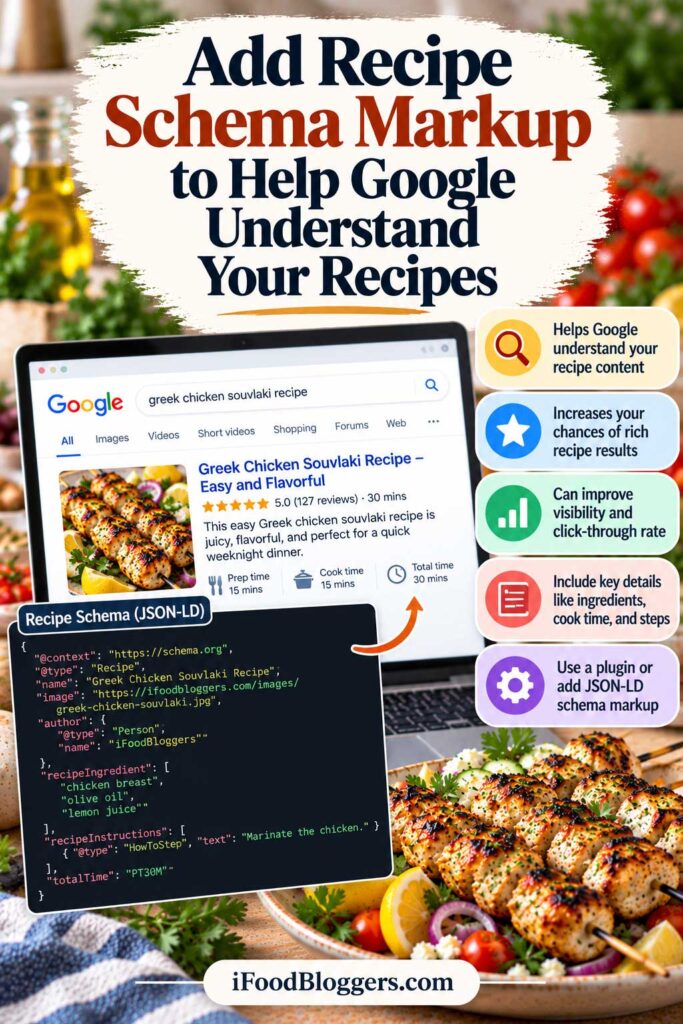
Add Recipe Schema Markup to Help Google Understand Your Recipes
Recipe schema markup is structured data that helps Google understand important details about your recipes, including ingredients, cooking instructions, preparation times, and servings.
It can also make eligible recipes appear with enhanced features in Google Search, such as photographs, ratings, and cooking times. These are known as rich results.
Fortunately, you don’t need coding experience to implement recipe schema. Many WordPress recipe plugins generate it automatically from your recipe card.
However, correct implementation matters. Structured data must accurately represent your visible recipe, and adding schema doesn’t guarantee rich results or higher rankings.
What Is Recipe Schema Markup?
Recipe schema uses the Schema.org Recipe vocabulary to describe cooking information in a standardized, machine-readable format.
For example, a Greek chicken souvlaki post may include photographs, ingredients, and instructions that readers can easily understand.
Recipe schema identifies these details for search engines, including the recipe name, author, images, ingredients, cooking times, yield, and preparation steps.
Google may use this information to display eligible recipes in enhanced search experiences, but eligibility doesn’t guarantee that a rich result will appear.
Think of recipe schema as a way to describe your recipe clearly to search engines, not a shortcut to better rankings.
How Recipe Schema Works
Most WordPress recipe plugins generate structured data using JSON-LD, a format that communicates recipe information to search engines without changing what visitors see.
For example, if a recipe takes 15 minutes to prepare and 30 minutes to cook, its structured data may contain PT15M and PT30M, which are standardized duration values.
You don’t need to write this code manually when using a properly configured recipe plugin.
What matters is that your structured data accurately reflects the recipe information displayed on the page.
Which Recipe Schema Properties Matter?
Google identifies required and recommended properties for recipe rich results. The recipe name and image are required for basic eligibility, while additional properties help describe the dish more completely.
Here are the main properties food bloggers should understand:
| Property | Purpose |
|---|---|
name | Recipe title |
image | Images of the finished dish |
description | Short recipe summary |
author | Recipe creator |
recipeIngredient | Ingredients and quantities |
recipeInstructions | Cooking steps |
prepTime | Preparation time |
cookTime | Cooking time |
totalTime | Overall preparation time |
recipeYield | Servings or quantity produced |
recipeCategory | Type of dish |
recipeCuisine | Cuisine associated with the dish |
nutrition | Nutritional information, when available |
aggregateRating | Genuine recipe ratings, when applicable |
video | Relevant cooking video |
Not every recipe needs every property. Include accurate information where available, but never invent nutrition values, ratings, or other details simply to complete the markup.
For current requirements, consult Google’s official Recipe structured data documentation.
The goal is accurate, complete recipe information—not filling every possible schema field.
Use Accurate Recipe Images in Your Structured Data
Recipe schema should reference clear, high-quality photographs that accurately represent the finished dish.
Google recommends providing suitable images in multiple aspect ratios, including 1:1, 4:3, and 16:9, when available.
For example, you could use a horizontal photograph of Greek moussaka in your article and a square crop of the same image for other search layouts.
You don’t need three different photographs. Properly cropped versions of one original image can work.
Make sure your image URLs are crawlable and indexable, and avoid excessive promotional text or graphics.
Accurate, accessible images help Google understand and potentially display your recipe in search results.
Add Step-by-Step Recipe Instructions
The recipeInstructions property describes how to prepare your dish.
Most WordPress recipe plugins generate this markup from the individual cooking steps entered into your recipe card.
For example, a homemade pita bread recipe might include separate steps for mixing, kneading, rising, dividing, and cooking the dough.
Write each step clearly rather than combining the entire process into one long paragraph.
Recipe markup can also use HowToStep and HowToSection to organize instructions when appropriate.
You usually won’t need to manage these properties manually, but understanding them can help you identify schema errors.
Be Careful With Recipe Ratings and Reviews
If your recipe plugin supports reader ratings, it may generate aggregateRating structured data.
These ratings must reflect genuine feedback associated with the recipe.
Never invent five-star ratings, fabricate review counts, or copy ratings from another website.
If your recipe hasn’t received any ratings, publish it without rating markup until genuine ratings become available.
Misleading structured data can make your page ineligible for Google rich results and may result in a manual action.
Accuracy matters more than displaying stars in search results.
How to Add Recipe Schema in WordPress
The easiest way to add recipe schema in WordPress is through a dedicated recipe plugin such as WP Recipe Maker, Tasty Recipes, or Create by Mediavine.
Install your chosen plugin, create a recipe card, and enter accurate ingredients, instructions, cooking times, servings, and photographs.
Insert the card into your post using the plugin’s block or shortcode. The plugin should then generate the corresponding structured data automatically.
If you’re also using Rank Math or Yoast SEO, check that your plugins aren’t producing duplicate or conflicting Recipe markup.
Multiple schema objects aren’t automatically problematic, but inconsistent information about the same recipe can cause issues.
Follow your recipe plugin’s documentation and test the published page to confirm the markup works correctly.
How to Test Your Recipe Schema Markup
After publishing a recipe, use Google’s Rich Results Test to check whether its structured data is eligible for supported Google search features.
Enter your recipe URL, run the test, and review any detected Recipe items.
Errors generally indicate problems that may prevent eligibility, while warnings identify recommended properties that are missing or need attention.
Not every warning requires a fix, especially when the property doesn’t apply to your recipe.
You can also use the Schema Markup Validator to examine your markup against Schema.org vocabulary.
Google’s Rich Results Test checks supported rich-result eligibility, while the Schema Markup Validator provides broader structured data validation.
Check Recipe Enhancements in Google Search Console
Google Search Console can help identify recipe structured data problems across your website.
When applicable, recipe enhancement reports show affected pages and detected issues, such as missing images or incorrectly formatted properties.
If several recipes have the same error, investigate whether it originates from your recipe plugin, WordPress theme, or recipe card settings.
After making corrections, use Search Console’s validation feature when available to request that Google recheck the issue.
Successful validation doesn’t guarantee a rich result. It only confirms that the specific reported problem was no longer detected during validation.
Common Recipe Schema Mistakes to Avoid
Recipe schema should describe a complete recipe that visitors can actually prepare.
For example, an article about Greek cuisine shouldn’t use Recipe markup simply because it mentions several traditional dishes.
Other common mistakes include mismatched cooking times, inaccessible images, incomplete instructions, fabricated ratings, and conflicting markup from multiple plugins.
Avoid copying structured data from another website without adapting it to your own recipe.
Your schema should accurately reflect the ingredients, instructions, and other information readers see on the page.
Does Recipe Schema Improve Google Rankings?
Recipe schema isn’t a direct ranking boost. Its main purpose is to help Google understand your recipe and determine eligibility for supported rich results.
Enhanced search appearances may encourage clicks, but results depend on the search query, competition, and how Google displays your listing.
Even perfectly implemented schema won’t compensate for a recipe that fails to satisfy search intent.
Treat structured data as one part of recipe SEO, alongside accurate instructions, original photographs, helpful content, internal linking, and technical website performance.
Keep Your Recipe Schema Updated
Google’s structured data requirements and WordPress plugin functionality can change, so periodically review your important recipe pages.
Pay particular attention after major plugin or theme updates.
When you revise ingredients, cooking times, or servings, make sure your recipe card and structured data remain consistent.
The simplest approach is to maintain accurate information in one recipe card and let a reliable plugin generate the corresponding schema.
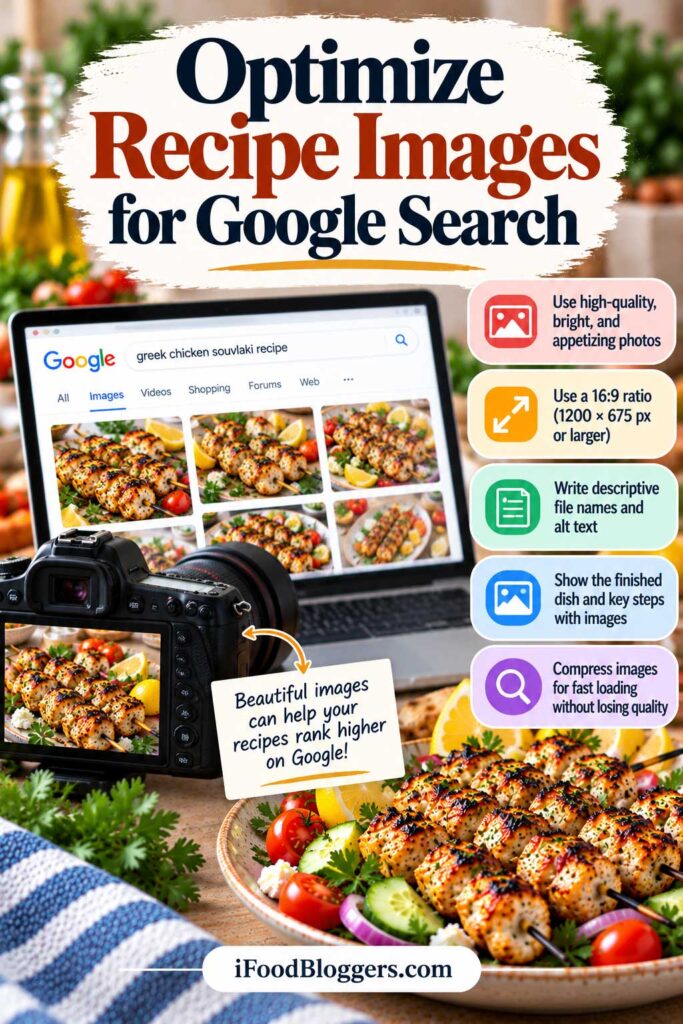
Optimize Recipe Images for Google Search
Great food photography helps readers understand what a finished dish should look like. Properly optimized images can also improve your visibility in Google Images and make your recipe posts more enjoyable to use.
However, large image files can slow down your website and frustrate mobile visitors.
Recipe image SEO involves using original photographs, descriptive file names, meaningful alt text, appropriate dimensions, and efficient image formats.
The right food blogging tools can help you edit, compress, and organize photographs without sacrificing quality.
You don’t need expensive equipment to get started. Consistent photography and image optimization practices matter more than having a professional studio.
Use Original, High-Quality Recipe Photographs
Whenever possible, photograph the food you’ve actually prepared.
Original images show readers what to expect and help illustrate important details such as texture, consistency, and presentation.
For example, a Bulgarian banitsa photograph might highlight its golden pastry layers and cheese filling, while a soup close-up could show the broth’s consistency.
You don’t need professional lighting. Natural window light, a clean background, and thoughtful composition can produce appealing results.
Avoid blurry, overly dark, or heavily edited photographs that misrepresent the dish.
Your food should look appetizing but realistic, reflecting what readers can achieve by following your recipe.
Choose the Right Featured Image
Your featured image may appear on your homepage, category pages, related posts, and social media previews.
Choose a photograph that clearly represents the finished dish and remains recognizable as a small thumbnail.
For many WordPress food blogs, a 16:9 featured image at 1200 × 675 pixels is a practical starting point, although the ideal dimensions depend on your theme.
For example, a Greek chicken souvlaki featured image might show grilled skewers with lemon wedges, fresh herbs, and a simple Mediterranean side dish.
Avoid excessive text overlays. The food itself should remain the main focus.
Remember that your preferred featured-image dimensions don’t replace Google’s separate image recommendations for recipe structured data.
Use Descriptive Image File Names
Give your recipe photographs meaningful filenames before uploading them to WordPress.
Instead of IMG_4827.jpg, use something descriptive like greek-chicken-souvlaki-skewers.jpg.
Keep filenames lowercase, separate words with hyphens, and describe what each photograph shows.
For example, an ingredients photograph could be named tzatziki-yogurt-cucumber-ingredients.jpg.
You don’t need to repeat your primary keyword in every filename. Different photographs should have names that reflect their actual content.
Descriptive filenames provide additional context for search engines and make your media library easier to manage.
Write Helpful Alt Text for Recipe Images
Alt text describes images for screen reader users and helps search engines understand their content.
Write descriptions of what’s actually visible rather than repeating keywords.
Weak alt text: “Greek recipe best Greek recipe delicious Greek food”
Better alt text: “Grilled Greek chicken souvlaki skewers served with lemon wedges and tzatziki”
For a preparation photograph, you might write:
“Raw chicken pieces coated in lemon and oregano marinade in a glass bowl.”
Keep descriptions concise and meaningful. Decorative images that provide no useful information may be better suited to an empty alt attribute.
Good alt text improves accessibility while providing natural context for image SEO.
Compress Recipe Images Without Losing Quality
Large photographs can slow down recipe pages, especially when an article contains numerous step-by-step images.
Compress photographs before uploading them or use optimization tools such as TinyPNG, ShortPixel, or Imagify.
Modern image formats like WebP and AVIF can also reduce file sizes while maintaining good visual quality.
There’s no universal file-size limit for every photograph. A small thumbnail and a full-width featured image have different requirements.
Aim for the smallest practical file size that still looks good at the image’s displayed dimensions.
Use Responsive Images for Different Screen Sizes
Responsive images allow browsers to deliver appropriately sized photographs for desktop, tablet, and mobile visitors.
WordPress supports this through srcset and sizes, which many themes and image optimization plugins handle automatically.
Still, check your published recipes on mobile to ensure visitors aren’t downloading unnecessarily large images.
Also review image cropping. Your featured photograph should remain attractive and keep the main dish visible on smaller screens.
Responsive images improve usability and help reduce unnecessary page weight.
Use Different Image Ratios When They Serve Different Purposes
Different platforms benefit from different image proportions.
For example, you might use 16:9 for your website’s featured image, square or 4:3 crops for certain Google recipe displays, and 2:3 vertical images for Pinterest.
Google recommends providing suitable recipe images in 1:1, 4:3, and 16:9 ratios when available.
You don’t need separate photo shoots for every format. Carefully cropping a high-resolution original often works well.
Just make sure the finished dish remains recognizable in every version.
Add Step-by-Step Photographs When They Help Readers
Step-by-step photographs are particularly useful for recipes involving unfamiliar techniques or multiple preparation stages.
For example, homemade baklava may benefit from images showing how to layer phyllo pastry, while bread recipes can illustrate how the dough should look before and after rising.
Homemade pasta instructions might show the correct dough thickness.
Simple recipes rarely need a photograph for every step.
Include images that clarify an ingredient, technique, or important cooking stage—not multiple nearly identical photographs simply to make the article longer.
Be Careful With Lazy Loading
Lazy loading delays images until they’re needed, helping reduce initial page weight on recipe posts with many photographs.
However, images visible near the top of the page, particularly your main featured image, shouldn’t be unnecessarily delayed.
That image may be the page’s Largest Contentful Paint (LCP) element, an important loading performance metric.
Below-the-fold recipe photographs are generally better candidates for lazy loading.
WordPress and optimization plugins often manage this automatically, but test your pages to ensure the settings improve performance rather than slow down important images.
Help Google Discover Your Recipe Images
Google needs access to your photographs to discover and index them.
Make sure important image URLs aren’t blocked by robots.txt rules, and use standard image elements that search engines can process.
Google can discover images directly from your recipe pages, while image sitemap information may provide additional assistance.
If you use a content delivery network (CDN), verify that image URLs remain accessible.
You can also use Google Search Console to investigate crawling and indexing problems affecting important recipe pages.
Even beautifully optimized photographs won’t help your visibility in Google Images if search engines can’t access them.
Optimize Images for Readers, Not Just Search Engines
Image optimization involves more than filenames, alt text, compression, and dimensions.
Your photographs should help readers understand the dish and prepare it successfully.
A finished-dish photograph shows what to expect, while preparation images can demonstrate important techniques, textures, and cooking stages.
The best recipe images combine accurate photography, useful visual information, accessibility, and efficient loading performance.
Focus on making your recipes easier to follow, not simply adding more photographs for SEO.
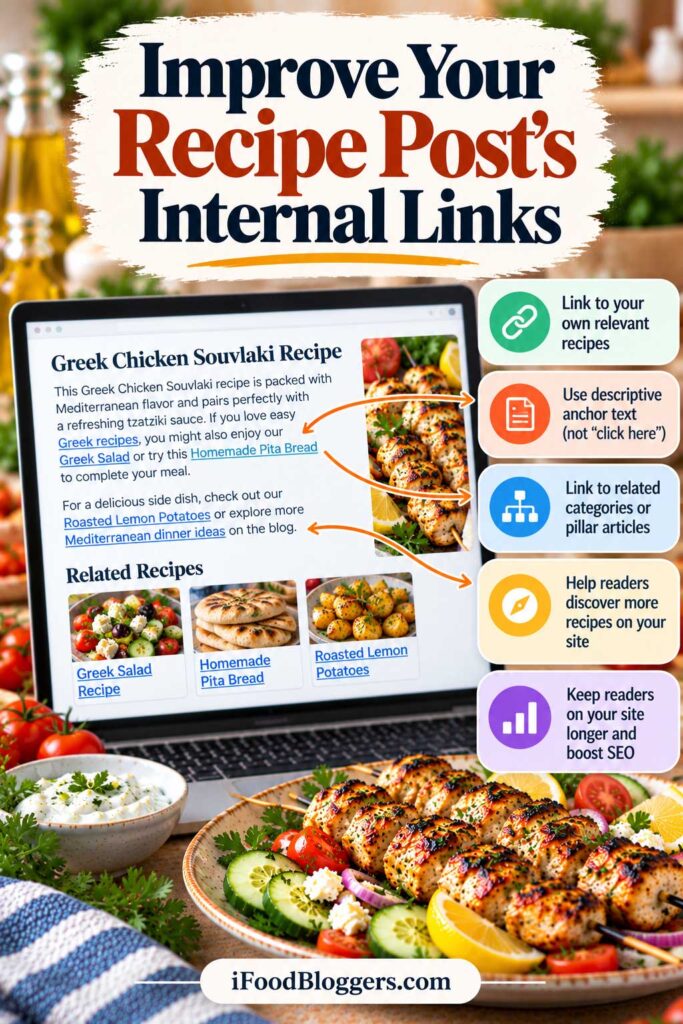
Improve Your Recipe Post’s Internal Links
Internal links connect related pages on your website, helping readers discover more recipes and search engines understand how your content fits together.
For example, a Greek tzatziki recipe could link to homemade chicken souvlaki because the two dishes are commonly served together.
Relevant links also help search engines discover other pages on your website and understand their relationships.
Internal linking is an important part of recipe SEO, but it works best alongside a broader content strategy. Our guide on how to get more traffic to your food blog explores additional ways to attract readers through Google, Pinterest, and other channels.
Why Internal Links Matter for Recipe SEO
Internal links help Google discover pages and understand the relationships between recipes.
For example, a Greek recipe collection linking to tzatziki, souvlaki, moussaka, and spanakopita creates a useful connection between related dishes.
These links also improve navigation. Someone preparing chicken souvlaki might appreciate suggestions for homemade pita bread or Greek salad.
Although internal links don’t guarantee higher rankings, they support content discovery, website organization, and a better reader experience.
The goal is to connect recipes that genuinely belong together.
Link to Recipes That Naturally Belong Together
The best internal links fit naturally into your recipe’s context.
For example, a Bulgarian kebapche recipe might suggest serving the grilled meat with a traditional salad:
“Serve the kebapche with a fresh shopska salad and warm bread for a Bulgarian-inspired meal.”
This link helps readers discover a complementary dish.
Adding an unrelated chocolate cake link simply to increase your link count provides little value.
Prioritize relevant recommendations over adding more links to every recipe.
Use Descriptive Anchor Text
Anchor text is the clickable wording of a link. It should help readers understand what they’ll find on the destination page.
For example, “Serve the grilled chicken with our homemade Greek tzatziki recipe” is more descriptive than “Click here for another recipe.”
Descriptive anchor text also gives search engines context about the linked page.
You don’t need to repeat the exact keyword every time. Natural variations such as “homemade tzatziki,” “Greek yogurt cucumber dip,” or “tzatziki sauce” can work when they accurately describe the destination.
Choose anchor text that fits naturally into the sentence rather than forcing keywords into every link.
Add a Related Recipes Section
A related recipes section helps visitors discover complementary dishes without searching elsewhere.
For example, after a Greek moussaka recipe, you might write:
“If you enjoyed this Greek moussaka, try our homemade pastitsio, traditional Greek salad, or roasted Greek lemon potatoes for more Mediterranean-inspired meals.”
Link each dish to its corresponding recipe when available.
A few carefully selected recommendations are usually more helpful than a long list of unrelated posts.
WordPress related-post widgets can automate suggestions, but manually chosen links often provide better control over relevance.
Connect Recipes to Relevant Category Pages
Well-organized category pages help readers browse similar recipes and give search engines additional paths to discover your content.
For example, a Greek lentil soup recipe might appear under both Greek Recipes and Soups, depending on your website’s structure.
Use meaningful categories that reflect how visitors explore your food blog.
Avoid creating dozens of overlapping categories containing only one or two recipes.
A smaller collection of useful, well-maintained categories is generally better than an unnecessarily complicated structure.
Build Recipe Collections Around Related Topics
As your food blog grows, create recipe collections that bring related dishes together.
For example, a guide to traditional Balkan breakfasts could introduce banitsa, mekitsi, kifli, and other regional favorites, linking to each individual recipe.
Those recipes can also link back to the broader collection when relevant.
You can use the same approach for Mediterranean dips, traditional soups, grilled meats, or homemade breads.
These collections help readers explore related recipes and create a clearer structure for your website.
Link From Older Recipes to Newer Posts
When publishing a new recipe, look for opportunities to link to it from relevant older articles.
For example, a new homemade pita bread recipe could be linked from existing posts about hummus, tzatziki, grilled chicken, or Mediterranean sandwiches.
These links help readers discover new content and give search engines additional paths to find it.
You don’t need to update dozens of articles. Start with your most relevant existing recipes and add links where they genuinely help readers.
Find Internal Linking Opportunities With Google Search Console
Google Search Console can help you prioritize recipes that already receive search impressions and clicks.
For example, if your Greek salad recipe attracts consistent traffic, review it for opportunities to link to newly published Greek side dishes.
Search Console’s Links report also provides information about your website’s internal linking patterns.
Combine this data with your recipe inventory to identify important posts that may need more relevant internal links.
Search Console won’t choose contextual links for you, but it can help you decide which pages to review first.
Avoid Orphan Recipe Posts
An orphan page has no discoverable internal links pointing to it, making it harder for visitors and search engines to find through normal website navigation.
This can happen when older recipes disappear from homepage listings or aren’t connected to relevant categories and collections.
Periodically review your recipe archive to identify important posts with few or no internal links.
Tools such as Screaming Frog SEO Spider can help audit your website’s link structure.
For a more complete orphan-page audit, compare crawl results with your XML sitemap and other known URLs.
Every important recipe should have a logical path from another relevant page on your website.
How Many Internal Links Should a Recipe Post Have?
There’s no ideal number of internal links for every recipe.
A simple smoothie post might naturally link to two or three related drinks, while a detailed Greek cooking guide may reference several recipes and collections.
Focus on relevance rather than reaching a specific link count.
Avoid repeatedly linking to the same page or adding long lists of unrelated recipes.
Every internal link should help readers discover something useful without interrupting the article.
Check for Broken and Redirected Links
Internal links can become outdated when you change recipe URLs, merge articles, or remove older content.
Although a permanent 301 redirect can preserve access after a URL change, update internal links to point directly to the current destination whenever practical.
Periodically check important recipe pages for broken links and unnecessary redirects.
This is especially useful after changing permalinks, reorganizing categories, or consolidating older posts.
Make Internal Linking Part of Your Publishing Workflow
Before publishing a new recipe, identify a few existing articles that would be helpful to its readers.
Add relevant links to those recipes, then review older posts for opportunities to link back to your new content.
Making this a regular publishing habit gradually creates a more connected recipe library.
Effective internal linking helps readers explore related dishes while giving search engines a clearer understanding of your website’s structure.
Make Recipe Posts Fast and Mobile-Friendly
Even a beautifully photographed recipe can frustrate visitors if the page loads slowly or is difficult to use on a phone.
Food blogs often contain large photographs, recipe cards, advertisements, videos, and interactive features. Together, these elements can affect loading speed and responsiveness.
A slow recipe page is frustrating, especially when someone’s trying to follow the instructions while cooking.
Your WordPress setup also plays a role. Our guide to WordPress SEO and security plugins explains which tools can support your website without unnecessary complexity.
Google uses Core Web Vitals in its ranking systems, but perfect performance scores don’t guarantee higher rankings.
Focus on recipe pages that load efficiently, work reliably on mobile devices, and make cooking instructions easy to follow.
Why Mobile Usability Matters for Food Blogs
Many readers follow recipes directly from their phones, whether they’re shopping for ingredients or preparing dinner.
Small text, intrusive pop-ups, difficult navigation, and buttons that are hard to tap can make cooking unnecessarily frustrating.
Google primarily uses the mobile version of your website for indexing, so important recipe content should remain accessible on smaller screens.
Make sure visitors can easily read ingredients, follow instructions, and use the recipe card without excessive zooming or awkward navigation.
A mobile-friendly recipe should be just as complete and useful as its desktop version.
Understand Google’s Core Web Vitals
Core Web Vitals measure three important aspects of website performance: loading speed, responsiveness, and visual stability.
| Metric | What it measures | Good threshold |
|---|---|---|
| Largest Contentful Paint (LCP) | How quickly the largest visible content element loads | 2.5 seconds or less |
| Interaction to Next Paint (INP) | How quickly the page responds to interactions | 200 milliseconds or less |
| Cumulative Layout Shift (CLS) | How much visible content unexpectedly moves | 0.1 or less |
Google evaluates these metrics at the 75th percentile of real user visits, separately for mobile and desktop.
Use PageSpeed Insights and Google Search Console to identify performance issues affecting your recipe pages.
Prioritize problems that impact real visitors rather than chasing a perfect performance score.
Optimize Large Recipe Photographs
Large, unoptimized photographs can significantly slow down recipe pages.
Use appropriately sized images, efficient formats such as WebP or AVIF, and compression to reduce unnecessary file weight.
Make sure your main featured image loads promptly, while photographs farther down the page can often benefit from lazy loading.
For detailed instructions on image dimensions, alt text, responsive images, and compression, refer to the image optimization section earlier in this guide.
Use Caching to Improve Page Performance
Caching helps WordPress deliver pages faster by reducing the need to generate the same content for every visitor.
Popular options include LiteSpeed Cache, WP Rocket, and W3 Total Cache.
Before installing a caching plugin, check whether your hosting provider already offers caching. Overlapping optimization tools can cause conflicts.
After changing settings, test your recipe cards, ingredient scaling, print buttons, and other interactive features.
A faster recipe page isn’t an improvement if essential cooking tools stop working.
Be Careful With Advertising Scripts
Display ads can generate revenue, but poorly implemented advertising scripts may slow down recipe pages or cause unexpected layout shifts.
For example, an advertisement loading above your recipe card without reserved space can push ingredients and instructions down the screen.
Work with your advertising provider to reserve appropriate space for ads and avoid placements that interrupt cooking instructions.
You don’t necessarily need to remove advertising to improve performance.
The goal is to balance monetization with a comfortable reading and cooking experience.
Reduce Unnecessary Plugins and Scripts
Food blogs often use plugins for recipe cards, social sharing, galleries, analytics, advertising, and pop-ups.
Not every plugin slows down a website. Performance depends more on how efficiently its code runs than on the total number installed.
Review your plugins regularly, remove unused features, and avoid keeping multiple tools that perform the same task.
Performance testing can help identify scripts that delay loading or user interactions.
Keep essential recipe functionality rather than sacrificing usability for a higher performance score.
Make Recipe Cards Comfortable to Use on Mobile
Your recipe card should be easy to read and interact with on a phone.
Check that ingredient lists are readable without zooming, cooking steps have enough spacing, and buttons for printing, scaling ingredients, or changing measurement units are easy to tap.
If your recipe plugin includes ingredient checkboxes or step tracking, test those features on mobile.
Also make sure photographs, tables, and videos fit within the screen without horizontal scrolling.
A recipe card that looks great on desktop still needs to work comfortably on smaller devices.
Avoid Intrusive Pop-Ups
Email signup forms and promotional pop-ups can help grow your food blog, but poorly timed overlays may frustrate visitors.
Imagine opening a recipe to check an ingredient measurement and encountering a full-screen subscription form with a difficult-to-find close button.
Use less intrusive signup forms or display offers when they won’t interrupt essential recipe content.
Google also provides guidance on intrusive interstitials, particularly for mobile search experiences.
Readers should be able to reach ingredients and cooking instructions without unnecessary obstacles.
Test Your Recipe Pages on Real Devices
Automated performance tools are helpful, but they can’t replace testing your recipes on an actual phone.
Open both short and image-heavy recipes. Try the Jump to Recipe button, ingredient scaling, print options, and other interactive features.
Check whether photographs display correctly and whether sticky ads or navigation elements cover important content.
You may discover problems that aren’t obvious in desktop previews or performance reports.
A good PageSpeed Insights score means little if readers struggle to follow your recipe while cooking.
Improve Performance Without Sacrificing Useful Content
Faster pages shouldn’t come at the expense of helpful recipe content.
Step-by-step photographs, cooking videos, ingredient notes, and interactive recipe cards can improve the reader’s experience.
Instead of removing these features, make them more efficient through image compression, optimized video embeds, caching, and fewer unnecessary scripts.
Focus on improvements that make a noticeable difference for visitors.
A fast food blog should still be a useful food blog.
Build Trust With Original Recipes and Real Cooking Experience
A recipe can have excellent SEO, beautiful photographs, and fast loading times but still disappoint readers if the instructions don’t work.
Recipe SEO isn’t just about search visibility. It’s also about publishing recipes people can trust.
Readers rely on your ingredient measurements, cooking times, and preparation instructions to recreate a dish successfully.
Missing ingredients, confusing steps, or unrealistic cooking times can undermine that trust.
The foundation of a reliable food blog is accurate recipes, genuine cooking experience, and transparency about how the content was developed.
Test Recipes Before Publishing Them
Preparing a recipe yourself helps uncover problems that aren’t obvious when writing instructions.
You might discover that a sauce needs more liquid, bread requires additional baking time, or pastry dough needs longer to rest.
Testing also helps you describe useful details, such as the correct bread dough consistency or when to add vegetables to a soup.
Not every recipe needs dozens of test batches, but you should have enough firsthand experience to provide dependable instructions.
If you’re adapting another recipe, prepare and evaluate your version before describing it as tested.
A recipe should work in a real kitchen, not just look convincing on a webpage.
Firsthand cooking experience helps you explain details that basic recipe instructions often miss.
For example, a Greek tzatziki recipe becomes more useful when you explain that squeezing moisture from grated cucumber helps prevent a watery dip.
Similarly, a Bulgarian banitsa recipe might explain how to handle delicate phyllo sheets or recognize when the pastry is properly baked.
These practical observations help readers avoid mistakes and achieve better results.
You don’t need to repeatedly tell readers you’ve tested a recipe.
Demonstrate your experience through accurate measurements, clear instructions, and useful cooking tips.
Use Original Photographs Whenever Possible
Original photographs help readers see what your recipe actually produces.
A finished-dish image shows the expected result, while step-by-step photographs can clarify important techniques, such as folding pastry dough or checking the texture of a sauce.
Avoid presenting stock images or AI-generated food pictures as photographs of dishes you’ve personally prepared.
If you use illustrative imagery, make its purpose clear.
Real photographs of your cooking provide useful visual evidence that supports your instructions.
Be Transparent About Recipe Adaptations
Traditional recipes often have regional and family variations, and adapting them to your ingredients or preferences is perfectly reasonable.
Just explain meaningful changes.
For example, if you replace a traditional Bulgarian cheese with a more accessible alternative, mention the substitution and how it affects the flavor or texture.
This helps readers distinguish between a traditional preparation and your personal interpretation.
If another creator inspired your recipe, acknowledge their contribution when appropriate.
Traditional dishes may share ingredients and techniques, but copying another blogger’s original writing or photographs without permission isn’t acceptable.
Use your own instructions, share your cooking observations, and credit sources when appropriate.
Add Clear Author Information
Readers may want to know who developed or tested the recipes they’re following.
A short author biography can explain your cooking background, experience, and the cuisines you specialize in.
For example, someone writing about traditional Bulgarian food might describe their familiarity with regional dishes and family cooking traditions.
Formal culinary training isn’t required. Experienced home cooks can offer valuable knowledge.
Be accurate about your background, and avoid claiming qualifications you don’t have.
A clear About page and consistent author information make it easier for readers to understand who’s behind your food blog.
Understand E-E-A-T Without Treating It as an SEO Score
Google uses the concepts of Experience, Expertise, Authoritativeness, and Trustworthiness (E-E-A-T) in its guidance for evaluating content quality.
For food bloggers, these principles can help guide recipe development.
- Experience: Share firsthand cooking observations and tested techniques.
- Expertise: Explain ingredients, preparation methods, and common mistakes accurately.
- Authoritativeness: Build a reputation for reliable content within your cooking specialties.
- Trustworthiness: Publish accurate recipes, disclose relevant information, and correct mistakes.
E-E-A-T isn’t a single numerical ranking score, and adding an author biography won’t automatically improve rankings.
Focus on demonstrating genuine experience and publishing dependable recipes rather than trying to optimize an imaginary E-E-A-T score.
Review Food Safety Information Carefully
Recipes involving poultry, seafood, eggs, and other perishable ingredients may require specific handling, cooking, and storage instructions.
When mentioning safe internal temperatures or storage durations, verify the information using reliable sources.
The USDA Food Safety and Inspection Service provides guidance on safe cooking temperatures, food handling, and storage.
Avoid guessing about food safety or including unverified recommendations.
You don’t need to turn every recipe into a food safety manual, but your instructions should help readers prepare food safely.
Be Careful With Health and Nutrition Claims
Discussing the nutritional qualities of ingredients can be helpful, but avoid unsupported medical claims.
For example, explaining that lentils contain protein and fiber is different from claiming that lentil soup can treat a disease.
If you provide nutrition information, clarify when the values are estimates.
Be cautious with labels such as “diabetic-friendly,” “heart-healthy,” or “allergy-safe,” because individual dietary needs and medical circumstances vary.
Accurate, appropriately qualified nutrition information builds more trust than exaggerated health promises.
Keep Older Recipes Accurate
Older recipes can remain useful for years, but occasional reviews help maintain their accuracy.
You might discover an incorrect ingredient measurement, an unclear instruction, or a preparation technique you’ve improved through experience.
When making significant changes, check that your recipe card, article content, photographs, and structured data remain consistent.
There’s no need to rewrite successful recipes or change publication dates simply to make them appear newer.
Update recipes when you have something genuinely useful to improve.
Create Recipes for Readers, Not Just Search Engines
Keywords, headings, and structured data support recipe SEO, but they shouldn’t dictate every editorial decision.
If readers need help fixing sticky dough, explain how. If a salad requires only a few simple steps, don’t add unnecessary paragraphs to make the post longer.
Share meaningful cultural background when it’s relevant, and focus on instructions that help people successfully prepare the dish.
The best recipe content combines reliable instructions, genuine cooking experience, and practical advice that readers can trust.
Technical SEO helps people discover your recipes. Their quality gives visitors a reason to return.
Optimize Recipes for Google AI Search Features
Google’s AI Overviews and AI Mode are changing how people discover recipes, cooking techniques, and ingredient information.
For food bloggers, the question is whether recipe SEO requires a different approach for AI-powered search.
The fundamentals remain largely the same.
You don’t need a special AI schema plugin or dozens of artificially generated questions.
Instead, publish original, well-organized recipes that answer real cooking questions, provide useful details, and remain accessible to search engines.
These practices support traditional recipe SEO while making your content useful across different search experiences.
How AI Search Changes Recipe Discovery
Traditional searches often use short phrases such as “homemade Greek tzatziki recipe.”
AI-powered search experiences can also help people explore more detailed questions, such as how to prevent watery tzatziki or make crispy roasted potatoes without burning the garlic.
Google may use information from relevant websites to answer these questions and link to supporting sources.
This creates opportunities for food bloggers who explain cooking techniques and common problems clearly.
However, AI-generated answers may also satisfy some searches without a website visit.
Being referenced in an AI response doesn’t guarantee additional traffic, so continue developing other traffic sources alongside Google Search.
Answer Specific Cooking Questions Clearly
Helpful recipe content answers the questions readers encounter while cooking.
For example, someone following your homemade tzatziki recipe may wonder why the sauce becomes watery.
Instead of offering vague advice, explain the technique:
“To prevent watery tzatziki, squeeze excess moisture from grated cucumber before mixing it with thick Greek yogurt. This helps maintain a creamy consistency.”
This explanation helps readers whether they discover your recipe through traditional search results, AI-powered features, or your website.
Focus on clear, accurate cooking advice rather than writing specifically for an algorithm.
Answer Specific Cooking Questions Clearly
Helpful recipe content answers the questions readers encounter while cooking.
For example, someone following your homemade tzatziki recipe may wonder why the sauce becomes watery.
Instead of offering vague advice, explain the technique:
“To prevent watery tzatziki, squeeze excess moisture from grated cucumber before mixing it with thick Greek yogurt. This helps maintain a creamy consistency.”
This explanation helps readers whether they discover your recipe through traditional search results, AI-powered features, or your website.
Focus on clear, accurate cooking advice rather than writing specifically for an algorithm.
Organize Your Content So Important Information Is Easy to Find
Clear headings and well-organized instructions help readers find important cooking information.
For example, a homemade pita bread article might explain how to prepare the dough, why pita sometimes fails to puff, and how to store leftovers.
Give each topic a descriptive heading and answer it directly.
You don’t need dozens of question-based headings or repetitive FAQs to optimize for AI search.
Keep essential recipe information easy to access, both for visitors and search engines.
Continue Using Accurate Recipe Structured Data
Recipe schema helps Google understand ingredients, cooking instructions, preparation times, images, and other recipe details.
However, there’s no separate AI-specific recipe schema required for Google’s AI Overviews or AI Mode.
Google’s guidance on AI features and your website emphasizes established SEO practices, including accessible content and appropriate structured data.
For WordPress food bloggers, a reliable recipe plugin and accurate schema are more useful than tools promising guaranteed AI visibility.
Continue following standard recipe SEO practices rather than chasing special AI optimization tricks.
Use Relevant Images and Videos
Photographs and videos can explain cooking techniques that are difficult to describe with words alone.
For example, a close-up of bread dough can show the correct consistency, while a short video can demonstrate how to fold phyllo pastry.
Use descriptive alt text, accurate video titles, and helpful explanations.
Add appropriate video structured data when relevant, but don’t assume that more media automatically improves AI search visibility.
Every image or video should help readers understand or prepare the recipe.
Don’t Create Artificially Long Articles for AI Search
AI-powered search doesn’t mean every recipe needs thousands of words.
A five-minute smoothie doesn’t require a history of fruit cultivation, and a simple salad doesn’t need twenty troubleshooting questions.
Include information that helps readers prepare the dish, solve common problems, or choose ingredients.
Remove paragraphs that repeat earlier explanations or add little practical value.
Useful details matter more than article length.
Can You Track Recipe Traffic From AI Search?
Google Search Console includes activity from eligible AI Overviews and AI Mode experiences in its overall Web search reporting, but doesn’t provide a complete separate breakdown for each feature.
That makes it difficult to measure exactly how much traffic individual AI experiences generate for your recipes.
You can still monitor impressions, clicks, click-through rates, and average positions for important pages.
If traffic changes, review the affected queries, seasonal trends, rankings, and recent website updates.
Don’t assume every traffic increase or decline is caused by AI search.
Should Food Bloggers Change Their Entire SEO Strategy for AI?
No. AI-powered search is changing how people discover recipes, but the fundamentals of recipe SEO still matter.
Continue publishing tested recipes, researching relevant keywords, maintaining accurate structured data, and improving older content.
Pay attention to cooking questions your readers ask. They can reveal opportunities to add useful explanations or troubleshooting tips.
You don’t need a separate SEO strategy built around AI. Focus on reliable recipes, helpful cooking advice, and a website that’s easy to navigate.
How to Update Older Recipe Posts Without Hurting SEO
Some of your best opportunities to improve recipe SEO may already be in your WordPress archive.
Perhaps an older Greek soup recipe still receives Google traffic but has outdated photographs, unclear instructions, or missing cooking tips.
Instead of publishing another article about the same dish, improving the existing recipe may be more valuable.
Updating older posts can improve accuracy, strengthen internal links, and answer questions your original article overlooked.
However, avoid changing content that already works simply to make it appear fresh.
Focus on meaningful improvements while preserving the elements that already serve readers and perform well in search.
Start With Google Search Console Data
Before updating a recipe, review its performance in Google Search Console.
Check impressions, clicks, average position, and the search queries bringing visitors to the page.
For example, your Greek lemon potatoes recipe might appear for searches such as “crispy Greek potatoes” or “why are my roasted potatoes soggy?”
If the article doesn’t explain how to achieve crispy potatoes, add a short troubleshooting section about moisture, pan crowding, and oven temperature.
This improves the recipe by answering a genuine cooking question.
Use search queries to identify helpful additions, not excuses to repeat more keywords.
Identify Recipes That Deserve Attention First
Not every older recipe needs updating.
Prioritize posts with clear improvement opportunities, declining search performance, or impressions that aren’t translating into many clicks.
For example, a popular Greek tzatziki recipe may deserve attention because readers also discover it through your souvlaki and pita bread articles.
Before making changes, investigate why performance has shifted. Seasonal demand, competing recipes, technical issues, and changes in search results can all affect traffic.
Start with recipes where a specific improvement could make a meaningful difference.
Preserve URLs That Already Have Search Visibility
Avoid changing an established recipe URL without a good reason.
For example, if your Greek lemon potatoes recipe already receives traffic at:
There’s usually no benefit in changing the address simply to include additional keywords.
You can improve the title, instructions, photographs, and headings while keeping the existing URL.
Unnecessary URL changes introduce redirects, require internal link updates, and may temporarily affect search visibility.
If a change is necessary, use an appropriate permanent redirect and update links pointing to the old address.
For routine recipe updates, keeping the existing URL is usually the safest approach.rovements, keeping the existing permalink is generally the safer approach.
Improve the Recipe Before Expanding the Article
When updating an older post, check the recipe itself before adding more content.
Review ingredient measurements, cooking times, serving sizes, and instructions. Make sure the recipe card matches the surrounding article.
For example, if your instructions say to bake a casserole for 30 minutes but the recipe card says 45 minutes, correct that inconsistency first.
Check for missing details, such as oven temperature, expected texture, or how to recognize when the dish is ready.
Fixing practical cooking problems is often more valuable than adding another SEO-focused paragraph.
Refresh Outdated Photographs
Older recipes may benefit from better photographs, especially if the originals have poor lighting or don’t clearly show the finished dish.
When you prepare the recipe again, consider capturing updated images that demonstrate important cooking stages.
You can also improve image compression, filenames, alt text, and responsive delivery where needed.
However, don’t replace useful photographs simply because they’re old.
A clear preparation image is often more helpful than a newer photograph that looks attractive but explains less.
Strengthen the Introduction and Headings
Review older introductions to make sure readers quickly understand what the recipe is and what to expect.
For example, a Bulgarian tarator recipe could begin by describing it as a chilled yogurt and cucumber soup traditionally enjoyed during warmer weather.
Remove unnecessary background information that delays the recipe.
Check whether your headings clearly organize ingredients, preparation tips, substitutions, and storage instructions.
Add sections only when they help readers, not simply to make an older article longer.
Update Internal Links to Related Recipes
Older recipes may be missing links to dishes you’ve published more recently.
For example, an existing Greek salad recipe could link to newer posts about souvlaki, tzatziki, roasted potatoes, or homemade pita bread.
Review the article for natural opportunities to recommend those dishes, and add links from newer recipes back to the older post when relevant.
Focus on useful connections rather than adding long lists of unrelated links.
Check Recipe Schema and Technical Issues
Older recipes may have missing or incorrectly configured Recipe structured data, especially if they were published before you installed a recipe plugin.
Test the published page using Google’s Rich Results Test and review any errors or warnings.
Also check mobile usability, loading performance, and outdated plugin features that might affect the recipe.
If the page already works correctly and has valid structured data, there’s no need to change it simply to make an update.
Fix genuine technical problems rather than making unnecessary changes.
Should You Change the Publication Date?
Changing a recipe’s publication date doesn’t automatically improve its Google rankings.
If you’ve substantially revised the content, displaying an accurate last-updated date can help readers understand when it was improved.
However, changing dates without meaningful updates can be misleading.
Keep structured data properties such as datePublished and dateModified consistent with your actual publication and revision history.
Use accurate dates, not artificial freshness signals.
Avoid Changing Everything at Once
If an older recipe already receives steady search traffic, start with focused improvements.
For example, you might clarify cooking instructions, add troubleshooting tips, update internal links, or correct recipe card information.
A complete rewrite may be appropriate when the original article contains serious problems, but avoid replacing useful content without a clear reason.
Keep a record of significant changes so you can evaluate their effects later.
Improve what’s necessary while preserving what already works.
Monitor Performance After Updating
After updating a recipe, allow time for Google to crawl and process the changes.
Monitor impressions, clicks, search queries, and average positions in Google Search Console over the following weeks.
Account for seasonal demand when comparing results. A Christmas cookie recipe, for example, may naturally attract more searches in December than in June.
Don’t expect every update to produce an immediate ranking improvement.
Some changes may improve recipe accuracy and usability even when search traffic stays the same.
When Should You Merge Similar Recipe Posts?
Older food blogs sometimes contain multiple articles targeting nearly identical searches.
For example, “Easy Greek Tzatziki,” “Homemade Tzatziki Sauce,” and “Traditional Greek Tzatziki Recipe” may compete for similar queries if they offer essentially the same recipe.
If the articles serve the same search intent, consider combining their strongest content into one comprehensive post.
However, different variations, such as traditional and dairy-free tzatziki, may deserve separate pages.
Before merging, review each article’s search performance, backlinks, and unique value.
If you consolidate pages, use appropriate permanent redirects from removed URLs to the most relevant surviving page.
Merge overlapping content when it improves the reader experience, not simply because recipes share ingredients.
Make Recipe Updates Part of Your Editorial Routine
You don’t need to update your entire recipe archive at once.
Build content maintenance into your regular publishing schedule. For example, you might publish two new recipes while improving one older article.
Focus on correcting mistakes, improving instructions, updating useful information, and addressing relevant search queries.
Over time, this keeps your recipe collection accurate without requiring a complete website overhaul.
The goal isn’t to make old recipes look new. It’s to make them more helpful and reliable.
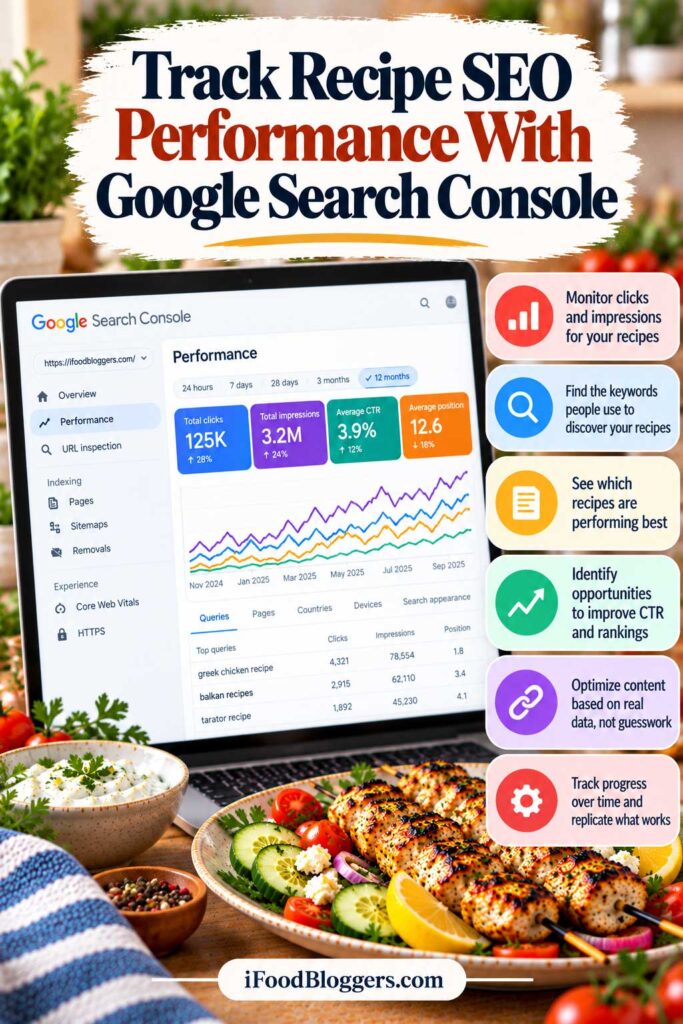
Track Recipe SEO Performance With Google Search Console
Publishing an optimized recipe is only the beginning. You also need to understand how people discover it through Google and where improvements may be needed.
Google Search Console is a free tool that shows which recipes receive search impressions and clicks, which queries bring visitors, and whether Google encounters crawling or indexing problems.
Unlike traditional website analytics, which focuses on visitor activity after someone arrives, Search Console provides insights into your website’s visibility in Google Search.
For recipe SEO, this data helps you make informed decisions instead of guessing what works.
Understand the Four Main Search Performance Metrics
Google Search Console’s Performance report provides four useful metrics:
| Metric | What it measures | Why it matters |
|---|---|---|
| Total clicks | Clicks from Google Search to your website | Measures search traffic |
| Total impressions | How often your pages appear in eligible search results | Shows search visibility |
| Average CTR | Percentage of impressions resulting in clicks | Helps evaluate click-through performance |
| Average position | Average position across recorded impressions | Provides ranking context |
Consider these metrics together rather than individually.
For example, a recipe ranking near the bottom of search results may receive many impressions but few clicks.
Another recipe targeting a specific search may attract fewer impressions but a higher CTR.
A low click-through rate doesn’t automatically mean your title needs changing. Ranking position, search intent, competing results, and the layout of Google’s search results can all influence how often people click.
Find the Search Queries Bringing Visitors to Your Recipes
Search Console shows which queries generate impressions and clicks for your recipes.
For example, a Bulgarian banitsa article might appear for searches such as “Bulgarian banitsa recipe,” “cheese phyllo pastry,” or “how to make banitsa with feta.”
These queries reveal what people want to know and may uncover useful content opportunities.
If visitors frequently search for cheese substitutions, consider adding a short explanation of suitable alternatives and how they affect the pastry.
Use real search queries to improve your recipe, not simply to add more keywords.
Identify Recipes With High Impressions but Few Clicks
Recipes with high impressions but relatively few clicks deserve a closer look.
Start by checking which queries generate those impressions and where your page typically appears.
If the recipe ranks in lower positions, visibility may be the main issue. If it appears prominently for relevant searches but receives few clicks, review its title and search appearance.
For example, “Greek Lemon Chicken and Potatoes Recipe” clearly describes the dish, while “My Favorite Family Dinner” doesn’t.
A descriptive title can help readers recognize a relevant result.
Don’t rewrite titles just to increase CTR. Make sure they accurately represent the recipe and match search intent.
Look for Keywords Ranking Near the First Page
Google Search Console can reveal queries where your recipes have some visibility but aren’t yet performing strongly.
For example, a Balkan bean soup recipe might receive impressions for a relevant query with an average position around 12.
Rather than repeating the keyword, examine the search results and compare your recipe with competing pages.
Does your content match search intent? Are the instructions complete? Could better photographs, cooking tips, or ingredient explanations help readers?
Also check for technical issues that might affect the page.
Treat average position as a clue for finding improvement opportunities, not a guarantee that small changes will produce first-page rankings.
Compare Performance Before and After Recipe Updates
After updating an older recipe, record the date and monitor its performance in Google Search Console.
For example, if you improve your Greek moussaka recipe with clearer instructions, updated photographs, and troubleshooting tips, compare clicks, impressions, queries, and average position before and after the changes.
Allow time for Google to process the updates, and avoid drawing conclusions from a few days of data.
Account for seasonal demand. A Thanksgiving side dish may naturally attract more searches in November than in summer.
For seasonal recipes, year-over-year comparisons can provide more useful context than comparing unrelated months.
Monitor Recipe Indexing
Recipes generally need to be indexed by Google to appear in its organic search results.
Use Search Console’s Page indexing report to identify URLs with indexing problems.
Possible causes include noindex directives, incorrect canonical URLs, crawling errors, or Google’s decision not to index a page.
The URL Inspection tool can help you investigate individual recipes.
Submitting a URL for indexing doesn’t guarantee inclusion in Google Search.
Before requesting indexing again, make sure the recipe is accessible, technically sound, and provides useful content.
Review Recipe Structured Data Reports
Google Search Console may display recipe enhancement reports when it detects supported Recipe structured data on your website.
These reports help identify errors affecting eligibility for recipe rich results.
For example, a plugin update might introduce missing or incorrect image information across multiple recipes.
Review affected URLs, correct the underlying issue, and request validation when available.
Valid structured data makes a recipe eligible for supported search features, but doesn’t guarantee that Google will display a rich result.
Understand the Difference Between Web Search and Google Images
Google Search Console lets you compare performance across search types, including Web and Image.
For example, your homemade baklava recipe might receive limited traffic from regular web results but generate impressions through Google Images.
If image visibility matters for your recipes, review photograph quality, descriptive alt text, and the surrounding content.
Remember that image search behaves differently. People often browse food photographs for inspiration without visiting the original website.
Evaluate image search performance separately from regular web search traffic.
Combine Search Console With Google Analytics
Search Console shows how people discover your recipes through Google Search, while Google Analytics helps you understand what visitors do afterward.
For example, Search Console might reveal a recipe attracting consistent organic clicks. Google Analytics 4 can then help you examine engagement and traffic patterns.
With appropriate event tracking, you can also measure actions such as recipe printing, newsletter signups, or affiliate link clicks.
These events may require additional setup.
Together, the tools help you understand both search visibility and how visitors interact with your food blog.
Don’t Obsess Over Daily Ranking Changes
Recipe rankings naturally fluctuate, so checking average position every morning rarely provides the full picture.
A change from position 8 to 10 over a few days doesn’t necessarily indicate a serious problem. Search Console averages positions across different queries and search appearances.
Instead, compare meaningful periods and look for consistent trends in clicks, impressions, and relevant search queries.
If performance changes significantly, investigate possible causes before rewriting the recipe.
Focus on longer-term patterns rather than reacting to every daily fluctuation.
Build a Simple Monthly Recipe SEO Review
You don’t need an advanced dashboard to monitor recipe SEO.
Once a month, review your most important recipes in Google Search Console. Look for pages gaining visibility, recipes losing clicks, and search queries revealing useful content opportunities.
Check for significant indexing or structured data problems, then decide which recipes deserve attention.
Keep a simple record of the articles you’ve updated, what changed, and when.
A consistent monthly review helps you prioritize improvements without spending hours analyzing unnecessary metrics.
Common Recipe SEO Mistakes to Avoid
Even experienced food bloggers make mistakes that affect how their recipes perform in Google Search.
Some are technical, such as missing structured data or indexing problems. Others involve poor keyword targeting, incomplete instructions, or unnecessary content that makes recipes harder to follow.
A quick review of your recipe card, keyword targeting, images, and technical settings before publishing can prevent many of these problems.
For additional website issues, see our guide to common WordPress mistakes.
Targeting Keywords That Don’t Match the Recipe
Choosing keywords based only on search volume can attract the wrong audience.
For example, a traditional Bulgarian tarator recipe may not satisfy someone searching for “healthy soup recipes,” who might expect a collection of different dishes.
A more relevant target would be “Bulgarian tarator recipe” or “cold cucumber yogurt soup.”
Before choosing a keyword, examine Google’s search results and consider what readers expect to find.
Choose keywords that accurately describe your recipe and match search intent, not simply those with the highest search volume.
Using the Same Primary Keyword for Multiple Similar Recipes
Publishing several nearly identical recipes can create unnecessary keyword overlap.
For example, “Easy Greek Tzatziki,” “Best Homemade Tzatziki,” and “Traditional Tzatziki Sauce” may target similar searches without offering substantially different information.
This is often called keyword cannibalization, although multiple pages ranking for related queries isn’t automatically a problem.
The important question is whether each recipe serves a distinct purpose.
Traditional and vegan tzatziki recipes may deserve separate pages, while several nearly identical versions might be better combined.
Focus on giving each recipe a clear purpose rather than creating multiple articles for slight keyword variations.
Stuffing Keywords Into Every Heading and Paragraph
Repeating your primary keyword excessively makes recipes harder to read without adding useful information.
For example:
“Our Greek chicken souvlaki recipe is the best Greek chicken souvlaki recipe because this Greek chicken souvlaki recipe is easy to make.”
A more natural version would be:
“This homemade Greek chicken souvlaki is marinated with lemon, olive oil, garlic, and oregano before grilling.”
The second sentence provides useful cooking information without unnecessary repetition.
You don’t need to achieve a specific keyword density percentage.
Use recipe keywords naturally and prioritize clear, helpful instructions over repetition.
Writing Long Introductions That Delay the Recipe
A recipe doesn’t need hundreds of words of background information before readers can find the ingredients.
Start with a brief explanation of the dish, what makes it appealing, and any important preparation details.
Cultural history and personal stories can add value when they’re relevant, but unrelated paragraphs shouldn’t delay the recipe.
For longer articles, a visible Jump to Recipe button helps readers reach the instructions quickly.
Keep introductions useful and make the recipe easy to find.
Publishing Incomplete or Inaccurate Recipe Cards
Missing ingredients, incorrect cooking times, and unclear instructions can frustrate readers.
For example, your instructions might mention adding garlic even though garlic is missing from the ingredient list.
Before publishing, compare the recipe card with your tested preparation process.
Check measurements, temperatures, cooking and resting times, servings, and instructions.
An accurate recipe card matters more than additional SEO-focused paragraphs.
Ignoring Recipe Structured Data
Publishing ingredients and instructions in ordinary paragraphs doesn’t automatically create valid Recipe structured data.
A dedicated recipe plugin can help, but incorrect settings or conflicting plugins may still cause problems.
Test important recipes using Google’s Rich Results Test and correct relevant errors.
Valid Recipe schema supports eligibility for certain Google search enhancements, but doesn’t guarantee rankings or rich results.
Using Poor-Quality or Unoptimized Images
Dark, blurry, or misleading photographs can make an otherwise excellent recipe less appealing.
Large image files may also slow down your website.
Use clear photographs of the finished dish and important preparation steps. Compress images appropriately, provide descriptive filenames and meaningful alt text, and use responsive image delivery.
Avoid adding multiple nearly identical photographs.
Every image should help readers understand or appreciate the recipe.
Forgetting About Mobile Visitors
A recipe that looks great on desktop may be difficult to follow on a phone.
Small text, overlapping ads, oversized images, and hard-to-tap buttons can interfere with the cooking experience.
Pay particular attention to recipe cards. Readers should be able to follow ingredients and instructions without zooming or struggling with the layout.
Test important recipes on mobile devices, especially after changing your theme, plugins, or advertising settings.
Make your recipes easy to read and use on smaller screens.
Internal links should help readers discover recipes that naturally belong together.
For example, a Greek salad article could recommend chicken souvlaki, homemade pita bread, or roasted Greek potatoes.
Linking to unrelated desserts, soups, and breakfast recipes simply to increase the number of links adds little value.
Use descriptive, natural anchor text and place links where they genuinely help readers.
Prioritize relevant recipe connections over link quantity.
Neglecting Older Recipes
Publishing new recipes is important, but older articles also need occasional attention.
Over time, you may discover broken links, unclear instructions, outdated photographs, or technical problems.
Google Search Console may also reveal new queries that suggest useful improvements.
However, don’t rewrite recipes simply because they’re several years old.
Prioritize updates based on content quality, search performance, and what readers actually need.
Copying Recipes Without Adding Original Value
Traditional dishes often share ingredients and cooking methods, but your content should still offer something original.
Copying another blogger’s writing or photographs without permission can create legal and ethical problems.
Instead, contribute your own tested instructions, photographs, cooking observations, and helpful explanations.
For example, when publishing a traditional Bulgarian banitsa recipe, explain which cheese you used, how you handled the phyllo dough, and what helped you achieve the desired texture.
Original value comes from genuine cooking experience, not inventing unnecessary recipe variations.
Publishing AI-Generated Recipes Without Testing Them
AI tools can help organize research, brainstorm article ideas, and improve draft wording.
However, AI-generated recipes may contain incorrect measurements, unrealistic cooking times, or unsafe instructions.
A recipe that sounds convincing doesn’t necessarily work in the kitchen.
Never present AI-generated instructions as personally tested unless you’ve actually prepared the dish.
Verify ingredient quantities, cooking methods, temperatures, and relevant food safety information.
AI can assist your writing process, but recipe testing and editorial responsibility remain with you.
Making Unsupported Health Claims
Avoid claiming that a recipe can prevent illness, treat medical conditions, or guarantee specific health benefits without reliable evidence.
Instead, describe verifiable nutritional characteristics, such as protein, fiber, or relevant ingredients.
For example, explaining that a lentil soup provides dietary fiber is more useful than suggesting it can cure digestive problems.
Use trustworthy sources when discussing nutrition, health, or food safety.
Keep health information accurate, appropriately qualified, and supported by evidence.
Expecting Immediate Results From Every SEO Change
Improving a recipe doesn’t guarantee an immediate increase in Google traffic.
Even after updating photographs, correcting structured data, or improving internal links, results may take time to appear.
Search demand, competition, seasonality, and changes in Google’s results can also affect performance.
Monitor meaningful trends in Google Search Console rather than reacting to daily ranking fluctuations.
Judge SEO improvements over appropriate periods, not just the first few days after publishing.
Focus on Fixing Problems That Actually Matter
Not every SEO issue deserves equal attention.
Correcting inaccurate cooking instructions is usually more important than adjusting an image filename. Improving a difficult-to-use mobile recipe card may help readers more than adding another keyword variation.
When reviewing your content, ask what would make the biggest difference to someone preparing the dish.
The best recipe SEO improvements make recipes easier to find, understand, prepare, and trust.
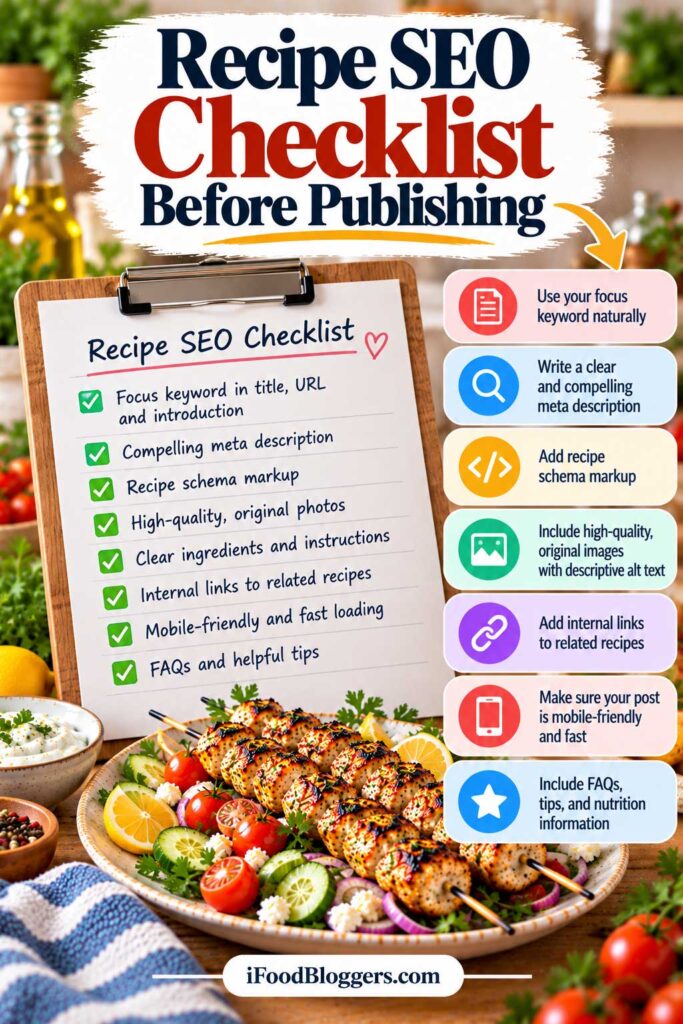
Recipe SEO Checklist Before Publishing
Before publishing a new recipe or updating an older one, use this recipe SEO checklist to catch common mistakes.
You don’t need to repeat every SEO audit from scratch. Focus on recipe accuracy, search intent, structured data, images, internal links, and usability.
1. Keyword Research and Search Intent
- Choose a primary keyword that accurately describes the dish.
- Check Google’s search results to understand search intent.
- Include relevant keyword variations naturally.
- Make sure you’re not duplicating an existing recipe targeting the same intent.
2. SEO Title, URL, and Meta Description
- Write a descriptive SEO title containing the primary keyword naturally.
- Use a short, readable URL.
- Write an accurate, compelling meta description.
- Avoid keyword stuffing.
- Preserve established URLs when updating older recipes unless a change is necessary.
3. Recipe Introduction and Content
- Explain the dish clearly near the beginning.
- Include the primary keyword naturally.
- Organize content with helpful headings.
- Add relevant cooking tips, substitutions, or troubleshooting advice.
- Remove unnecessary repetition.
4. Recipe Card Accuracy
- Verify ingredients, measurements, and quantities.
- Check cooking instructions, temperatures, and timing.
- Include accurate servings or yield.
- Confirm that the recipe card matches the article.
- Make sure the instructions reflect the recipe you’ve tested.
5. Recipe Schema Markup
- Confirm that valid Recipe structured data is present.
- Make sure structured data matches the visible recipe.
- Check for missing required properties or conflicting markup.
- Avoid fabricated ratings, reviews, or nutrition values.
- Test the published URL with Google’s Rich Results Test.
6. Recipe Images
- Use clear, accurate photographs of the dish.
- Add descriptive filenames and meaningful alt text.
- Compress images without sacrificing necessary quality.
- Check image display on mobile devices.
- Include preparation photographs when helpful.
- Link to relevant recipes or supporting guides.
- Use natural, descriptive anchor text.
- Assign appropriate recipe categories.
- Check for broken links.
- Link to the new recipe from relevant older posts when useful.
8. Mobile Experience and Page Performance
- Test the recipe on a mobile device.
- Check ingredient lists and instructions for readability.
- Test Jump to Recipe and Print Recipe buttons, if available.
- Check for overlapping ads, pop-ups, or layout problems.
- Review performance using PageSpeed Insights.
9. Trust, Accuracy, and Editorial Quality
- Confirm recipe testing and factual accuracy.
- Include useful observations from genuine cooking experience.
- Verify relevant food safety information.
- Avoid unsupported health claims.
- Credit sources and adaptations appropriately.
- Proofread the article and check formatting.
10. Final Publishing and Monitoring
- Preview the complete recipe before publishing.
- Confirm that important pages aren’t accidentally marked
noindex. - Check the canonical URL.
- Make sure readers can find the recipe through your website.
- Monitor indexing and search performance in Google Search Console.
- Record significant updates for future comparison.
How to Use This Checklist Without Slowing Down Your Workflow
A recipe SEO checklist may seem time-consuming at first, but most checks become routine with practice.
Your WordPress recipe plugin can help manage structured data, your SEO plugin can simplify metadata, and image optimization tools can handle compression.
That leaves more time for testing recipes, taking useful photographs, and writing clear cooking instructions.
Start with the recipe and your readers’ needs, complete the technical checks before publishing, and review search performance periodically.
The goal isn’t a perfect SEO plugin score. It’s a reliable publishing process that produces accurate, accessible, and genuinely helpful recipes.
Frequently Asked Questions About Recipe SEO
What is recipe SEO?
Recipe SEO is the process of optimizing recipes so search engines can discover, understand, and display them for relevant searches. It includes keyword research, helpful cooking instructions, structured data, optimized images, internal links, and website performance.
How do I get my recipes to rank on Google?
Target relevant keywords, publish tested recipes with clear instructions and original photographs, and use descriptive titles and URLs. Add a properly configured recipe card, improve mobile usability, and connect related content through internal links. Rankings depend on competition, search intent, and other factors.
Is recipe schema necessary for food blogs?
Recipe schema isn’t required for ordinary Google Search listings, but it is important for eligibility for supported recipe rich results. WordPress recipe plugins can generate this markup. Check your pages using Google’s Rich Results Test.
Does recipe schema improve rankings?
Recipe schema helps Google interpret recipe information and can make pages eligible for enhanced search appearances. It doesn’t guarantee higher rankings or rich results. Accurate structured data should support, not replace, useful recipe content.
What is the best recipe SEO plugin for WordPress?
Popular options include WP Recipe Maker, Tasty Recipes, and Create by Mediavine.
Choose based on recipe card usability, structured data, accessibility, features, maintenance, and compatibility with your website. General SEO plugins such as Rank Math or Yoast SEO can complement a dedicated recipe plugin.
How long should a recipe blog post be for SEO?
There’s no ideal word count. A smoothie recipe may need only a brief explanation, while sourdough bread may require detailed instructions and troubleshooting. Include enough information to help readers prepare the dish successfully without unnecessary filler.
Should I put the recipe card at the top or bottom of the post?
Either placement can work. Many food bloggers use a Jump to Recipe button near the introduction so readers can quickly access ingredients and instructions. Prioritize usability rather than assuming one position improves rankings.
How many times should I use my recipe keyword?
There’s no required keyword density. Include your primary keyword naturally in the title, main heading, introduction, and relevant content. Avoid repetitive phrasing that makes the article difficult to read.
Can recipe images help with SEO?
Yes. Clear, relevant photographs can support visibility in Google Images and certain recipe search features. Use descriptive filenames, meaningful alt text, appropriate dimensions, and efficient compression. Original preparation photographs can also help readers follow your instructions.
Do I need original recipes to rank on Google?
You don’t need to invent a new dish. Traditional recipes can provide excellent content when you contribute tested instructions, original photographs, and practical cooking advice. Avoid copying another creator’s writing or images without permission.
Should I update old recipes or publish new ones?
Both are valuable. New recipes expand your content library, while updates improve existing articles. Use Google Search Console to identify opportunities, prioritize meaningful changes, and preserve established URLs unless there’s a good reason to change them.
How long does recipe SEO take to work?
There’s no fixed timeline. Google may discover a recipe quickly, but meaningful search traffic can take weeks or months to develop. Competition, website history, search demand, and content quality all influence results.
Can AI-written recipes rank on Google?
AI-assisted content isn’t automatically excluded from Google Search. However, AI can produce inaccurate ingredients, cooking times, or instructions. Verify information, test recipes before presenting them as tested, and maintain meaningful editorial oversight.
How do I know if my recipe SEO is working?
Use Google Search Console to track clicks, impressions, queries, and average positions. Check indexing and structured data issues, and use Google Analytics 4 to evaluate visitor engagement and configured events. Focus on meaningful trends rather than daily fluctuations.
Final Thoughts: Build Recipe Posts That Deserve to Rank
Learning recipe SEO doesn’t mean mastering every WordPress plugin, ranking factor, or technical detail before publishing your next recipe.
Start with what matters most: choose relevant keywords, understand search intent, and publish recipes you’ve tested with clear instructions and useful photographs.
Then make sure your recipe cards, structured data, internal links, and mobile experience support that content.
But remember, recipe SEO isn’t about writing longer articles or repeating keywords more often.
It’s about helping someone successfully prepare a dish.
Sometimes that means explaining why bread dough isn’t rising, showing how to fold a pastry, or suggesting an ingredient substitution that actually works.
Those practical details are what make your content valuable.
Keep improving older recipes, monitor performance in Google Search Console, and build a connected collection of reliable dishes rather than publishing articles simply to target more keywords.
Search technology will continue to change, but readers will always appreciate recipes they can trust.
The best long-term recipe SEO strategy is simple: create recipes worth finding and make them easy to discover.
Read Next: More Food Blogging SEO Guides
Ready to improve other parts of your food blog? These guides cover keyword research, traffic growth, useful tools, and content planning.
- How to Find Low-Competition Recipe Keywords — Discover recipe searches with realistic opportunities for smaller food blogs.
- How to Get More Traffic to Your Food Blog — Explore ways to attract visitors through Google, Pinterest, and other channels.
- Best Tools for Food Bloggers — Find useful tools for managing, optimizing, and promoting your recipes.
- Content Discovery Tools for Food Bloggers — Discover seasonal trends, audience questions, and fresh content ideas.
- Best Productivity Tools for Food Bloggers — Organize your publishing schedule and spend less time on repetitive tasks.
Choose the guide that addresses your next challenge and build on what you’ve learned.