
Pinterest SEO for food bloggers can help more people discover your recipes, visit your website, and become regular readers.
Unlike traditional social media platforms, Pinterest works as a visual search engine. People use it to find meal ideas, cooking inspiration, and specific recipes, from easy chicken dinners to traditional Greek desserts.
When your Pins match those searches, they have a better chance of reaching people interested in your content. And unlike social media posts that quickly disappear from feeds, Pinterest Pins can continue attracting visitors months or even years after publication.
But beautiful food photography alone isn’t enough.
Pinterest also uses information such as Pin titles, descriptions, boards, and linked content to understand what you’re sharing. Choosing relevant keywords and creating clear, appealing images can make your recipes easier to discover.
The good news? You don’t need expensive tools or hours of daily work to get started.
In this guide, you’ll learn how to research Pinterest keywords, optimize recipe Pins, organize boards, plan seasonal content, and use Pinterest Analytics to identify which Pins actually bring traffic to your food blog.
What Is Pinterest SEO for Food Bloggers?
Pinterest SEO is the process of optimizing your Pins, boards, profile, and linked recipe pages to improve their visibility in Pinterest search results and recommendations.
Think of it as helping Pinterest understand exactly what recipes you publish.
For example, imagine you’ve created a Pin for homemade banana bread.
A generic title such as Delicious Homemade Bread doesn’t tell readers much about the recipe.
A more descriptive title would be:
Easy Moist Banana Bread Recipe With Ripe Bananas
This immediately identifies the dish and matches the language someone might use when searching for banana bread recipes.
You can strengthen the Pin by adding a natural description, saving it to a relevant board such as Homemade Baking Recipes, and linking directly to the complete recipe.
However, Pinterest SEO isn’t about repeating keywords everywhere. Your images should attract attention, your descriptions should accurately represent the dish, and your recipe pages should deliver what the Pin promises.
A Pin advertising a 15-Minute Chicken Dinner, for example, shouldn’t lead to a recipe that takes an hour to prepare.
The goal of Pinterest SEO is simple: help the right people discover recipes they genuinely want to make.
When you combine relevant keywords, attractive food photography, and useful recipe content, you create a stronger foundation for consistent Pinterest traffic.
If you’re new to the platform, explore our Pinterest for Food Bloggers resource hub for additional tutorials on Pin creation, traffic growth, and Pinterest marketing.
Affiliate Disclosure: Some links in this article may be affiliate links. If you make a purchase or sign up through one of these links, iFoodBloggers may earn a commission at no extra cost to you.
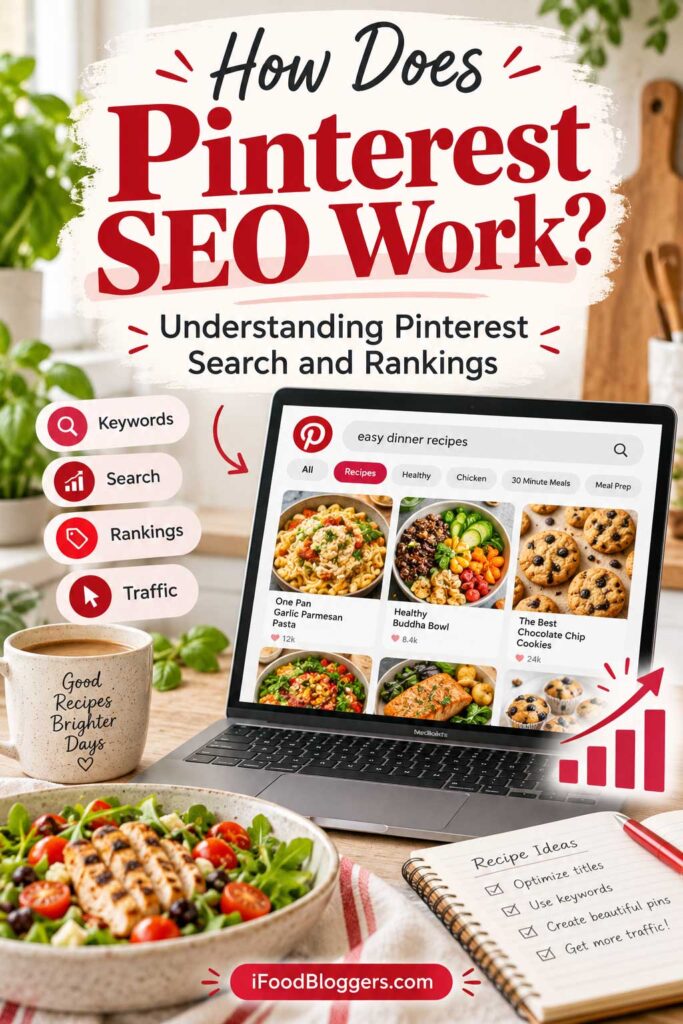
How Does Pinterest SEO Work? Understanding Pinterest Search and Rankings
Pinterest doesn’t simply show people the newest Pins or content from accounts with the most followers.
When someone searches for a recipe, Pinterest considers relevance, engagement, user interests, and other signals to determine which content to display.
Search results can also differ from one person to another. Someone who regularly saves vegetarian meals may discover different recipes than someone interested in grilling.
Although Pinterest doesn’t publish its complete ranking formula, its official Pin performance and distribution guidelines explain several factors that can influence discovery.
1. Keyword Relevance
Keywords help Pinterest understand what your recipe is about.
The platform uses information from Pin titles, descriptions, related boards, and linked pages to identify relevant topics.
Take a traditional Greek chicken souvlaki recipe. Here’s how its Pinterest title, description, board, and destination can work together:
Pin Title: Easy Greek Chicken Souvlaki Recipe
Pin Description: Make juicy Greek chicken souvlaki with a simple lemon, garlic, olive oil, and oregano marinade. These homemade chicken skewers are perfect for Mediterranean dinners and summer grilling.
Board: Traditional Greek Recipes
Destination: Your complete chicken souvlaki recipe.
These elements consistently describe the dish, making it easier for Pinterest to associate the Pin with relevant searches.
Compare that with a vague title such as The Best Dinner Ever.
It may sound exciting, but it doesn’t explain what the recipe actually contains.
The goal is to use descriptive keywords naturally, not repeat the same phrase in every field.
2. Engagement and User Interest
Pinterest also considers how people interact with Pins.
When someone saves a recipe, opens a Pin, or clicks through to a website, those actions can provide information about the content’s appeal.
For example, a bright photograph of homemade lasagna with a clear headline may attract more attention than a dark image with difficult-to-read text.
However, engagement doesn’t guarantee a particular ranking, and Pinterest doesn’t disclose exactly how much weight each interaction receives.
Focus on creating recipes and images that appeal to your intended audience rather than trying to achieve a specific ranking position.
3. Image Quality and Visual Relevance
Pinterest is built around visual discovery, making food photography especially important.
A colorful Mediterranean salad, golden roasted potatoes, or freshly baked bread can immediately capture someone’s attention.
Your image should make the dish recognizable, even on a smartphone.
Use good lighting, clear typography, and a short headline when appropriate. Avoid covering the food with excessive text or decorative graphics.
A beautiful photograph attracts attention, while a descriptive headline helps people understand what they’ll find.
4. Relevant Pinterest Boards and Destination Pages
Pinterest boards provide additional context about your content.
For example, saving Greek moussaka to a board called Traditional Greek Recipes creates a clearer topical connection than saving it to a generic board named Yummy Food.
You don’t need hundreds of boards. A smaller collection organized around your main recipe categories is a sensible starting point.
Your destination page matters just as much.
If a Pin advertises an Easy 20-Minute Pasta Recipe, the linked article should deliver that recipe with accurate preparation times.
Link directly to the relevant recipe rather than sending visitors to your homepage.
Make sure the page loads properly, works on mobile devices, and provides easy access to the ingredients and instructions.
Pinterest SEO should create a consistent experience from the Pin to the finished recipe.
5. Content Freshness, Seasonality, and Long-Term Discovery
One of Pinterest’s biggest advantages is that older Pins can continue attracting attention.
A recipe published months ago may appear in search results or recommendations when it becomes relevant again.
Seasonal recipes are a good example.
A Christmas cookie Pin published in October could attract interest as holiday baking approaches, then potentially receive renewed attention the following year.
Similarly, summer salads, Easter desserts, and comforting winter soups may experience recurring seasonal demand.
However, older Pins aren’t guaranteed to keep performing, and publishing new content doesn’t automatically improve rankings.
Pinterest considers relevance, user interests, engagement, and other factors when distributing content.
For food bloggers, the opportunity is to build a collection of useful evergreen and seasonal recipes that people can continue discovering over time.
Pinterest SEO vs. Google SEO: What’s the Difference?
Both Pinterest and Google help people discover relevant content, but they support different search experiences.
| SEO Factor | Pinterest SEO | Google SEO |
|---|---|---|
| Primary purpose | Visual discovery and inspiration | Finding information and answers |
| Main content | Pins, images, videos, and boards | Web pages, images, videos, and other results |
| Keyword optimization | Pin titles, descriptions, and boards | Page titles, headings, and content |
| Visual importance | Central to discovery and engagement | Important for recipe search and usability |
| Engagement | Saves, clicks, and other interactions can inform distribution | Uses different ranking systems |
| Seasonal content | Older Pins may resurface when relevant | Seasonal pages can attract recurring searches |
| Traffic destination | Linked recipe or website | Relevant search result or webpage |
Neither platform should replace the other.
Google can help you reach people searching for specific recipes, while Pinterest can introduce your dishes to users exploring meal ideas and cooking inspiration.
The strongest strategy combines both: publish search-optimized recipes on your website, then create attractive Pinterest Pins that help new readers discover them. For a deeper explanation of optimizing recipes for Google, read our Recipe SEO guide.
This gives each recipe more opportunities to attract visitors without requiring entirely different content for every platform.
How to Find the Best Pinterest Keywords for Your Food Blog
Keyword research is the foundation of Pinterest SEO for food bloggers. Choosing relevant search terms helps your recipes appear when people look for specific dishes, ingredients, and cooking inspiration.
You don’t need expensive SEO software to get started. Pinterest’s search suggestions, Pinterest Trends, and existing search results can help you discover relevant phrases and understand what your audience is looking for.
The goal isn’t to find the most popular keyword. It’s to choose search terms that accurately describe your recipes and attract interested readers.
Start With Pinterest Search Suggestions
Pinterest’s search bar is one of the easiest places to begin keyword research.
When you start typing a phrase, Pinterest may suggest related searches based on user activity and interests.
For example, enter chicken recipes and investigate more specific phrases such as easy chicken dinner recipes, healthy chicken recipes, or Mediterranean chicken recipes.
If you’re promoting traditional Greek chicken souvlaki, you could research:
- Greek chicken souvlaki recipe
- Greek chicken skewers
- Mediterranean grilled chicken
- Chicken souvlaki marinade
These are potential keyword ideas, not verified current autocomplete results.
Each phrase represents a slightly different search intent. Someone searching for Greek chicken souvlaki recipe likely wants that specific dish, while someone searching for Mediterranean grilled chicken may still be exploring dinner ideas.
Choose keywords that genuinely match your recipe rather than targeting every related phrase.
Use Pinterest Trends to Research Recipe Keywords
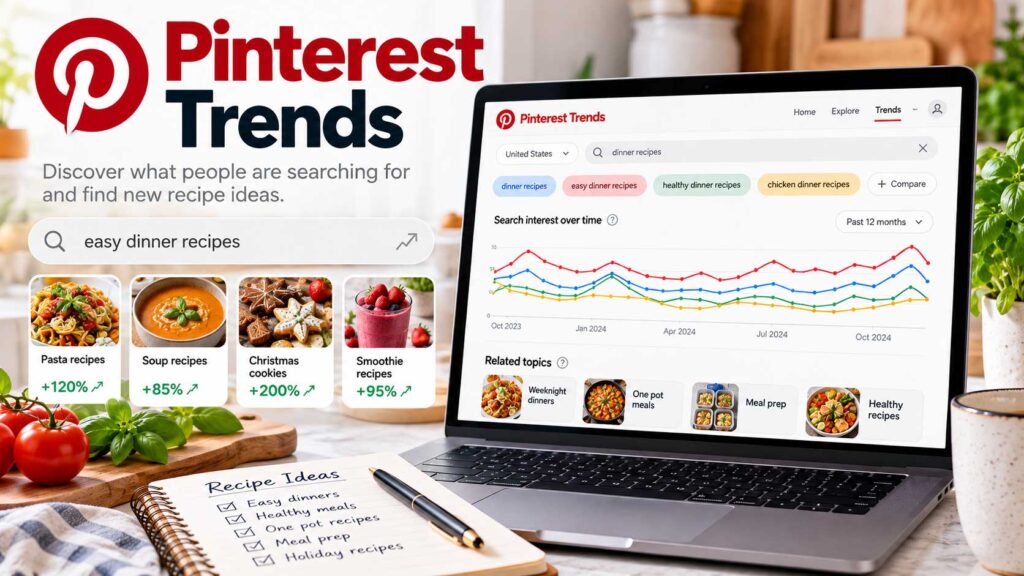
Pinterest Trends helps you explore how interest in different searches changes over time.
This is particularly useful for seasonal recipes such as pumpkin bread, Christmas cookies, summer salads, and holiday desserts.
Start by selecting your target country and entering a relevant keyword. Review the historical data to see whether interest remains consistent or changes during particular months.
You can also compare related phrases, such as pumpkin muffins, pumpkin bread, and pumpkin cookies.
Pinterest Trends is especially useful for spotting seasonal patterns, but it doesn’t provide exact monthly search volumes. We’ll explain how to interpret its search-interest scores in the dedicated Pinterest Trends section below.
Use Pinterest Trends to identify seasonal patterns, compare related topics, and plan content before interest increases.
We’ll explore seasonal Pinterest keyword research in greater detail later in this guide.
Focus on Long-Tail Pinterest Keywords
Broad searches such as dessert recipes or healthy breakfast ideas can describe thousands of different dishes.
Long-tail keywords provide more specific information about what someone wants.
For example, easy no-bake chocolate dessert communicates much more than simply dessert recipes.
Here’s how broad keywords compare with more specific alternatives.
| Broad Keyword | More Specific Pinterest Keyword |
|---|---|
| Chicken recipes | Easy Mediterranean chicken dinner |
| Breakfast ideas | Make-ahead high-protein breakfast |
| Pasta recipes | Creamy garlic mushroom pasta recipe |
| Healthy desserts | Greek yogurt dessert recipes |
| Soup recipes | Easy homemade lentil soup |
| Greek food | Traditional Greek dinner recipes |
| Smoothie recipes | Strawberry banana protein smoothie |
| Vegetarian recipes | Easy Mediterranean vegetarian meals |
These are examples of keyword specificity, not verified search-volume or competition data.
Pinterest keyword research is different from Google keyword research, but both benefit from understanding search intent and choosing specific phrases. If you’re also improving your organic search traffic, our guide to finding low-competition recipe keywords explains how to evaluate opportunities for your food blog.
Specific keywords help you understand what someone actually wants to cook.
For example, Greek lentil soup recipe clearly identifies a dish, while healthy food could mean almost anything.
That doesn’t guarantee easier rankings, but it gives you a better opportunity to match the recipe with the right search.
Choose the phrase that describes your dish most accurately, not simply the longest keyword you can find.
Understand Pinterest Search Intent
Search intent describes what someone hopes to find when entering a keyword.
Consider three searches involving chicken:
Someone searching for chicken breast recipes may want general dinner inspiration.
A person searching for how to cook juicy chicken breast in the oven wants a specific cooking technique.
Someone searching for chicken meal prep bowls may be looking for make-ahead meals.
Although these searches involve the same ingredient, they serve different needs.
The same principle applies to dietary keywords.
If your Greek tzatziki recipe contains traditional dairy yogurt, targeting dairy-free cucumber dip would be misleading.
Instead, use phrases such as homemade tzatziki sauce or Greek yogurt cucumber dip when they accurately represent the dish.
Matching search intent helps attract readers who are more likely to find your content useful.
Study Pinterest Search Results
Once you’ve identified a potential keyword, search for it directly on Pinterest.
Look at the recipes appearing in the results, the types of photographs used, and how creators present their content.
For example, a search for easy Mediterranean breakfast recipes might feature egg dishes, yogurt bowls, savory breakfasts, or overnight oats.
These results can help you understand what people may expect from the topic.
Pay attention to whether Pins feature close-up food photographs, descriptive headlines, or multiple images showing preparation steps.
However, Pinterest personalizes search results, so the Pins you see aren’t necessarily ranked in the same order for everyone.
You also can’t determine exact keyword difficulty simply by examining popular Pins.
Use search results to understand the content and visual presentation, not as a definitive measure of competition.
Find Keyword Opportunities in Your Existing Recipes
You don’t always need to publish new recipes to target additional Pinterest searches.
Your existing articles may already match several relevant keywords.
For example, a traditional Greek moussaka recipe could be relevant to searches for Greek moussaka recipe, homemade moussaka, or Greek eggplant casserole.
Research which phrases accurately describe the dish and select the strongest primary keyword.
You can also create genuinely different Pinterest designs using original photographs from the same recipe.
One Pin might show the entire casserole, while another features a sliced portion revealing its layers.
Both can link to the original recipe.
Avoid publishing large numbers of nearly identical Pins simply to target minor keyword variations.
Choose One Primary Keyword for Each Recipe Pin
After researching your options, select one primary keyword that best represents your recipe.
Use that phrase naturally in the Pin title and support it with relevant details in the description.
Here’s an example for a homemade Greek lemon chicken recipe.
Primary Keyword: Greek lemon chicken recipe
Related Keywords: Mediterranean chicken dinner, lemon garlic chicken, Greek chicken with oregano
Pinterest Title: Easy Greek Lemon Chicken Recipe
Pinterest Description:
Make this flavorful Greek lemon chicken with olive oil, garlic, oregano, and fresh lemon juice. This Mediterranean-inspired chicken dish is perfect for an easy family dinner and pairs beautifully with roasted potatoes or a fresh Greek salad.
Notice how the description includes relevant ingredients and serving ideas without repeating the exact keyword unnecessarily.
That’s what effective Pinterest keyword optimization should look like.
Keep Your Pinterest Keyword Research Organized
As your recipe library grows, a simple keyword tracking spreadsheet can help you stay organized.
Record the recipe name, primary Pinterest keyword, related phrases, relevant board, destination URL, and any seasonal considerations.
You can also add publication dates and performance metrics once your Pins are live.
This makes it easier to identify recipes that haven’t been promoted and discover which topics consistently attract outbound clicks.
You don’t need a complicated system. Google Sheets or Excel is enough for most food bloggers.
Before publishing a new recipe Pin, research what people are searching for, choose a relevant primary keyword, and make sure the Pin accurately represents the dish.
That simple habit can help you create more focused Pinterest content and give your recipes better opportunities to reach interested readers.
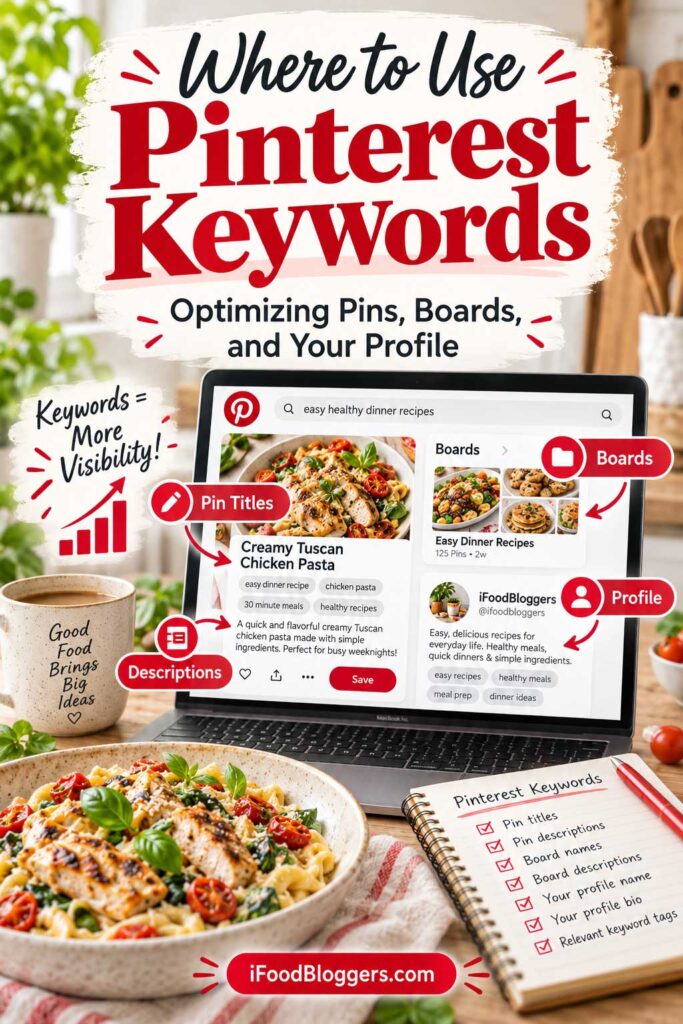
Where to Use Pinterest Keywords: Optimizing Pins, Boards, and Your Profile
Once you’ve researched relevant Pinterest keywords, the next step is using them in the right places.
Pinterest uses information from Pin titles, descriptions, boards, and linked content to understand what you’re sharing. Your profile also helps visitors recognize your food blog’s specialty.
The goal isn’t to repeat the same keyword everywhere. It’s to create a consistent connection between what people search for, what your Pin promises, and what they’ll find on your website.
Optimize Your Pinterest Pin Titles
Your Pin title should clearly identify the recipe and include your primary keyword naturally.
For example, a generic title such as Delicious Potatoes Everyone Will Love doesn’t explain much about the dish.
A more descriptive alternative would be:
Greek Lemon Potatoes Recipe – Crispy and Delicious
You could also use Easy Greek Roasted Potatoes With Garlic if that accurately describes your recipe.
Pinterest allows Pin titles of up to 100 characters, although the full title may not appear everywhere. Place the most important information near the beginning and avoid unnecessary words.
A good title doesn’t need to be clever or complicated. It should help people recognize the recipe and decide whether it’s what they’re looking for.
Write Natural, Keyword-Rich Pinterest Descriptions
Pinterest descriptions provide additional context about your recipe, including ingredients, cooking methods, flavors, and serving suggestions.
Although Pinterest allows up to 800 characters, you don’t need to use the entire limit.
Consider this description for homemade Greek tzatziki:
Poor Description:
Greek food, Greek recipes, healthy recipes, easy recipes, cucumber recipes, yogurt recipes, Mediterranean food.
This reads like a collection of keywords rather than useful information.
Improved Description:
Make this refreshing Greek tzatziki recipe with thick Greek yogurt, cucumber, garlic, olive oil, and fresh dill. This creamy Mediterranean yogurt dip pairs beautifully with grilled chicken, homemade gyros, pita bread, and fresh vegetables. Get the complete recipe and preparation tips.
The difference is easy to see. Instead of listing keywords, this description tells readers what’s in the dish and how they might serve it.
That’s what a good Pinterest description should do: explain the recipe naturally while including search terms that genuinely fit.
Include Keywords in Your Pinterest Image Text
Text overlays help people recognize your recipes while scrolling through Pinterest.
For example, a photograph of homemade baklava could feature the headline:
Traditional Greek Baklava Recipe
Or:
Easy Homemade Baklava With Walnuts
Both identify the dish without overwhelming the image.
Avoid unnecessarily long headlines such as Best Easy Traditional Homemade Greek Baklava Recipe With Walnuts and Honey Syrup.
Keep the text short, readable, and relevant to your primary keyword.
Remember that the text displayed on your image and the Pin title serve different purposes. Your image headline helps viewers understand the photograph, while the Pin title and description provide explicit information Pinterest can use for content discovery.
We’ll cover Pinterest image dimensions, typography, and design techniques later in this guide.
Optimize Pinterest Board Names and Descriptions
Pinterest boards organize your content and provide additional context about the recipes you publish.
A board named My Favorite Foods doesn’t communicate a clear topic.
A name such as Easy Mediterranean Dinner Recipes immediately tells visitors what they’ll find.
Other useful examples include Traditional Greek Recipes, Homemade Bread Recipes, and Healthy Breakfast Ideas.
Board descriptions should explain the collection using natural, relevant keywords.
Example Board: Traditional Balkan Recipes
Discover traditional Balkan recipes from Bulgaria, Greece, Serbia, Romania, and neighboring countries. Explore homemade dinners, comforting soups, fresh salads, savory pastries, and authentic desserts inspired by Southeastern European cooking.
This description communicates the subject without repeating the board name unnecessarily.
You don’t need separate boards for every keyword variation. For example, Greek Dinner Recipes and Easy Greek Dinner Ideas may overlap enough to belong in one collection.
Focus on creating useful, recognizable categories that reflect your actual content.
Use Relevant Keywords in Your Pinterest Profile
Your Pinterest profile should make it easy for visitors to understand what your food blog is about.
Start with a recognizable display name that includes your brand and, when appropriate, a short description of your specialty.
For example:
Pinterest Display Name: Balkan Recipes | Greek & Balkan Cooking
Your bio can provide additional information about the recipes you share.
Example Pinterest Bio:
Discover authentic Balkan and Mediterranean recipes, traditional family dishes, easy dinners, homemade desserts, and cooking inspiration from Bulgaria, Greece, and Southeastern Europe.
This approach communicates your niche without turning the profile into a list of keywords.
Keep your brand name recognizable and use the description to explain what readers can expect.
Your profile should also include your food blog’s website address.
If you’re using a Pinterest business account, claim your domain to connect your website with your Pinterest presence and access relevant website-sharing analytics.
You can complete verification through an HTML tag, HTML file, or DNS TXT record.
Claiming your website doesn’t guarantee better rankings, but it’s a useful part of setting up your food blog’s Pinterest account.
Link Directly to the Correct Recipe
Your Pinterest destination URL should lead visitors to the recipe advertised in the Pin.
If you’re promoting homemade Greek chicken souvlaki, link directly to the complete chicken souvlaki recipe—not your homepage or an unrelated chicken dish.
Descriptive URLs are also helpful when creating new recipe articles.
For example:
/greek-chicken-souvlaki/
is clearer than:
/post-1847/
However, don’t change established recipe URLs simply to insert additional keywords. Changing URLs without proper redirects can create unnecessary SEO and technical problems.
Instead, focus on accurate destinations, working links, and a consistent experience between your Pinterest content and website.
Use Pinterest Topics and Alt Text Appropriately
Pinterest may provide additional topic selections when you create a Pin.
Choose topics that genuinely match your recipe. For example, a traditional Greek salad could fit topics related to salads or Mediterranean cooking, depending on the available options.
Don’t select unrelated topics simply because they appear popular.
If an alt text field is available, use it to describe the image for people using assistive technologies.
For example:
Bowl of traditional Bulgarian tarator, a cold cucumber and yogurt soup garnished with fresh dill and walnuts.
This is more useful than filling the field with repeated recipe keywords.
Alt text should primarily support accessibility, not serve as another place for keyword stuffing.
Example: How to Optimize Pinterest Keywords for One Recipe
Let’s put these recommendations together using a traditional Bulgarian banitsa recipe.
| Pinterest Element | Optimization Example |
|---|---|
| Primary keyword | Bulgarian banitsa recipe |
| Pin title | Traditional Bulgarian Banitsa Recipe |
| Pin description | Make traditional Bulgarian banitsa with flaky filo pastry, eggs, and cheese. This savory Bulgarian pastry is perfect for breakfast, brunch, or family gatherings. |
| Image headline | Traditional Bulgarian Banitsa |
| Board name | Traditional Bulgarian Recipes |
| Board description | Discover authentic Bulgarian dishes, homemade pastries, traditional breakfasts, comforting dinners, and desserts. |
| Destination | Direct link to your complete banitsa recipe |
Notice how each element supports the same topic without repeating identical language unnecessarily.
The title identifies the dish, the description explains what makes it appealing, the board provides context, and the destination delivers the complete recipe.
Effective Pinterest keyword optimization comes down to relevance and consistency.
Choose keywords that accurately describe your food, use them naturally, and make sure your Pins lead visitors to the recipes they expect to find.
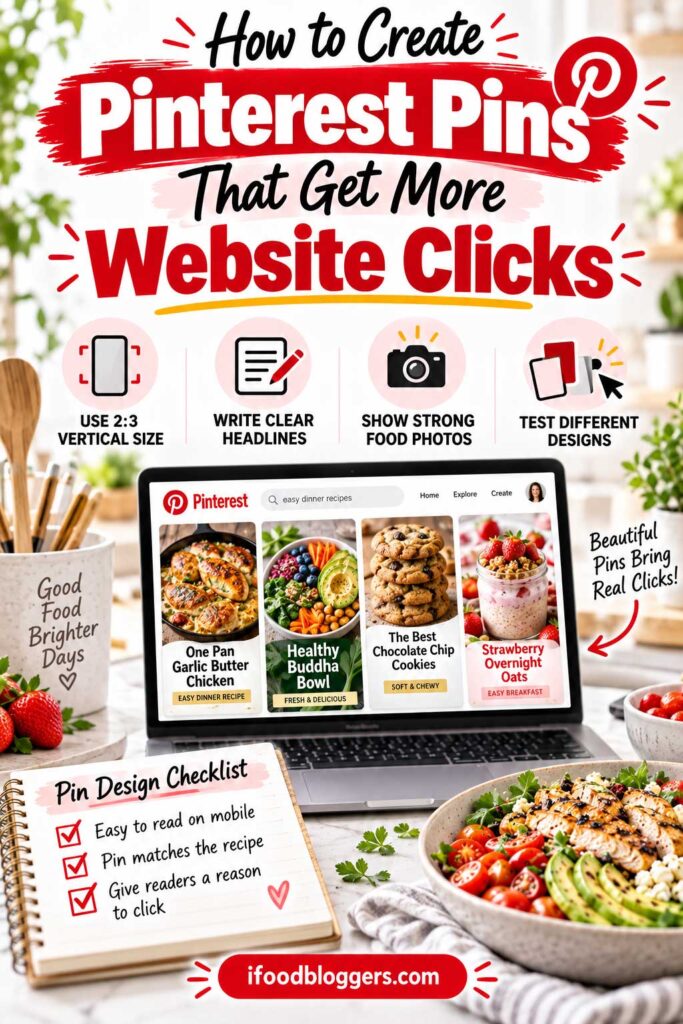
How to Create SEO-Friendly Pinterest Pins That Get More Clicks
A well-optimized Pin title and description help Pinterest understand your recipe, but your image is usually what catches someone’s attention first.
When people browse Pinterest, they’re surrounded by photographs of delicious meals, desserts, and cooking ideas. Your Pin needs to stand out while making the recipe immediately recognizable.
Good Pin design is an important part of Pinterest SEO for food bloggers. An appealing photograph catches someone’s attention, while a descriptive headline helps them understand the recipe and decide whether to click through.
Use the Best Pinterest Pin Dimensions
Pinterest recommends a 2:3 aspect ratio for standard image Pins, making 1000 × 1500 pixels a practical starting point. You can review supported formats, image requirements, and character limits in Pinterest’s official Pin specifications.
Vertical images fit naturally into Pinterest’s scrolling feed and provide enough space for food photography, a short headline, and subtle branding.
| Image Size | Best Use |
|---|---|
| 1000 × 1500 px | Recommended standard recipe Pin |
| 800 × 1200 px | Smaller vertical Pin |
| 1200 × 1800 px | Higher-resolution vertical image |
| 1080 × 1920 px | Full-screen vertical video |
| 1200 × 675 px | Horizontal blog featured image |
Remember that your WordPress featured image and Pinterest graphic don’t need to be identical.
Your blog may use horizontal 16:9 images, while Pinterest generally benefits from a separate vertical design. You can use the same original photograph, adjusting the crop and layout for each platform.
Tools such as Canva, Adobe Express, and Photoshop make it easy to create properly sized Pinterest graphics. If you’re comparing design, scheduling, or research software, our guide to the best Pinterest tools for food bloggers covers free and paid options.
Choose Food Photography That Makes Your Recipe Stand Out
Beautiful food photography can make someone stop scrolling, but the photograph also needs to communicate what they’re looking at.
For example, a distant photograph of homemade Greek moussaka may not reveal much about the dish.
A close-up showing the eggplant, meat filling, and golden béchamel layers immediately makes the recipe more recognizable and appealing.
Different foods benefit from different camera angles.
An overhead photograph works beautifully for colorful salads, while a side angle may better showcase layered cakes, pastries, or casseroles.
Natural lighting, a clean background, and thoughtful composition can make a significant difference without requiring expensive equipment.
Most importantly, keep the food as the main attraction.
Avoid covering your best photographs with oversized headlines, decorative shapes, or unnecessary graphics.
The photograph should make someone want to try the recipe before they even read the description.
Add Clear, Keyword-Relevant Text Overlays
Text overlays help people recognize recipes quickly while scrolling through Pinterest.
Imagine a photograph of grilled chicken skewers.
A headline such as You Have to Try This! might create curiosity, but it doesn’t explain the dish.
A more descriptive headline would be:
Easy Greek Chicken Souvlaki
Or:
Juicy Greek Chicken Skewers
Both communicate what the recipe offers and naturally incorporate relevant keywords.
Keep image headlines shorter than your full Pin titles. Pinterest’s title and description fields can provide additional information that won’t fit comfortably into the design.
Typography matters, too.
Choose readable fonts, use sufficient contrast, and avoid placing text over busy parts of the photograph.
Decorative script fonts can work for short accents, but your main recipe headline should remain easy to read.
Before publishing, preview the image at mobile size. If you struggle to read the headline, simplify the design.
Keep Colors and Branding Consistent
Consistent branding helps readers recognize your food blog when they discover multiple Pins.
You don’t need elaborate designs or oversized logos.
A small website name, recognizable typography, and a few consistent brand colors are often enough.
For example, a traditional Balkan recipe Pin could feature a bright food photograph, a descriptive headline, and BalkanRecipes.com near the bottom center.
This identifies the source without distracting from the recipe.
Choose colors that complement your photography.
Fresh salads may work well with light backgrounds and green accents, while chocolate desserts often look appealing with warmer, neutral tones.
Avoid excessive filters that make ingredients appear unnatural.
Your tomatoes should still look red, herbs should look fresh, and baked pastries should retain their golden appearance.
Keep branding away from areas that may be obscured by Pinterest’s interface or affected by cropping.
The goal is visual consistency without making every Pin look identical.
Give People a Reason to Click Your Recipe
Getting impressions and saves is encouraging, but most food bloggers also want visitors to click through to their websites.
A Pin can receive thousands of impressions without generating many outbound clicks.
That’s why your design should communicate what readers will find when they visit the complete recipe.
For example, a Pin featuring homemade cinnamon rolls could include:
Soft Homemade Cinnamon Rolls
With a smaller supporting phrase:
Easy Step-by-Step Recipe
This tells readers that the full instructions are available.
Short calls to action such as Get the Recipe or See How to Make It can also be useful when they fit naturally into the layout.
However, you don’t need promotional text on every image. Sometimes, a compelling photograph and descriptive headline are enough.
Avoid misleading claims.
If your Pin advertises a 15-Minute Dinner, the linked recipe should genuinely match that preparation time. Likewise, a Five-Ingredient Dessert should contain the promised number of ingredients.
An effective Pin doesn’t just encourage clicks. It attracts readers who will find exactly what they’re looking for.
Create Different Pinterest Designs for Your Best Recipes
You don’t need to publish a new recipe every time you want to create another Pinterest Pin.
Existing recipes can provide opportunities for additional promotion, especially when you have several original photographs.
Imagine you’ve published a traditional Greek spanakopita recipe.
Your first Pin could feature a close-up of a sliced pastry with the headline Traditional Greek Spanakopita.
A second Pin might show the entire baked pie with the headline Homemade Greek Spinach and Feta Pie.
Both accurately represent the recipe while offering different visual perspectives.
You can also experiment with collage designs when multiple photographs add value.
For example, a stuffed peppers Pin might show the finished dish alongside a photograph revealing the filling.
However, don’t overcrowd the image with several tiny photographs.
A strong single image is often the best starting point.
Pinterest also supports video Pins, which can be useful for demonstrating cooking techniques, such as folding Bulgarian banitsa or preparing homemade pasta.
Short, clear videos can add value, but they don’t automatically generate more website traffic than standard images.
Avoid creating dozens of nearly identical Pins by changing only background colors or moving text around.
Pinterest discourages repetitive content, so prioritize genuinely different visual presentations.
Keep Pinterest Images Optimized for Quality and Speed
Pinterest images should be sharp and visually appealing without becoming unnecessarily large files.
JPEG is often a practical choice for food photographs because it offers efficient compression.
PNG can work well for graphics requiring particularly crisp text, although file sizes may be larger.
Export your designs at appropriate dimensions and avoid excessive compression that makes the image blurry.
If you embed Pinterest-specific graphics in WordPress, optimize those images for website performance as well.
Large, uncompressed photographs can slow down recipe pages, especially on mobile devices.
Remember that a beautiful Pin loses much of its value if visitors click through to a slow or difficult-to-use website.
Test Which Pinterest Designs Generate More Website Clicks
Not every attractive Pin will generate the same results.
One design may receive more saves, while another encourages more readers to visit the complete recipe.
Pinterest Analytics can help you understand those differences.
Pay particular attention to outbound clicks and outbound click rate when website traffic is your primary goal.
For example, imagine two Pins promoting the same Greek baklava recipe.
The first receives 10,000 impressions and 40 outbound clicks.
The second receives 6,000 impressions and 90 outbound clicks.
The second Pin receives fewer impressions but generates more outbound clicks.
That’s worth investigating. Its photograph or headline may encourage more people to open the recipe, although timing, audience interests, and distribution can also affect the results.
Compare several Pins before deciding which design elements work best for your audience.
Example: Creating an SEO-Friendly Pinterest Pin
Let’s put everything together with a traditional Bulgarian shopska salad recipe.
You have an original photograph showing fresh tomatoes, cucumbers, peppers, onions, and grated Bulgarian white brined cheese.
Here’s how you could prepare the Pinterest Pin.
Image Dimensions: 1000 × 1500 pixels
Main Photograph: A bright overhead image showing the salad’s fresh ingredients.
Text Overlay: Traditional Bulgarian Shopska Salad
Branding: Your website name near the bottom center.
Pinterest Title: Traditional Bulgarian Shopska Salad Recipe
Pinterest Description:
Make traditional Bulgarian shopska salad with fresh tomatoes, cucumbers, peppers, onions, and grated white brined cheese. This refreshing Balkan salad is easy to prepare and makes a delicious side dish for summer meals and grilled meats. Get the complete recipe and preparation tips.
Pinterest Board: Traditional Bulgarian Recipes
Destination: The complete shopska salad recipe on your food blog.
Every element supports the same topic.
The image makes the dish appealing, the headline identifies the recipe, and the description gives readers useful information.
Most importantly, the destination delivers the recipe they expect.
What Makes a Successful Pinterest Recipe Pin?
There’s no perfect design for every recipe.
A close-up photograph may work beautifully for layered baklava, while an overhead image might be more appealing for a colorful Greek salad.
Start with the photograph that best showcases the dish. Add a clear headline, keep the text readable, and make sure the linked recipe delivers what the image promises.
Then use Pinterest Analytics to learn which designs encourage people to visit your website.
A good recipe Pin should make someone recognize the dish, want to prepare it, and know where to find the complete instructions.
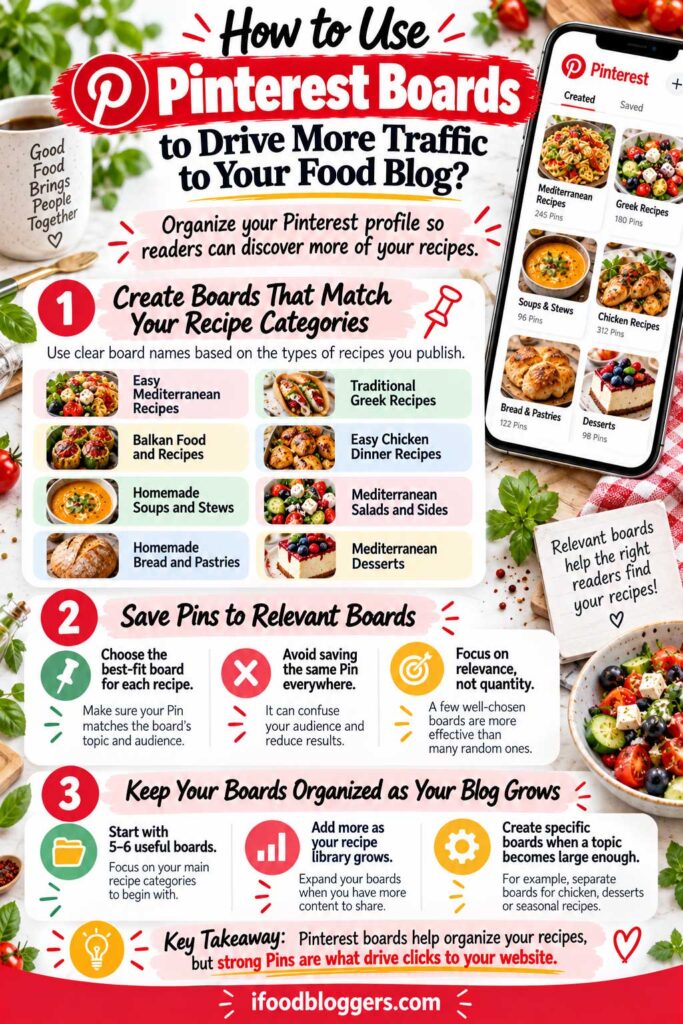
How to Optimize Pinterest Boards for Better SEO
Pinterest boards play an important role in Pinterest SEO for food bloggers by organizing recipes into relevant collections and helping visitors discover related content. Clear board names and descriptions also provide Pinterest with additional context about what you publish.
For example, a board called Traditional Greek Recipes clearly communicates its topic, while a generic name such as Food I Love tells visitors very little.
When you save a Greek moussaka Pin to a relevant board, Pinterest receives additional information about the recipe’s subject.
However, board optimization doesn’t guarantee higher rankings. It’s one part of a broader Pinterest SEO strategy that includes relevant keywords, engaging images, and useful recipe content.
The goal is to build an organized collection of boards that accurately reflects your food blog.
How Many Pinterest Boards Should a Food Blogger Have?
There’s no official number of Pinterest boards required for better SEO.
A food blog dedicated to homemade bread may need fewer boards than a website covering international cuisine, healthy meals, baking, and seasonal recipes.
For beginners, 8–12 focused boards can be a manageable starting point. This isn’t a Pinterest ranking requirement, just a practical way to organize your content.
Start with your main recipe categories and expand as your website grows.
Avoid creating dozens of nearly empty boards or several collections covering almost identical topics.
Every board should have a clear purpose and contain recipes your audience would genuinely want to explore.
Organize Pinterest Boards Around Your Recipe Categories
Your website’s existing recipe categories can help you develop a logical Pinterest board structure.
For example, a food blog specializing in Balkan and Mediterranean cuisine might use the following organization.
| Pinterest Board | Example Recipes |
|---|---|
| Traditional Bulgarian Recipes | Banitsa, shopska salad, tarator |
| Authentic Greek Recipes | Moussaka, souvlaki, tzatziki |
| Traditional Balkan Recipes | Ćevapi, burek, sarma |
| Easy Mediterranean Dinners | Lemon chicken, baked fish, pasta |
| Homemade Soups and Stews | Lentil soup, bean stew, chicken soup |
| Mediterranean Salads | Greek salad, cucumber salad, bean salad |
| Traditional European Desserts | Baklava, cakes, pastries |
| Homemade Bread and Pastries | Flatbread, pita, savory pastries |
| Easy Vegetarian Recipes | Stuffed peppers, vegetable casseroles |
| Christmas and Holiday Recipes | Christmas cookies, festive pastries |
This structure combines cuisine-specific boards with broader meal categories.
You don’t need to create every board immediately. If your website doesn’t publish many vegetarian dishes, for example, you can introduce that category later.
Focus on organizing the recipes you actually have rather than building boards simply to target additional keywords.
Write Keyword-Rich Board Names and Descriptions
Pinterest board names should be descriptive, natural, and easy to understand.
For example, Easy Homemade Dessert Recipes communicates more information than Sweet Treats.
Similarly, Easy Chicken Dinner Recipes is clearer than Delicious Chicken Ideas.
Choose one main topic for each board and avoid stuffing several keyword variations into the title.
Board descriptions provide additional space to explain what visitors can find.
Example: Traditional Greek Recipes
Discover authentic Greek recipes, including homemade moussaka, chicken souvlaki, tzatziki, fresh Greek salads, traditional pastries, and comforting Mediterranean dinners. Explore easy-to-follow recipes inspired by classic Greek cooking.
Example: Healthy Breakfast Recipes
Find healthy breakfast recipes for busy mornings, including overnight oats, Greek yogurt bowls, homemade smoothies, egg dishes, and make-ahead breakfast ideas.
Both descriptions use relevant keywords naturally while accurately describing the collection.
You don’t need to repeat the board name several times or include unrelated search phrases.
The description should help people understand what they’ll discover when opening the board.
Should You Create Broad or Niche Pinterest Boards?
Both broad and niche boards can be useful.
A broad board such as Homemade Dessert Recipes can accommodate cakes, cookies, pastries, and other sweets.
A more focused board such as Traditional Bulgarian Desserts serves readers interested in a particular cuisine.
The best approach often combines both.
For example, a homemade Greek baklava recipe could fit naturally into Authentic Greek Recipes or Homemade Dessert Recipes.
However, creating separate boards called Greek Desserts, Easy Greek Desserts, and Best Greek Dessert Recipes may introduce unnecessary overlap.
Create specialized boards when you have enough relevant recipes to make them useful.
Otherwise, keep your content organized within broader collections.
Where Should You Save Your Recipe Pins?
When publishing a new Pin, choose the board that best matches the recipe.
For example, homemade Greek chicken souvlaki belongs naturally in Authentic Greek Recipes.
It could also be relevant to Easy Mediterranean Dinners.
However, there’s no reason to save it to boards about vegetarian meals, chocolate desserts, or homemade bread.
Pinterest doesn’t guarantee better rankings simply because you save the same Pin to multiple boards.
Choose the strongest topical match first. If another board is genuinely relevant, you can consider saving the existing Pin there as well.
Avoid repeatedly distributing identical Pins across numerous collections just to increase exposure.
Relevance matters more than the number of boards where a recipe appears.
Use Board Sections and Covers to Improve Organization
As your Pinterest account grows, some boards may contain hundreds of Pins.
Pinterest board sections can make large collections easier to navigate.
For example, a board called Traditional Balkan Recipes might include sections for Bulgarian recipes, Greek recipes, Serbian dishes, desserts, and traditional breakfasts.
This helps visitors explore specific topics without scrolling through the entire collection.
However, sections are primarily an organizational feature. Pinterest doesn’t guarantee higher rankings simply because a board contains more sections.
Board covers can also improve your profile’s appearance.
Choose attractive food photographs that represent each collection, such as Greek salad for a Mediterranean recipes board or homemade baklava for desserts.
You can maintain consistent colors and typography across your covers, but elaborate graphics aren’t necessary.
A recognizable photograph is often enough.
Create Seasonal Pinterest Boards
Seasonal boards can help organize recipes associated with holidays, celebrations, and recurring food searches.
Examples include Christmas Cookies and Holiday Baking, Thanksgiving Side Dishes, Summer Grilling Recipes, and Fall Comfort Food.
These boards allow visitors to find recipes relevant to a particular time of year.
For example, a Christmas baking board could feature traditional European cookies, gingerbread, festive cakes, and holiday pastries.
Use Pinterest Trends to research when interest in these topics typically increases.
You don’t need to archive seasonal boards when the holiday ends. They can remain public throughout the year and become useful again during future seasons.
As your recipe collection grows, add new content to the appropriate seasonal boards.
Are Pinterest Group Boards Worth Joining?
Group boards allow multiple creators to contribute Pins to a shared collection.
They were once a popular strategy among bloggers looking to expand their reach, but joining group boards shouldn’t be treated as an automatic way to increase traffic.
A large group board isn’t necessarily more valuable than a well-organized collection on your own profile.
If you find an active group board dedicated to Mediterranean cooking or traditional recipes, it may offer opportunities to connect with other creators.
Before joining, check whether the content matches your niche and whether the board is properly maintained.
Avoid unrelated boards that encourage excessive self-promotion or repetitive Pin sharing.
For most beginners, developing relevant boards on their own profiles should remain the priority.
Should You Delete or Archive Old Pinterest Boards?
If you’ve used Pinterest for several years, you may have boards that no longer reflect your food blog.
Perhaps your profile contains collections about home decoration, travel, or unrelated hobbies.
You don’t necessarily need to delete them.
Start by reviewing whether each board still serves a useful purpose.
Some may benefit from updated names and descriptions. Others could be reorganized or made private if they’re intended for personal use.
Pinterest also provides archiving options for boards you no longer want to maintain actively.
Before deleting an established board, consider whether it contains useful Pins or continues to attract relevant visitors.
Deleting boards simply because they receive little engagement isn’t a proven Pinterest SEO strategy.
Your goal should be a clear, relevant profile—not removing content purely to satisfy an assumed ranking factor.
Common Pinterest Board SEO Mistakes
Most board optimization mistakes come from unnecessary complexity.
Creating several nearly identical boards can make your profile harder to manage. Names such as Easy Chicken Recipes, Simple Chicken Recipes, and Best Chicken Recipes may overlap enough to belong in one collection.
Vague titles are another issue. A board called Yummy Food doesn’t communicate its subject as clearly as Easy Weeknight Dinner Recipes.
Saving unrelated Pins also makes collections less useful. A vegetarian dinner board shouldn’t contain dozens of unrelated meat dishes.
Finally, avoid creating boards without enough relevant content or spending excessive time organizing collections while neglecting your actual recipes.
Your Pinterest boards should support content discovery, not become another complicated project to maintain.
How Often Should You Review Your Pinterest Boards?
Once you’ve created a clear board structure, regular maintenance should be relatively simple.
Every few months, review your collections for outdated descriptions, overlapping topics, or boards that no longer reflect your website.
When you introduce a new recipe category, consider whether an existing board can accommodate it before creating another one.
You can also use Pinterest Analytics to identify which recipe topics attract the most interest.
For example, if your Greek dinner Pins consistently generate outbound clicks, you may want to publish additional recipes in that category.
However, strong performance doesn’t necessarily mean you need several new boards covering the same subject.
Keep your organization simple and make changes when they genuinely improve the browsing experience.
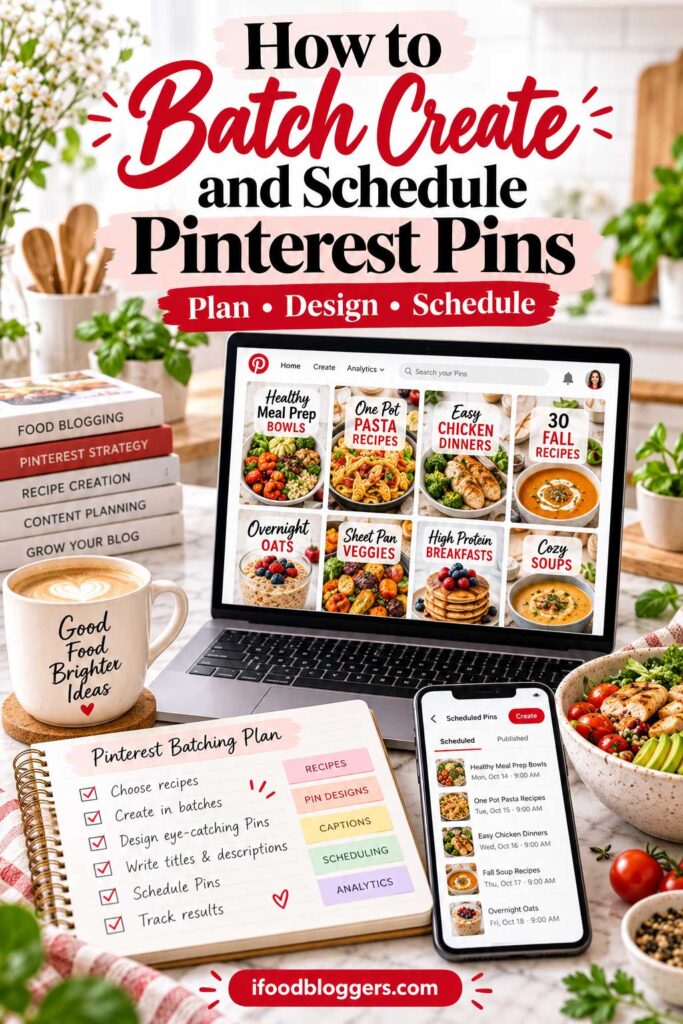
How to Schedule Pinterest Pins and Build a Consistent Publishing Strategy
Consistency is an important part of Pinterest SEO, but that doesn’t mean you need to publish dozens of Pins every day.
A manageable publishing schedule helps you regularly share recipes, reach new audiences, and make better use of your existing content.
For food bloggers, the easiest approach is to connect Pinterest publishing with your regular recipe workflow. Every new article provides an opportunity to create a Pin, while older recipes can offer additional content when you have original photographs and useful ideas to share.
The goal is to publish quality content consistently without turning Pinterest into another full-time job.
How Often Should Food Bloggers Post on Pinterest?
Pinterest doesn’t require a specific number of daily Pins to improve search visibility.
Instead, its guidance encourages creators to publish fresh, original content regularly.
For beginners, three to five original Pins per week can be a realistic starting point. An established recipe blog with a larger content library may choose to publish more frequently.
Not sure how many designs to create for each recipe or how often to publish them? Our guide to how many Pins food bloggers should create includes practical posting schedules, fresh Pin examples, and strategies for both new and established food blogs.
However, quality matters more than volume.
Publishing twenty nearly identical Pins every day isn’t necessarily more effective than sharing four well-designed Pins featuring different recipes.
Start with a schedule you can maintain, then adjust based on your available content and Pinterest Analytics results.
What Counts as a Fresh Pinterest Pin?
A fresh Pin should offer an original or meaningfully different visual presentation.
For example, imagine you’ve published a traditional Greek moussaka recipe.
Your first Pin shows the complete casserole with the headline Traditional Greek Moussaka Recipe.
A second Pin could feature a different photograph showing a sliced portion and its layers, with the title Homemade Greek Moussaka With Eggplant.
Both Pins can link to the same recipe, but they provide distinct visual perspectives.
Simply changing a border color, moving a logo, or repeatedly uploading the same photograph isn’t a useful fresh-content strategy.
Pinterest discourages excessive duplication, so avoid creating dozens of nearly identical designs for one recipe.
Start with one strong Pin and create meaningful variations when your photographs and content justify them.
Saving an existing Pin to another relevant board is also different from publishing a new Pin. You can organize content across appropriate boards, but repeatedly saving the same image to numerous collections isn’t a guaranteed way to increase traffic.
How to Schedule Pins Using Pinterest’s Free Scheduler
Pinterest offers a free scheduling feature for business accounts, allowing you to prepare recipe Pins ahead of time.
According to Pinterest’s official scheduling instructions, you can schedule individual standard Pins up to 30 days in advance, with a maximum of 10 scheduled Pins at one time.
To schedule a Pin, open your Pinterest business account and select Create Pin. Upload your image, enter a descriptive title and description, choose a relevant board, and add the direct URL of your recipe.
Then select Publish at a later date, choose your preferred date and time, and confirm the schedule.
You can edit a scheduled Pin’s publication date, title, description, board, and destination link. However, you cannot replace its image or video through the scheduling editor.
For beginners publishing a few original Pins each week, this free feature may be all you need.
Should You Use Pinterest Scheduling Tools?
As your recipe library grows, third-party scheduling tools can help simplify content management.
Services such as Tailwind and Buffer offer social media scheduling features, although their Pinterest capabilities, pricing, and limits may change.
The right choice depends on your workflow.
If Pinterest is your primary traffic channel, a Pinterest-focused tool may be useful. If you also publish content on Instagram, Facebook, and other platforms, a broader scheduling service could be more convenient.
However, avoid paying for features you don’t need.
A food blog publishing a few Pins each week can often manage its schedule using Pinterest’s native tools.
For larger websites, scheduling software becomes more valuable when it saves meaningful time and helps organize original content.
Choose reputable services that support Pinterest’s publishing policies rather than tools promising guaranteed rankings or automated engagement.
Can You Automatically Publish Pins From WordPress?
Pinterest also supports automatic publishing through RSS feeds for eligible business accounts with claimed websites.
An RSS feed contains information about recently published articles, including titles, descriptions, images, and links.
When connected to Pinterest, eligible feed content can be used to create Pins automatically.
This can be convenient for WordPress food blogs that publish recipes regularly.
However, automatic publishing has limitations.
If your WordPress RSS feed includes only horizontal featured images, Pinterest may create Pins using those images instead of the vertical graphics you’ve designed specifically for the platform.
Generic article excerpts may also be less effective than descriptions written for Pinterest.
Before enabling RSS publishing, review your feed’s images, titles, descriptions, and destination links.
Automation can reduce manual work, but it doesn’t guarantee attractive or properly optimized Pins.
For smaller food blogs, manually preparing quality images is often a better starting point.
Create Pinterest Pins in Batches
Batching is one of the easiest ways to maintain a consistent Pinterest schedule without working on it every day.
Instead of designing Pins individually throughout the week, set aside one session to prepare several recipes.
For example, choose five recipes from your website that deserve Pinterest promotion.
Review their photographs, research relevant keywords, and select the strongest image for each dish.
Next, use Canva, Adobe Express, or another design tool to create your graphics.
Reusable templates can help maintain consistent branding and save time.
However, avoid making every Pin look identical. A close-up photograph of homemade bread may need a different layout than an overhead image of a Mediterranean salad.
Once the designs are finished, write their titles and descriptions, check the destination URLs, and schedule publication.
This allows you to prepare a week’s Pinterest content in one session while maintaining editorial control.
Plan Seasonal Pins Before Search Interest Increases
Seasonal recipes can benefit from advance planning because Pinterest users often search for ideas before holidays and special occasions.
For example, people may begin collecting Christmas cookie recipes well before December.
Likewise, searches related to pumpkin desserts, summer grilling, and Easter baking may increase ahead of their respective seasons.
Use Pinterest Trends to investigate historical search patterns and identify when interest begins rising.
Then prepare your recipe Pins before that period.
There’s no universal rule that every seasonal Pin must be published exactly 30 or 60 days in advance.
Timing depends on the recipe, audience, and search trends.
Also, maintain a balance between seasonal and evergreen content.
Recipes such as homemade banana bread, Greek tzatziki, chicken soup, and easy pasta dinners may remain relevant throughout the year.
Combining both types of content helps you maintain a useful Pinterest publishing calendar.
Build a Four-Week Pinterest Content Calendar
A monthly content calendar can make Pinterest publishing easier to manage.
Instead of deciding what to post each day, you can organize your recipes and prepare their graphics in advance.
Here’s an example for a Balkan and Mediterranean food blog publishing four original Pins per week.
| Week | Recipe Focus | Pinterest Content |
|---|---|---|
| Week 1 | Traditional Greek Recipes | Chicken souvlaki, Greek salad, tzatziki, moussaka |
| Week 2 | Bulgarian Recipes | Banitsa, shopska salad, tarator, stuffed peppers |
| Week 3 | Mediterranean Dinners | Lemon chicken, lentil soup, grilled vegetables, baked fish |
| Week 4 | Desserts and Seasonal Recipes | Baklava, yogurt cake, seasonal fruit dessert, traditional pastry |
This schedule provides sixteen Pin opportunities over four weeks without requiring sixteen new recipes.
You can promote existing articles using appropriate original photographs, provided the Pins accurately represent the linked content.
The calendar can also be adjusted around seasonal interests or successful recipe categories.
You don’t need to follow a rigid formula. The purpose is to maintain consistent publishing while making good use of your content library.
Does the Time You Publish Pinterest Pins Matter?
There’s no single posting time that guarantees better results for every Pinterest account.
Pinterest users browse from different locations and time zones, and Pins can continue receiving attention long after publication.
For beginner food bloggers, consistency is usually more important than finding a supposedly perfect publishing hour.
Start with a convenient schedule.
Once you have enough performance data, experiment with different publishing times and compare results over several weeks.
However, remember that differences in recipe topics, photography, audience interests, and seasonal demand can also influence performance.
Don’t spend more time researching the perfect posting hour than improving your actual Pinterest content.
Track Your Pinterest Publishing Schedule and Results
As your recipe library grows, a simple spreadsheet can help you manage your Pinterest content.
Record each recipe’s name, primary keyword, destination URL, image filename, associated board, publishing date, and status.
You can mark Pins as planned, designed, scheduled, or published.
This helps prevent accidental duplication and makes it easier to identify recipes that haven’t received Pinterest promotion.
Once your Pins are live, you can add performance metrics such as impressions, saves, outbound clicks, and outbound click rate.
Google Sheets or Excel is sufficient for most food bloggers.
You don’t need a complicated tracking system unless you’re managing a large publishing operation.
How Long Should You Test Your Pinterest Strategy?
Pinterest SEO results can take time, and individual Pins may perform differently depending on audience interests, competition, and seasonality.
An initial 60–90-day testing period can provide a practical window for evaluating your publishing routine.
This isn’t an official Pinterest requirement or a guarantee of traffic growth.
Instead, use that time to publish consistently and collect enough data to identify useful patterns.
For example, if you publish four original Pins each week, you’ll create approximately 32–52 Pins over eight to thirteen weeks.
Review which recipe categories receive attention, which designs generate outbound clicks, and whether certain seasonal topics perform differently.
Avoid making major decisions based on one successful or unsuccessful Pin.
As you collect more information, use Pinterest Analytics to refine your publishing schedule and identify content worth promoting further.
With a manageable workflow, Pinterest can become a regular part of your food blogging strategy without demanding hours of attention every day.
How to Use Pinterest Trends and Seasonal Keywords to Increase Recipe Traffic
Pinterest users often search for recipes weeks before they’re ready to cook them. Someone planning Thanksgiving dinner might begin saving ideas in October, while Christmas cookie searches can increase well before December.
For food bloggers, understanding these seasonal patterns creates opportunities to promote recipes when people are actively looking for inspiration.
Instead of guessing which dishes might become popular, you can use Pinterest Trends to explore search interest, compare keywords, and identify seasonal opportunities.
What Is Pinterest Trends?
Pinterest Trends is a free research tool that helps you understand how search interest changes over time.
It’s particularly useful for food bloggers because cooking trends often follow holidays, seasonal ingredients, and changing eating habits.
For example, searches related to pumpkin desserts may increase during autumn, while cold soups and summer salads can attract more attention during warmer months.
Pinterest Trends allows you to examine these patterns and compare related search terms.
Depending on your region and account, you may also find information about emerging topics, seasonal events, and audience interests.
The goal is to identify relevant opportunities before investing time in new recipes or Pinterest graphics.
How to Research Recipe Keywords With Pinterest Trends
Start by opening Pinterest Trends and selecting the country you want to research.
If most of your readers are in the United States, begin with US search data.
Enter a recipe-related keyword, such as chicken soup recipe, and examine how its popularity changes throughout the available historical period.
Next, investigate related phrases such as homemade chicken soup, chicken noodle soup, or easy chicken soup recipe.
Look for patterns. Does search interest remain relatively consistent, or does it increase during certain months?
Pinterest Trends also allows you to compare up to four keywords, making it easier to explore related recipe topics.
For example, you could compare pumpkin bread, pumpkin muffins, pumpkin cookies, and banana bread.
This can help you identify which topics show stronger seasonal patterns and which may remain relevant throughout the year.
However, don’t select a keyword simply because it appears more popular. It still needs to accurately describe the recipe you’re promoting.
Understand Pinterest Trends Search Interest Scores
According to Pinterest’s official Trends documentation, search-interest graphs use normalized values from 0 to 100 rather than exact monthly search volumes.
A score of 100 represents the highest indexed interest within the displayed data. It doesn’t indicate a specific number of searches or predict how many visitors your food blog will receive.
For example, imagine pumpkin bread recipe shows an interest score of 20 during spring and 100 during autumn.
That suggests substantially stronger relative interest during autumn, but it doesn’t tell you how many searches occurred.
Use these scores to identify patterns and changes in interest rather than treating them as exact search-volume estimates.
This distinction is especially important when comparing broad keywords with highly specific recipe searches.
Identify Seasonal Recipe Keywords Before Interest Peaks
The most useful part of seasonal keyword research isn’t necessarily finding the month with the highest search interest.
It’s identifying when interest begins to rise.
Imagine Pinterest Trends shows that searches for pumpkin bread usually increase during late summer.
You could prepare your recipe photographs, update the article, and publish a relevant Pin before that increase.
The same approach works for Christmas cookies, Easter bread, Thanksgiving side dishes, and summer grilling recipes.
Review historical patterns to see whether interest increases around similar periods each year.
However, avoid assuming that every seasonal topic requires the same lead time.
Holiday baking, back-to-school lunches, and summer salads may follow different search patterns.
Use historical Pinterest search data to guide your publishing schedule rather than relying on a universal rule about how early to post.
Create a Seasonal Pinterest Keyword Calendar
A seasonal content calendar helps you plan which recipes to promote throughout the year.
Start by identifying holidays, seasonal ingredients, and meal occasions relevant to your audience.
Then research related keywords using Pinterest Trends.
Here’s an example of seasonal recipe opportunities for a general food blog.
| Season or Occasion | Pinterest Keyword Ideas | Recipe Opportunities |
|---|---|---|
| Winter | Homemade soup recipes, comfort food | Soups, stews, casseroles |
| Valentine’s Day | Chocolate desserts, romantic dinners | Cakes, strawberry desserts |
| Spring and Easter | Easter bread, spring brunch | Traditional breads, fresh salads |
| Summer | Summer salads, grilling recipes | Skewers, cold soups, smoothies |
| Back to School | Easy lunch ideas, quick dinners | Lunchboxes, family meals |
| Autumn | Pumpkin bread, apple desserts | Muffins, cakes, fall soups |
| Thanksgiving | Thanksgiving sides, holiday pies | Casseroles, roasted vegetables |
| Christmas | Christmas cookies, holiday desserts | Traditional pastries, festive sweets |
These are planning examples, not verified current keyword rankings or search volumes.
The actual timing should be checked in Pinterest Trends.
Your calendar should also reflect your food blog’s specialty.
A Mediterranean recipe website may focus on summer salads and grilled dishes, while a Balkan food blog could feature traditional Easter bread, Christmas Eve meals, and winter stews.
You don’t need to promote every holiday. Focus on occasions that genuinely match your content.
Discover Emerging Food Trends With Pinterest Predicts
Not every Pinterest opportunity follows a predictable seasonal pattern.
Some topics gain attention because of changing food preferences, popular ingredients, or emerging cooking styles.
Pinterest Trends can help you investigate growing interests, while Pinterest Predicts provides annual forecasts of emerging consumer trends.
For example, you might research whether interest is increasing in high-protein breakfasts, fermented vegetables, Mediterranean meal preparation, or traditional homemade pastries.
These are potential research topics, not confirmed current trending keywords.
If a growing trend naturally connects with your existing recipes, it may offer an opportunity to create new Pinterest content.
A Balkan food blog, for instance, could investigate interest in fermented vegetables or cabbage dishes and promote relevant traditional recipes.
However, don’t chase every popular ingredient simply because it appears in a trend report.
The strongest opportunities connect emerging interests with recipes your website already covers well.
Pinterest Predicts is best used for inspiration and early research, not as a guarantee of future traffic.
Use Pinterest Moments and Audience Trends
Pinterest Trends may also provide features such as Moments, which highlight seasonal events and cultural occasions.
These can help you investigate when people begin planning for holidays, celebrations, and other important events.
For example, an Easter-related Moment might inspire research into Easter brunch recipes, traditional breads, or homemade desserts.
Pinterest also offers audience-specific trend information for eligible business accounts.
This can help you explore topics that interest people who already engage with your Pins.
If your audience frequently interacts with Mediterranean meals, you might investigate related searches for homemade bread, simple family dinners, or meal preparation.
However, audience trend data isn’t available to every account, and some features vary by region.
New food bloggers can still use general search trends without needing a large following.
Research Pinterest Trends in the Right Country
Pinterest search behavior varies by location, language, and culinary traditions.
A recipe familiar to readers in Bulgaria may be less recognizable to American audiences.
That’s why choosing the appropriate geographic market matters.
For example, someone in Bulgaria may recognize the traditional dish sarmi, while an English-speaking audience may be more familiar with the phrase stuffed cabbage rolls.
A descriptive Pin title could use both:
Traditional Bulgarian Sarmi (Stuffed Cabbage Rolls)
This preserves the dish’s cultural identity while helping unfamiliar readers understand what it is.
Research relevant phrases in the country you’re targeting rather than assuming searches are identical everywhere.
If your food blog serves an international audience, you may eventually want to compare several regions.
Find Seasonal Opportunities in Your Existing Recipe Library
You don’t need to publish a completely new recipe every time a seasonal keyword becomes popular.
Your existing articles may already provide plenty of opportunities.
Imagine you have 200 recipes on your website.
Some might be particularly relevant during certain seasons:
- Homemade apple cake during autumn.
- Bulgarian tarator and shopska salad during summer.
- Traditional festive pastries before Christmas or Easter.
- Comforting soups and stuffed cabbage rolls during colder months.
Start by reviewing which recipes match upcoming seasonal searches.
Then check whether those articles need updated photographs, clearer instructions, or improved Pinterest graphics.
A single recipe can also be relevant to several occasions.
For example, roasted vegetables might work as a summer grilling side dish, an autumn dinner accompaniment, or part of a holiday menu.
However, each promotion should accurately represent the recipe.
Avoid repeatedly publishing nearly identical Pins with only the seasonal keyword changed.
Sometimes, improving an existing recipe and creating one strong new Pin is more valuable than publishing another article about nearly the same dish.
Balance Evergreen and Seasonal Pinterest Keywords
Not every recipe needs a seasonal publishing window.
Evergreen recipes, such as homemade banana bread, easy chicken dinners, and Greek tzatziki, can attract interest throughout the year.
Seasonal recipes may receive stronger attention around particular holidays or weather patterns.
A balanced Pinterest strategy includes both.
| Keyword Type | Example | Publishing Approach |
|---|---|---|
| Evergreen | Easy chicken dinner recipes | Promote throughout the year |
| Evergreen | Homemade banana bread | Maintain ongoing visibility |
| Seasonal | Pumpkin bread recipe | Prepare before autumn interest rises |
| Seasonal | Christmas cookies | Promote ahead of holiday baking |
| Seasonal | Summer pasta salad | Research spring and summer demand |
| Event-related | Game-day appetizers | Plan ahead of relevant events |
| Emerging trend | Newly popular ingredient | Research demand before creating content |
Some recipes can fit more than one category.
For example, homemade soup may attract searches throughout the year while becoming more popular during colder months.
Use Pinterest Trends to understand these differences rather than assigning every dish to a rigid seasonal category.
Combine Pinterest Trends With Google Search Console
Pinterest Trends becomes more useful when you combine it with data from your own website.
Google Search Console shows which queries generate impressions and clicks for your recipes through Google Search.
Pinterest Trends helps you investigate whether similar topics attract interest on Pinterest.
For example, imagine Search Console shows increasing impressions for your homemade Greek lemon potatoes recipe.
You could research related Pinterest keywords to see whether the dish also presents an opportunity for Pinterest promotion.
If the searches are relevant, create an attractive vertical image and optimize its Pin title and description.
These tools measure different platforms, so their data shouldn’t be compared directly.
However, using them together can help you identify recipes that deserve more attention across multiple traffic channels.
Measure Your Seasonal Pinterest Results
Publishing seasonal Pins is only useful if you’re learning from their performance.
Use Pinterest Analytics to review impressions, saves, and outbound clicks.
For food bloggers focused on website traffic, outbound clicks are particularly valuable because they show how often users click toward the linked recipe.
You can also use Google Analytics 4 to investigate Pinterest-related website sessions and landing pages.
After a major holiday or seasonal period, review which recipes attracted the most visitors.
For example, did traditional Christmas cookies generate more outbound clicks than holiday cakes? Did summer salads perform better than grilled dishes?
These patterns can guide your next content calendar.
However, avoid making major decisions based on one unusually successful Pin.
Performance depends on audience interests, seasonality, content quality, and other factors.
Look for consistent results across several recipes and reporting periods.
Example: Seasonal Pinterest Planning for a Balkan Food Blog
Imagine you’re managing a recipe website focused on Balkan and Mediterranean cooking.
Your existing articles include Bulgarian banitsa, Greek moussaka, tarator, shopska salad, stuffed cabbage rolls, baklava, and homemade soups.
Instead of promoting every recipe equally throughout the year, you use Pinterest Trends to investigate seasonal opportunities.
During spring, you research traditional Easter baking and festive family meals.
As summer approaches, you prepare Pins for refreshing dishes such as tarator, shopska salad, and Greek chicken souvlaki.
During autumn and winter, you investigate searches related to comfort food, soups, casseroles, and traditional stuffed cabbage rolls.
Before Christmas, you promote suitable festive pastries and desserts.
Throughout the year, you continue sharing evergreen recipes that remain useful regardless of the season.
This creates a balanced strategy based on your actual recipe collection.
You aren’t forcing unrelated trends into your content calendar or publishing new articles simply because a holiday is approaching.
Instead, you’re connecting existing recipes with periods when people may be particularly interested in discovering them.
Make Pinterest Trends Part of Your Content Planning
A quick monthly review of Pinterest Trends can help you spot upcoming seasonal opportunities.
Check which searches are gaining interest, review recipes you already have, and prepare relevant Pins before demand increases.
Use trends to guide your planning, not dictate everything you publish. Your best opportunities will usually come from matching genuine reader interest with recipes your website already covers well.
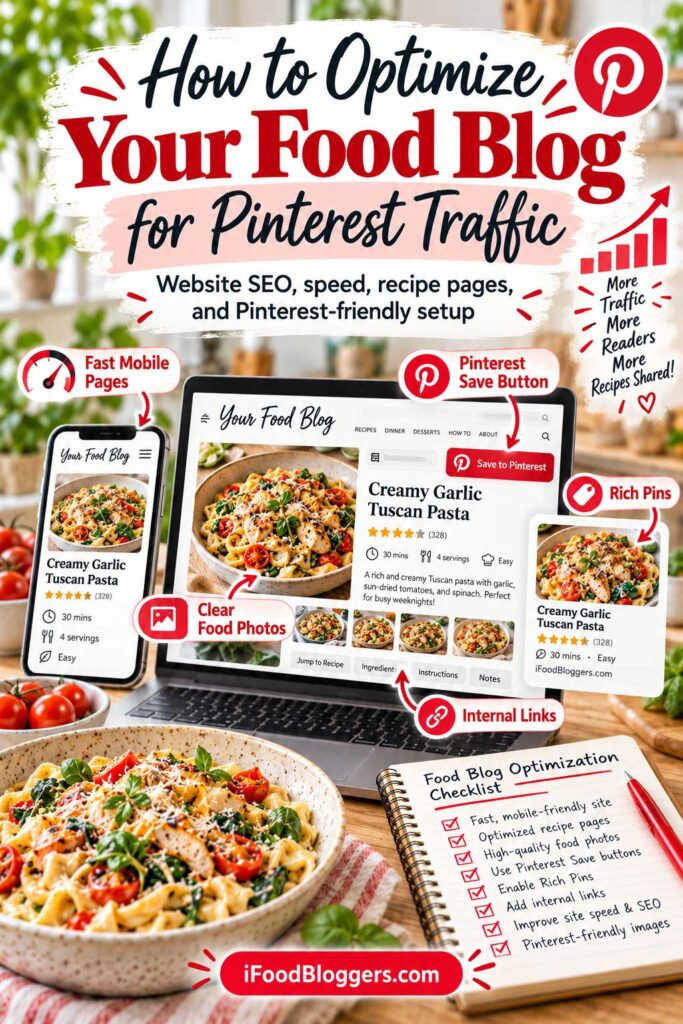
How to Optimize Your Food Blog for Pinterest Traffic
Pinterest SEO for food bloggers doesn’t stop with creating attractive Pins. Your website also needs to deliver a good experience when someone clicks through to read the complete recipe.
Imagine a reader discovers your homemade Greek chicken souvlaki Pin. The photograph looks delicious, but after clicking, they encounter a slow-loading page, intrusive pop-ups, and instructions that are difficult to find.
Even a successful Pin can’t compensate for a frustrating website experience.
Fortunately, most improvements that support Pinterest traffic also benefit your food blog’s overall usability and SEO.
If you’re using WordPress, you can implement many of these changes through your existing theme, SEO plugin, and recipe card plugin.
Claim Your Food Blog’s Website on Pinterest
Claiming your website connects your domain to your Pinterest business account.
This helps Pinterest associate content saved from your website with your profile and provides access to relevant website-sharing analytics.
Pinterest supports website verification through methods such as an HTML tag, HTML file, or DNS TXT record. You can follow the official Pinterest website claiming instructions to connect your domain with your business account.
For WordPress users, adding the verification tag through a compatible SEO plugin or website settings can be convenient.
After completing verification, check your Pinterest account to confirm that the domain is successfully claimed.
Remember that adding a website link to your Pinterest profile and claiming the domain are separate actions.
Claiming your website doesn’t guarantee better rankings, but it’s an important step in establishing your food blog’s Pinterest presence.
Enable Pinterest Recipe Rich Pins
Pinterest Recipe Rich Pins can display additional details from your website, including ingredients, cooking times, serving sizes, and other supported recipe information. This helps readers learn more about a dish before opening the complete recipe.
For example, someone discovering your homemade Greek moussaka Pin might appreciate knowing how long the dish takes to prepare before deciding to visit the full recipe.
To support Recipe Rich Pins, your website needs appropriate structured recipe information.
For WordPress food bloggers, a dedicated recipe card plugin is usually the simplest solution.
Many recipe plugins generate Schema.org Recipe markup from the information entered into the recipe card, including ingredients, instructions, cooking times, and servings.
It’s important to understand the distinction:
Recipe structured data exists on your website and helps compatible services understand your recipe.
Pinterest Recipe Rich Pins use supported website information to display additional recipe details on Pinterest.
Google can also use Recipe structured data to determine eligibility for certain search enhancements, although Google’s requirements and presentation differ from Pinterest’s.
Installing a recipe plugin doesn’t automatically guarantee Rich Pin eligibility or a particular Pinterest display.
Check that your markup is accurate, accessible, and consistent with the recipe shown on the page.
Also, make sure ratings reflect genuine reader feedback rather than fabricated reviews.
You can learn more through Pinterest’s official Rich Pins documentation.
Make Your Recipe Images Easy to Save
Visitors who discover your recipes through Google Search or other sources may want to save them to Pinterest for later.
Adding a Pinterest Save button makes this process easier.
Pinterest provides an official Save Add-On, and some WordPress sharing plugins include similar functionality.
Choose one solution that works with your website’s theme and doesn’t interfere with the reading experience.
For example, a small Pinterest button on a recipe photograph is more useful than an oversized sharing overlay that covers the food.
Test the button on both desktop and mobile devices.
Also, make sure Pinterest selects the correct recipe photograph rather than an unrelated image from your sidebar.
Your WordPress featured image and Pinterest graphic don’t need to be identical.
A horizontal featured image may work well for your blog, while a separate vertical 1000 × 1500-pixel graphic can be better suited to Pinterest.
Depending on your sharing plugin, you may be able to specify which image visitors save.
Simply uploading a vertical graphic to your WordPress Media Library doesn’t guarantee Pinterest will select it, so test the actual sharing process.
Optimize Image Metadata and Social Sharing Information
Clear image information helps your website communicate what its photographs represent.
Before uploading a recipe image, use a descriptive filename.
For example:
Generic filename: IMG_4837.jpg
Descriptive filename: traditional-greek-moussaka.jpg
Alt text should explain what the photograph shows, primarily for visitors using assistive technologies.
A useful description might be:
Slice of homemade Greek moussaka showing layers of eggplant, meat filling, and golden béchamel sauce.
Avoid filling alt text with repeated recipe keywords.
Your WordPress SEO plugin can also help manage social sharing metadata, including Open Graph titles, descriptions, and representative images.
For example, a traditional Bulgarian banitsa article should provide a relevant title, description, and photograph when shared.
Remember that Open Graph metadata and Recipe structured data serve different purposes. Both can support content presentation, but they aren’t interchangeable.
If your website uses separate SEO and recipe plugins, make sure their information is consistent and that multiple plugins aren’t generating conflicting metadata.
Link Every Pinterest Pin to the Correct Recipe
Your Pinterest destination URL should lead directly to the article advertised in the Pin.
If someone clicks a photograph labeled Traditional Bulgarian Banitsa Recipe, they should arrive at the complete banitsa recipe.
Sending visitors to your homepage, an unrelated article, or a category archive creates unnecessary frustration.
Make sure your destination URLs use HTTPS and load correctly.
If you change an established recipe URL, configure an appropriate permanent redirect so visitors following older Pins can still reach the content.
Avoid changing URLs merely to insert additional Pinterest keywords.
A stable, descriptive URL structure is useful for both search optimization and website maintenance.
Improve Mobile Usability and Website Speed
Many Pinterest visitors browse on smartphones, so your recipe pages should work comfortably on smaller screens.
Start by checking that the text is readable, photographs display correctly, and important content isn’t hidden behind intrusive pop-ups.
A clear recipe card makes a significant difference.
Readers should be able to find ingredient measurements, preparation times, and cooking instructions without searching through unnecessary distractions.
Adding a Jump to Recipe link near the beginning of the article can help visitors reach the instructions quickly.
Website speed matters, too.
Food blogs often contain numerous photographs, and uploading large, uncompressed images can slow down individual recipe pages.
Use appropriately sized images, efficient compression, and modern formats when supported by your website.
Lazy loading can help with images farther down the page, but avoid delaying important above-the-fold content unnecessarily.
You can evaluate performance using Google PageSpeed Insights.
However, don’t sacrifice recipe functionality or image quality simply to achieve a perfect performance score.
The goal is a fast, comfortable browsing experience that makes your recipes easy to use.
Make Sure Pinterest Can Access Your Website
Sometimes Pinterest may have difficulty retrieving recipe information from a WordPress website.
Security plugins, caching systems, firewall rules, or incorrectly configured metadata can occasionally interfere with external services.
If Pinterest displays the wrong image, incomplete recipe details, or unexpected titles, begin by checking the affected page.
Make sure the recipe is publicly accessible and doesn’t require a login.
Verify that the correct metadata is present and that the destination URL loads normally.
If you’re using a security plugin or content delivery network, investigate whether legitimate Pinterest requests are being blocked.
Don’t disable important website protections simply to troubleshoot sharing problems. Identify the specific configuration issue before making changes.
Also, avoid installing multiple plugins that generate duplicate structured data or conflicting social metadata.
For most food bloggers, these technical checks are only necessary when something isn’t working correctly or after a major website change.
Encourage Pinterest Visitors to Explore Related Recipes
Once someone reaches your website, make it easy for them to discover other recipes they might enjoy.
For example, a reader visiting your Greek chicken souvlaki article may also want homemade tzatziki, Greek pita bread, or a fresh Greek salad.
Natural internal links can help readers find those complementary dishes.
You might mention serving souvlaki with homemade tzatziki in the cooking tips or recommend a few related Greek recipes near the end of the article.
Choose links that genuinely support the original recipe.
Avoid adding dozens of unrelated articles simply to encourage extra page views.
Original food photography, accurate measurements, useful substitutions, and practical cooking tips also encourage readers to explore your website.
Pinterest introduces people to your recipes, but the quality of your content gives them a reason to stay and return.
Track Pinterest Visitors With Google Analytics 4
Pinterest Analytics and Google Analytics 4 provide different information about your traffic.
Pinterest Analytics shows how people interact with your Pins, including impressions, saves, and outbound clicks.
Google Analytics 4 helps you understand what happens after visitors reach your food blog.
For example, you can use GA4 to investigate which recipe pages attract Pinterest-related sessions and how those visitors engage with your website.
This can help you identify recipes worth promoting further.
Remember that Pinterest outbound clicks and GA4 sessions won’t necessarily match.
Privacy settings, consent choices, browser restrictions, and differences in measurement can affect the reported numbers.
Use both tools to identify meaningful patterns rather than expecting identical totals.
We’ll explore Pinterest Analytics and traffic measurement in greater detail in the next section.
Test Your Pinterest Sharing Experience
Before heavily promoting a recipe, perform a quick test.
Open the recipe page on your smartphone and confirm that it loads properly.
Check that the ingredients and instructions are easy to find.
If you’ve enabled Pinterest Save buttons, test whether they use an appropriate image and lead to the correct URL.
Review the displayed title and description.
If your recipe supports Rich Pins, check whether the available recipe information is accurate.
Testing is especially useful after changing your WordPress theme, recipe card plugin, image optimization settings, or caching configuration.
A small technical issue can affect the sharing experience across many recipe pages.
Pinterest Website Optimization Checklist
Use this checklist to review the most important elements of your food blog before promoting recipes on Pinterest.
| Website Element | What to Check | Priority |
|---|---|---|
| Pinterest website claim | Your domain is successfully verified | High |
| Recipe structured data | Accurate Recipe markup on recipe pages | High |
| Destination links | Pins lead to the correct recipes | High |
| Mobile usability | Ingredients and instructions are easy to access | High |
| Website performance | Images are optimized and pages load reliably | High |
| Pinterest images | Appropriate vertical graphics are available | High |
| Recipe Rich Pins | Supported metadata is recognized where applicable | Medium |
| Pinterest Save buttons | Visitors can save the intended images | Medium |
| Social sharing metadata | Titles, descriptions, and images are accurate | Medium |
| Internal linking | Readers can discover related recipes | Medium |
| Google Analytics 4 | Pinterest-related visits can be analyzed | Medium |
You don’t need to complete every optional improvement before publishing your first Pin.
Start with a working website, accurate recipe content, and correct destination links. Then improve your sharing functionality and technical setup as your Pinterest strategy develops.
When your Pinterest content and website work together, you create better opportunities to attract visitors, encourage return visits, and build long-term recipe traffic.
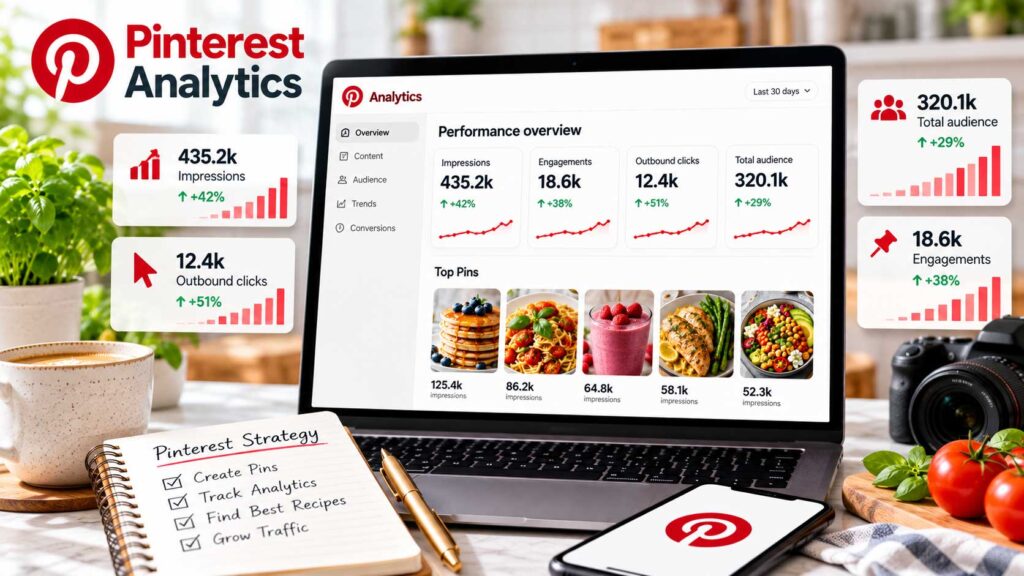
How to Use Pinterest Analytics to Improve Your SEO and Increase Recipe Traffic
You’ve started publishing recipe Pins, and the impressions are increasing. But are people actually visiting your food blog?
That’s where Pinterest Analytics becomes useful.
A Pin with thousands of impressions may generate only a handful of outbound clicks, while another with a smaller audience may attract considerably more interest in the full recipe.
Pinterest Analytics helps you spot those differences, understand which recipes perform well, and decide what to improve next.
How to Access Pinterest Analytics
Pinterest provides free analytics tools for business accounts.
To access them, sign in to your Pinterest business account and open Analytics → Overview. You can also consult Pinterest’s official Analytics documentation for more information about available reports and metrics.
The dashboard provides performance information about your Pins, including impressions, engagements, saves, outbound clicks, and audience activity.
You can change the reporting period, examine individual Pins, and use available filters to compare different content types.
If you’re primarily interested in attracting free website traffic, focus on organic performance rather than combining it with paid advertising results.
The exact dashboard layout and available filters may vary between desktop, mobile, and account types.
Understand the Most Important Pinterest Analytics Metrics
Pinterest tracks several types of interactions, but not every metric has equal value for food bloggers.
| Pinterest Metric | What It Measures | Why It Matters |
|---|---|---|
| Impressions | Number of times your Pins appeared on screen | Measures visibility |
| Saves | Times people saved your Pins | Indicates interest in keeping the recipe |
| Pin clicks | Clicks to view a Pin more closely | Measures interest in exploring the Pin |
| Outbound clicks | Clicks leading outside Pinterest | Measures traffic-generating actions |
| Outbound click rate | Outbound clicks divided by impressions | Helps compare traffic efficiency |
| Engagement rate | Engagements relative to impressions | Measures overall interaction |
| Total audience | People who saw or engaged with your Pins | Estimates audience reach |
| Engaged audience | People who interacted with your Pins | Estimates active audience |
For food bloggers focused on increasing website visitors, outbound clicks are usually the most important Pinterest metric.
Impressions show that your content is being displayed, while saves suggest people want to remember it for later.
Neither guarantees that someone visited your recipe.
For example, a homemade baklava Pin might receive thousands of saves from people planning holiday desserts. Meanwhile, a Greek chicken souvlaki Pin may attract fewer saves but more immediate recipe visits.
Both provide useful information about audience behavior.
How to Calculate Pinterest Outbound Click Rate
Outbound click rate measures how frequently people click through to your website relative to the number of times your Pin appears.
The formula is:
Outbound Click Rate = (Outbound Clicks ÷ Impressions) × 100
Imagine you’ve published two Pins featuring Mediterranean dinners.
The first receives 10,000 impressions and 80 outbound clicks.
Its outbound click rate is 0.8%.
The second receives 8,000 impressions and 160 outbound clicks.
Its outbound click rate is 2%.
The second Pin receives fewer impressions but generates twice as many outbound clicks.
That’s a promising result if your main objective is website traffic. It suggests the Pin may be better at encouraging readers to open the linked recipe.
Remember, though, that Pinterest outbound clicks aren’t identical to recorded website sessions. Google Analytics 4 provides a separate view of the traffic that reaches your website.
However, there’s no universal click rate that guarantees Pinterest success.
Performance varies by recipe, search intent, audience, season, and Pin format.
Compare similar content within your own account rather than relying on arbitrary industry benchmarks.
Find Your Best-Performing Pinterest Pins
One of the easiest ways to improve your Pinterest strategy is to study the Pins that already generate traffic.
Open Pinterest Analytics → Overview and locate the Top Pins section.
Where available, sort your Pins by outbound clicks rather than impressions.
This helps you identify which recipes attract visitors to your website.
For example, imagine your top-performing Pins include Greek lemon chicken, homemade tzatziki, Bulgarian banitsa, and traditional moussaka.
Look for similarities.
Do they feature clear photographs of finished dishes? Are their headlines descriptive? Do they match popular seasonal searches?
You might discover that close-up food photographs consistently attract more clicks than images dominated by text.
Or perhaps Pins featuring traditional dinner recipes outperform general meal inspiration graphics.
These patterns can guide your future content without requiring you to reinvent your Pinterest strategy.
However, one successful Pin doesn’t prove that every recipe in the same category will perform equally well.
Look for repeated patterns across multiple Pins and reporting periods.
If your Pins receive plenty of impressions but few outbound clicks, it’s worth reviewing your photographs, headlines, and overall traffic strategy. Our guide on how to get Pinterest traffic to a food blog explores practical ways to encourage more readers to visit your recipes.
How to Identify Underperforming Pinterest Pins
Not every Pin will generate substantial traffic, and different performance patterns suggest different opportunities.
Consider this hypothetical example:
| Recipe Pin | Impressions | Outbound Clicks | Click Rate |
|---|---|---|---|
| Greek Chicken Souvlaki | 12,000 | 180 | 1.5% |
| Homemade Greek Baklava | 18,000 | 54 | 0.3% |
| Bulgarian Tarator Soup | 2,000 | 40 | 2.0% |
The chicken souvlaki Pin generates the most outbound clicks.
Baklava receives the most impressions but generates fewer outbound clicks relative to its visibility.
Tarator reaches a smaller audience but has the highest outbound click rate.
These results provide useful starting points for improvement.
If impressions are high but clicks are low, examine whether your photograph and headline give people a clear reason to visit the complete recipe.
For example, Summer Dinner Inspiration may be less informative than Easy Greek Chicken Souvlaki Recipe.
If impressions are low but the click rate is strong, investigate whether the recipe could benefit from another genuinely different Pin design or more descriptive keywords.
If both impressions and clicks are low, review the Pin’s relevance, image quality, associated board, and seasonal demand.
However, don’t assume every underperforming Pin has an SEO problem.
A specialized traditional dish may naturally attract a smaller audience than a familiar dinner recipe.
Similarly, seasonal Pins might become more relevant later in the year.
Use these patterns to guide testing rather than deleting Pins or repeatedly changing their descriptions.
Use Audience Insights to Understand Your Readers
Pinterest Audience Insights can provide additional information about people who see and interact with your content.
Depending on your account and available data, you may be able to examine audience interests, demographics, and devices.
For example, a Mediterranean food blogger might discover that their audience is also interested in meal preparation, healthy dinners, or homemade bread.
These insights could inspire relevant recipe ideas.
However, don’t change your entire content strategy because your followers also show interest in unrelated topics.
Focus on interests that naturally connect with your food blog.
It’s also useful to understand the difference between total audience and engaged audience.
Total audience estimates how many people saw or engaged with your Pins, while engaged audience focuses on people who interacted with them.
These numbers differ from impressions because one person can see multiple Pins.
For new accounts, individual Pin performance is usually more useful than advanced audience analysis.
Track Pinterest Traffic in Google Analytics 4
Pinterest Analytics shows what happens on Pinterest. Google Analytics 4 helps you understand what happens after visitors reach your website.
To investigate Pinterest traffic in GA4, open:
Reports → Acquisition → Traffic acquisition
Change the reporting dimension to Session source / medium, or use an available source dimension to identify Pinterest-related visits.
Depending on your tracking setup, Pinterest traffic may appear under referral or organic social classifications.
You can also use GA4 landing page reports or Explorations to identify which recipes receive the most Pinterest traffic.
For example, you might discover that your Greek chicken souvlaki article receives consistent Pinterest visits, while Bulgarian banitsa attracts more readers during particular seasonal periods.
This information helps you identify recipes worth improving or promoting further.
You can also examine engagement and relevant key events to understand whether Pinterest visitors explore additional articles or complete other meaningful actions.
Why Pinterest Outbound Clicks and GA4 Sessions Don’t Match
It’s normal for Pinterest Analytics and Google Analytics 4 to report different numbers.
Pinterest measures clicks associated with destinations outside its platform.
GA4 measures website sessions based on its own tracking and attribution methods.
For example, Pinterest might report 500 outbound clicks while GA4 records 390 Pinterest-related sessions.
That difference doesn’t automatically indicate a technical problem.
A visitor may close the page before analytics loads, browser privacy settings may affect tracking, or consent restrictions may prevent data collection.
Differences in attribution, time zones, and reporting periods can also contribute.
Use Pinterest Analytics to understand Pin performance and GA4 to understand website visits.
If the discrepancy becomes unusually large or changes suddenly, investigate your website’s tracking, redirects, consent configuration, and page-loading behavior.
Compare Image Pins and Video Pins
Pinterest supports both image and video Pins, and each format can serve a different purpose.
A photograph of homemade Greek tzatziki might encourage someone to click for the exact ingredient measurements.
A short video demonstrating how to prepare the dip could attract views and saves without generating as many website visits.
Pinterest Analytics allows you to examine performance by available Pin formats.
Video Pins may also provide additional metrics, such as video views and watch time.
However, those metrics shouldn’t be confused with website traffic.
If your main goal is bringing visitors to your food blog, compare outbound clicks and outbound click rates alongside format-specific engagement.
Don’t assume video is automatically more effective than photography.
Use Pinterest Analytics to Discover Recipe Opportunities
Your Pinterest results can also help you decide which recipes to create or improve.
Imagine your Greek lemon potato Pins consistently generate outbound clicks.
That could suggest an opportunity to research related dishes, such as Greek roasted vegetables, lemon chicken, or other Mediterranean side dishes.
Before developing a new recipe, check whether your website already covers the topic.
You might discover that an existing article simply needs better photographs or Pinterest promotion.
You can also use Pinterest Trends to investigate related searches and seasonal patterns.
However, don’t let one successful Pin determine your entire editorial strategy.
Pinterest performance should complement your recipe expertise, audience needs, and broader keyword research.
Export Your Pinterest Data for Better Tracking
As your Pinterest account grows, exporting analytics can make performance analysis easier.
Pinterest provides CSV export options for supported reporting data.
You can open those files in Google Sheets or Excel and organize results by recipe or content category.
Useful columns include the recipe name, Pin URL, destination URL, publication date, impressions, saves, outbound clicks, and outbound click rate.
Keeping monthly snapshots can help you identify longer-term changes.
For example, you might notice that Mediterranean dinners consistently generate more website clicks than general food inspiration Pins.
Or perhaps Christmas desserts contribute a large share of traffic during the holiday season.
You don’t need complicated reporting software.
A simple spreadsheet is enough for most food bloggers.
Measure Whether Pinterest Traffic Supports Your Monetization Goals
Pinterest impressions and clicks don’t directly tell you how much money your food blog earns.
If your website uses display advertising, affiliate links, digital products, or other monetization methods, you also need to examine the relevant website and revenue data.
For example, you might compare Pinterest-attributed traffic with your advertising reports to understand whether those visits contribute meaningful revenue.
However, revenue per visitor can vary substantially.
Audience location, advertising demand, device type, page views, and visitor behavior all affect monetization.
Don’t assume Pinterest traffic generates the same revenue per session as Google Search traffic.
For newer food blogs, attracting interested readers and developing a reliable traffic source may be more important than immediately calculating revenue.
For established websites, combining traffic analysis with actual earnings data provides a clearer picture of Pinterest’s business value.
Build a Simple Monthly Pinterest Analytics Report
You don’t need to check Pinterest Analytics every day.
For most food bloggers, a monthly review provides enough information to identify useful performance patterns.
Here’s a practical reporting process:
| Step | What to Review | Action |
|---|---|---|
| 1. Visibility | Impressions and audience reach | Identify major changes |
| 2. Traffic | Outbound clicks and click rate | Find traffic-generating Pins |
| 3. Top content | Best-performing recipes and categories | Identify successful topics |
| 4. Weak content | High impressions with few clicks | Review headlines and images |
| 5. Website traffic | Pinterest sessions and landing pages in GA4 | Understand visitor behavior |
| 6. Seasonal patterns | Comparable periods and Pinterest Trends | Plan upcoming content |
| 7. Next actions | Opportunities supported by the data | Choose improvements to test |
An established food blogger publishing frequently may also benefit from weekly monitoring.
However, avoid making major changes based on a single day or one unusually successful Pin.
Pinterest performance can fluctuate with seasonality, audience interests, and content distribution.
Compare equivalent reporting periods and look for trends across multiple recipes.
Use your monthly reports to make a few practical decisions. Improve Pins that attract attention but few clicks, promote recipes that readers consistently respond to, and investigate seasonal opportunities before they peak.
Good analytics should help you decide what to improve next—not give you another dashboard to check every day.
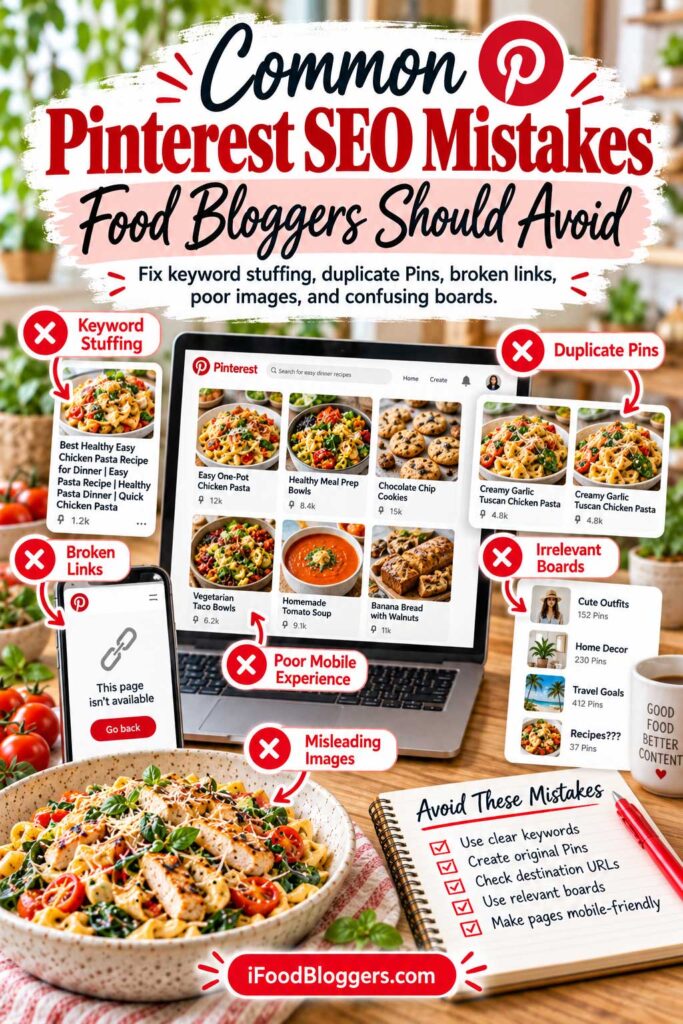
Common Pinterest SEO Mistakes Food Bloggers Should Avoid
Even well-designed Pinterest Pins can struggle to attract visitors when they’re published with unclear keywords, repetitive images, or incorrect destination links.
Sometimes the issue isn’t your recipe or Pinterest’s algorithm. It’s a small mistake that makes the content harder to discover or less useful to readers.
Here are the most common Pinterest SEO mistakes food bloggers should watch for and how to correct them.
1. Using Vague Keywords or Stuffing Descriptions
Keywords help Pinterest understand your recipes, but adding more phrases doesn’t automatically improve visibility.
For example, a Pin titled Delicious Food Recipe doesn’t clearly identify a traditional Bulgarian banitsa.
A better title would be Traditional Bulgarian Banitsa Recipe or Bulgarian Cheese Pastry With Filo Dough.
Keyword stuffing creates a different problem.
A description filled with repeated phrases such as Greek recipes, Greek food, easy Greek recipes, healthy Greek food provides little useful information.
Instead, describe the actual dish, including relevant ingredients, cooking methods, or serving suggestions.
How to fix it: Choose one primary keyword that accurately represents your recipe, then incorporate related phrases naturally.
2. Creating Beautiful but Confusing Pinterest Images
Food photography is one of Pinterest’s biggest advantages, but attractive images still need to communicate what readers will find.
A photograph of grilled chicken with the headline You Have to Try This! may attract attention without identifying the recipe.
A clearer headline would be:
Easy Greek Chicken Souvlaki Recipe
The opposite problem is covering food photographs with too much text, oversized graphics, or decorative elements.
A long headline can become unreadable when the Pin appears on a smartphone.
How to fix it: Use original food photography, a short descriptive headline, and readable typography. For standard image Pins, a vertical 2:3 design is a practical starting point.
Keep the finished dish as the main focus.
3. Publishing Duplicate or Nearly Identical Pins
Creating multiple Pins for one recipe can be useful, but repeatedly uploading nearly identical images isn’t an effective long-term strategy.
Imagine creating fifteen Pins for homemade Greek moussaka using the same photograph and changing only the background color.
Those designs provide little new value.
Pinterest discourages repetitive and duplicate content, and excessive duplication can create spam-related problems.
A better approach is to use genuinely different photographs.
One Pin might show the entire casserole, while another reveals a sliced portion with its eggplant and béchamel layers.
Both can link to the same recipe without relying on cosmetic changes.
How to fix it: Start with one strong Pin and create additional designs only when you have meaningful visual variations or new original content.
4. Making Claims Your Recipe Doesn’t Support
Misleading headlines may generate curiosity, but they can disappoint visitors.
A Pin advertising 10-Minute Homemade Chicken Soup shouldn’t link to a recipe requiring 45 minutes.
Similarly, a dessert containing dairy shouldn’t be promoted as vegan, and a traditional meat-based moussaka shouldn’t target vegetarian moussaka recipe.
This is why search intent matters.
A keyword may be related to your dish without accurately describing what readers will find.
How to fix it: Verify preparation times, ingredients, dietary claims, and cooking methods before publishing.
Your Pinterest image, title, description, and recipe page should all communicate the same promise.
5. Saving Pins to Irrelevant Boards or Neglecting Your Profile
Pinterest boards help organize your recipes into recognizable topics.
However, saving Greek chicken souvlaki to boards about vegan desserts, breakfast smoothies, and homemade bread provides little value.
Choose boards that genuinely match the recipe, such as Traditional Greek Recipes or Mediterranean Dinner Ideas.
Your profile should also clearly represent your food blog.
Use a recognizable display name, a natural description of your cooking specialty, and organized recipe boards.
If you’re using a Pinterest business account, claim your website to connect your domain with your Pinterest presence and access relevant sharing information.
How to fix it: Keep board names, descriptions, and saved recipes relevant. Avoid creating dozens of overlapping collections or distributing the same Pin across unrelated boards.
6. Linking to Broken, Incorrect, or Incomplete Recipes
A Pinterest Pin may receive substantial attention but fail to generate useful traffic if its destination doesn’t work.
Common problems include 404 errors, outdated URLs, unnecessary redirects, and links leading to unrelated articles.
For example, a Pin advertising traditional Greek baklava should open the complete baklava recipe—not your homepage or a different dessert.
The destination article should also be ready for visitors.
Missing ingredient measurements, unfinished instructions, or incorrect cooking times can make even an attractive recipe difficult to use.
How to fix it: Test destination links before publishing and review important Pins after changing WordPress permalinks or migrating your website.
Use appropriate permanent redirects when URLs change, and make sure every promoted recipe has accurate ingredients, instructions, and photographs.
7. Ignoring Mobile Performance and Website Accessibility
Many Pinterest visitors use smartphones, so your food blog needs to work comfortably on smaller screens.
Oversized photographs, intrusive pop-ups, difficult-to-read text, and shifting page elements can make cooking instructions frustrating to access.
A clearly organized recipe card and a Jump to Recipe link can help visitors find what they need.
Technical problems can also interfere with Pinterest’s ability to retrieve information from your website.
For example, an incorrectly configured firewall, robots.txt file, or security plugin may prevent Pinterest’s crawler from accessing certain pages.
However, low impressions alone don’t mean Pinterestbot is blocked.
How to fix it: Test your recipe pages on mobile devices, optimize images, and investigate technical restrictions only when you have evidence of an access or sharing problem.
Maintain appropriate website security while troubleshooting.
8. Using Stock or AI-Generated Food Images That Misrepresent Recipes
Pinterest users should be able to trust that your food photography represents the recipes you’re promoting.
Using an unrelated stock photograph of a spinach pastry to promote homemade Greek spanakopita can create misleading expectations.
AI-generated food images can cause similar problems when they depict ingredients, textures, or results that don’t match the actual dish.
For recipe bloggers, original photography offers an important advantage.
It shows readers what you’ve prepared and helps them understand how their finished recipe might look.
How to fix it: Whenever possible, photograph the dishes you actually prepare.
If you use illustrations or AI-assisted graphics, make sure they don’t misrepresent the ingredients or finished recipe.
9. Relying on Excessive Automation and Publishing Volume
Scheduling tools can make Pinterest easier to manage, but automation doesn’t replace editorial judgment.
Publishing hundreds of repetitive Pins won’t necessarily produce better results than maintaining a smaller collection of useful, original images.
Be especially cautious with services promising guaranteed Pinterest rankings, artificial engagement, or automated mass publishing.
Pinterest restricts unauthorized automation and spam-like activity.
How to fix it: Use Pinterest-supported scheduling methods and reputable tools.
Review your images, titles, descriptions, boards, and destination links before scheduling content.
Focus on quality and consistency rather than meeting arbitrary daily Pin quotas.
10. Ignoring Seasonality or Expecting Immediate Results
Not every Pinterest Pin will generate traffic immediately.
Seasonal recipes may become more relevant during particular periods of the year.
For example, publishing Christmas cookie Pins on December 24 may miss much of the holiday planning period.
Similarly, a cold cucumber soup recipe may attract more interest during warmer months than in winter.
Use Pinterest Trends to research when related searches typically begin increasing.
However, don’t assume that a slow start means a Pin has failed.
Some Pins can continue attracting attention long after publication.
How to fix it: Prepare seasonal content ahead of relevant search interest and evaluate performance over meaningful periods rather than reacting to daily fluctuations.
11. Measuring Followers and Impressions Instead of Website Traffic
Pinterest followers and impressions can be encouraging, but neither guarantees website visits.
A Pin receiving 20,000 impressions and 40 outbound clicks generates fewer traffic-related actions than one receiving 8,000 impressions and 120 outbound clicks.
If your goal is growing your food blog, that distinction matters.
Followers can support audience development, but people can also discover your Pins through search and recommendations without following your account.
Avoid buying followers or participating in artificial engagement schemes.
How to fix it: Review outbound clicks, outbound click rates, and relevant website traffic in Google Analytics 4.
Use that information to identify which recipes and images deserve more attention.
12. Never Reviewing or Improving Older Pinterest Content
Pinterest SEO isn’t a one-time project.
As your recipe library grows, some older Pins may benefit from updated information, better photography, or more relevant descriptions.
For example, an older Pin might still link to a recipe URL that changed during a WordPress migration.
Another may use a vague headline even though you’ve since developed a clearer keyword strategy.
However, constant editing isn’t necessary.
Don’t repeatedly change successful Pins simply to appear active.
How to fix it: Review your important Pins periodically, repair broken destinations, and create new visual content when it provides genuine value.
Use Pinterest Analytics to help prioritize improvements.
Pinterest isn’t the only place where small optimization mistakes can affect your results. Our guide to SEO mistakes food bloggers should avoid covers additional issues involving recipe content, keyword targeting, structured data, and website performance.
Pinterest SEO Mistakes and How to Fix Them
Here’s a quick reference for reviewing your Pinterest content.
| Common Mistake | Recommended Fix |
|---|---|
| Vague recipe keywords | Identify the specific dish and search intent |
| Keyword stuffing | Write natural, descriptive titles and descriptions |
| Unclear or cluttered images | Use recognizable food photography and readable headlines |
| Duplicate Pin publishing | Create meaningful visual variations |
| Misleading recipe claims | Verify ingredients, cooking times, and dietary labels |
| Irrelevant Pinterest boards | Save Pins to focused, relevant collections |
| Broken destination URLs | Test links and maintain redirects |
| Poor mobile experience | Improve page speed, usability, and recipe access |
| Misleading stock or AI images | Use authentic, accurate recipe visuals |
| Excessive automation | Use approved tools with editorial review |
| Poor seasonal timing | Research search-interest patterns in advance |
| Focusing only on followers | Track outbound clicks and website traffic |
| Technical access problems | Investigate crawler, firewall, and metadata issues |
| Incomplete recipe articles | Finish reviewing recipes before promotion |
| Neglecting older Pins | Audit important content periodically |
You don’t need to fix everything immediately.
Start with issues that directly prevent visitors from reaching or using your recipes. Then improve your content presentation and publishing workflow.
How to Audit Your Existing Pinterest Pins
A simple Pinterest audit can help you find improvements without redesigning your entire account.
Begin with your top-performing Pins in Pinterest Analytics.
Check that their destination links still work and that the corresponding recipes remain accurate.
Next, review Pins receiving substantial impressions but relatively few outbound clicks.
Examine whether their photographs and headlines clearly communicate what the recipes offer.
Then review your publishing history for unnecessary duplicate images and confirm that your boards contain relevant content.
Finally, test your most important recipe pages on mobile devices.
Pay attention to loading performance, recipe cards, sharing functionality, and whether the correct photographs appear when saved to Pinterest.
For most food bloggers, reviewing important content every few months is more manageable than constantly changing every Pin.
The goal isn’t to make every Pin perfect. It’s to create accurate, useful Pinterest content that connects interested readers with recipes they genuinely want to prepare.
Pinterest SEO Checklist for Food Bloggers: What to Do Before Publishing Every Pin
Before publishing a new recipe Pin, take a few minutes to check that everything is accurate, optimized, and ready for visitors.
You don’t need to repeat your entire Pinterest keyword research or design process every time. A simple checklist helps you catch mistakes, maintain consistency, and make sure each Pin gives readers a good reason to explore your recipe.
1. Make Sure Your Recipe Is Ready
Start with the destination page.
Your recipe should include complete ingredients, accurate measurements, clear cooking instructions, and realistic preparation times.
Check that the recipe card works properly, photographs display correctly, and visitors can comfortably read the article on their phones.
Don’t promote unfinished content or recipes with missing information.
The goal is to send Pinterest visitors to a page that’s genuinely useful.
2. Check Your Pinterest Keyword and Title
Choose one primary keyword that accurately describes your dish.
For example, Greek chicken souvlaki recipe communicates more information than a generic phrase such as delicious chicken dinner.
Use the primary keyword naturally in your Pin title, preferably near the beginning.
Keep your headline descriptive and avoid misleading claims about cooking times, ingredients, or dietary characteristics.
If you’re targeting a seasonal recipe, check Pinterest Trends to understand when interest typically increases.
3. Review Your Pinterest Image
Your image should make the finished dish recognizable and appealing.
For standard recipe Pins, 1000 × 1500 pixels (2:3 aspect ratio) is a practical choice.
Use original food photography whenever possible, with a short headline that remains readable on mobile devices.
Avoid covering the food with oversized text or unnecessary decorations.
Subtle website branding can help identify your content without distracting from the recipe.
Before publishing, preview the design at a smaller size.
If the headline is difficult to read or the dish isn’t immediately recognizable, adjust the layout.
4. Write a Natural Pinterest Description
Your description should explain what the recipe is and why someone might want to make it.
Include relevant ingredients, flavors, cooking methods, or serving suggestions.
For example, a Greek chicken souvlaki description could mention lemon, garlic, oregano, grilled chicken skewers, and Mediterranean dinners.
Use related keywords naturally rather than listing search phrases separated by commas.
You can also include a simple invitation such as Get the complete recipe and step-by-step instructions.
The description should accurately reflect what’s available on your website.
5. Select the Right Board and Destination URL
Save your Pin to the board that best matches the recipe.
A Greek tzatziki Pin belongs naturally in Traditional Greek Recipes or another relevant Mediterranean food collection.
Avoid unrelated boards simply to increase exposure.
Next, check your destination URL.
The Pin should link directly to the corresponding recipe—not your homepage, an unrelated article, or a broken page.
Open the link before publishing to confirm that it works correctly.
6. Preview and Schedule Your Pin
Before selecting Publish or Schedule, review the finished Pin one last time.
Check the photograph, headline, description, selected board, and destination link.
This is particularly important when using reusable templates or preparing several Pins in one session.
It’s easy to accidentally leave an old recipe title or URL in a new design.
Also, make sure you’re not repeatedly uploading nearly identical Pins.
If everything looks correct, publish immediately or schedule the Pin according to your content calendar.
Complete Pinterest SEO Publishing Checklist
Use this quick-reference table whenever you prepare a new recipe Pin.
| Pinterest SEO Element | What to Check |
|---|---|
| Recipe page | Complete, accurate, and published |
| Primary keyword | Relevant to the actual recipe |
| Pin title | Descriptive, accurate, and keyword-focused |
| Pin description | Natural language with useful recipe details |
| Image dimensions | Ideally 1000 × 1500 pixels |
| Food photography | Attractive and accurately represents the dish |
| Text overlay | Short and readable on mobile |
| Branding | Website name or subtle logo included |
| Pinterest board | Matches the recipe’s topic |
| Destination URL | Direct link to the correct recipe |
| Mobile experience | Page and recipe card work properly |
| Originality | Avoid unnecessary duplicate Pins |
| Seasonal timing | Appropriate for the recipe when relevant |
| Final review | Check image, spelling, details, and links |
You can save this checklist in Google Sheets, Excel, or your editorial workflow to make it easier to use each time.
What Should You Check Periodically?
Some Pinterest optimization tasks don’t need to be repeated for every Pin.
For example, claiming your website, configuring Recipe structured data, and setting up Pinterest Save buttons are generally website-level tasks.
Review these settings after major WordPress updates, theme changes, plugin migrations, or when Pinterest sharing stops working correctly.
You should also review your Pinterest profile and boards occasionally to make sure they still reflect your website’s content.
Once a month, use Pinterest Analytics to examine which Pins attract impressions, saves, and outbound clicks.
That information can help you improve your next batch of Pinterest content.
As your recipe library grows, this consistency will help you promote more content while maintaining quality.
Frequently Asked Questions About Pinterest SEO for Food Bloggers
Still have questions about Pinterest SEO? Here are some quick answers to common questions food bloggers ask when trying to grow their Pinterest traffic.
Is Pinterest SEO Worth It for Food Bloggers?
Yes. Pinterest can help food bloggers attract visitors beyond Google Search, particularly for recipes, meal ideas, and seasonal content.
Unlike traditional social media posts, Pinterest Pins can continue appearing in search results and recommendations long after publication.
However, traffic isn’t guaranteed. Results depend on your content, photography, keyword relevance, competition, and audience interests.
How Long Does Pinterest SEO Take to Work?
There’s no guaranteed timeline.
Some Pins attract attention shortly after publication, while others take longer or become popular during a particular season.
For beginners, consider using the first 60–90 days to publish consistently, collect performance data, and identify promising recipes. This is a practical testing period, not an official Pinterest ranking timeline.
How Many Pins Should Food Bloggers Publish Per Week?
Pinterest doesn’t require a specific number of Pins to achieve better rankings.
For beginners, three to five original Pins per week can be a manageable starting point.
Established food bloggers with larger recipe libraries may publish more frequently, but quality and consistency matter more than meeting an arbitrary daily quota.
Do Pinterest Followers Matter for SEO?
You don’t need thousands of followers to attract Pinterest traffic.
People can discover your recipes through search results and recommendations even when they don’t follow your account.
Followers can help build an audience, but they aren’t the best measure of website traffic.
If your goal is attracting readers to your food blog, focus on relevant Pins and outbound clicks.
Hashtags aren’t a substitute for relevant keywords and descriptive Pin information.
Pinterest’s optimization guidance emphasizes clear titles, useful descriptions, and relevant boards rather than requiring a particular number of hashtags.
For most food bloggers, researching appropriate keywords and creating attractive recipe images is a better use of time than adding long collections of hashtags.
Can I Create Multiple Pinterest Pins for the Same Recipe?
Yes. Different Pins can link to the same recipe when they provide genuinely distinct visual presentations.
For example, one banana bread Pin might show the entire loaf, while another features individual slices.
However, avoid repeatedly uploading nearly identical designs with minor color or text changes.
Start with one strong Pin and develop meaningful variations when you have additional original photography.
What Is the Best Pinterest Image Size for Recipes?
For standard image Pins, 1000 × 1500 pixels with a 2:3 aspect ratio is a practical choice.
Vertical images work well in Pinterest’s scrolling feed and provide space for an appealing photograph, readable headline, and subtle branding.
Image dimensions alone don’t guarantee success. Clear photography, recognizable dishes, and mobile-friendly typography are equally important.
Should Food Bloggers Use Pinterest Recipe Rich Pins?
Recipe Rich Pins can display additional information from your website, such as cooking times, ingredients, or serving details, depending on the supported metadata.
WordPress recipe card plugins can generate structured data that Pinterest may use for this purpose.
Rich Pins can improve how recipe information is presented, but they don’t guarantee higher rankings.
Why Do My Pinterest Pins Get Impressions but Few Clicks?
Impressions mean your Pin appeared on someone’s screen, not that they visited your website.
Some users save recipes for later, while others browse for inspiration without opening the full instructions.
If a Pin receives many impressions but few outbound clicks, examine its photograph, headline, and search intent.
A specific title such as Easy Greek Chicken Souvlaki Recipe may communicate more value than Delicious Dinner Inspiration.
Why Has My Pinterest Traffic Suddenly Dropped?
Pinterest traffic can fluctuate because of seasonality, audience interests, competition, or changes in content distribution.
For example, Christmas cookie Pins may attract fewer visitors after the holiday season ends.
Review Pinterest Analytics to see whether the decline affects your entire account or only certain recipes.
Also, check for broken destination links or recent website changes before assuming there’s an algorithm-related problem.
Do I Need a Pinterest Business Account for My Food Blog?
A free Pinterest business account is recommended for food bloggers who want to measure and improve their traffic.
It provides access to Pinterest Analytics, website claiming, scheduling features, and other business tools.
You don’t need to purchase advertising to use Pinterest’s organic publishing and analytics features.
Can Pinterest Traffic Help Me Make Money From My Food Blog?
Yes. Pinterest visitors may contribute to revenue through display advertising, affiliate recommendations, digital products, or other monetization methods.
However, Pinterest impressions and saves don’t directly generate website earnings.
Track outbound clicks in Pinterest Analytics and website sessions in Google Analytics 4. Compare those results with your actual revenue reports to understand how Pinterest contributes to your food blog.
Is Pinterest Better Than Google for Food Blog Traffic?
Neither platform is automatically better for every food blog.
Google is useful for reaching people searching for specific recipes or cooking instructions. Pinterest also supports specific searches but places greater emphasis on visual discovery and inspiration.
The strongest approach is to use both: publish helpful, search-optimized recipes on your website and create Pinterest Pins that introduce those dishes to new readers.
This gives your content multiple opportunities to attract traffic without depending entirely on one platform.
Final Thoughts: Build a Pinterest SEO Strategy That Brings Readers to Your Recipes
Pinterest SEO for food bloggers works best when you focus on helping people discover recipes they genuinely want to prepare. Relevant keywords, original food photography, and useful recipe content all contribute to that experience.
And getting started doesn’t have to be complicated.
Choose a few recipes you’re proud of, use your best photographs, research relevant keywords, and create Pins that make each dish easy to recognize.
As you publish more content, pay attention to what happens. Some Pins may attract plenty of saves, while others encourage people to open your website and follow the recipe.
Use those results to improve your next designs.
Pinterest also works best alongside Google SEO, email marketing, and your other traffic sources. You don’t want your entire food blog depending on one platform.
Start with five recipes, create one strong Pin for each, and build from there.
Over time, you’ll develop a better understanding of what your audience enjoys and which recipes deserve more attention.
That experience is far more useful than trying to discover the perfect posting schedule or a secret Pinterest ranking trick.
Read Next: More Ways to Grow Your Food Blog
Want to take your food blogging strategy further? These guides will help you improve your search visibility, discover new content opportunities, and attract more readers.
Get More Traffic to Your Food Blog
Explore practical strategies for growing your audience through Google, Pinterest, and other traffic sources.
30 Ways to Get Traffic to Your Food Blog
Find Low-Competition Recipe Keywords
Learn how to discover recipe keywords with realistic ranking opportunities and attract more organic visitors.
How to Find Low-Competition Recipe Keywords
Discover Free Keyword Research Tools
Find useful tools for researching recipe ideas, identifying search opportunities, and planning your content.
Best Free Keyword Research Tools for Food Bloggers
Avoid Common Food Blog SEO Mistakes
Discover common optimization mistakes that can hurt your search visibility and learn how to fix them.
SEO Mistakes Food Bloggers Should Avoid