

Starting a food blog is easier than ever, but choosing the right platform can make a big difference in how easily your site can grow later.
Some blogging platforms let you start publishing recipes for free within minutes. Others give you much more control over your design, SEO, recipe cards, advertising, affiliate links, email marketing, and the other tools you may eventually need.
The right choice depends on what you want your food blog to become.
If you simply want a place to share family recipes, cooking ideas, or food stories, a free blogging platform may be all you need. But if your goal is to grow search traffic, rank recipes in Google, build an email list, work with brands, earn affiliate commissions, or make money from display ads, choosing a platform with room to grow becomes much more important.
In this guide, we’ll compare the best blogging platforms for food bloggers, including both free and paid options. We’ll look at ease of use, pricing, customization, SEO, monetization, recipe features, and how well each platform can support a growing food blog.
Whether you’re starting your first recipe site or looking for a better platform for an existing blog, this guide to the best blogging platforms for food bloggers will help you compare the options and choose the one that fits your goals.
Best Blogging Platforms for Food Bloggers at a Glance
Before looking at each platform in detail, it helps to compare the main differences side by side.
Different food blogging platforms serve different types of creators. Some are designed for beginners who want the easiest possible setup, while others provide more control over recipes, SEO, monetization, and long-term growth.
The table below compares the best blogging platforms for food bloggers based on ease of use, free options, monetization potential, and how well each platform can support a growing website.
Affiliate Disclosure: Some links in this article may be affiliate links. If you make a purchase or sign up through one of these links, iFoodBloggers may earn a commission at no extra cost to you.
| Platform | Best For | Free Option | Monetization | Ease of Use | Long-Term Growth |
|---|---|---|---|---|---|
| WordPress.org | Serious food bloggers | Software is free | Excellent | Medium | Excellent |
| WordPress.com | Beginners who want simplicity | Yes | Limited on free plan | Easy | Good |
| Wix | Visual drag-and-drop sites | Yes | Good on paid plans | Very Easy | Good |
| Squarespace | Design-focused food bloggers | No permanent free plan | Good | Easy | Good |
| Ghost | Publishing + memberships | Self-hosted option | Excellent | Medium | Very Good |
| Blogger | Simple hobby blogs | Yes | Basic | Easy | Limited |
| Medium | Writers focused on publishing | Yes | Platform-based | Very Easy | Limited |
| Substack | Newsletter-first creators | Yes | Paid subscriptions | Very Easy | Moderate |
| Joomla | Technical users | Software is free | Excellent | Harder | Very Good |
Quick Takeaway
For food bloggers who want to build a long-term website around recipes, search traffic, affiliate marketing, display advertising, sponsored content, and email growth, self-hosted WordPress.org offers the most flexibility.
That does not mean it is the best fit for everyone. Wix and WordPress.com may be easier for beginners, Squarespace is a strong option for design-focused creators, and Ghost or Substack may make more sense if newsletters and memberships are central to your strategy.
The key question is whether you simply want a place to publish content or whether you want to build a food blog you can customize, monetize, and expand over time.
As we compare the best blogging platforms for food bloggers below, pay particular attention to recipe functionality, SEO control, monetization options, and how easily each platform can grow with your site.

1. WordPress.org — Best Overall Platform for Serious Food Bloggers
If your goal is to build a food blog that can grow into a serious website or business, self-hosted WordPress.org is one of the strongest options available.
WordPress.org itself is free, open-source software, but you will need your own domain name and web hosting before you can launch your site. That setup requires a little more effort than using an all-in-one website builder, but it also gives you far more control over how your food blog looks, functions, and grows.
You can choose your own hosting company, install themes and plugins, customize your design, add recipe cards, build an email list, run advertising, use affiliate links, sell products, and expand the website as your audience grows.
For food bloggers in particular, the WordPress plugin ecosystem is one of its biggest advantages. Instead of relying only on features built into the platform, you can add specialized tools for recipes, SEO, performance, email marketing, analytics, affiliate links, backups, security, and much more.
Why WordPress.org Works So Well for Food Blogs
Food blogs often become more complicated than standard personal blogs.
A site may begin with a handful of recipes, but over time you might want structured recipe cards, recipe schema, nutrition information, print buttons, searchable categories, email signup forms, affiliate links, Pinterest integration, analytics, and display advertising.
This is where WordPress becomes especially useful.
Rather than rebuilding your website every time you need a new feature, you can usually add the functionality through a plugin, theme, integration, or custom development.
You are also not locked into a single hosting company. If your site grows and your current host is no longer fast enough or affordable enough, you can move your WordPress site elsewhere.
That flexibility becomes increasingly valuable as your traffic and content library grow.
Why WordPress for Food Bloggers Is So Popular
One reason WordPress for food bloggers remains so popular is the size of its ecosystem. You can choose from specialized recipe plugins, SEO tools, performance plugins, themes, email integrations, advertising tools, and other features designed for content-heavy websites.
That flexibility is particularly useful as a recipe site grows because you can add new functionality without rebuilding the entire website.
Recipe Plugins and Food Blogging Features
Recipe publishing is one of the strongest reasons to consider WordPress for a food blog.
Dedicated recipe plugins can help you format ingredients and instructions, add structured recipe data, create print-friendly recipes, display nutrition information, collect ratings, and improve the overall experience for readers.
This can be much easier than trying to build those features manually on a general-purpose website builder.
If recipe content will be a major part of your site, it is worth comparing the best WordPress recipe plugins before deciding how you want to structure your recipes.
If you’re choosing a recipe blog platform specifically, look beyond the basic blogging editor and consider how easily you can add recipe schema, printable cards, ratings, nutrition data, and other recipe-specific features.
Is WordPress.org Free?
The WordPress software itself is free, but running a self-hosted WordPress site is not completely free.
At minimum, you will need web hosting and a domain name. Your hosting stores the website files and keeps the site accessible online, while the domain gives visitors an address such as yourfoodblog.com.
You may eventually decide to pay for a premium theme, recipe plugin, email marketing platform, optimization service, or other tools, but you do not need to buy everything at the beginning.
A simple WordPress installation with reliable hosting, a lightweight theme, and a good recipe plugin can be enough to launch your first food blog.
If you are still comparing providers, see our guide to the best hosting for food bloggers.
SEO and Long-Term Growth
WordPress also gives food bloggers extensive control over SEO.
You can customize titles, meta descriptions, URLs, internal links, categories, redirects, structured data, sitemaps, and many other technical elements.
As the site grows, you can also add tools for caching, image optimization, database cleanup, internal linking, schema, and performance monitoring.
The platform itself does not guarantee better rankings, but the level of control makes it easier to adjust your SEO strategy as your site becomes more established.
For a food blog with hundreds of recipes, that flexibility can become much more important than it seems when you are publishing your first few posts.
Monetizing a WordPress Food Blog
WordPress.org also gives you considerable freedom when it comes to monetization.
A growing food blog can potentially use display advertising, affiliate marketing, sponsored recipes, brand partnerships, memberships, digital cookbooks, meal plans, courses, or physical products.
You are not limited to one built-in monetization program or one advertising system.
That gives you more freedom to experiment with different income streams as your traffic and audience develop.
Pros and Cons of WordPress.org
| Pros | Cons |
|---|---|
| Extensive control over design and functionality | Requires separate hosting and a domain |
| Huge ecosystem of themes and plugins | Slightly steeper learning curve |
| Excellent options for recipe plugins | You are responsible for more site maintenance |
| Strong SEO flexibility | Too many plugins can complicate a site |
| Excellent monetization potential | Premium themes and plugins can add to costs |
| Easy to expand as the site grows | More setup than an all-in-one website builder |
| Can move between hosting companies | Beginners may need time to learn WordPress terminology |
Best For
WordPress.org is best for food bloggers who want to build a serious long-term website and want the freedom to customize, monetize, and expand it over time.
It is particularly well suited to recipe publishers who expect to build a large content library, depend heavily on search traffic, use affiliate marketing, or eventually work with advertising networks.
Our Take
WordPress.org requires more setup than Wix, Squarespace, or other hosted website builders, but that extra effort gives you much more control over your site.
If you only want somewhere to occasionally publish recipes, you may not need that flexibility.
But if your goal is to build a substantial food website with hundreds of recipes, strong SEO, an email audience, affiliate income, and advertising, starting with self-hosted WordPress can help you avoid a complicated platform migration later.
That combination of recipe functionality, SEO control, monetization options, and long-term flexibility is why WordPress.org remains one of the strongest blogging platforms for serious food bloggers.
2. WordPress — Best for Beginners Who Want WordPress Without Managing Hosting
WordPress.com is a hosted website platform built around WordPress. Unlike WordPress.org, you do not need to buy separate web hosting or install the software yourself.
That makes WordPress.com much easier for beginners who want to start publishing without dealing with hosting dashboards, server settings, backups, or software installation.
You can create a site, choose a design, start writing posts, and manage everything from one account.
For a casual food blog or someone who wants to test blogging before investing more money, that simplicity can be very appealing.
WordPress.com vs. WordPress.org
The names are similar, but the two platforms work quite differently.
With WordPress.org, you use the open-source WordPress software on your own hosting account. That gives you extensive control over themes, plugins, monetization, technical settings, and website functionality.
With WordPress.com, hosting is included and much of the technical maintenance is handled for you.
That convenience is the main advantage.
The tradeoff is that your level of control depends much more heavily on the plan you choose.
For food bloggers, this becomes important once you want to add advanced recipe tools, custom plugins, advertising, SEO tools, or more control over how the site works.
Can You Start a Food Blog for Free?
Yes. WordPress.com offers a free option that allows you to create a basic website without purchasing a traditional hosting plan.
That can be useful if you want to practice blogging, share recipes with friends and family, learn how WordPress works, or test an idea before spending money.
The free version is best viewed as a starting point rather than a complete long-term solution for a serious food business.
As your site grows, you may want more customization, stronger branding, advanced tools, or greater control over monetization.
At that point, upgrading to a paid plan or moving to a self-hosted WordPress setup may make more sense.
Recipe Blogging on WordPress.com
For a simple food blog, the built-in WordPress editor is more than capable of publishing recipes, cooking guides, food photography, and other types of content.
The challenge comes when you want more specialized functionality.
A growing food blog may eventually need recipe cards, structured recipe data, nutrition information, ratings, print-friendly recipes, advanced SEO tools, email opt-ins, affiliate tools, or image optimization.
WordPress.com has become much more flexible in recent years. All paid plans now support plugin installation, while free sites still have more restrictions.
That is why it is worth comparing the cost of a more advanced WordPress.com plan with the cost of running WordPress.org on your own hosting.
SEO and Customization
WordPress.com includes many of the basic tools you need to create search-friendly content.
You can publish optimized titles, use categories and tags, structure your posts, add images, and create a clean site architecture.
Paid plans provide additional flexibility, but you still have less technical control than you would with self-hosted WordPress.org.
For a small food blog, this may not matter very much.
For a site with hundreds of recipes, advanced schema, detailed internal linking, custom redirects, performance optimization, and specialized SEO tools can become much more important.
Monetizing a WordPress.com Food Blog
WordPress.com can support several monetization methods, especially on paid plans.
A food blogger may use affiliate links, sponsored content, digital products, memberships, paid newsletters, brand partnerships, or advertising depending on the plan and tools available.
The main difference is flexibility.
With WordPress.org, you have more freedom to choose advertising partners, affiliate tools, plugins, and custom integrations.
With WordPress.com, you are working within the limits of the hosted platform and your selected plan.
That can be perfectly acceptable for many beginners, but it is something to consider before committing long term.
Pros and Cons of WordPress.com
| Pros | Cons |
|---|---|
| Hosting is included | Free and lower-tier plans have more limitations |
| Beginner-friendly setup | Less technical control than WordPress.org |
| No manual WordPress installation required | Advanced features may require higher-priced plans |
| Maintenance is largely handled for you | Plugin access depends on the plan |
| Free option available | Less flexibility for large-scale customization |
| Familiar WordPress editor | Monetization options vary by plan |
| Easy to upgrade | Migrating later may require additional work |
Best For
WordPress.com is best for beginners who want to start a food blog without managing hosting, updates, or other technical maintenance.
It can also work well for hobby bloggers or anyone who wants to experiment with recipe publishing before committing to a more advanced setup.
Our Take
WordPress.com is easier to start with than self-hosted WordPress.org.
If your main goal is to publish recipes, learn how blogging works, and avoid technical maintenance, it can be an excellent entry point.
The question is how far you expect the site to grow.
If you eventually want to publish hundreds of recipes, use advanced recipe plugins, build substantial search traffic, join premium advertising networks, or create a more complex food business, WordPress.org usually gives you more control from the beginning.
For bloggers who value simplicity and convenience more than complete control, however, WordPress.com remains one of the better beginner-friendly blogging platforms.
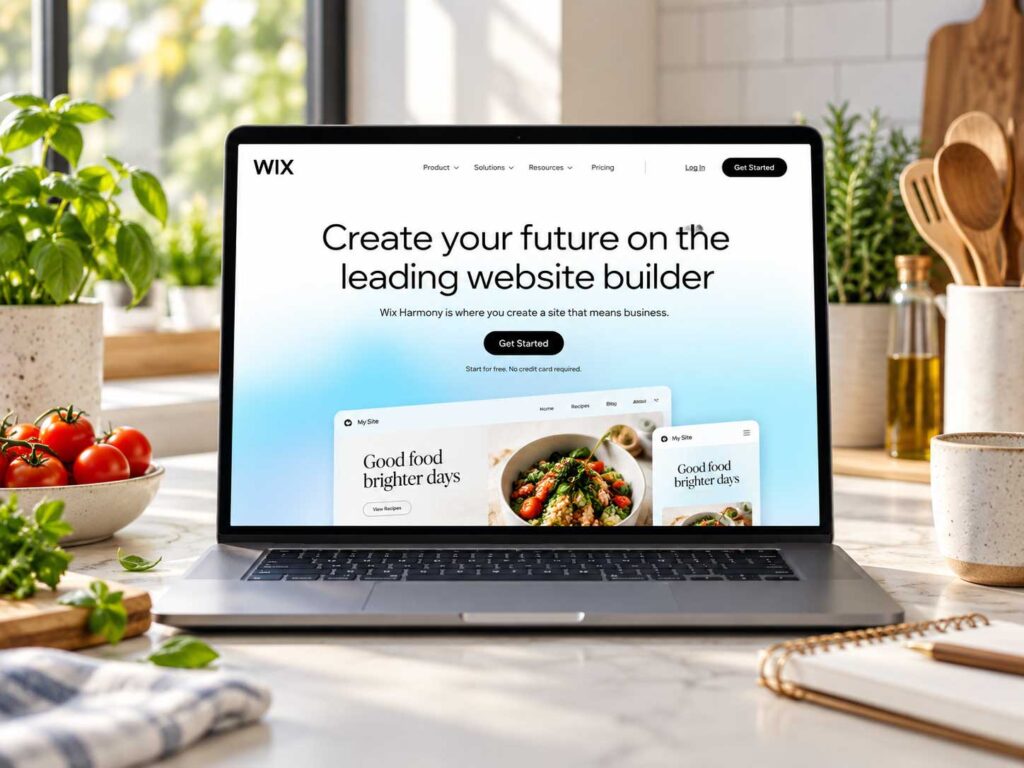
3. Wix — Best Drag-and-Drop Website Builder for Beginners
Wix is a popular all-in-one website builder for people who want to create a polished website without dealing with separate hosting, complicated setup, or much technical maintenance.
For new food bloggers, its biggest advantage is simplicity.
You can choose a template, edit the design visually, add your content, and publish without needing to understand themes, plugins, databases, or server settings.
That makes Wix appealing if you want to focus more on recipes, photography, and branding than on the technical side of running a website.
Is Wix Good for a Food Blog?
Yes, especially for beginners and smaller food blogs.
Wix includes built-in blogging tools that let you publish recipes, cooking tips, food photography, restaurant reviews, and other types of content without adding a separate content management system.
You can organize posts into categories, schedule content, customize layouts, add signup forms, and connect other marketing features from within the same platform.
For someone launching a first food blog, having these tools in one place can make the process feel much easier.
Can You Start a Wix Food Blog for Free?
Wix offers a free option, which is useful if you want to explore the platform before paying for a plan.
The free version is useful for getting a feel for Wix, but most food bloggers building a professional brand will eventually want a paid plan and their own domain.
If you want to use your own domain, remove Wix branding, access more storage, or unlock additional business features, you will generally need a paid plan.
For a professional food blog, using a custom domain is worth considering early because it gives the site a cleaner identity and makes the brand easier to remember.
Food Blog Design With Wix
Design is one of Wix’s biggest strengths.
Its visual editor lets you adjust page layouts, move elements around, change spacing, and create a custom look without needing to write code.
That works especially well for food bloggers because presentation matters.
You can create attractive recipe pages, landing pages, category pages, email signup pages, about pages, product recommendation pages, and other sections around your brand.
For food photographers, chefs, or recipe creators who care strongly about visual presentation, this can be a major advantage.
The tradeoff is that visual flexibility is not the same as technical flexibility.
As your food blog grows, you may eventually want specialized tools or integrations that are easier to find in the WordPress ecosystem.
Recipe Features on Wix
Wix can handle standard recipe publishing well, especially if your recipes are presented as regular blog posts or custom-designed pages.
You can include ingredients, instructions, images, videos, and additional cooking information in a polished layout.
However, serious recipe publishers may eventually want more specialized features such as advanced recipe schema, nutrition data, serving adjustments, ratings, or dedicated print functionality.
Wix can support structured content and additional functionality, but the ecosystem for food-specific publishing is not as extensive as WordPress’s.
For a smaller food blog, that may not matter. For a site with hundreds or thousands of recipes, it becomes more important.
SEO and Wix
Wix has improved significantly in SEO over the years.
You can customize page titles, meta descriptions, URLs, image alt text, redirects, structured data, and other important search settings.
For many small and medium-sized food blogs, those tools are more than enough.
Advanced publishers may still prefer a platform that gives them deeper control over hosting, plugins, caching, server settings, and technical optimization.
That difference becomes more noticeable as a site grows larger and more complex.
Monetizing a Wix Food Blog
A Wix food blog can support several monetization models.
Depending on your plan and setup, you may use affiliate links, sponsored content, advertising, ecommerce, memberships, digital products, courses, or brand partnerships.
This makes Wix more than just a simple website builder.
The bigger question is whether the platform gives you enough flexibility for the type of business you want to build several years from now.
If your strategy becomes heavily dependent on advanced advertising, affiliate management, custom tools, or large-scale recipe publishing, you may eventually want more control than Wix provides.
Pros and Cons of Wix
| Pros | Cons |
|---|---|
| Very easy to use | You are tied to the Wix ecosystem |
| Visual drag-and-drop editor | Cannot simply move the site to another hosting provider |
| Hosting is included | Less flexibility than self-hosted WordPress |
| Attractive templates | Advanced recipe functionality may require workarounds |
| No coding required for most tasks | Free plan has branding and other limitations |
| Free option for testing | Paid features can increase the long-term cost |
| Built-in marketing and business tools | Smaller plugin ecosystem for food-specific needs |
| Good for visually focused brands | Less technical control for very large sites |
Best For
Wix is best for beginner food bloggers who want an attractive website quickly and prefer a visual drag-and-drop editor over managing hosting and plugins themselves.
It can also work well for food photographers, chefs, small food businesses, or recipe creators who want a polished website without a steep technical learning curve.
If you’re looking for the best website builder for food bloggers who prioritize simplicity and visual editing, Wix deserves a place near the top of your shortlist.
Our Take
Wix is one of the easiest ways to launch a professional-looking food blog.
If your main priorities are simplicity, design, and avoiding technical maintenance, it can be a very practical choice.
The main limitation is long-term flexibility.
If you eventually want to build a very large recipe site with advanced SEO, specialized recipe plugins, sophisticated advertising, affiliate management, and complete control over the technical setup, self-hosted WordPress usually gives you more room to grow.
For bloggers who prioritize ease of use and visual design, though, Wix remains one of the strongest alternatives.
4. Squarespace — Best for Beautiful Food Blog Design
Squarespace is a strong option for food bloggers who want a polished, professional-looking website without spending much time managing technical details.
It is especially popular with creators, photographers, restaurants, and small businesses because of its clean templates and strong visual presentation.
For food bloggers, that can be a major advantage.
Recipes are highly visual, and a well-designed site can make food photography, recipe collections, seasonal guides, and featured content feel more professional from the beginning.
Is Squarespace Good for a Food Blog?
Yes, especially if design and simplicity are high priorities.
Squarespace includes built-in tools for blogging, image galleries, email signup forms, ecommerce, analytics, scheduling, and other common website features.
That makes it possible to build a food blog, portfolio, recipe collection, or small food business website without relying on a large number of third-party plugins.
For beginners, having these features already integrated can make the platform easier to manage.
Does Squarespace Have a Free Plan?
Squarespace is different from Wix, Blogger, and WordPress.com because it does not focus on a permanent free blogging plan.
Instead, it is primarily a paid website platform.
That makes it a better fit for bloggers who are comfortable investing in a professional website from the start rather than someone who only wants to experiment for free.
For a creator building a serious brand, that is not necessarily a disadvantage.
The tradeoff is that you are committing to an ongoing platform cost from the beginning.
Design and Food Photography
Design is where Squarespace stands out most.
Its templates are generally clean, modern, and image-focused, which works particularly well for recipe blogs, baking sites, food photography portfolios, restaurant websites, cookbook promotion, and chef brands.
You can create a polished layout without designing every page from scratch.
That is especially useful for food creators because large photos, clean spacing, and strong visual hierarchy can make recipes and editorial content much more appealing.
For photographers and visually driven brands, Squarespace often feels more refined out of the box than many other beginner-friendly platforms.
Recipe Publishing on Squarespace
Squarespace can handle recipe posts and food content well, especially when recipes are presented as beautifully designed articles.
You can combine images, ingredients, instructions, videos, and storytelling into attractive layouts.
However, food bloggers who need advanced recipe-specific functionality may find fewer options than they would with WordPress.
Features such as dedicated recipe cards, nutrition data, serving adjustments, advanced recipe schema, star ratings, and print tools may require more customization or third-party solutions.
For a smaller recipe blog, that may be perfectly fine.
For a large recipe publication, those limitations can become more noticeable.
Squarespace is also a contender for the best website builder for food bloggers who care more about polished design and photography than extensive technical customization.
SEO on Squarespace
Squarespace includes many of the SEO features most bloggers need.
You can customize page titles, meta descriptions, URLs, image alt text, and other important elements while also benefiting from responsive templates and built-in sitemaps.
For a small or medium-sized food blog, these tools are often more than sufficient.
Advanced publishers may still prefer the deeper technical control available with self-hosted WordPress, especially when it comes to plugins, caching, custom schema, redirects, and large-scale optimization.
That difference becomes more important as a site grows.
Monetizing a Squarespace Food Blog
Squarespace supports several ways to make money from a food website.
You can use affiliate links, sponsored content, digital products, memberships, ecommerce, services, online courses, or brand partnerships depending on your business model.
This makes Squarespace especially attractive for food bloggers who also sell products or services.
A photographer, private chef, bakery, cookbook author, or food consultant may appreciate being able to combine blogging, ecommerce, portfolios, and service pages in one place.
Pros and Cons of Squarespace
| Pros | Cons |
|---|---|
| Beautiful, polished templates | No permanent free plan |
| Excellent for food photography | Smaller ecosystem than WordPress |
| Hosting is included | Less technical flexibility |
| Easy to manage | Fewer specialized recipe tools |
| Strong branding options | Advanced customization may be more limited |
| Built-in ecommerce features | Less control over hosting and performance |
| Good for creators selling products or services | Can become restrictive for very large recipe sites |
| Less maintenance than self-hosted WordPress | Ongoing platform cost |
Best For
Squarespace is best for food bloggers, photographers, chefs, and creators who prioritize design and want an all-in-one platform that is relatively easy to manage.
It is especially well suited to visually driven food brands, portfolios, cookbook sites, and smaller recipe websites.
Our Take
Squarespace is one of the strongest options if you want your food blog to look polished from day one.
Its biggest strength is not unlimited technical freedom. It is the ability to create a professional-looking site without becoming a web developer.
For photography-heavy food brands, chef websites, cookbook projects, or smaller recipe blogs, that can be exactly what you need.
If your long-term goal is to build a very large recipe publication with advanced plugins, complex advertising, specialized recipe tools, and maximum technical control, WordPress.org still offers more flexibility.
But for food bloggers who value beautiful design, simplicity, and an integrated platform, Squarespace remains a very strong choice.
5. Ghost — Best for Publishing, Newsletters, and Memberships
Ghost is a modern publishing platform built for writers, independent publishers, newsletters, memberships, and paid subscriptions.
Compared with Wix or Squarespace, Ghost is less focused on visual page building and more focused on publishing content and building a direct relationship with readers.
For food bloggers, that can make it especially interesting if your strategy includes recipes, newsletters, premium content, memberships, or subscriber-supported publishing.
Is Ghost Good for a Food Blog?
Ghost can work very well for a content-focused food website, especially if your priority is publishing regularly and growing an email audience.
Its editor is clean and relatively simple, which makes it well suited to recipes, cooking guides, ingredient articles, meal-planning content, food travel stories, newsletters, and members-only posts.
Ghost also includes newsletter and membership tools directly within the platform, which means you may not need as many separate services to manage your audience.
That gives Ghost a very different feel from a traditional recipe site built mainly around search traffic and display advertising.
Ghost(Pro) vs. Self-Hosted Ghost
There are two main ways to use Ghost.
Ghost(Pro) is the managed version. Hosting, updates, backups, security, and much of the technical maintenance are handled for you.
You can also download the open-source Ghost software and host it yourself.
Self-hosting gives you more control, but it also requires more technical knowledge and ongoing maintenance.
For most beginners and solo creators, Ghost(Pro) is usually the easier route.
Newsletters Are One of Ghost’s Biggest Strengths
One of Ghost’s strongest features is its built-in newsletter system.
Instead of publishing an article and then connecting a separate email platform, Ghost can combine your website, subscriber list, newsletters, and membership system in one place.
For a food creator, that opens up a lot of possibilities.
You could send a weekly recipe newsletter, seasonal menu ideas, baking tips, meal plans, ingredient guides, or exclusive recipes directly to subscribers.
That makes Ghost especially appealing to creators who want email to be a central part of their business rather than simply an extra marketing channel.
Memberships and Paid Content
Ghost also makes it possible to create free and paid membership tiers.
For example, you could keep most recipes public while offering premium subscribers access to additional meal plans, exclusive recipes, downloadable guides, cooking lessons, or members-only newsletters.
This can create recurring revenue directly from your audience.
That model is quite different from a traditional food blog that depends heavily on display ads or affiliate clicks.
For creators with a loyal audience, that difference can be a major advantage.
Recipe Publishing on Ghost
Ghost handles general publishing very well, but it is not built specifically around recipe websites.
You can publish beautifully structured recipe posts with images, instructions, ingredient sections, and other supporting content.
The limitation is the smaller ecosystem of dedicated food-blogging tools.
Features such as advanced recipe schema, serving adjustments, nutrition calculations, ingredient checklists, ratings, and specialized print-friendly recipe cards are generally easier to implement with WordPress recipe plugins.
For a newsletter-focused food creator, this may not matter much.
For a site built around hundreds or thousands of structured recipes, it can become a more significant limitation.
SEO on Ghost
Ghost includes a strong set of SEO features without requiring a separate SEO plugin.
It supports clean URLs, metadata, canonical tags, sitemaps, structured markup, and responsive pages.
The platform is also relatively lightweight, which can help with performance.
That streamlined approach is attractive for publishers who do not want to manage a large collection of plugins.
However, advanced food publishers may still prefer the deeper customization available with WordPress, especially for recipe schema, internal linking tools, advertising setups, and highly customized site architecture.
Monetizing a Ghost Food Blog
Ghost is especially strong for audience-based monetization.
A food creator could potentially earn through paid memberships, premium newsletters, digital products, affiliate marketing, sponsored content, courses, meal plans, or recipe collections.
Display advertising can also be added, but Ghost is not as closely tied to the traditional ad-supported recipe-blog model as WordPress.
That makes Ghost a better fit for creators who want readers and subscribers to become the core of the business.
Pros and Cons of Ghost
| Pros | Cons |
|---|---|
| Excellent publishing experience | Smaller ecosystem than WordPress |
| Built-in newsletters | Fewer specialized recipe tools |
| Built-in memberships | Self-hosting can be more technical |
| Supports paid subscriptions | Less suited to very large recipe databases |
| Clean and lightweight platform | Fewer food-specific integrations |
| Strong SEO foundation | Advanced recipe features may require custom work |
| Open-source software | Less familiar to many beginner bloggers |
| Good for direct audience monetization | Not as closely aligned with display-ad-heavy food blogging |
Best For
Ghost is best for food creators who want to combine blogging with newsletters, memberships, premium content, or paid subscriptions.
It can be especially useful for chefs, recipe creators, cookbook authors, and niche food publishers who want to build a direct relationship with readers.
Our Take
Ghost takes a different approach to food blogging.
Instead of relying heavily on plugins and third-party services, it combines publishing, newsletters, subscriber management, and memberships into one streamlined system.
That makes it a strong option for a newsletter-first or membership-first food business.
For a traditional recipe site focused heavily on Google search traffic, recipe plugins, display advertising, and a very large recipe library, WordPress.org still offers a broader ecosystem.
But if email subscribers and premium content are central to your strategy, Ghost is one of the most compelling alternatives on this list.

6. Blogger — Best Completely Free Option for Simple Food Blogs
Blogger is one of the oldest blogging platforms still available. It launched in 1999 and was later acquired by Google, which continues to operate the service.
Its biggest advantage is simple: you can start a blog without paying for hosting.
That makes Blogger appealing for someone who wants to experiment with food blogging, publish family recipes, or learn the basics before investing in a more advanced website.
For a hobby blog or small personal recipe site, that simplicity can be enough.
Is Blogger Good for a Food Blog?
Blogger can work well for a basic food blog.
You can publish recipes, upload food photography, organize posts with labels, customize the layout, and connect your own domain if you want the site to look more professional.
You can also make additional design changes if you are comfortable editing HTML or CSS.
The platform becomes less attractive when you want to build a larger publishing business with advanced recipe features, deeper SEO control, sophisticated advertising, or extensive integrations.
Blogger Is Free to Use
Unlike many website builders, Blogger does not require a paid hosting plan.
You can create a site using a Blogspot address such as yourfoodblog.blogspot.com and begin publishing without paying for server space.
You can also connect a custom domain, which is usually the better option if you want to build a recognizable food brand.
Using an address such as yourfoodblog.com looks more professional and gives you a domain you can continue building around over time.
Blogger Is Easy to Manage
One of Blogger’s strongest advantages is how little technical maintenance it requires.
You do not need to choose a hosting company, install a content management system, manage server settings, or maintain a collection of plugins.
You create the blog, choose a theme, customize the basic layout, and start publishing.
For someone who finds self-hosted WordPress overwhelming, that can make Blogger a much easier place to begin.
The tradeoff is that this simplicity also means fewer options when you eventually want more control.
Recipe Features on Blogger
Blogger works well for publishing recipes as standard posts, but it does not have the same specialized recipe ecosystem available to WordPress users.
A serious recipe site may eventually need structured recipe cards, nutrition information, preparation and cooking times, serving adjustments, ratings, print buttons, and recipe schema.
Those features are much easier to add on platforms with dedicated recipe plugins.
With Blogger, advanced recipe functionality may require custom code, manual formatting, or third-party solutions.
That can become increasingly inconvenient as your recipe library grows.
SEO on Blogger
Blogger provides basic SEO controls that are enough for publishing search-friendly content.
You can manage important elements such as post titles, descriptions, URLs, headings, internal links, and image information.
A Blogger site can certainly rank in search engines.
The main limitation is flexibility.
Self-hosted platforms such as WordPress give you access to a much larger ecosystem of SEO tools for schema, internal linking, redirects, caching, performance optimization, and technical site management.
That difference may not matter much when you have 20 posts.
It can matter considerably more when the site has hundreds of recipes and you want to optimize it at a deeper level.
Can You Make Money With Blogger?
Yes. Blogger can be monetized.
A food blogger may potentially earn through display advertising, affiliate marketing, sponsored content, digital products, services, or brand partnerships.
Blogger includes built-in support for connecting AdSense, and you can also add advertising code from other services.
However, simply being able to monetize a platform does not mean it provides the same level of flexibility as a self-hosted site.
As your business grows, you may want advanced ad management, affiliate tools, custom landing pages, better email integrations, or more sophisticated analytics.
That is where Blogger may begin to feel restrictive.
Pros and Cons of Blogger
| Pros | Cons |
|---|---|
| Free to start | Limited advanced customization |
| Hosting is included | Smaller theme ecosystem |
| Easy to use | Fewer integrations than WordPress |
| No plugin maintenance | Limited recipe-specific functionality |
| Can use a custom domain | Less control over technical SEO |
| Good for hobby bloggers | Advanced monetization setups can be harder |
| Simple publishing interface | Smaller development ecosystem |
| Backed by Google | Less suitable for large recipe publications |
Best For
Blogger is best for beginners who want to start a simple food blog with almost no technical setup or hosting cost.
It is also a good fit for hobby bloggers who mainly want somewhere to share recipes, cooking stories, or family food traditions.
Our Take
Blogger’s strongest advantage is simplicity.
You can create a site and begin publishing without buying hosting, learning server management, or maintaining plugins.
If your goal is simply to share recipes and see whether you enjoy blogging, Blogger can be perfectly adequate.
The limitations become more important when your ambitions grow.
If you already know that you want to build a large food website, grow significant search traffic, use advanced recipe functionality, or create several income streams, starting with WordPress.org may save you from a more complicated migration later.
For a simple, free food blog, though, Blogger remains a practical option.
7. Medium — Best for Writers Who Want to Publish Without Building a Website
Medium is different from most of the other blogging platforms on this list.
Instead of giving you a traditional website that you fully control, Medium works more like a large publishing network where writers publish inside the Medium ecosystem.
That makes it extremely easy to start.
You do not need hosting, a theme, plugins, or a separate website builder. You create an account, write your article, and publish.
For food writers who care more about storytelling and reaching readers than building a standalone recipe website, that simplicity can be appealing.
Is Medium Good for Food Bloggers?
Medium can work well for certain types of food content.
It is especially suited to personal food stories, cooking essays, food culture articles, restaurant experiences, culinary travel writing, and behind-the-scenes creator content.
It is much less suited to building a traditional recipe website with hundreds of structured recipe pages.
That is the key distinction.
Medium is primarily a publishing platform, not a dedicated recipe-blogging system.
Medium’s Built-In Audience
One of Medium’s biggest advantages is that your work can potentially be discovered by readers who are already using the platform.
That gives new writers a way to publish without having to build every part of their audience from scratch.
However, publishing on Medium does not guarantee large amounts of traffic.
Topic selection, quality, consistency, engagement, and the platform’s own distribution system still play a major role in how widely an article is seen.
For food creators, Medium can therefore work especially well as an additional publishing channel rather than necessarily serving as the main home for an entire brand.
You Have Less Control Over the Platform
One of the biggest differences between Medium and a self-hosted website is ownership and control.
With a self-hosted WordPress site, you control the site structure, design, plugins, monetization strategy, navigation, and overall user experience.
On Medium, you are publishing inside someone else’s platform.
Medium controls much of the design, distribution system, features, and reader experience.
That makes publishing simpler, but it also gives you fewer options when it comes to building a highly customized food brand.
Recipe Publishing on Medium
You can publish complete recipes on Medium, but they are generally presented more like articles than specialized recipe pages.
That means you do not get the same food-specific ecosystem available on WordPress.
Advanced recipe cards, serving adjustments, dedicated print buttons, nutrition calculations, ingredient checklists, and specialized recipe schema are not central to the platform.
For occasional recipes, that may not be a problem.
For a website built around hundreds of recipes, it becomes a much bigger limitation.
SEO and Search Visibility
Medium articles can appear in search engines, and the platform handles most of the technical infrastructure for you.
You do not need to worry about hosting performance, caching plugins, theme updates, or server maintenance.
The tradeoff is that you have much less control over technical SEO and site architecture.
A large recipe website may eventually need more control over internal linking, category structure, recipe indexes, schema, custom landing pages, affiliate layouts, advertising placements, and conversion optimization.
A standalone website gives you far more flexibility in those areas.
Making Money on Medium
Medium operates a Partner Program that allows eligible writers to earn money from qualifying content.
How much a writer earns depends on the current rules of the program and how readers interact with eligible stories.
This can give food writers a way to monetize content without setting up display advertising or managing their own payment system.
The tradeoff is dependence on the platform.
If your income relies heavily on one third-party publishing system, changes to distribution, eligibility, or monetization rules can affect your business.
That is one reason many professional bloggers prefer to build their primary brand on a website they control.
Pros and Cons of Medium
| Pros | Cons |
|---|---|
| Free to start publishing | Limited control over design and branding |
| Extremely easy to use | Not designed for large recipe libraries |
| No hosting required | Limited recipe-specific functionality |
| No technical maintenance | Less control over SEO |
| Built-in reader community | Limited advertising flexibility |
| Clean writing experience | Fewer third-party integrations |
| Potential access to the Partner Program | You are building inside Medium’s ecosystem |
| Good for food essays and storytelling | Harder to build a fully independent food brand |
Best For
Medium is best for food writers who mainly want to publish articles, stories, essays, and opinions without building or maintaining their own website.
It can also be useful as a secondary publishing channel for an established food blogger who wants to reach additional readers.
Our Take
Medium is excellent at removing the technical side of blogging.
You can concentrate almost entirely on writing and publishing.
The tradeoff is control.
For someone interested in food storytelling, culinary essays, or experimenting with online publishing, Medium can be a useful place to start.
For someone who wants to build a recognizable recipe brand, grow an email list, use multiple monetization methods, and create a valuable website over the long term, Medium usually works better as a supporting channel than as the primary platform.
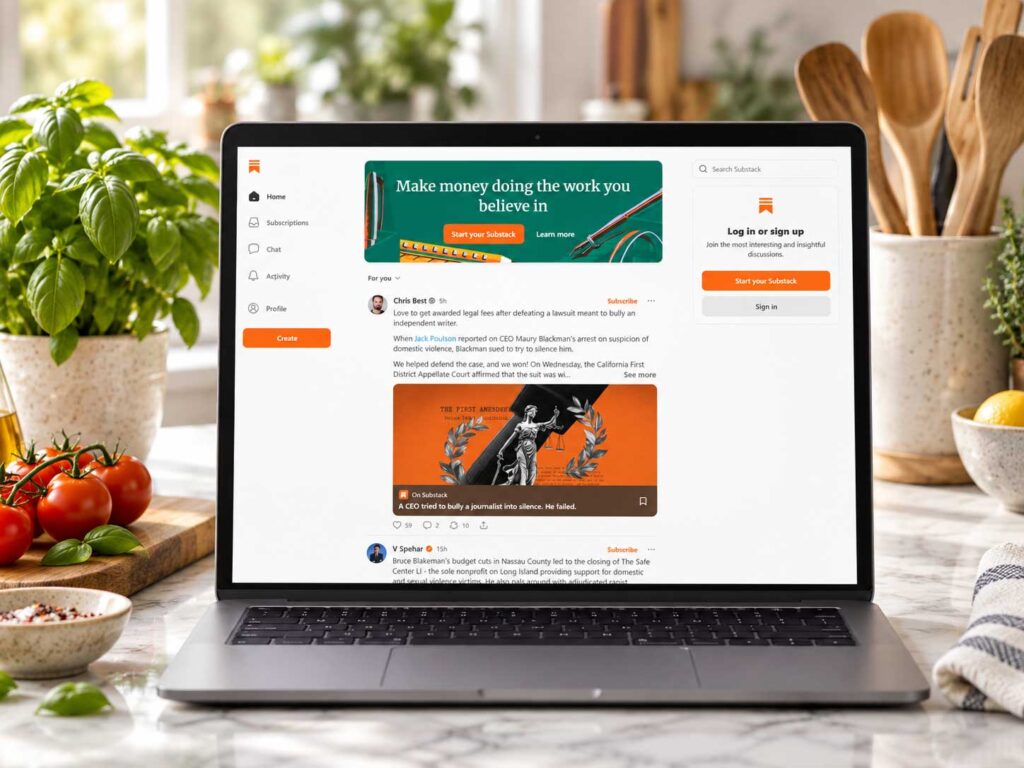
8. Substack — Best for Newsletter-First Food Creators
Substack is a publishing platform built around newsletters, subscriptions, and direct relationships with readers.
Instead of creating a traditional blog and then connecting a separate email marketing service, Substack combines publishing and email in one place.
For food creators, that can be especially useful if your main goal is to build a loyal audience around recipes, meal ideas, cooking advice, baking content, or food stories.
Is Substack Good for Food Bloggers?
Yes, but it works best for a specific kind of food creator.
Substack is a strong fit for weekly recipes, meal plans, seasonal cooking ideas, baking newsletters, restaurant recommendations, ingredient guides, food travel stories, and personal food essays.
Its biggest advantage is that readers can subscribe and receive new content directly in their inbox.
That creates a different growth model from a traditional recipe site built primarily around search traffic.
You Can Start Without Traditional Hosting
One of Substack’s biggest advantages is how quickly you can launch.
You can create a publication, start collecting subscribers, publish posts, and send newsletters without setting up a traditional hosting account.
That makes it easy to test an idea before investing heavily in a full website.
For example, a baker could launch a weekly newsletter with one recipe, one technique, and one seasonal recommendation without first building a large recipe site.
Free and Paid Subscriptions
Substack also makes it easy to combine free and paid content.
You might publish some recipes publicly while reserving premium meal plans, exclusive recipes, seasonal menus, advanced baking guides, or members-only newsletters for paying subscribers.
That makes the platform attractive for creators who want to earn directly from their audience rather than relying entirely on advertising.
For niche food creators with a loyal following, this subscription model can be especially appealing.
Built-In Email Distribution
Email is central to the Substack experience.
When you publish new content, you can send it directly to subscribers from the same platform.
That simplifies a process that often requires several separate tools on a traditional website.
With WordPress, for example, you may need to connect signup forms, an email service, automations, and newsletter templates.
Substack removes much of that setup and keeps publishing and email closely connected.
Recipe Publishing on Substack
Substack can handle recipes well when they are published as regular posts.
You can include ingredients, instructions, images, commentary, and additional cooking notes in a clean editorial format.
The limitation is that Substack does not have the same specialized recipe ecosystem as WordPress.
Features such as advanced recipe cards, structured recipe schema, serving adjustments, nutrition data, ratings, and dedicated print functionality are not the platform’s main focus.
For a weekly recipe newsletter, that may not matter at all.
For a large recipe archive with hundreds or thousands of search-focused pages, it matters much more.
SEO and Search Traffic
Substack publications can appear in search engines, but the platform is not primarily built for advanced SEO management.
You have less control over technical SEO, site architecture, structured data, page templates, and internal linking than you would with a self-hosted site.
For a creator whose main strategy is growing a subscriber community, that can be perfectly acceptable.
For someone trying to build a large recipe site around Google traffic, the limitations become more significant.
Monetizing a Substack Food Publication
Paid subscriptions are the most obvious revenue opportunity, but they are not the only one.
A food creator may also use affiliate links, sponsorships, brand partnerships, digital cookbooks, courses, or product recommendations.
A strong subscriber base can also become valuable later if you launch your own products or services.
That makes Substack particularly interesting for creators who want to build a direct audience first and monetize that relationship over time.
Pros and Cons of Substack
| Pros | Cons |
|---|---|
| Easy to start | Less control over site design |
| No traditional hosting setup required | Limited recipe-specific functionality |
| Publishing and email are combined | Less technical SEO control |
| Supports free and paid subscriptions | Limited structured data options |
| Very little technical maintenance | Not ideal for large recipe databases |
| Strong for building a direct audience | Fewer advanced integrations than WordPress |
| Good for recurring recipe newsletters | You are building within Substack’s ecosystem |
| Simple paid-content model | Less flexibility for complex advertising setups |
Best For
Substack is best for food creators who want to build an audience primarily through newsletters and potentially monetize through paid subscriptions.
It can work particularly well for recipe creators, chefs, bakers, food writers, and niche experts who can consistently provide useful content to subscribers.
Our Take
Substack can be an excellent choice when the newsletter is the core product, rather than simply a marketing channel for a larger website.
A creator publishing one strong recipe newsletter each week may find Substack much easier to manage than a traditional website plus a separate email platform.
If your goal is to build a large searchable recipe library and attract significant traffic from search engines, though, WordPress gives you much more control.
For some creators, the strongest strategy may be to use both: a self-hosted food blog for evergreen search content and Substack for building a loyal subscriber audience.
9. Joomla (Self-Hosted) — Best for Technical Users Who Want More Control
Joomla is a free, open-source content management system that can be used to build everything from simple blogs to large publishing websites, directories, and online communities.
Like WordPress.org, the Joomla software itself is free, but you need your own web hosting and domain name to run it.
Joomla is highly flexible and can be customized with templates, extensions, and custom development. The tradeoff is that it generally has a steeper learning curve than beginner-focused platforms such as Wix, Squarespace, or WordPress.com.
For that reason, it is usually a better fit for users who are comfortable working with more technical website settings.
Is Joomla Good for a Food Blog?
Yes, Joomla can absolutely be used to build a food blog.
You can publish recipes, organize content into categories, create custom menus, manage different content types, and extend the site with third-party tools.
It can also handle more complex food websites, including recipe databases, cooking magazines, multilingual blogs, restaurant directories, membership sites, and community-based projects.
Joomla is certainly capable of running a serious food site. The more practical question is whether its extra flexibility is worth the steeper learning curve for what you actually want to build.
The bigger question is whether the extra flexibility is worth the additional setup and learning curve for the type of food blog you want to build.
Joomla Is Open Source
One of Joomla’s biggest advantages is control.
Because it is open-source software, you can choose your own hosting provider, modify the code, install extensions, change templates, and customize the website much more deeply than you can with many hosted platforms.
You are not locked into one website builder or one hosting company.
That can make Joomla attractive to developers, technically experienced publishers, or food businesses with more complex website requirements.
Extensions and Templates
Joomla has its own ecosystem of extensions and templates that can expand both the design and functionality of a site.
You can add tools for SEO, ecommerce, forms, galleries, memberships, security, backups, social sharing, and email integrations.
That gives Joomla plenty of flexibility.
However, its ecosystem is smaller than WordPress’s, especially when it comes to tools built specifically for food bloggers and recipe publishers.
For a general content site, this may not matter much.
For a recipe-heavy website, the difference can become more noticeable.
Recipe Functionality
This is one area where WordPress has a clear advantage for most food bloggers.
WordPress has a much larger selection of tools built specifically for recipe publishing, including recipe cards, nutrition information, serving adjustments, ratings, print buttons, and recipe schema.
Joomla can support similar functionality through extensions or custom development, but you may have fewer ready-made options.
That can mean more setup, more testing, and sometimes more custom work.
If your entire site is centered around recipes, WordPress will usually be easier to configure.
Multilingual Food Blogs
One area where Joomla can be especially appealing is multilingual publishing.
Joomla has strong multilingual features built into the core system, which makes it easier to manage content in several languages without relying entirely on third-party tools.
That can be useful for food publishers targeting readers in multiple countries or publishing regional recipes in more than one language.
For international food websites, this can be one of Joomla’s strongest advantages.
SEO With Joomla
Joomla provides a solid SEO foundation and gives users control over important elements such as URLs, metadata, page structure, menus, and content organization.
Additional extensions can expand those capabilities.
Because you control the hosting environment, you can also make deeper technical changes related to performance, caching, redirects, and server configuration.
The downside is that taking full advantage of this flexibility usually requires more technical knowledge than using a beginner-focused website builder.
Monetizing a Joomla Food Blog
Joomla gives site owners considerable freedom when it comes to monetization.
A food website built with Joomla can potentially use display advertising, affiliate marketing, sponsored content, ecommerce, memberships, courses, services, digital products, or brand partnerships.
Because you control the website, you are not limited to one built-in monetization system.
That gives Joomla far more flexibility than many free hosted platforms.
Pros and Cons of Joomla
| Pros | Cons |
|---|---|
| Free and open source | Steeper learning curve |
| Full control over hosting and site structure | More technical than beginner platforms |
| Strong multilingual capabilities | Smaller food-blogging ecosystem than WordPress |
| Flexible content management | Fewer specialized recipe tools |
| Can handle complex websites | Setup and maintenance can take more time |
| Extendable with templates and extensions | Smaller pool of recipe-specific tutorials and integrations |
| Good for custom development | May be more complex than most food bloggers need |
| Strong monetization flexibility | Less beginner-friendly overall |
Best For
Joomla is best for technically experienced bloggers, developers, or publishers who want an open-source platform with strong customization and multilingual capabilities.
It can also be a good fit for more complex food websites that go beyond a traditional recipe blog.
Our Take
Joomla is a capable and flexible CMS, but capability alone does not make it the best choice for most food bloggers.
For a typical recipe website, WordPress is usually easier to build, optimize, and expand because its ecosystem of recipe plugins, themes, tutorials, hosting providers, and specialized tools is much larger.
However, if you already know Joomla, need strong multilingual features, or want to build a more customized publishing platform, it can be an excellent option.
For the average beginner, though, a simpler platform will usually make more sense.
How to Choose the Best Blogging Platform for Your Food Blog
Choosing among the best blogging platforms for food bloggers becomes much easier once you know what you want your website to become.
A hobby blogger who wants to share family recipes has very different needs from someone planning to publish hundreds of recipes, grow search traffic, build an email list, and eventually earn income from ads, affiliate marketing, products, or sponsorships.
Before choosing a platform, think beyond what is easiest today and consider what you may need as the site grows.
Decide Whether This Is a Hobby or a Business
This is one of the most important questions to answer first.
If you simply want somewhere to publish recipes occasionally, a free platform such as Blogger, WordPress.com, Medium, or Substack may be enough.
If your goal is to turn your food blog into a business, you should think further ahead.
A growing food site may eventually need advanced SEO tools, recipe cards, advertising integrations, affiliate management, email marketing, analytics, custom landing pages, and more control over how the site is structured.
Choosing a platform with room to grow can save you from having to rebuild or migrate the site later.
Consider How Important Recipe Features Are
Not every blogging platform is designed specifically for recipe publishing.
A traditional food blog may eventually benefit from structured recipe cards, recipe schema, nutrition information, print buttons, serving adjustments, ratings, and other features that make recipes easier to use and understand.
Platforms with strong recipe ecosystems make these features much easier to add.
This is one reason self-hosted WordPress is so popular among recipe publishers.
If you mainly publish food essays, culinary stories, newsletters, or personal writing rather than structured recipes, platforms such as Medium, Ghost, or Substack may suit you just as well.
Think About SEO and Search Traffic
If you want Google and other search engines to become a major source of traffic, SEO flexibility matters.
At a basic level, you should be able to control page titles, meta descriptions, URLs, image alt text, internal links, categories, redirects, and navigation.
As your website grows, you may also want more control over schema, page speed, caching, sitemaps, canonical URLs, redirects, and other technical SEO elements.
Most modern blogging platforms provide basic SEO tools, but self-hosted systems usually give you more room to customize and expand your setup.
That extra control becomes more valuable as your content library grows.
Look at Monetization Options
You may not plan to make money from your food blog immediately, but your goals can change once traffic begins to grow.
Food blogs can potentially earn through display advertising, affiliate marketing, sponsored content, digital cookbooks, meal plans, memberships, online courses, paid newsletters, brand partnerships, and physical products.
Before choosing a platform, make sure it supports the monetization methods you may want later.
A free platform can look attractive at the beginning but feel restrictive once you want to add advertising, use specialized affiliate tools, create sales pages, or sell products directly.
Decide How Much Technical Work You Want
Some platforms handle most of the technical work for you.
Wix, Squarespace, WordPress.com, Medium, and Substack are designed to reduce the amount of setup and maintenance required.
Self-hosted WordPress and Joomla give you more control, but they also give you more responsibility.
You may need to think about hosting, updates, backups, performance, security, plugins, and other technical details.
Neither approach is automatically better.
The right choice depends on whether you value convenience more than control or whether you are comfortable managing more of the site yourself in exchange for greater flexibility.
Think About Your Email Strategy
Building an email list gives you a direct connection with readers that does not depend entirely on search engines or social platforms.
If newsletters will be central to your strategy, Ghost and Substack have a major advantage because email publishing is built directly into the platform.
WordPress, Wix, and Squarespace can also work very well with email marketing, but you may need to connect additional tools or services.
For a traditional recipe blog, that extra setup is often worth it because you gain more control over the website itself.
Consider How Much Design Freedom You Need
Food blogging is highly visual, so your platform should make it easy to showcase photography and create an attractive reading experience.
Squarespace and Wix are particularly strong when it comes to visual website building.
WordPress can also produce extremely polished food blogs, but the final result depends more heavily on the theme, plugins, and design tools you choose.
If you want a beautiful site without touching code or managing many technical settings, an all-in-one website builder may be the easier option.
Think About Where You Want the Blog to Be in Five Years
It is easy to choose a platform based only on what you need today.
Try to imagine what the site could look like several years from now.
You might start with 10 recipes and eventually publish 500. You may begin with no traffic and later qualify for a major advertising network. You could launch a cookbook, sell meal plans, build a membership program, or even hire writers.
A platform that feels slightly more complicated today may save you considerable work if it gives you room to grow later.
Which Blogging Platform Should Food Bloggers Choose?
There is no single platform that works perfectly for every food blogger.
For most people planning to build a serious recipe website, self-hosted WordPress.org offers one of the strongest combinations of ownership, flexibility, SEO control, recipe functionality, and monetization options.
If ease of use and visual design are more important, Wix or Squarespace may be a better fit.
If newsletters and paid subscribers are central to your strategy, Ghost or Substack deserve serious consideration.
And if you simply want to experiment with blogging without spending much money, Blogger, WordPress.com, Medium, or another free platform can help you get started.
The best platform is the one that fits what you need now without making it unnecessarily difficult to reach where you want your food blog to go later.
If you’re trying to find the best platform for a food blog, start by deciding whether your priority is recipe publishing, search traffic, visual design, newsletters, or ease of use.
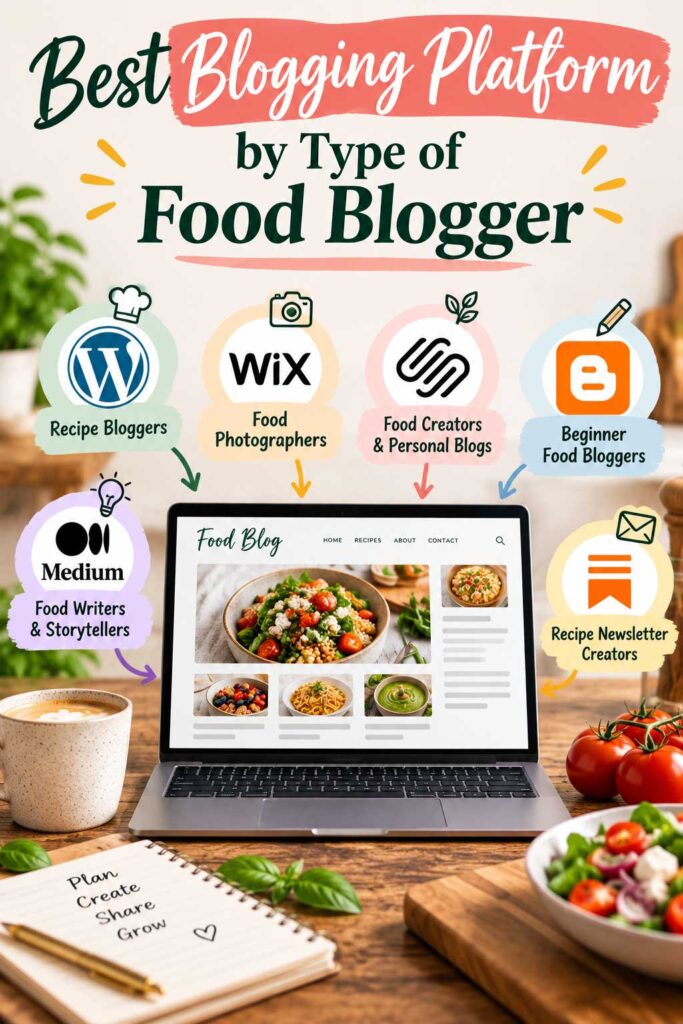
Best Blogging Platform by Type of Food Blogger
Even among the best blogging platforms for food bloggers, different platforms are better suited to different types of creators.
Some platforms are better for large recipe sites, while others make more sense for newsletters, visual portfolios, hobby blogs, or creators who want as little technical maintenance as possible.
| Type of Food Blogger | Best Fit | Why |
|---|---|---|
| Serious recipe blogger | WordPress.org | Strong recipe tools, SEO flexibility, monetization, and room to grow |
| Complete beginner | Wix | Easy visual editor and minimal technical setup |
| Design-focused creator | Squarespace | Polished templates and strong visual presentation |
| Newsletter-first creator | Substack | Publishing and email are built around subscribers |
| Membership-focused creator | Ghost | Strong built-in tools for newsletters, memberships, and paid content |
| Hobby blogger on a budget | Blogger | Free hosting and a simple publishing setup |
| Food writer or storyteller | Medium | Easy publishing with an existing reader ecosystem |
| Beginner who wants managed WordPress | WordPress.com | Familiar WordPress experience without managing hosting |
| Technical or multilingual publisher | Joomla | Strong customization and multilingual capabilities |
For Serious Recipe Bloggers
If you plan to build a large recipe website, grow organic traffic, use advanced recipe cards, run display advertising, and add affiliate links, WordPress.org is usually the strongest long-term fit.
Its main advantage is flexibility. You have much more control over plugins, SEO, monetization, design, hosting, and site functionality than you do with most hosted platforms.
Which Blogging Platforms Are Best for Beginners?
The best blogging platforms for beginners are generally the ones that remove most of the technical setup.
Wix and WordPress.com are both easy places to start. Wix is especially appealing if you prefer a visual drag-and-drop editor, while WordPress.com gives you the familiar WordPress publishing experience without requiring you to manage hosting yourself.
Squarespace is another beginner-friendly option if design is one of your biggest priorities. Blogger, Medium, and Substack are also relatively simple because much of the technical setup is handled for you.
Beginners who expect their food blog to become a larger business may still prefer WordPress.org, even though it requires a little more setup at the beginning.
For Beginners Who Want Simplicity
Wix and WordPress.com are both easier to manage than a self-hosted setup.
Wix is especially attractive if you prefer a visual drag-and-drop editor, while WordPress.com may be more appealing if you like the WordPress publishing experience but do not want to manage hosting yourself.
Squarespace also belongs in this group if design is one of your top priorities.
For Newsletter and Membership Creators
Substack and Ghost take a different approach.
Instead of focusing primarily on search traffic and large recipe archives, they make it easier to build a direct relationship with subscribers.
Substack is particularly simple for newsletter-first creators, while Ghost gives you more built-in flexibility for memberships, premium content, and paid subscriptions.
For Hobby Bloggers and Writers
Blogger and Medium are better suited to simpler publishing goals.
Blogger works well for hobby blogs and personal recipe collections, while Medium is a better fit for food essays, culinary stories, restaurant experiences, and other writing-focused content.
Neither is as flexible as a self-hosted website, but both make it easy to start publishing without building a complex site.
For Technical or Multilingual Publishers
Joomla can be a strong option if you already have technical experience or need a more customized multilingual website.
It offers extensive control, but the additional complexity is usually unnecessary for someone who simply wants to launch a standard recipe blog.
Quick Recommendation
For most serious recipe bloggers, WordPress.org is our overall pick because it offers the strongest mix of recipe functionality, SEO control, monetization, and long-term flexibility. If your priorities are different—such as newsletters, visual design, or simplicity—one of the alternatives above may be a better fit.
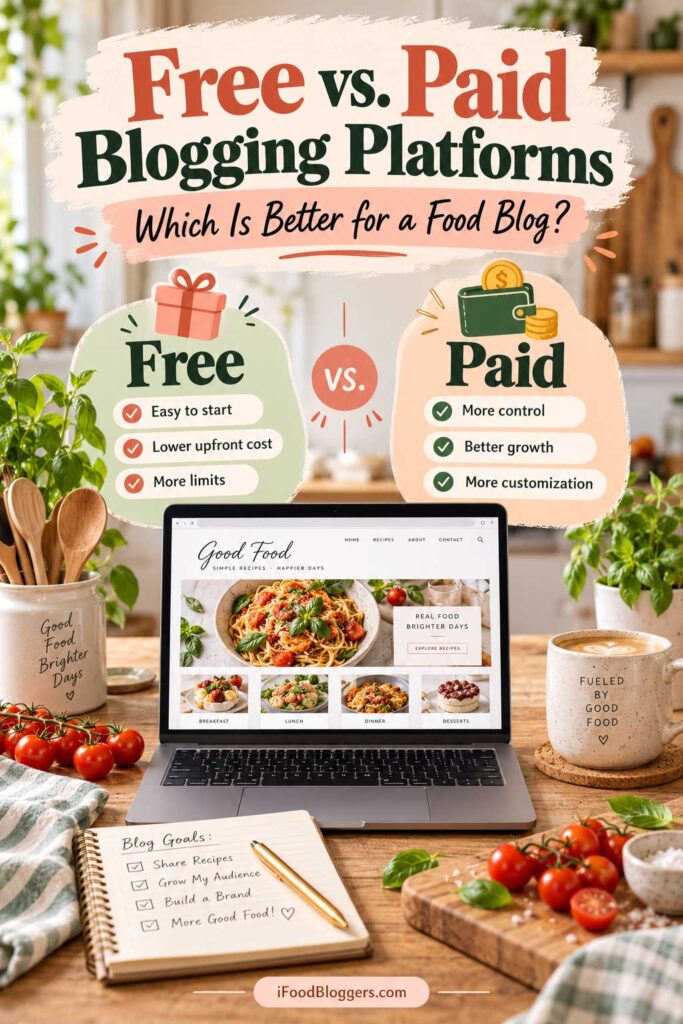
Free vs. Paid Blogging Platforms: Which Is Better for a Food Blog?
Starting with a free blogging platform can make sense if you are completely new and simply want to see whether you enjoy publishing recipes.
Free and paid platforms, however, are built for slightly different goals.
The right choice depends less on your budget and more on what you eventually want your food blog to become.
Both free and paid food blogging platforms can work well, but they offer very different levels of control and flexibility.
When a Free Blogging Platform Makes Sense
A free platform can be a good choice if you are testing whether you enjoy blogging, sharing family recipes, learning how online publishing works, or starting with almost no budget.
Platforms such as Blogger, WordPress.com, Medium, and Substack make it possible to begin publishing without committing to a traditional hosting plan.
For many beginners, that simplicity is useful.
It is often better to publish your first few recipes and learn from the process than spend weeks comparing hosting companies, themes, plugins, and technical settings before creating any content.
The Limitations of Free Blogging Platforms
The main tradeoff is control.
Free plans may limit your ability to use a custom domain, remove platform branding, install advanced tools, customize the site deeply, or monetize it exactly the way you want.
Those limitations may not matter when your site contains 10 or 20 recipes.
They become much more important when you have hundreds of posts, regular search traffic, display advertising, affiliate links, email automation, and custom landing pages.
That is when a more flexible platform starts to make a noticeable difference.
Why Paying for a Blogging Platform Can Be Worth It
A paid platform usually gives you more professional features and greater control.
Depending on the service, that may include a custom domain, more storage, better design options, stronger SEO tools, ecommerce features, advanced analytics, email integrations, premium support, or additional plugins and extensions.
If you plan to build a real business around your food blog, those features can save time and make the site easier to grow.
The cost is better viewed as part of running the website rather than simply as an extra expense.
Free Does Not Always Mean Cheaper Long Term
A free platform may cost nothing today, but moving away from it later can create a lot of work.
You may need to migrate posts, move images, rebuild your design, reconnect analytics, set up redirects, and recreate parts of the site manually.
That does not mean free platforms are a bad choice.
It simply means you should think about your long-term plans before committing to one.
If you already know that you want to build a large recipe website, starting with a platform designed for long-term growth may be easier than migrating later.
A Paid Setup Does Not Have to Be Expensive
You do not need an expensive stack when launching your first food blog.
A simple setup can include:
- A domain name
- Entry-level hosting
- A free theme
- A free or affordable recipe plugin
- Basic analytics
- An email signup tool
That is more than enough to start publishing.
You can add premium software later when the site actually needs it.
Buying every blogging tool before you have traffic usually adds cost and complexity without providing much real benefit.
Which Option Is Better for Making Money?
If monetization is a major goal, paid or self-hosted platforms generally give you more flexibility.
A serious food blog may eventually earn through display advertising, affiliate marketing, sponsorships, digital products, memberships, paid newsletters, or other revenue streams.
Having more control over the website makes it easier to test different monetization models and choose the tools that fit your business.
Free platforms can still generate income, but you may have fewer options or depend more heavily on the platform’s own monetization system.
Which One Should You Choose?
If you are still deciding whether blogging is something you want to pursue, starting free can be perfectly reasonable.
Publish a few recipes, learn how content creation works, and see whether you enjoy the process.
If you already know that you want to build a serious food website, paying for your own domain and choosing a platform with more control is usually the better long-term decision.
For most ambitious food bloggers, self-hosted WordPress.org offers one of the strongest balances of affordability, ownership, flexibility, and room to grow.
How Much Does It Cost to Start a Food Blog?
The cost of starting a food blog can range from almost nothing to several hundred dollars, depending on the platform, tools, and design you choose.
You do not need an expensive setup to begin.
If you’re researching how to start a food blog, choosing the platform is one of the first major decisions because it affects your hosting costs, design options, recipe features, and future monetization.
For most new bloggers, the better approach is to start with the essentials and upgrade only when the site begins to grow.
Starting a Food Blog for Free
If your budget is zero, you can start with a free platform such as Blogger, WordPress.com, Medium, or Substack.
That allows you to begin publishing without paying for traditional web hosting.
The tradeoff is flexibility. Free platforms often come with more limits around branding, customization, monetization, advanced SEO, or specialized recipe features.
They can be excellent for testing an idea, but they may not be the best long-term choice if you already know that you want to build a serious food business.
Starting With Self-Hosted WordPress
A basic self-hosted WordPress food blog usually has two essential costs: a domain name and web hosting.
Your domain is the address people use to reach your site, such as yourfoodblog.com, while hosting is the service that stores your website and keeps it online.
Many hosting companies bundle a domain with the first year of hosting, although renewal prices and included features vary.
You can then keep costs low by using a free WordPress theme, a free or affordable recipe plugin, and free analytics tools.
Typical Food Blog Startup Costs
Exact prices vary by provider and plan, but this gives you a useful idea of where the money usually goes.
| Expense | Typical Need | Can You Start Free? |
|---|---|---|
| Domain name | Professional website address | Sometimes bundled with hosting |
| Web hosting | Required for self-hosted WordPress | No |
| WordPress theme | Controls your site design | Yes |
| Recipe plugin | Adds recipe-specific features | Yes |
| Analytics | Tracks traffic and performance | Yes |
| Email marketing | Builds your subscriber list | Usually |
| SEO tools | Helps with optimization and research | Yes |
| Design tools | Graphics, pins, and social images | Yes |
The important point is that most of the optional tools do not need to be premium from day one.
Optional Costs as Your Blog Grows
As your food blog becomes more established, you may decide to invest in better tools for recipe publishing, email marketing, SEO, image optimization, backups, security, design, or social media scheduling.
These upgrades can be useful, but they should solve a real problem.
Buying a large collection of premium plugins and subscriptions before you have traffic usually makes the site more expensive and more complicated without adding much value.
Where Should You Spend Money First?
If your budget is limited, focus on the foundation of the site.
A good domain, reliable hosting, and a stable platform are usually more important than premium themes or advanced software.
After that, invest where the site actually needs improvement.
If performance becomes a problem, spend on speed. If your email list grows, upgrade your email platform. If recipe formatting becomes too limited, move to a more advanced recipe plugin.
That approach keeps your costs tied to real growth rather than guesswork.
Can You Start a Food Blog for Under $100?
In many cases, yes.
A basic self-hosted setup can often be launched for a relatively modest amount, especially if you use free themes, free plugins, and entry-level hosting.
The exact total depends on the hosting company, billing period, domain cost, and any introductory pricing available when you sign up.
The goal should not be to find the absolute cheapest setup.
It should be to choose something reliable enough to support your site without paying for features you do not yet need.
Do You Need Premium Tools Right Away?
Usually, no.
Many food blogs start with very simple setups.
In the beginning, your content matters more than having every premium feature.
Your priorities should be publishing useful recipes, learning basic SEO, building a consistent content library, and understanding what readers respond to.
The technical setup can improve as the site grows.
Think of Costs as Part of Building the Business
A food blog can start very lean, but some ongoing costs are normal if you want a professional site with reliable hosting, strong performance, good security, and more advanced tools.
The good news is that you do not have to make every investment at once.
Start with the basics, grow the content and traffic, and upgrade strategically when the blog actually gives you a reason to spend more.
Learning how to start a food blog does not mean buying every premium tool immediately. A domain, reliable hosting, and a simple publishing setup are enough to begin.
Frequently Asked Questions About Blogging Platforms for Food Bloggers
What Is the Best Blogging Platform for a Food Blog?
For most people building a serious recipe website, self-hosted WordPress.org is one of the strongest choices because it gives you extensive control over SEO, recipe plugins, design, advertising, affiliate marketing, and other monetization options.
The best platform still depends on your goals. Wix and Squarespace are easier for beginners, while Substack and Ghost are better suited to newsletter-first creators.
Can I Start a Food Blog for Free?
Yes.
You can start publishing food content for free with platforms such as Blogger, WordPress.com, Medium, or Substack.
Free platforms are useful for testing an idea and learning how blogging works, but they usually provide less control over branding, customization, monetization, and advanced features.
Is WordPress Good for Food Bloggers?
Yes. WordPress is especially popular with food bloggers because it supports a large ecosystem of recipe plugins, SEO tools, themes, advertising integrations, email tools, and affiliate marketing features.
WordPress.org gives you the most flexibility, while WordPress.com offers a more managed setup with less technical maintenance.
What Should I Look for in a Recipe Blog Platform?
A good recipe blog platform should make it easy to publish recipes, organize categories, optimize content for search engines, display food photography, and add recipe-specific features as your site grows.
If you’re comparing the best website builder for food bloggers, also consider how much control you will have over SEO, monetization, email marketing, and future integrations. Beginners may prefer an all-in-one builder, while serious recipe publishers often choose WordPress for greater flexibility.
Is Wix Good for a Recipe Blog?
Wix can work very well for a small or medium-sized recipe blog, especially if you want an easy visual website builder.
It is a good option for beginners who do not want to manage hosting or plugins.
For very large recipe sites, WordPress usually offers a broader selection of recipe tools and more technical flexibility.
Is Squarespace Good for Food Bloggers?
Yes. Squarespace is particularly well suited to food bloggers who care about design and photography.
Its polished templates make it a strong fit for food photographers, chefs, cookbook authors, restaurants, and smaller recipe brands that want a professional-looking site without much technical setup.
Is Blogger Still Good for Blogging?
Blogger can still be useful for simple personal or hobby blogs.
It is free, hosting is included, and you can connect a custom domain.
Its main limitation is that it offers fewer advanced recipe, SEO, design, and monetization tools than platforms such as WordPress.
Should I Use Medium for a Food Blog?
Medium works better for food writing than for building a traditional recipe website.
It can be useful for culinary stories, food culture articles, personal essays, restaurant experiences, and educational content.
If your goal is to build a large searchable recipe library, another platform will usually give you more control.
Is Substack Good for Recipe Creators?
Yes, especially if you want to send recipes directly to subscribers.
Substack works well for weekly recipe newsletters, meal plans, baking content, food essays, and premium subscriber content.
It is less suitable for building a large, highly structured recipe database.
Do I Need My Own Domain for a Food Blog?
You do not need a custom domain when you are only experimenting with blogging.
However, a domain such as yourfoodblog.com gives your brand a more professional identity and is easier to promote.
If you already know that you want to grow the blog seriously, using your own domain from the beginning can also help you avoid changing URLs later.
Can a Food Blog Make Money?
Yes. Food blogs can potentially earn income through display advertising, affiliate marketing, sponsored content, digital products, cookbooks, memberships, courses, and brand partnerships.
How much a blog earns depends on factors such as traffic, niche, audience, content quality, monetization strategy, and operating costs.
What Is the Easiest Blogging Platform for Beginners?
Wix, WordPress.com, Squarespace, Blogger, Medium, and Substack are all relatively beginner-friendly because much of the technical setup is handled for you.
Self-hosted WordPress has a slightly steeper learning curve, but it provides much more flexibility if you want to build a larger site over time.
Which Blogging Platform Is Best for SEO?
Most major blogging platforms provide the basic tools needed to create search-friendly content.
Self-hosted WordPress is especially flexible because it gives you extensive control over SEO plugins, structured data, redirects, internal linking, caching, performance optimization, and other technical elements.
That does not mean WordPress automatically ranks better than Wix, Squarespace, Ghost, or other platforms. SEO results depend much more on content quality, search intent, site structure, page experience, authority, and how well the site is optimized overall.
For food bloggers who want deeper control over technical SEO and recipe-specific optimization, WordPress.org is one of the strongest options, but the platform itself is only one part of the SEO equation.
Should I Start With a Free Platform and Move Later?
You can, especially if you are unsure whether you will continue blogging.
The downside is that moving an established site later may involve migrating posts, images, URLs, analytics, redirects, and other settings.
If you already know that you want to build a long-term food blogging business, starting on the platform you expect to use long term can make things easier.
Final Thoughts: Choosing the Best Blogging Platform for Your Food Blog
There is no single blogging platform that is perfect for every food creator.
The best choice depends on how much control you want, how comfortable you are with technical setup, how you plan to monetize the site, and how large you expect the blog to become.
For food bloggers who want to build a serious recipe website with strong SEO, advanced recipe tools, affiliate marketing, display advertising, and room to grow, self-hosted WordPress.org remains one of the strongest long-term options.
If simplicity and design matter more, Wix and Squarespace can make it easier to launch a polished site without managing as many technical details.
For creators focused on newsletters, memberships, and direct audience relationships, Substack and Ghost offer a different approach that can work especially well.
And if you are still testing the idea of blogging, free platforms such as Blogger, WordPress.com, and Medium can help you start publishing without a large upfront investment.
The most important thing is to choose a platform that matches your goals today without limiting where you want to go later.
When comparing the best blogging platforms for food bloggers, focus less on which platform has the most features today and more on which one supports where you want your site to go.
Start with a solid foundation, publish useful content consistently, and add more advanced tools as your food blog grows.
Keep Learning: More Food Blogging Guides
Choosing your blogging platform is only the beginning.
Once your food blog is live, the next steps usually involve choosing reliable hosting, adding the right recipe tools, researching keywords, building an email list, and improving the systems you use to create and promote content.
These guides can help you continue building from there.
Choose Better Hosting
Your hosting provider affects site speed, reliability, security, and overall performance.
If you are using self-hosted WordPress, choosing the right host is one of the most important decisions you will make early on.
Read: Best Hosting for Food Bloggers
Add the Right Recipe Plugin
A good WordPress recipe plugin can help you create professional recipe cards, add structured recipe data, improve usability, and make recipes easier for readers to print and follow.
Read: Best WordPress Recipe Plugins
Improve Your Keyword Research
Keyword research can help you understand what people are searching for before you spend hours developing, testing, photographing, and writing a recipe.
Using the right tools can also help you find lower-competition topics and build stronger content clusters.
Read: Best Free Keyword Tools for Food Bloggers
Build Your Email List
An email list gives you a direct way to stay connected with readers instead of depending entirely on Google, Pinterest, or social media platforms.
The right email marketing service can help you collect subscribers, send newsletters, automate welcome sequences, and promote new recipes.
Read: Best Email Marketing Services for Food Bloggers
Build a Better Blogging Toolkit
Running a food blog involves much more than writing recipes.
The right tools can help with SEO, photography, design, analytics, email marketing, content planning, social media, and day-to-day website management.
Read: Best Tools for Food Bloggers
Build Your Food Blog One Step at a Time
You do not need every premium tool on day one.
Start with a solid platform, reliable hosting, and the tools you actually need to publish good content.
As your traffic, recipe library, email list, and revenue grow, you can add more advanced tools where they genuinely make a difference.
That approach keeps costs under control while still giving your food blog plenty of room to grow.