

Starting a food blog is exciting. You get to create recipes, photograph food, share ideas with readers, and potentially turn something you enjoy into a source of income.
But building a successful food blog takes more than publishing a few recipes and waiting for people to find them.
Many new food bloggers spend months creating content before realizing that some of their early decisions are making growth harder than it needs to be.
That might mean choosing a niche that is too broad, ignoring SEO, using a slow website setup, or publishing without a clear content plan.
The good news is that most of these problems can be avoided.
You do not need a perfect website on day one, expensive photography equipment, or hundreds of recipes before your blog can begin growing. What matters more is building a strong foundation and making smart decisions early.
Successful food blogging is usually less about finding one secret strategy and more about getting the basics right: useful recipes, good photography, solid SEO, a fast website, and content your readers actually want.
It also takes patience.
A new food blog may receive very little traffic during its first few months, and that does not necessarily mean anything is wrong. Search visibility, Pinterest traffic, email subscribers, and returning readers usually build gradually.
Growth usually takes time, so it helps to begin with realistic expectations.
Instead of focusing only on publishing as many recipes as possible, concentrate on creating useful, original, well-structured content around a clearly defined food niche.
Below are 15 common food blogging mistakes beginners make—and what you can do differently from the beginning.
Why Do Most New Food Bloggers Fail?
Most new food blogs do not fail because the owner cannot cook, write, or take good photos.
More often, the problem is that expectations and strategy do not match reality.
A blogger may publish consistently for a few months and expect traffic to grow quickly. When search rankings, Pinterest traffic, email subscribers, or income remain low, it can feel like the site is not working.
Early results are rarely a good measure of what the blog can become over the long term.
Growth often depends on many small things working together: choosing a clear niche, publishing genuinely useful content, learning basic SEO, improving photography, building internal links, growing an email list, and updating older posts as the site develops.
Another common problem is trying to do too much at once.
A new blogger may attempt to manage recipes, Instagram, Pinterest, Facebook, YouTube, email marketing, affiliate links, and SEO from the first week. That can quickly become overwhelming.
A better approach is to build the site step by step.
Start with a clear niche and strong content. Then improve your SEO, promotion, email strategy, and monetization as you learn what works for your audience.
The 15 mistakes below cover some of the most common problems that can slow down a new food blog—and how to avoid them.
Affiliate Disclosure: Some links in this article may be affiliate links. If you make a purchase or sign up through one of these links, iFoodBloggers may earn a commission at no extra cost to you.
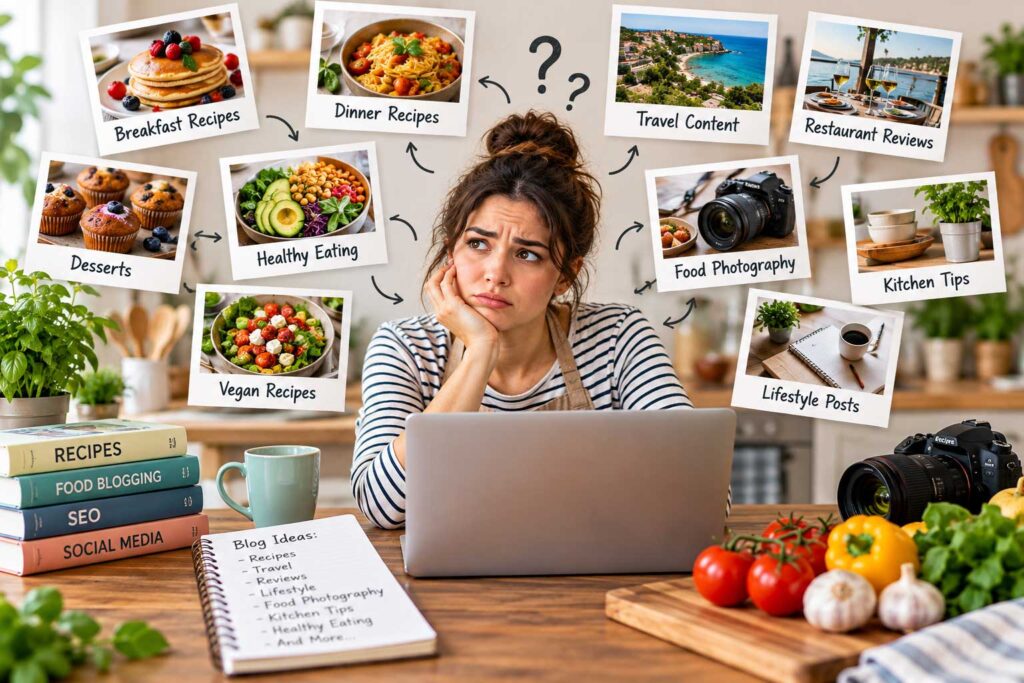
1. Choosing a Food Niche That Is Too Broad
One of the biggest mistakes new food bloggers make is trying to write about everything.
It can be tempting to publish breakfast recipes one day, restaurant reviews the next, followed by travel content, kitchen organization tips, and a completely unrelated lifestyle post.
The problem is that a new blog is much easier to build when readers can quickly understand what you specialize in and your content consistently covers related topics.
Instead of trying to cover every type of food content, start with a more focused direction.
| Niche Direction | Example Content |
|---|---|
| Easy weeknight dinners | Quick meals, one-pan dinners, family recipes |
| Balkan recipes | Bulgarian, Serbian, Greek, Romanian, and other regional dishes |
| High-protein meals | Breakfasts, lunches, dinners, and snacks |
| Air fryer recipes | Chicken, vegetables, appetizers, and desserts |
| Vegan desserts | Cakes, cookies, puddings, and no-bake recipes |
| Mediterranean recipes | Salads, dips, grilled dishes, seafood, and breads |
You can always expand into related topics later.
A focused niche also makes content planning much easier. Instead of constantly wondering what to publish next, you can build groups of closely related articles around the same subject.
For example, a Mediterranean food blog could cover hummus, tzatziki, grilled chicken, Greek salad, roasted vegetables, dips, breads, and meal-prep ideas. Those articles naturally support one another and give readers more reasons to explore the site.
Avoid Choosing a Niche That Is Too Narrow
There is also such a thing as becoming too specific.
A blog focused entirely on one extremely limited ingredient or tiny recipe category may eventually leave you struggling to find useful new topics.
Before committing to a niche, make a rough list of future recipe and article ideas. If you quickly run out of meaningful topics, the niche may be too narrow.
The strongest food blog niches are focused enough to give the site a clear identity but broad enough to leave room for growth.
Build Around Topics, Not Random Recipes
Instead of publishing unrelated recipes whenever inspiration strikes, build small content clusters around important topics.
For example, if you publish a recipe for homemade pizza dough, you could also create:
- How to freeze pizza dough
- Best flour for pizza dough
- How long pizza dough lasts in the fridge
- Homemade pizza sauce
- Pizza dough troubleshooting tips
- Best pizza toppings
- How to reheat pizza
This gives you a connected group of useful articles rather than a collection of random posts.
Your niche does not have to limit your creativity. It simply gives your food blog a clearer direction and helps readers understand what they can expect when they return.
2. Picking the Wrong Domain Name
Your domain name is one of the first major decisions you will make when starting a food blog, and changing it later can be a hassle.
A good domain should be easy to remember, easy to spell, and flexible enough to grow with your website.
Avoid names that are overly long, confusing, difficult to pronounce, or filled with numbers and hyphens. If someone hears your domain name in a conversation, video, or podcast, they should ideally be able to remember it and type it correctly later.
For example, a name such as EasyFamilyMeals.com is much easier to remember than something like Best-Easy-Family-Recipes-247.com.
Do Not Make the Name Too Restrictive
Another common mistake is choosing a domain that locks you into an extremely narrow topic.
If you name your website something like OnlyChickenSoupRecipes.com, expanding later into baking, desserts, or general dinner recipes may feel awkward.
A slightly broader brand gives you room to evolve. Think about where you might want the blog to be several years from now, not just what you plan to publish during the first few months.
Check the Name Before Buying
Before registering a domain, check whether:
- The name is already associated with an established brand
- Matching or similar social media usernames are available
- The domain is easy to spell and pronounce
- It could easily be confused with another website
- The name would still make sense if your content expands
If a good .com version is available, it is often the simplest choice because readers already recognize the extension.
You also do not need to force an exact keyword into your domain name. A memorable brand is usually more useful than forcing phrases such as “best recipes” or “healthy food blog” into the URL.
Choose a name you can build a recognizable brand around. Your domain may eventually appear on recipe cards, Pinterest graphics, newsletters, social profiles, videos, cookbooks, and other products, so it should still feel right as your food blog grows.
3. Choosing Hosting Based on Price Alone
It is understandable to look for affordable hosting when you are starting a food blog.
The problem is not necessarily choosing a low-cost plan. The real mistake is choosing hosting based only on price without considering performance, support, backups, security, and how easily the plan can grow with your site.
Food blogs can become fairly demanding because recipe posts often include large images, recipe cards, ads, videos, analytics scripts, and other features that add weight to a page.
An entry-level hosting plan may work perfectly well when your blog is small, but you should have an easy upgrade path as your traffic, images, and site features grow.
What to Look for in a Hosting Provider
When comparing hosting companies, look beyond the monthly price.
A good host should offer reliable uptime, solid performance, SSL, backups, useful security features, responsive support, and enough resources for your current site.
It is also worth checking how easy it is to restore a backup, upgrade your plan, or move to a more powerful server later.
You may start with affordable shared or managed WordPress hosting and upgrade only when your traffic and revenue justify the additional cost.
Website Speed Can Affect More Than SEO
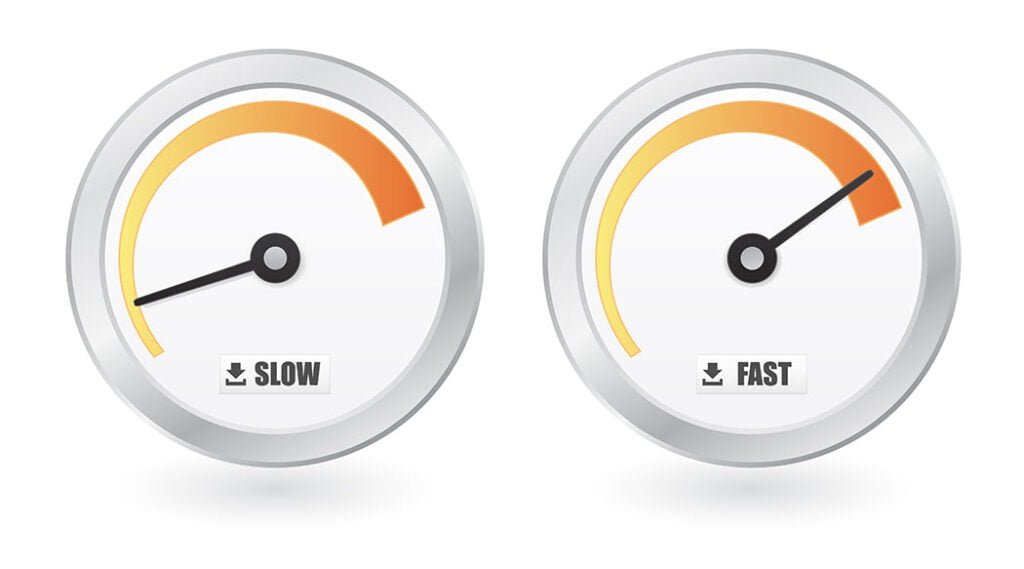
Slow hosting does not only create a technical SEO issue. It can also frustrate readers.
Imagine someone standing in the kitchen trying to pull up a dinner recipe on their phone. If your page takes several seconds to load while another recipe appears almost instantly, they may simply leave and use the faster site.
Good hosting is only one part of website performance, but it provides the foundation for everything else.
Image optimization, caching, your WordPress theme, plugins, advertisements, and third-party scripts can all affect loading speed too.
The goal is not to buy the most expensive hosting available. It is to choose reliable hosting that gives your food blog enough performance, support, and room to grow.
If your website regularly goes offline, loads painfully slowly, or getting support is difficult when something breaks, saving a few dollars each month probably is not worth it.

4. Choosing the Wrong Blogging Platform or Website Setup
Your blogging platform affects how much control you have over your website, how easily you can optimize it, and how well it can grow with your business.
One common mistake is choosing a platform simply because it looks easy or free at the beginning without thinking about what you may need later.
As your food blog grows, you may want to add recipe cards, display ads, affiliate links, email forms, advanced SEO tools, custom designs, analytics, and other features.
That is why it helps to think beyond your first few months. If you are still comparing your options, see our guide to the best blogging platforms for food bloggers before choosing your setup.
WordPress Is Still a Strong Choice for Food Bloggers
Self-hosted WordPress remains a flexible option for food bloggers because it gives you control over your hosting, design, plugins, content, and monetization setup.
It also works with a wide range of tools for recipe cards, SEO, caching, email marketing, affiliate links, advertising, analytics, and other features commonly used by food websites.
That flexibility is a major advantage, but WordPress is not automatically the right choice for everyone simply because it is popular.
You still need reliable hosting, a well-built theme, regular updates, backups, security, and some basic maintenance.
Be Careful With Free Website Builders
A free website builder can be perfectly fine if you are experimenting or simply want a place to start publishing.
The limitations become more noticeable when you want to turn your food blog into a business.
Depending on the platform, you may have less control over design, monetization, SEO settings, redirects, advertising, integrations, or even how your content is structured.
Moving a large recipe library later can also become much more complicated than choosing a scalable setup from the beginning.
Before selecting a platform, think about what you may want your site to do two or three years from now.
If your goal is to build traffic, grow an email list, work with brands, earn money, and eventually turn your food blog into a larger business, choose a setup that can support those plans.
Your first website does not have to be perfect, but it should give you room to improve without forcing you into a complete rebuild shortly after launch.
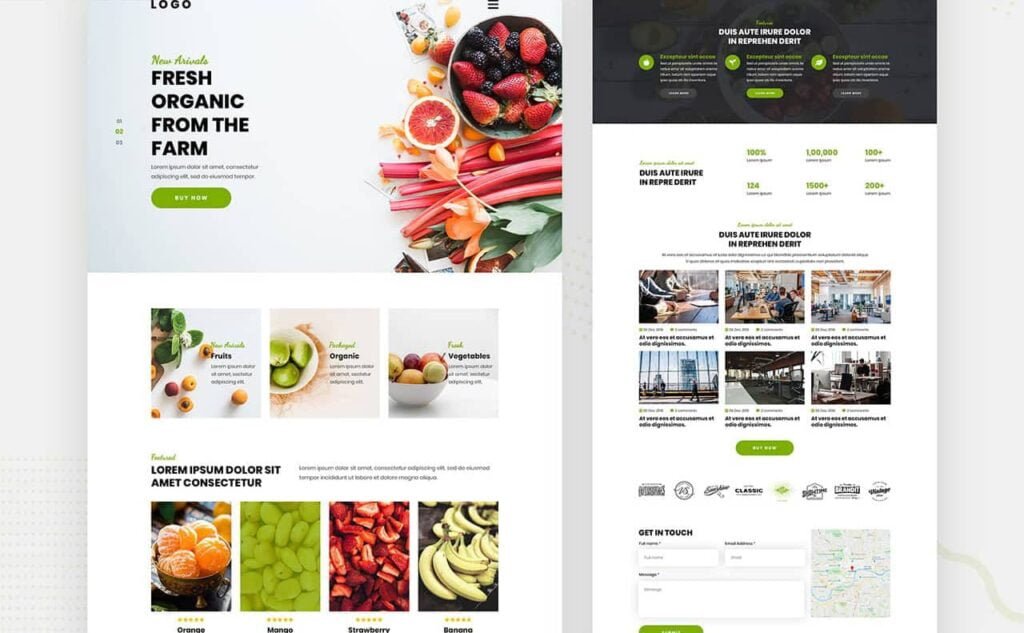
5. Choosing the Wrong WordPress Theme
A beautiful food blog is important, but design should never come at the expense of speed, usability, or readability.
One of the most common beginner mistakes is choosing a WordPress theme mainly because the demo looks impressive.
A theme may include large animations, sliders, oversized images, and dozens of visual effects, but that does not automatically make it a good fit for a recipe website.
For food bloggers, the better choice is usually a theme that is fast, clean, mobile-friendly, easy to navigate, and built to keep the focus on the recipes.
What to Look for in a Food Blog Theme
Before installing a theme, check whether it performs well on mobile, uses readable typography, works smoothly with your recipe plugin, and makes categories, archives, and individual posts easy to browse.
It should also receive regular updates and work with current versions of WordPress.
Customization matters too, but you should not need excessive code or a pile of extra plugins just to make basic design changes.
Your theme should make your content easier to use, not compete with it.
Avoid Overly Complicated Designs
Food blogs already tend to load a lot of visual content.
Recipe photos, ads, recipe cards, videos, Pinterest graphics, email forms, and related-post sections can all add weight to a page.
Adding a bloated theme on top of that can make the site feel unnecessarily heavy.
A simple layout with strong photography often looks more professional than a site packed with animations and decorative elements.
Think About the Mobile Experience First
Many readers will discover and use your recipes on a phone, so mobile usability should be part of your theme decision from the beginning.
Someone may be checking ingredients in a grocery store or following your recipe while cooking in the kitchen.
Navigation should be easy to use, text should be comfortable to read, buttons should be easy to tap, and important information should not be buried under unnecessary design elements.
Your website does not need to look complicated to look professional.
A clean, fast theme that puts your recipes, photography, and brand first will usually serve your food blog much better over the long term.
6. Installing Too Many WordPress Plugins
Plugins are one of the biggest advantages of WordPress because they let you add useful features without building everything from scratch.
The problem starts when new bloggers install a plugin for every small feature they want.
Over time, that can lead to unnecessary scripts, duplicated functionality, compatibility problems, security risks, and slower page loading.
The issue is not simply the number of plugins you use.
A site with 25 lightweight, well-maintained plugins can sometimes perform better than one with 10 poorly optimized plugins.
What matters more is whether each plugin serves a clear purpose and is actively maintained.
Only Install Plugins That Serve a Clear Purpose
Before adding a plugin, check whether your theme or another existing plugin already handles the same job.
Also look at how recently the plugin has been updated, whether it is compatible with your version of WordPress, and whether the developer still provides support.
If two plugins are doing nearly the same thing, or you no longer remember why one was installed, it is probably time to review your setup.
Remove Plugins You No Longer Use
Deactivating an old plugin and leaving it installed indefinitely is not a great habit.
Review your plugin list occasionally and remove anything you no longer use.
You should also keep active plugins updated because outdated plugins can create compatibility and security problems.
Be Careful With Overlapping Plugins
Another common mistake is installing several plugins that perform similar functions.
For example, you may accidentally have multiple plugins handling caching, image optimization, SEO, redirects, or security.
That can create conflicts, duplicate settings, and unnecessary work.
For a food blog, your plugin setup will usually cover a few core needs such as recipe formatting, SEO, performance, backups, security, analytics, and email marketing.
Keep the setup as simple as your site allows.
If you cannot explain what a plugin is doing for your site, it is worth asking whether you still need it.
For more practical options, see our best tools for food bloggers.
7. Ignoring SEO Until Later
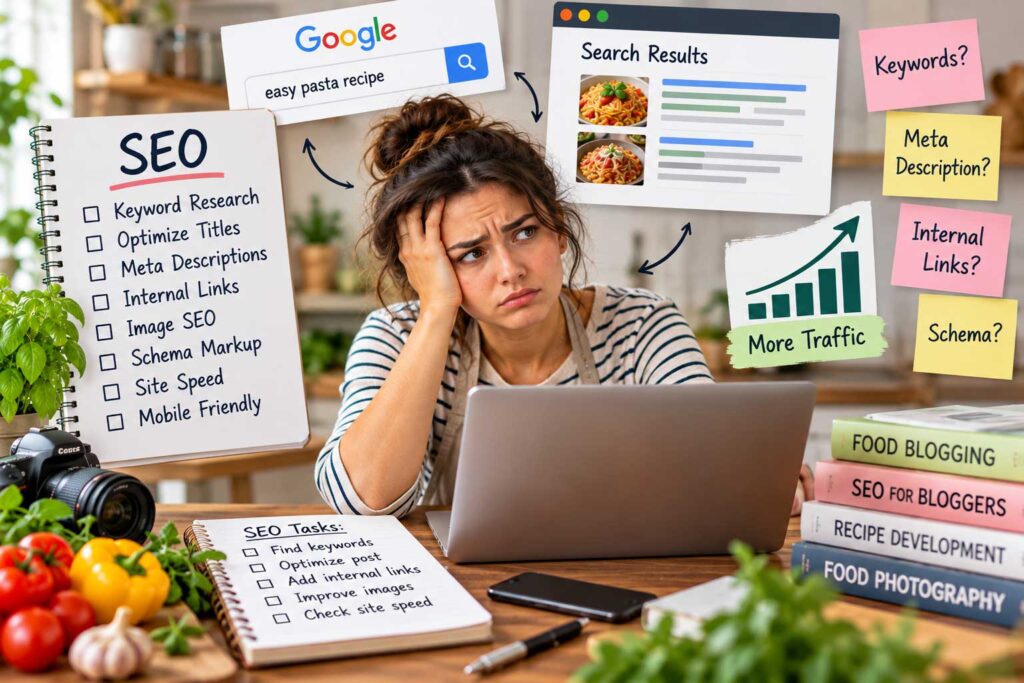
A common mistake among new food bloggers is treating SEO as something they can worry about after publishing dozens of recipes.
That usually creates more work later.
You do not need to become an SEO expert before publishing your first post, but it helps to understand a few basic principles from the beginning.
If you are just getting started with keyword research, see our guide to the best free keyword tools for food bloggers.
Start With Search Intent
Before writing a recipe or food-related article, think about what someone is actually trying to find.
For example, a person searching for easy chicken dinner ideas wants something very different from someone searching for how long to bake chicken breast at 400°F.
The page should give that person the kind of answer they came looking for.
That means your title, introduction, headings, recipe instructions, FAQs, and supporting information should all help answer the reader’s main question.
Avoid Writing Only for Search Engines
SEO does not mean repeating the same keyword in every paragraph.
Your writing should still sound natural and be useful to a real person.
Instead of forcing one phrase over and over, cover the topic thoroughly and include related information where it makes sense.
For a recipe post, that might include ingredient substitutions, cooking time, storage, reheating, serving suggestions, and common mistakes.
Use Internal Links Naturally
Over time, those connections can turn a collection of individual posts into a much stronger content library.
You can also use Google Search Console to see which search queries are already generating impressions and clicks for your site.
For more SEO resources, see our guide to the best SEO tools for food bloggers.
Do Basic On-Page SEO From the Start
Before publishing, make sure each important post has a clear title, descriptive URL, useful headings, optimized images, internal links, and a strong meta description.
The page should also be easy to read on mobile and load without unnecessary delays.
SEO is much easier when you think about it while planning the post instead of trying to repair everything after publishing.
8. Publishing Recipes Without Enough Helpful Information
A recipe post should do more than list ingredients and instructions.
New food bloggers sometimes publish recipes that technically explain how to make the dish but still leave readers with important unanswered questions.
That can make the recipe harder to follow and less useful than it needs to be.
Think About What the Reader Needs Before Cooking
Before publishing, think about the questions someone might have while making the recipe.
Depending on the dish, that could include ingredient substitutions, recommended equipment, preparation tips, cooking temperature, storage, freezing, reheating, serving suggestions, or how to tell when the dish is done.
You do not need to add extra paragraphs simply to make a recipe longer.
The goal is to include information that genuinely helps someone make the dish successfully.
Explain Important Steps Clearly
Instructions such as “cook until done” or “bake until ready” do not give the reader much guidance.
Whenever possible, include practical signals they can actually use.
Instead of writing:
Bake until golden.
A clearer instruction would be:
Bake for about 20 to 25 minutes, or until the top is lightly golden and the center is cooked through.
Small details like timing, texture, color, and doneness can make a recipe much easier to follow, especially for someone making it for the first time.
Include a Proper Recipe Card
A structured recipe card makes the most important information easy to find.
It should clearly show the ingredients, instructions, preparation and cooking times, servings, and any notes that are important for getting the recipe right.
Readers should not have to search through the entire article just to find ingredient quantities or basic cooking instructions.
Do Not Add Filler Just to Increase Word Count
There is a difference between useful supporting information and content added only to make the article longer.
A personal story can absolutely belong in a recipe post when it adds context, personality, family history, or something meaningful about the dish.
The problem is making readers dig through unrelated information when they are simply trying to understand the recipe.
The strongest recipe posts give readers enough context to cook with confidence while still making the actual recipe easy to find and use.
9. Using Poor-Quality Food Photography
Photography is often the first thing a reader notices about a recipe.
You can have an excellent dish, but if the photos are dark, blurry, poorly framed, or unappetizing, readers may never give the recipe a chance.
The good news is that you do not need an expensive camera setup to create attractive food photos.
Modern smartphones can produce excellent results when you combine good lighting, thoughtful composition, and basic editing.
Natural Light Makes a Huge Difference
One of the easiest ways to improve food photography is to use soft natural light.
Try photographing near a window instead of relying on harsh overhead kitchen lights.
Avoid mixing different light sources whenever possible, because that can create strange color casts and make the food look less natural.
Keep the Background Simple
Your food should remain the focus of the image.
You do not need a table full of props for every photo. A simple plate, neutral background, napkin, cutting board, or a few ingredients can often create a cleaner and more professional result.
Too many decorative elements can make the photo feel cluttered and distract from the dish itself.
Show the Recipe From More Than One Angle
Do not rely on a single photo for the entire recipe.
A finished hero image is important, but a close-up can show texture, an overhead shot can show the full dish, and a few process photos can help explain unfamiliar steps.
The exact combination depends on the recipe. A simple smoothie may need only a few finished photos, while bread, pastry, or a more technical dish may benefit from step-by-step images.
Optimize Images Before Uploading Them
Large image files can slow down your website, so resize and compress photos before or during upload and use modern image formats when your setup supports them.
Give image files descriptive names before uploading them instead of leaving names such as IMG_4827.jpg.
For example, homemade-chicken-parmesan.jpg tells you what the image contains at a glance.
You should also write meaningful alt text when an image needs a text alternative. Avoid forcing keywords into alt text simply for SEO.
Strong food photography can help recipes stand out on your website, in search results, on Pinterest, and across social media.
Your photos do not need to look like they came from a professional cookbook. They just need to make the dish look clear, appealing, and worth trying.

10. Not Building an Email List From the Beginning
You do not need thousands of visitors before starting an email list.
Even a small food blog can begin collecting subscribers from the readers it already has.
Social media followers are valuable, but those audiences live on platforms you do not control. Algorithms change, reach can drop, and accounts can lose visibility unexpectedly.
An email list gives you a more direct way to stay connected with people who already enjoy your recipes.
Give Readers a Reason to Subscribe
A basic “Join my newsletter” form can work, but a useful free resource often gives readers a stronger reason to sign up.
For a food blog, that might be a simple meal plan, printable grocery list, baking conversion chart, seasonal recipe collection, or short recipe e-book.
The offer should fit the kind of content you already publish.
If your blog focuses on quick family dinners, for example, a printable weeknight meal plan makes much more sense than an unrelated general cookbook.
Make Your Emails Useful
Do not treat your email list only as a place to send links to new posts.
Give subscribers a reason to keep opening your emails.
You might share a favorite recipe of the week, seasonal meal ideas, cooking tips, ingredient substitutions, kitchen shortcuts, or a small collection of recipes built around a theme.
The goal is to make your emails useful enough that subscribers are happy to hear from you.
Place Signup Forms Where Readers Can See Them
Add signup forms in natural places such as within articles, at the end of recipes, on your homepage, or on a dedicated signup page.
Just avoid overwhelming visitors with too many pop-ups and competing messages.
Starting with a small list is completely normal.
Even a small subscriber list can be valuable because those readers have already chosen to hear from you again.
The earlier you start building that relationship, the more valuable your email list can become as your food blog grows.
Give Readers a Clear Next Step
Do not let every article end without giving the reader somewhere to go next.
A simple call-to-action might invite someone to join your email list, read a related recipe, download a meal plan, leave a comment, or explore another useful guide.
The call-to-action should match the page rather than feel forced. For example, a reader finishing a weeknight dinner recipe may be more interested in another easy dinner or a weekly meal plan than in following five different social media accounts.
You do not need multiple competing calls-to-action on every page. One clear next step is often enough.
11. Relying Too Heavily on Social Media for Traffic
Social media can be a powerful way to promote a food blog, but relying on it as your main source of traffic is risky.
Platforms change constantly. Algorithms shift, organic reach can decline, and a strategy that works well today may become much less effective later.
That does not mean you should ignore social media. It simply means your blog should not depend on one platform for most of its visibility.
Diversify Where Your Traffic Comes From
Try to build traffic from more than one place.
That might include Google Search, Pinterest, email newsletters, Instagram, Facebook, YouTube, direct visitors, and referral traffic from other websites.
You do not need to master every channel at once.
Start with the ones that best fit your content and audience, then expand gradually as you learn what actually sends useful traffic to your site.
Pinterest Can Be Useful for Food Content
Pinterest can be a strong fit for recipes, seasonal ideas, meal planning, baking, and other visual food content.
Results vary by niche, but well-designed pins can help recipes reach people who are actively looking for ideas.
For important posts, you can test more than one pin design over time and compare which images and headlines earn the most clicks.
Do Not Build Only for Followers
A large follower count can look impressive, but it does not always translate into meaningful traffic or engagement.
A smaller audience that regularly visits your website, joins your email list, saves recipes, and returns for more content can be far more valuable than a much larger but passive following.
Use social media to support your blog, not replace it.
Your website should remain the central place where your recipes, email list, affiliate content, advertising, and brand can grow over time.

12. Publishing Without a Consistent Content Plan
Another common mistake is publishing only when inspiration strikes.
That often leads to long gaps, random topics, and a website that grows without a clear direction.
You do not need to publish every day. What matters more is having a realistic schedule you can actually maintain.
Create a Simple Editorial Calendar
Planning a few weeks or months ahead can make content creation much easier.
The right workflow can make this much easier, especially when you are managing recipes, SEO, images, and promotion at the same time.
See our best tools for food bloggers for more options.
A food blog calendar might mix evergreen recipes with seasonal dishes, holiday content, recipe roundups, cooking tutorials, ingredient guides, product-related posts, and other topics that support your main niche.
Planning ahead is especially useful for seasonal content.
For example, Thanksgiving recipes should not first appear a few days before Thanksgiving. Publishing or updating them earlier gives both readers and search engines more time to discover the content before interest peaks.
Quality Matters More Than Publishing Every Day
New bloggers sometimes assume they need to publish as much as possible.
That can lead to rushed recipes, weak photography, thin content, and posts that never receive the attention they need.
One strong recipe with clear instructions, original photos, useful tips, internal links, and solid SEO can be much more valuable than several rushed posts.
Choose a schedule you can sustain without sacrificing quality. That might mean two posts per week, one per week, or another pace that fits your available time.
Update Older Content Too
Your content calendar should not focus only on new posts.
Older recipes may benefit from better photos, clearer instructions, stronger internal links, improved titles, updated recipe cards, refreshed SEO, or broken-link fixes.
If an older post already has impressions, backlinks, Pinterest traffic, or decent rankings, improving it may be a better use of your time than starting another article from zero.
Consistency is not about constantly producing more content. It is about steadily improving your website and publishing useful content with a clear purpose.
13. Ignoring Website Speed and Core Web Vitals
A beautiful recipe blog can still lose readers if it feels slow.
Food websites are especially vulnerable because they often contain large images, recipe plugins, display ads, videos, tracking scripts, pop-ups, and other elements competing for resources on the same page.
If pages take too long to load or shift around while someone is trying to read a recipe, the experience quickly becomes frustrating.
Keep Recipe Pages Lightweight
Some of the biggest performance problems come from things that seem harmless individually.
Large uncompressed images, autoplay videos, too many fonts, unnecessary scripts, bloated page builders, and poorly optimized ads can all add up.
Focus on the basics first: properly size and compress images, use caching, remove plugins and scripts you no longer need, choose a lightweight theme, and keep pop-ups and animations under control.
You do not need to strip every feature from the site. The goal is simply to avoid making each recipe page heavier than it needs to be.
Pay Attention to Core Web Vitals
Core Web Vitals give you one way to spot usability problems such as slow loading, delayed interaction, and content that shifts unexpectedly while the page loads.
Google’s page experience guidance also recommends looking at the overall experience rather than chasing a perfect score for a single metric.
For a recipe site, layout shifts can be particularly annoying.
A reader may be trying to tap the “Jump to Recipe” button when an advertisement or image suddenly loads and moves everything on the page.
Do not chase a perfect performance score while ignoring how the site actually feels to use.
Test Your Site on a Real Phone
Do not judge your website only from a fast desktop computer.
Open several recipe posts on your phone and use them the way a reader would.
Can you find the recipe quickly? Does the page scroll smoothly? Are pop-ups easy to close? Do ads cover important content? Are the ingredient list and instructions comfortable to read?
Technical optimization matters, but the ultimate goal is simple: make your food blog fast and comfortable to use.
A reader who can quickly find and follow your recipe is much more likely to stay, explore another post, and return later.

14. Monetizing Without a Clear Strategy
There is nothing wrong with earning money from a new food blog.
The mistake is adding ads, affiliate links, sponsored products, and promotional banners without thinking about how they fit the reader experience or your long-term business.
Monetization works best when it supports useful content instead of distracting from it.
Build Monetization Around Helpful Content
You can think about revenue from the beginning, but start with content that gives readers a reason to trust and return to your site.
As your blog grows, you may eventually earn through display advertising, affiliate marketing, sponsored content, digital cookbooks, meal plans, printable resources, courses, or brand partnerships.
You do not need to use every method.
Choose the ones that make sense for your niche, audience, and the type of content you already create.
Use Affiliate Links Naturally
Affiliate marketing can work well for food bloggers when the recommendation genuinely fits the content.
If affiliate marketing is part of your strategy, see our guide to the best affiliate programs for food bloggers for additional ideas.
That might include cookware, small appliances, baking tools, storage containers, ingredients, or cookbooks you use and would recommend anyway.
A blender link inside a smoothie recipe makes sense. Filling an unrelated article with product links simply because they pay a commission does not.
Clearly disclose affiliate relationships so readers understand when you may earn a commission from a purchase.
Do Not Sacrifice User Experience for Ads
Display advertising can become an important source of income as traffic grows, but too many ads can make a recipe frustrating to use.
Pay particular attention to the mobile experience.
Readers should still be able to find ingredients, follow instructions, scroll comfortably, and navigate the page without constantly closing overlays or accidentally tapping advertisements.
Think of Monetization as Part of the Business
Instead of asking only, “How can I make money from this post?” think about the role each piece of content plays in the larger site.
Some posts may primarily attract search traffic, while others can grow your email list, perform well on Pinterest, support affiliate recommendations, or lead readers toward a digital product.
Over time, several revenue streams can make a food blog less dependent on any one source of income.
You can monetize from the beginning when it makes sense. Just make sure the monetization supports the content rather than becoming the main reason the content exists.
15. Giving Up Too Soon
Food blogging usually takes longer to gain momentum than beginners expect.
A new site may publish useful recipes for months before search traffic begins to grow consistently. Pinterest can take time to gain traction, email lists start small, and affiliate income may be minimal at first.
That can be discouraging, especially when you compare a new blog with established food sites that have been publishing for years.
Do Not Expect Overnight Results
The established food blogs you see ranking today usually have years of recipes, updates, links, photography, audience growth, and experimentation behind them.
Growth often comes from dozens of small improvements over time. You publish better content, improve older posts, learn what attracts traffic, and gradually understand what your readers respond to.
Progress may feel slow at first, but those improvements can build on one another over time.
Track the Right Signs of Growth
Revenue should not be the only thing you watch in the beginning.
Use Google Search Console to watch impressions, clicks, search queries, and which pages are beginning to gain visibility.
You can also look for growing Pinterest traffic, new email subscribers, returning visitors, and a few posts beginning to outperform the rest.
Learn From the Content That Performs Best
You do not need every recipe to become successful.
If a handful of posts begin attracting most of your traffic, study them.
Look at the topic, search intent, photos, format, seasonality, internal links, and the questions those posts answer especially well.
Then create more useful content around the areas where you are already seeing traction.
Keep Improving Instead of Starting Over
It is easy to assume the solution is a new domain, another niche, a redesign, or an entirely new website.
Sometimes a change is necessary, but constantly starting over can prevent you from ever building momentum.
Give a good strategy enough time to work.
Keep publishing, improve what you already have, learn from your analytics, and adjust based on real results.
A successful food blog is rarely built from one viral recipe. It is usually the result of useful content, steady improvements, and staying with the project long enough for those efforts to add up.
Frequently Asked Questions About Food Blogging Mistakes
What is the biggest mistake new food bloggers make?
One of the biggest mistakes is publishing without a clear strategy. A new food blog is easier to grow when the niche, content plan, SEO, internal linking, and audience goals all work together.
How often should a new food blogger publish?
There is no perfect publishing schedule. A useful post published consistently is better than forcing yourself to publish frequently and sacrificing quality. Choose a pace you can realistically maintain.
How long does it take a food blog to get traffic?
Traffic growth varies widely from one food blog to another. Your niche, competition, content quality, SEO, promotion, and how consistently you improve the site can all affect how quickly traffic develops.
Can food bloggers still make money?
Yes. Food blogs can earn through display ads, affiliate marketing, sponsored content, digital products, meal plans, cookbooks, courses, and brand partnerships. The strongest monetization usually comes from useful content and an engaged audience.
Is WordPress good for food blogging?
Self-hosted WordPress is still a strong option because it gives food bloggers control over themes, recipe plugins, SEO, advertising, affiliate tools, email integrations, and site customization.
Should a new food blogger focus on Google or Pinterest?
Both can be useful, and they serve different purposes. Google can bring visitors searching for specific recipes and answers, while Pinterest can work well for visual, seasonal, and evergreen food content. It is usually better not to depend entirely on one traffic source.
Keep Growing Your Food Blog
Avoiding common food blogging mistakes is only the beginning. These guides can help you choose better tools, improve your SEO, and build a stronger foundation for your site:
- Best Blogging Platforms for Food Bloggers: Free & Paid Options
- Best Tools for Food Bloggers: 25+ Essential Blogging Tools
- Best Free Keyword Tools for Food Bloggers
- Best Affiliate Programs for Food Bloggers
These guides cover some of the next decisions that usually matter most once your food blog is up and running.
Final Thoughts: Build a Better Food Blog From the Start
Starting a food blog involves a lot of moving parts, so making a few mistakes along the way is normal.
You may choose the wrong tool, publish content that never gains traction, spend too much time on social media, or realize later that an older post needs a complete update.
What matters is noticing what is not working and making better decisions as the site grows.
Focus on useful recipes, a clear niche, strong photography, solid SEO, good site performance, and a content plan you can realistically maintain.
Early mistakes are much easier to fix when you catch them before the site becomes large.
A smaller collection of genuinely helpful recipes can give you a much stronger foundation than hundreds of posts published without a clear purpose.
Keep learning from your traffic, your readers, and the content that performs best. Then keep improving the site instead of chasing every new blogging tactic that comes along.
Keep improving what works, fix what does not, and give the blog enough time to grow.