
Getting traffic to a food blog can be frustrating, especially in the beginning. You may spend hours developing a recipe, testing it, taking photos, writing the post, and publishing it—only to find that very few people actually visit the page.
That is common for new and growing food blogs.
Traffic usually does not come from publishing a recipe and simply waiting for people to find it. In practice, food blog growth often comes from several sources working together, including Google Search, Pinterest, email, social media, referrals, and returning readers.
The good news is that you do not need a huge social following or a large advertising budget to start growing.
A well-optimized recipe can continue bringing visitors from Google long after it is published. A Pinterest pin can gain traction weeks or months later. An email subscriber can return whenever you publish something new. And one strong article can lead readers to several more pages across your site.
A more sustainable approach is to build several ways for readers to discover and return to your site.
In this guide, we will cover 30 practical ways to get traffic to your food blog, including SEO, keyword research, Pinterest, social media, email marketing, content updates, internal linking, and website optimization.
You do not need to use all 30 strategies at once. Start with the methods that make the most sense for your current stage, build a consistent publishing and promotion process, and expand your traffic sources as your food blog grows.
Where Does Food Blog Traffic Come From?
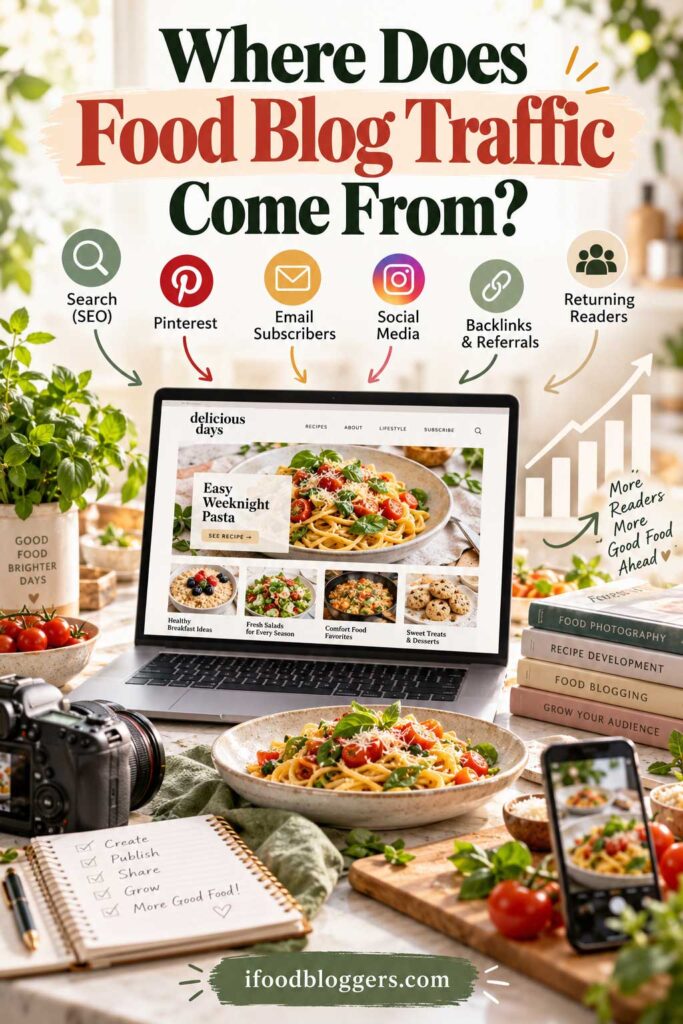
If you want to get traffic to your food blog, it helps to understand where those visitors can come from. Food blog traffic usually comes from a mix of search engines, visual discovery platforms, email, social media, referrals, and returning readers.
Google is often one of the most important sources because people actively search for recipes, cooking tips, ingredient substitutions, meal ideas, and answers to food-related questions.
Pinterest can also be especially valuable for food bloggers because users frequently search for recipes, seasonal dishes, desserts, meal-planning ideas, and cooking inspiration.
Other readers may discover your content through Instagram, TikTok, YouTube, backlinks from other websites, recipe communities, or recommendations from friends.
Then there is another type of traffic that becomes increasingly important as your site grows: returning visitors.
These are people who already know your blog. They may come back through an email newsletter, a saved bookmark, Pinterest, social media, or simply by searching for your website directly.
The strongest food blogs usually do not depend entirely on one traffic source.
Search rankings change, Pinterest traffic fluctuates, and social platforms regularly change how content is distributed.
Building several traffic channels gives your blog a more stable foundation and more opportunities for people to discover your recipes.
That is why the strategies below cover more than SEO alone. They are designed to help you attract new visitors from several different sources while also giving existing readers more reasons to return.
Affiliate Disclosure: Some links in this article may be affiliate links. If you make a purchase or sign up through one of these links, iFoodBloggers may earn a commission at no extra cost to you.
1. Target Long-Tail Food Keywords
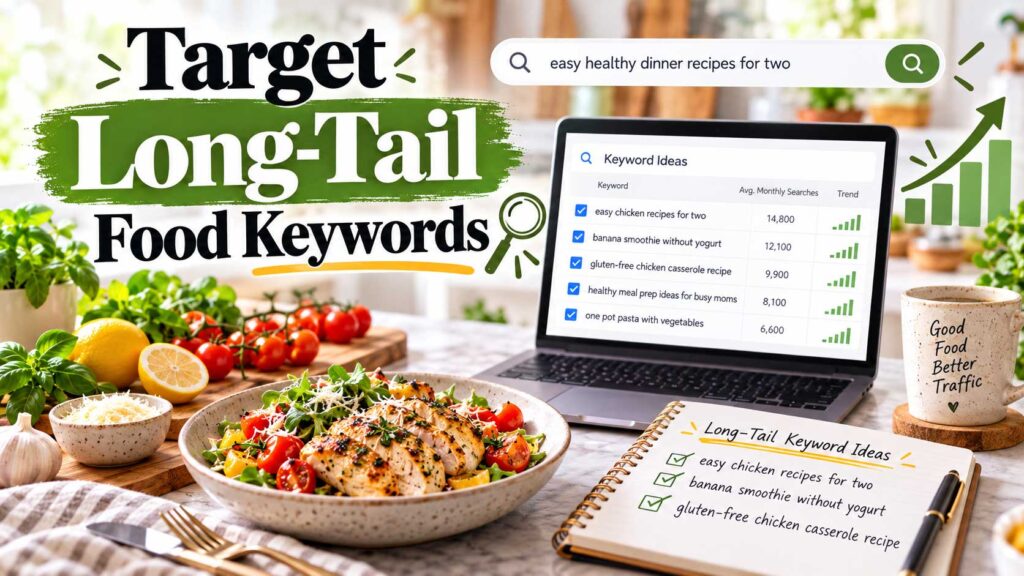
One of the most practical ways to get traffic to your food blog is to target long-tail keywords instead of competing immediately for broad, highly competitive search terms.
A keyword such as “chicken recipes” may attract a huge number of searches, but it is also extremely competitive. Large recipe websites with established authority often dominate those results.
A newer food blog usually has a better chance of ranking for more specific searches such as easy chicken recipes for two, healthy chicken dinner without dairy, air fryer chicken thighs without breading, quick chicken dinner for busy weeknights, or gluten-free chicken casserole recipe.
These searches may have lower volume individually, but they often have clearer intent.
Someone searching for air fryer chicken thighs without breading already has a very specific idea of what they want. If your recipe matches that need closely, you have a better chance of attracting the right visitor.
Long-tail keywords can also help you build stronger topical coverage over time.
Instead of publishing one broad article about smoothies, for example, you could create separate posts about high-protein smoothies, smoothies without bananas, breakfast smoothies, low-calorie smoothies, and smoothies for meal prep.
Those posts can link to one another and gradually build a larger smoothie content cluster on your site.
How to Find Long-Tail Keywords
Start with a broad recipe or food topic and look at the suggestions that appear as you type it into Google.
You can also find ideas in Google’s People Also Ask results, related searches, Google Search Console, Pinterest search suggestions, keyword research tools, reader questions, and relevant food communities.
The goal is not to find the keyword with the highest search volume.
Look for searches that closely match what people are actually trying to cook, learn, substitute, fix, or compare.
For example, instead of targeting:
banana smoothie
you may discover more specific opportunities such as:
banana smoothie without yogurt
or:
banana smoothie with peanut butter and oats
Those searches are narrower, but they may also be more realistic opportunities for a smaller or growing food blog.
Don’t Force Keywords Into Your Writing
Once you choose a target keyword, use it naturally.
You do not need to repeat the exact phrase throughout every paragraph.
Include it where it genuinely makes sense, such as in the title, introduction, URL, relevant headings, and image alt text when the image actually supports that description.
Then write the rest of the article for the reader.
You do not need to repeat the same exact phrase everywhere for a page to stay focused on its topic. Repeating the same keyword unnaturally can make your content harder to read without making it more useful.
The goal is to create the best answer for the search, not the page with the highest number of keyword repetitions.
For a growing food blog, dozens or hundreds of smaller search opportunities can eventually add up to substantial traffic.
That is often a much more realistic strategy than trying to compete for the biggest food keywords from day one.
2. Do Keyword Research Before Writing
If you want to get traffic to your food blog through search, keyword research should happen before you spend hours developing, photographing, and writing a recipe.
One of the most common mistakes food bloggers make is creating a post first and only thinking about SEO afterward.
Sometimes that works because the recipe happens to match something people are already searching for. But it leaves a lot to chance.
A better approach is to identify the search opportunity first, then create the strongest possible post around it.
For example, you may start with a general idea for a pasta salad recipe. A little research could reveal more specific opportunities such as pasta salad without mayo, Italian pasta salad for a crowd, healthy pasta salad for meal prep, or pasta salad with feta and cucumbers.
That information can influence how you position the recipe, which ingredients or variations you emphasize, and what questions you answer in the post.
Look Beyond Search Volume
High search volume can be attractive, but it should never be the only reason you choose a keyword.
A phrase with 20,000 searches per month may be extremely difficult to rank for, while a more specific search with far less volume could bring you traffic much sooner.
Look at the full opportunity.
How specific is the search? What type of pages already rank? Do smaller independent blogs appear in the results, or is the first page dominated by major publishers? Does the keyword match the recipe you actually want to create? Is demand seasonal? Most importantly, can you produce something genuinely more useful for the reader?
These questions matter even more for newer food blogs that are still building search visibility.
Check the Search Results Before You Write
Once you find a promising keyword, search it yourself.
Study the pages already ranking near the top and ask:
What does Google seem to think this person wants?
If nearly every result is a recipe, a long informational article may not be the right format.
If the results are mostly tutorials, comparisons, or guides, that points to a different type of search intent.
You should also look for weaknesses in the existing results.
Maybe the top recipes do not explain substitutions clearly. Perhaps the storage instructions are missing, the photographs are poor, the steps are confusing, or important reader questions are left unanswered.
Those gaps can help you make your own article more useful rather than simply creating another version of what already exists.
Keyword research becomes much easier when you have the right workflow and tools. Our best free keyword research tools for food bloggers guide explains several ways to research topics before you start writing.
Use Keyword Research to Build a Content Plan
Keyword research becomes even more useful when you use it to plan groups of related articles instead of choosing topics one post at a time.
For example, a food blog gaining traction with air fryer recipes could expand into air fryer chicken breast, chicken thighs, chicken wings, frozen chicken, chicken tenders, and recipes without breading.
Each article can target a different search intent while supporting the same broader topic.
Over time, this creates a deeper content library around subjects your audience is already interested in.
The strongest food blog content calendars are not based only on what sounds interesting to publish.
They combine your own recipes and expertise with evidence of what people are actively searching for.
3. Create High-Quality Recipe Content
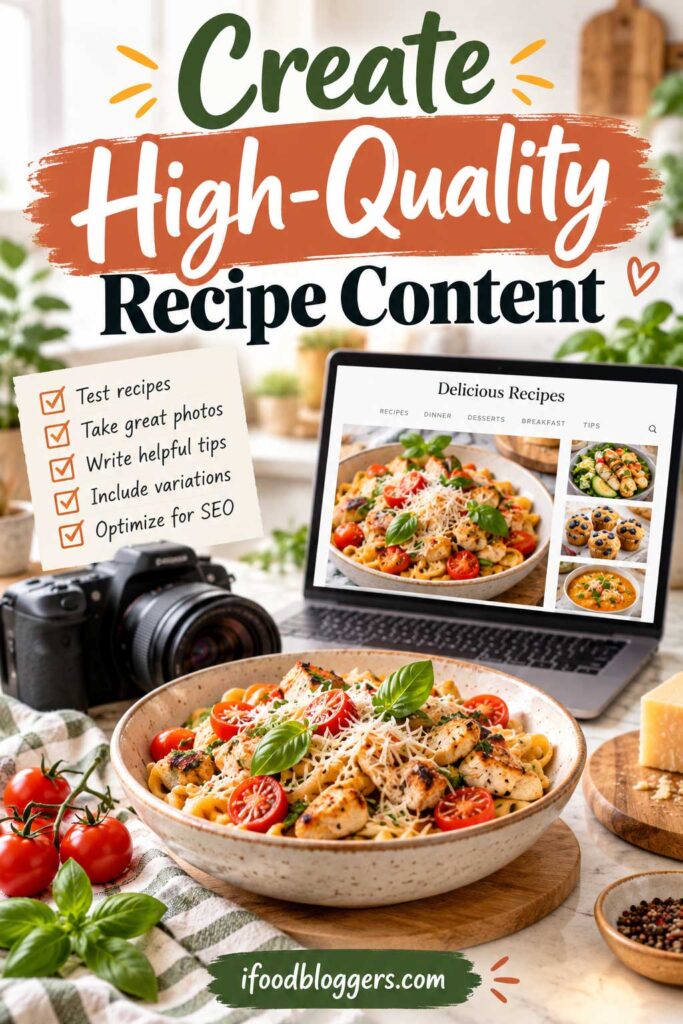
Getting traffic is not only about choosing the right keyword. Your content also needs to be useful enough that readers want to stay, make the recipe, and come back to your site again.
For food bloggers, that means going beyond a short introduction followed by a recipe card.
A strong recipe post should help someone successfully make the dish from start to finish. Clear instructions matter, but so do the details that prevent confusion along the way.
Make the Recipe Easy to Follow
Readers should not have to dig through a long article to understand what to do next.
Explain the details that can make a real difference in the kitchen. That might include which ingredients can be substituted, how to tell when the dish is done, common mistakes to avoid, whether ingredients should be at room temperature, how far ahead the recipe can be prepared, and how leftovers should be stored or frozen.
These details make the post more useful and can naturally help you cover related searches without forcing extra keywords into the article.
Add First-Hand Experience
Generic recipe content is easy to create. First-hand experience is much harder to replace.
If you tested a recipe several times before getting the texture right, explain what changed.
If one ingredient works better than another, tell readers why.
If the dish can easily dry out, burn, separate, or become too thick, give readers a specific sign to watch for.
Small details like these make a recipe feel as though it was written by someone who actually cooked it.
Clear writing matters too. If you want to improve your editing and content workflow, see our guide to the best writing tools for food bloggers.
Instead of writing:
Bake until done.
you could say:
Start checking the muffins a few minutes before the suggested baking time. They are ready when the tops spring back lightly when pressed and a toothpick inserted into the center comes out with only a few moist crumbs.
That is far more useful to someone standing in the kitchen trying to decide whether to take the pan out of the oven.
Use Photos That Actually Help
Good food photography can improve the reader experience, but you do not need dozens of images in every recipe.
Use photos when they add useful information.
A finished-dish photo shows readers what they are aiming for. A step-by-step image can clarify the correct consistency of a batter, dough, sauce, or filling. A close-up can show the texture inside bread, cake, meat, or another dish where appearance matters.
The purpose of the image should be to help the reader understand the recipe, not simply make the article longer.
Answer the Questions Readers Are Likely to Have
Before publishing, think about what might stop someone from making the recipe successfully.
A reader making bread may wonder why the dough did not rise. Someone making a smoothie may need an alternative to banana or dairy. A person using an air fryer may want to know whether cooking times vary between models.
Answering those questions can make the article more complete while also helping you naturally cover additional search queries.
Quality Supports More Than Google Traffic
High-quality recipe content can help across several traffic channels.
A genuinely useful recipe is more likely to be saved on Pinterest, shared with friends, linked to by another website, revisited by an email subscriber, or promoted through social media.
That is why content quality should be treated as part of your traffic strategy rather than something separate from it.
Getting the click is only the beginning.
The longer-term goal is to create a food blog that readers find useful enough to remember, trust, and visit again.
4. Optimize Every Post for Search Intent
Choosing the right keyword is important, but your article also needs to match why someone is searching for that keyword in the first place.
This is known as search intent.
Two keywords can look similar while requiring completely different types of content.
Someone searching for best blender for smoothies is probably looking for a comparison or buying guide.
Someone searching for how to make a strawberry smoothie wants a recipe or tutorial.
And someone searching for are smoothies healthy is looking for information.
If you create the wrong type of page for the search, it can be difficult to rank even if the content itself is well written.
Check What Already Ranks
One of the easiest ways to understand search intent is to look at the current search results.
Pay attention to the types of pages appearing near the top. Are most of them recipes, tutorials, product comparisons, informational guides, videos, or category pages?
You do not need to copy what is already ranking, but the results can give you a strong clue about what Google believes users want from that search.
If nearly every result is a recipe, that usually tells you that a general informational article is not the best fit.
Match the Reader’s Main Goal Quickly
Once someone lands on your page, make it obvious that they found the right content.
For a recipe, readers usually want to know what the dish is, how difficult it is, how long it takes, which ingredients they need, whether substitutions are possible, and how to make it successfully.
Do not bury those answers under a long introduction that has little connection to the recipe.
Your personality and story can still be part of the post, but they should support the reader’s experience rather than delay the information they came for.
Cover the Important Supporting Questions
Matching search intent does not mean your article has to be short.
A detailed post can still perform well when every section supports the reader’s main goal.
For example, someone searching for how to make homemade pizza dough may also want to know which flour works best, how long the dough should rise, whether it can be refrigerated overnight, whether it can be frozen, why it keeps shrinking, and what temperature to use when baking the pizza.
Answering those questions makes the article more useful without pulling it away from the original search intent.
Avoid Adding Sections Just for SEO
It can be tempting to squeeze every related keyword you find into one post.
That often makes the article feel unfocused.
If a question deserves a detailed answer of its own, it may be better to cover it in a separate article and link to it naturally.
For example, your main chocolate chip cookie recipe probably does not need a 1,000-word explanation of every type of flour.
You could answer the most relevant flour question briefly and link to a separate guide about the best flour for cookies.
That keeps the recipe focused while also helping you build stronger supporting content around the topic.
The goal is simple: when someone searches for a topic and lands on your food blog, the page should make them feel that they found exactly what they were looking for.
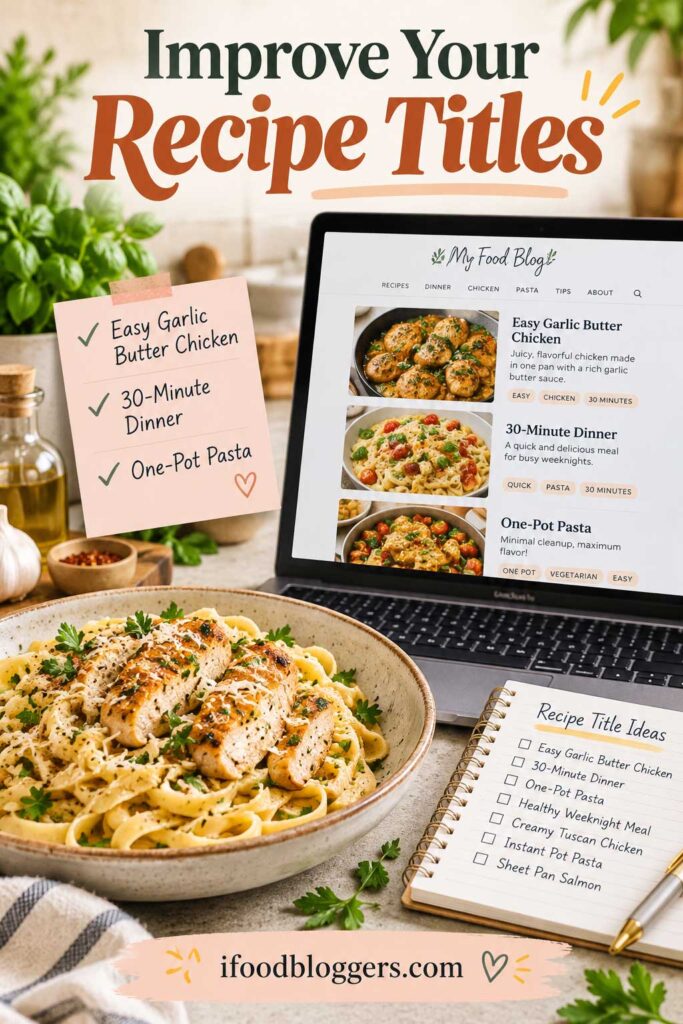
5. Improve Your Recipe Titles
Your recipe title has a major impact on whether people click your post in Google, Pinterest, social media, or even from another page on your own website.
A weak title may describe the recipe accurately but still fail to stand out.
For example, Chicken Pasta is clear, but it gives the reader very little reason to choose that result over dozens of similar recipes.
A stronger title such as Creamy Garlic Chicken Pasta in 30 Minutes or Easy One-Pot Chicken Pasta for Busy Weeknights tells the reader much more before they click.
Include the Main Keyword Naturally
Your primary keyword should usually appear in the title, especially when the post is built around search traffic.
If your target keyword is air fryer chicken thighs, a title such as Crispy Air Fryer Chicken Thighs in 25 Minutes keeps the main phrase intact while adding a useful benefit.
Avoid forcing extra keywords into the title just because an SEO tool suggests them.
A good title should still sound natural when a real person reads it.
Give the Reader a Clear Reason to Click
Strong recipe titles often highlight one useful benefit.
That might be speed, simplicity, convenience, meal-prep potential, beginner-friendliness, or the fact that the recipe uses only a few ingredients.
For example, 30-Minute Creamy Tomato Pasta immediately tells the reader that the recipe is relatively quick.
One-Pot Chicken and Rice highlights convenience.
Easy No-Bake Cheesecake tells the reader both the difficulty level and the cooking method.
The benefit should always be accurate. If a dish takes 90 minutes to prepare, calling it a quick dinner just to attract clicks will only hurt trust.
Specific Titles Usually Beat Vague Titles
Compare Chocolate Cake with Moist Chocolate Cake With Rich Chocolate Frosting.
Or compare Potato Soup with Creamy Potato Soup With Bacon and Cheddar.
The more specific version gives the reader a much clearer idea of what makes the recipe different.
That specificity can also help you target longer search phrases naturally.
Do Not Make Titles Too Long
Adding useful details is good, but there is a point where the title becomes cluttered.
Something like:
The Best Easy Delicious Creamy Homemade Garlic Parmesan Chicken Pasta Recipe for Dinner
looks more like a string of keywords than a useful title.
A cleaner version would be:
Creamy Garlic Parmesan Chicken Pasta
You can communicate additional benefits in the SEO title, meta description, introduction, and supporting headings.
Use Different Titles Where It Makes Sense
Your on-page recipe title does not always have to match your Pinterest pin headline or social media caption exactly.
For example, your article title might be:
Easy Blueberry Muffins
while a Pinterest pin promoting the same recipe could say:
Soft & Fluffy Blueberry Muffins You Can Make at Home
The recipe stays the same, but the promotional headline emphasizes a slightly different angle.
Testing different headline styles can help you learn what attracts your audience on different platforms.
Your recipe title is often one of the first things a potential visitor sees.
Make it clear, specific, accurate, and appealing enough to earn the click.
6. Write Better SEO Titles and Meta Descriptions
Your SEO title and meta description can influence whether someone chooses your result when it appears in Google.
They do not replace strong content, but they can make your search result clearer, more relevant, and more appealing.
For food bloggers, the goal is to describe the page accurately while giving searchers a good reason to click.
Write an SEO Title for the Search Result
Your SEO title can be slightly different from the visible title on the page.
For example, your article title might be:
Creamy Tomato Pasta
while the SEO title could be:
Creamy Tomato Pasta Recipe – Easy 30-Minute Dinner
The second version gives someone scanning Google more context before they click.
A strong SEO title usually includes the main keyword naturally, describes the recipe accurately, and highlights one useful detail such as preparation time, cooking method, or convenience.
Keep it readable.
Avoid cramming several variations of the same keyword into the title simply because an SEO plugin suggests them.
Make Your Meta Description Useful
The meta description is the short text that may appear below your title in search results.
Google may choose to display different text from the page, so you cannot control it completely. Even so, writing a useful description is still worthwhile.
Instead of:
This is a recipe for creamy tomato pasta. Read more here.
you could write:
Make this creamy tomato pasta in about 30 minutes with simple ingredients. Includes easy substitutions, storage tips, and step-by-step instructions.
The second version tells the reader much more about what they will find after clicking.
Focus on Clarity, Not Clickbait
Avoid titles and descriptions that make exaggerated promises.
Phrases such as The Only Recipe You Will Ever Need or This Recipe Will Change Your Life may attract attention, but they can also make the result feel less trustworthy.
A specific benefit is usually stronger.
For example:
One-Pot Creamy Garlic Pasta Ready in 25 Minutes
immediately tells the reader what the recipe is and why it may be useful.
Give Every Important Page Unique Metadata
Every important recipe or article on your food blog should have its own SEO title and meta description.
If dozens of pages use nearly identical wording, you miss an opportunity to show what makes each one different.
This becomes especially important as your site grows and you begin publishing many recipes within the same category.
A chicken soup, potato soup, and tomato soup post should not all use nearly identical titles and descriptions.
Each one should reflect the specific recipe and the reason someone might choose it.
Review Older Posts Too
Do not limit this strategy to new content.
Google Search Console can help you find pages receiving plenty of impressions but relatively few clicks.
Sometimes the article is already visible in search results, but the title is too vague to attract attention.
For example, changing:
Easy Soup Recipe
to:
Easy Creamy Potato Soup With Bacon – Ready in 40 Minutes
gives potential readers far more information before they visit the page.
Small improvements like these may not look dramatic on a single post, but across dozens or hundreds of articles, better titles and descriptions can create more opportunities to turn search impressions into actual visitors.
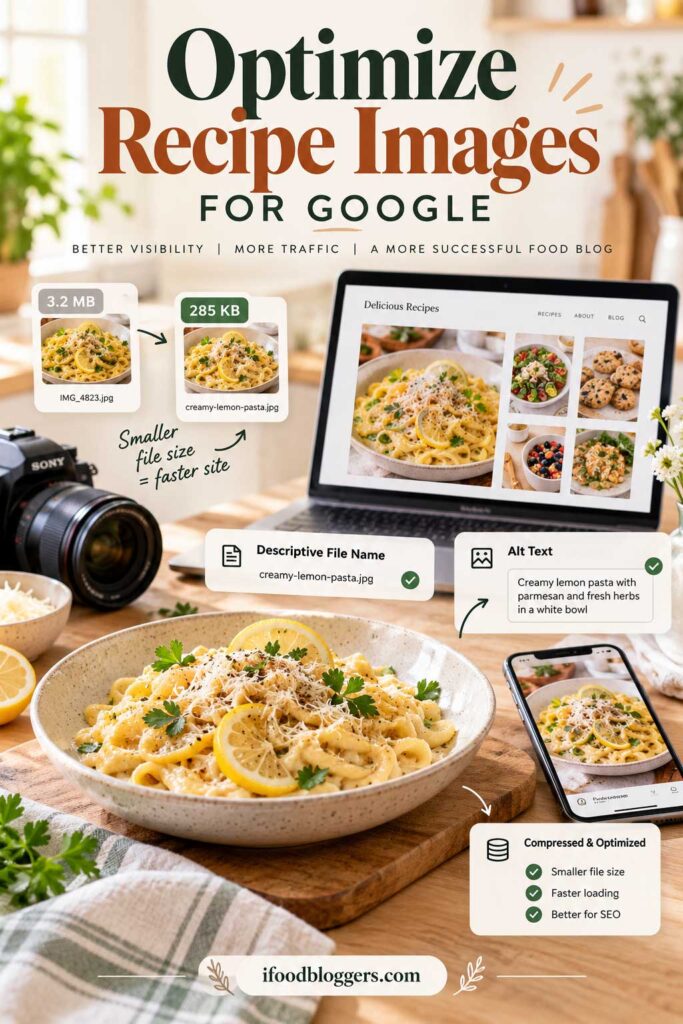
7. Optimize Recipe Images for Google
Food blogs rely heavily on images, so image optimization can improve both user experience and search visibility.
High-quality photos make recipes more appealing, but oversized image files can slow down your website. That can be especially frustrating for readers on mobile devices.
The goal is to balance image quality, file size, and SEO.
Use Descriptive Image File Names
Before uploading an image, give it a useful file name.
Instead of:
IMG_5832.jpg
use something like:
creamy-garlic-chicken-pasta.jpg
Descriptive file names help keep your media library organized and give search engines more context about what the image shows.
Keep them short and natural rather than stuffing several keywords into one filename.
Write Helpful Alt Text
Alt text describes an image for accessibility and can also help search engines understand its content.
For example:
Creamy garlic chicken pasta served in a white bowl with parsley
is far better than:
pasta recipe food dinner easy pasta best pasta recipe
Alt text should accurately describe the image. It should not be treated as another place to force keywords.
Compress Images Before Uploading
Large food photos can easily be several megabytes each.
If you upload ten or fifteen oversized images to one recipe post, the page can become unnecessarily heavy.
Resize images to dimensions that make sense for your website and compress them before or during upload.
Modern formats such as WebP and AVIF can often reduce file size while maintaining good visual quality.
Many WordPress optimization plugins and hosting platforms can also automate part of this process.
Use the Right Image Dimensions
Uploading a 5,000-pixel-wide image when your content area displays it at around 1,000 pixels is usually unnecessary.
Use images that are large enough to look sharp without making every file much heavier than it needs to be.
This becomes increasingly important as your site grows.
A food blog with hundreds of posts can eventually contain thousands of images, so efficient image handling can make a noticeable difference to overall performance.
Include Original Food Photography
Whenever possible, use your own photos.
Original photography helps make your recipe distinctive and shows readers what your version of the dish actually looks like.
A useful image might show the finished recipe, an important preparation step, the correct texture of a batter or dough, or a close-up of the final result.
You do not need to photograph every tiny step.
Focus on images that genuinely help readers understand the recipe or make them want to try it.
Think About Google Images Too
Food is highly visual, which means some readers may discover your recipes through Google Images.
Clear, attractive photography combined with relevant surrounding text, descriptive file names, helpful alt text, and a well-optimized page can give search engines more context about your images.
That creates another potential discovery channel beyond traditional search results.
Don’t Sacrifice Speed for Photography
Beautiful food photography is valuable, but a recipe page should not take forever to load because every image is enormous.
Compress your images, use responsive image settings, and use lazy loading for images farther down the page when appropriate.
A fast page with excellent photography gives you the best of both worlds: a more appealing experience for readers and a more efficient website overall.
For a food blog, images are not just decoration. They support your SEO, branding, Pinterest strategy, user experience, and overall traffic growth.
8. Use Recipe Schema
Recipe schema is structured data that helps search engines understand the information on your recipe page.
For a food blog, that can include details such as the recipe name, ingredients, preparation time, cooking time, servings, images, ratings, nutrition information, and step-by-step instructions.
When this information is marked up correctly, Google can interpret the page more clearly and may use parts of that data in enhanced search features.
Google also publishes its own recipe structured data documentation, which explains the properties it uses to understand recipe pages.
Use a Proper Recipe Plugin
For most WordPress food bloggers, the easiest way to add recipe schema is through a dedicated recipe plugin.
A good recipe plugin can generate the structured data automatically when you complete the recipe card.
That does not mean you should simply install the plugin and forget about it.
The information you enter still needs to be accurate, complete, and consistent with the recipe shown on the page.
Complete Your Recipe Card Carefully
Your recipe card should contain the information someone actually needs to make the dish successfully.
Use a clear recipe name, list ingredients in a logical order, and break the instructions into easy-to-follow steps.
Preparation and cooking times should reflect how long the recipe genuinely takes, and the yield should clearly explain how many servings or portions the recipe makes.
Include a good image of the finished dish as well.
Depending on the recipe, you may also want to provide useful details such as cuisine, course, nutrition information, equipment, or dietary categories when they genuinely apply.
The goal is not to fill every available field just because it exists. Include information that is accurate and useful.
Keep Schema Consistent With the Page
The information in your structured data should match what readers can see on the page.
If the recipe card says the dish takes 20 minutes but the actual instructions require an hour, that creates an obvious inconsistency.
The same applies to ingredients, servings, nutrition information, and ratings.
Do not add ratings that were never submitted by real users or use structured data to represent information that does not actually appear in the content.
Schema should describe the recipe honestly, not create a more attractive version of it for search engines.
Test Your Recipe Pages
After publishing or updating an important recipe, check that the structured data is working properly.
Google’s testing tools can help identify errors or warnings in the markup.
You can check a published page with Google’s Rich Results Test to see which supported structured data Google detects.
Not every warning means the recipe is broken, but errors involving important required information are worth investigating.
It is also a good idea to check your recipe markup again after changing themes, recipe plugins, or major site settings.
Schema Is Not a Ranking Shortcut
Recipe schema does not automatically push a page to the top of Google.
You still need useful content, strong photography, relevant keywords, good internal linking, solid site performance, and a recipe people actually want to make.
Think of structured data as a way to help search engines understand the content you have already created.
For food bloggers, that makes recipe schema an important technical foundation rather than a shortcut to higher rankings.
Once it is set up correctly, you can spend more of your time creating recipes readers want to find, cook, save, and share.
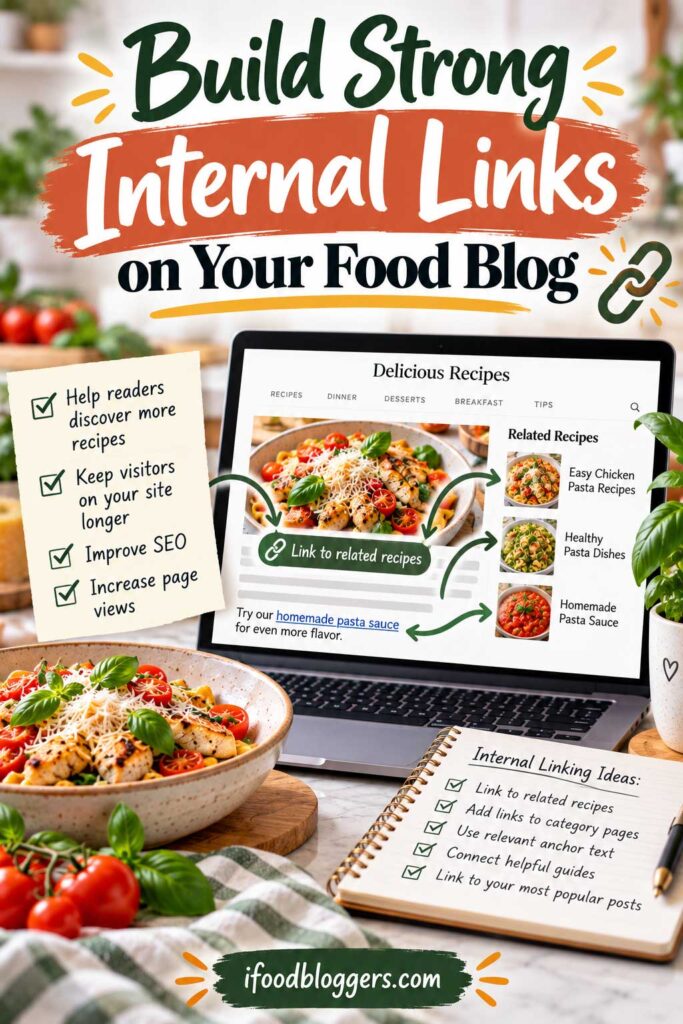
9. Build Strong Internal Links
Internal links connect one page on your food blog to another page on the same website.
They are easy to overlook, but they can help readers discover more of your content and make it easier for search engines to understand how your articles relate to one another.
A food blog with strong internal linking feels less like a collection of random recipes and more like an organized library.
Link Related Recipes Together
Whenever you publish a new post, look for natural opportunities to link to other useful content.
A recipe for homemade tomato soup, for example, could link to a grilled cheese recipe, homemade croutons, an easy bread recipe, another soup, or a collection of simple lunch ideas.
Those links give readers an obvious next step instead of leaving them at the end of a single recipe.
The connection should make sense. A related link is useful because it continues the same meal, solves another problem, or helps the reader explore a closely related topic.
Use Descriptive Anchor Text
The clickable words in a link are called anchor text.
Whenever possible, use wording that tells the reader what they will find.
For example:
Try our easy homemade garlic bread recipe
is much more useful than:
Click here for another recipe.
Descriptive anchor text improves the reader experience and gives search engines additional context about the page you are linking to.
You do not need to force an exact keyword into every link. Natural wording is usually better.
Link From Older Posts to New Content
Internal linking should not happen only when you publish a new article.
When you add a new recipe, look through older posts that could naturally point to it.
If you publish an air fryer salmon recipe, for example, you might add links from existing content about air fryer dinners, salmon recipes, seafood meals, healthy weeknight dinners, or meal prep.
This gives your new page more ways to be discovered and helps connect it to content that may already receive traffic.
Create Content Hubs Around Bigger Topics
As your food blog grows, broader hub pages can help organize related recipes.
A page such as Easy Air Fryer Recipes could link to individual recipes for chicken wings, potatoes, salmon, vegetables, and desserts.
Those individual recipes can also point readers back to the larger collection when it is useful.
The same structure can work for smoothie recipes, chicken dinners, healthy breakfasts, baking, vegetarian meals, slow cooker recipes, or holiday desserts.
This creates a clearer relationship between your broad topics and the individual posts that support them.
Don’t Overdo It
Internal links should help the reader, not distract them.
You do not need to add a link to every paragraph or repeatedly point to the same page.
A banana bread post might naturally link to another banana recipe, a guide to freezing baked goods, and a collection of easy breakfast ideas.
That is much more useful than adding a dozen unrelated links simply to increase pageviews.
Use Internal Links to Keep Readers Exploring
A visitor who discovers one recipe through Google may be interested in several related recipes.
If those options are presented naturally within the article, one search visit can turn into a longer session across your site.
That can also increase the value of the traffic you already have, particularly if your blog earns revenue through display ads, affiliate links, or other monetization methods.
Make internal linking part of your publishing process rather than something you remember months later.
And as your site grows, periodically revisit older posts to make sure your best content is connected rather than buried deep in the archives.
10. Update Older Food Blog Posts
You do not always need to publish something new to increase traffic.
Sometimes one of the best opportunities is already sitting in your archives.
Older recipes may still be ranking in Google, receiving impressions, earning backlinks, or attracting Pinterest traffic even though the content has not been updated in years.
Improving those posts can sometimes be more effective than starting from zero with a brand-new article.
Find Posts That Are Losing Traffic
Start with Google Search Console and look for pages that used to perform better than they do now.
Pay attention to recipes that have dropped in average position, receive plenty of impressions but few clicks, rank just outside the strongest search positions, or still attract traffic even though the content is clearly outdated.
You may also notice posts with weak titles, old photography, missing internal links, incomplete recipe cards, or information that no longer reflects how you would write the article today.
Those pages are often strong candidates for an update.
Improve the Content Instead of Just Changing the Date
Updating a post should mean more than changing the publication date.
Read the article as if you were seeing it for the first time and ask:
Is this still the best version of this recipe I can publish?
You may need to rewrite the introduction, clarify the instructions, add useful substitutions, improve the recipe card, answer common reader questions, replace outdated links, or add better storage and reheating advice.
You may also find opportunities to improve internal linking, update old photos, add step-by-step images where they are genuinely useful, or rewrite the SEO title and meta description.
The goal is to make the page noticeably better, not simply newer.
Check Whether Search Intent Has Changed
Search results can change over time.
A keyword that was dominated by short recipe posts several years ago may now show longer tutorials, videos, recipe collections, or more specialized variations.
Search your main keyword again and look at what currently ranks.
This can help you determine whether your older post still matches what people are actually looking for.
Refresh Seasonal Recipes Before Demand Peaks
Seasonal content should ideally be reviewed before the season begins.
Thanksgiving, Christmas, Halloween, Easter, summer grilling, back-to-school lunches, Valentine’s Day, and Super Bowl recipes can all benefit from an early refresh.
Do not wait until the holiday itself.
Updating those pages ahead of time gives search engines a chance to recrawl them and gives your Pinterest content more time to circulate before interest reaches its peak.
Add Links to Newer Content
Older articles were often published before much of your current content existed.
That means they can contain valuable internal-linking opportunities.
If you update a five-year-old pancake recipe and you have since published homemade syrup, breakfast smoothies, French toast, and muffin recipes, add links to the most relevant ones.
You can also link from newer posts back to the older recipe when it makes sense.
Don’t Delete a Post Just Because It Is Old
An older post may have more value than it appears to have at first glance.
It might already have backlinks, historical rankings, social shares, or an established URL that search engines know well.
Before deleting or completely replacing a page, check whether it still receives traffic, impressions, or links.
In many cases, improving the existing URL is a better choice than starting over.
A food blog with 200 posts does not necessarily need another 200 posts to grow.
Sometimes the faster opportunity is to improve the strongest pages you already have.
11. Create Topic Clusters
Topic clusters can help organize your food blog around subjects you want to become known for.
Instead of publishing unrelated recipes across dozens of categories, you build groups of closely connected articles around a larger topic.
For example, if you want to grow traffic around smoothie recipes, you could publish individual posts for strawberry smoothies, banana smoothies, high-protein smoothies, smoothies without yogurt, green smoothies, breakfast smoothies, smoothie bowls, and frozen-fruit smoothies.
Those articles could then connect to a broader hub such as:
Best Smoothie Recipes for Every Day
This creates a clearer structure for both readers and search engines.
Start With Topics That Fit Your Blog
Do not build clusters around random high-volume keywords just because they look attractive.
Choose topics that fit your niche and that you can realistically cover in depth.
A baking blog might focus on sourdough, cookies, cakes, muffins, bread, and holiday baking.
A healthy recipe blog might build clusters around high-protein meals, meal prep, healthy breakfasts, salads, smoothies, and lower-calorie dinners.
The more clearly your content connects around related topics, the easier it becomes to build a useful library instead of a collection of isolated posts.
Create a Main Hub Page
A topic cluster usually works best when a broader page connects the individual articles.
For example, a page titled 25 Easy Air Fryer Recipes could link to recipes for chicken, potatoes, vegetables, fish, snacks, and desserts.
Those individual recipes can also link back to the main collection or to other relevant posts inside the cluster.
This gives readers multiple paths through your content and helps reinforce the relationship between the pages.
Fill Gaps Around Your Best Topics
Google Search Console can help you see which subjects are already gaining traction.
If your chicken recipes are receiving impressions and clicks, do not automatically move on to a completely unrelated category.
Look for ways to expand the topic naturally.
That could mean publishing chicken breast recipes, chicken thigh recipes, air fryer chicken, slow cooker chicken, healthy chicken dinners, meal-prep recipes, or chicken soups.
One successful topic can often lead to many useful supporting articles.
If you are struggling to find those supporting topics, our guide to the best content discovery tools for food bloggers can help you uncover trends, questions, and new content angles.
Avoid Keyword Cannibalization
A topic cluster does not mean creating several pages that all target essentially the same search.
Each article should have a distinct purpose.
For example, best smoothie recipes and 25 healthy smoothie recipes may overlap heavily depending on how they are written.
But banana smoothie without yogurt and high-protein breakfast smoothie serve different searches and can comfortably exist on the same site.
Before creating a new article, check whether you already have a page answering the same question.
If you do, improving the existing post may be better than publishing another one that competes with it.
Use Clusters to Strengthen Internal Linking
One of the biggest advantages of topic clusters is that internal linking becomes much more natural.
Someone reading your homemade pizza dough recipe may also want pizza sauce, topping ideas, garlic knots, or instructions for freezing pizza dough.
Those links make sense because they all belong to the same subject.
Over time, this turns isolated recipes into connected resources that encourage readers to explore more of your site.
Instead of asking:
“What random recipe should I publish next?”
ask:
“What useful piece is still missing from this topic?”
That simple shift can make your food blog content strategy much more focused.
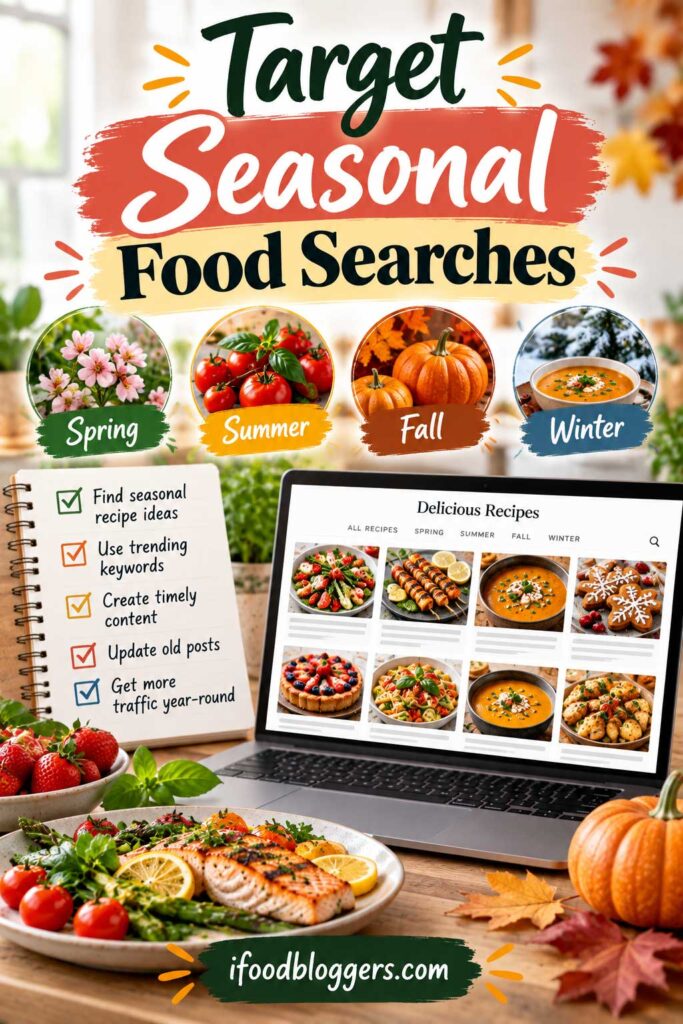
12. Target Seasonal Food Searches
Seasonal content can bring major traffic spikes to a food blog because search behavior changes throughout the year.
People look for very different recipes around Thanksgiving, Christmas, Easter, Halloween, Valentine’s Day, Super Bowl Sunday, summer grilling season, back-to-school season, fall baking, and the start of a new year.
A recipe that receives modest traffic most of the year can suddenly become one of your top-performing pages when the right season arrives.
Build Seasonal Content Around Topics That Already Work
You do not always need completely new ideas.
One of the easiest ways to expand seasonal traffic is to build seasonal versions of topics that already perform well on your site.
If cookies are a strong category for your blog, you might publish Christmas sugar cookies, Halloween cookies, Valentine’s Day cookies, Easter cookies, or pumpkin cookies for fall.
If smoothies perform well, seasonal opportunities might include pumpkin smoothies, cranberry smoothies, summer berry smoothies, or healthy breakfast smoothies for the new year.
The strongest seasonal strategy often builds on topics where your site already has some traction.
Update Seasonal Posts Every Year
Do not forget about seasonal content once the holiday or season has passed.
Before the next peak period begins, revisit those posts and check whether anything needs improvement.
Look at the recipe itself, the photography, internal links, SEO title, FAQs, Pinterest graphics, and any details that may now feel outdated.
You may already have a page with several years of history, links, or search visibility behind it, which can make improving the existing article more valuable than starting over.
Create Seasonal Content Hubs
Seasonal hub pages can also help readers discover several related recipes at once.
Examples include 30 Easy Thanksgiving Side Dishes, 25 Christmas Cookie Recipes, 20 Summer Grilling Recipes, or 15 Healthy Back-to-School Lunch Ideas.
These larger collections can link to individual recipes and give you another page to promote through Google, Pinterest, email, and social media.
Seasonal traffic will naturally rise and fall, but when you plan ahead, it can become one of the most predictable traffic opportunities on a food blog.
13. Publish Recipes Before Seasonal Demand Peaks
Creating seasonal content is only half the strategy.
Timing matters too.
If you publish a Christmas cookie recipe on December 23, you may miss much of the search and Pinterest activity that happened earlier in the season.
People often begin planning holiday meals, party food, desserts, and seasonal recipes weeks before the actual event.
That means your content should ideally be live before interest reaches its highest point.
Work Backward From the Season
A simple way to plan seasonal content is to start with the holiday or season and work backward.
Thanksgiving recipes can begin going live in September and October. Christmas content can start appearing in October and November. Summer grilling posts can be published in spring, while back-to-school recipes can begin in early summer.
You do not need to publish everything months in advance.
The goal is simply to give your content enough lead time to be discovered, indexed, shared, and saved before demand peaks.
If you already have a seasonal post that performed well before, refresh that established page early rather than automatically creating a new one.
Give Pinterest Extra Lead Time
Pinterest users often plan further ahead than people using traditional search.
Someone may begin saving Thanksgiving side dishes or Christmas desserts long before they are ready to cook them.
That makes Pinterest especially useful for seasonal food content.
Create your pins early, and consider publishing several different designs for the same seasonal recipe over time rather than waiting until the final week.
Build Your Editorial Calendar Around Future Demand
Instead of deciding what to publish each week at random, organize part of your content calendar around what people are likely to search for next.
An August schedule, for example, might include apple recipes, pumpkin recipes, easy school lunches, meal-prep breakfasts, slow cooker meals, and early fall desserts.
By the time interest starts rising, those pages are already live and ready to be discovered.
Instead of reacting only to what people are searching for today, plan part of your calendar around what they are likely to want next.
14. Create Pinterest Pins for Every Recipe
Pinterest can be another effective way to get traffic to your food blog because recipes are highly visual and easy for users to save for later.
Pinterest content can sometimes continue being discovered well after it is first published, giving older recipes additional opportunities to earn impressions, saves, and clicks.
That makes Pinterest especially useful for both evergreen recipes and seasonal content.
Create a Dedicated Pin for Each New Post
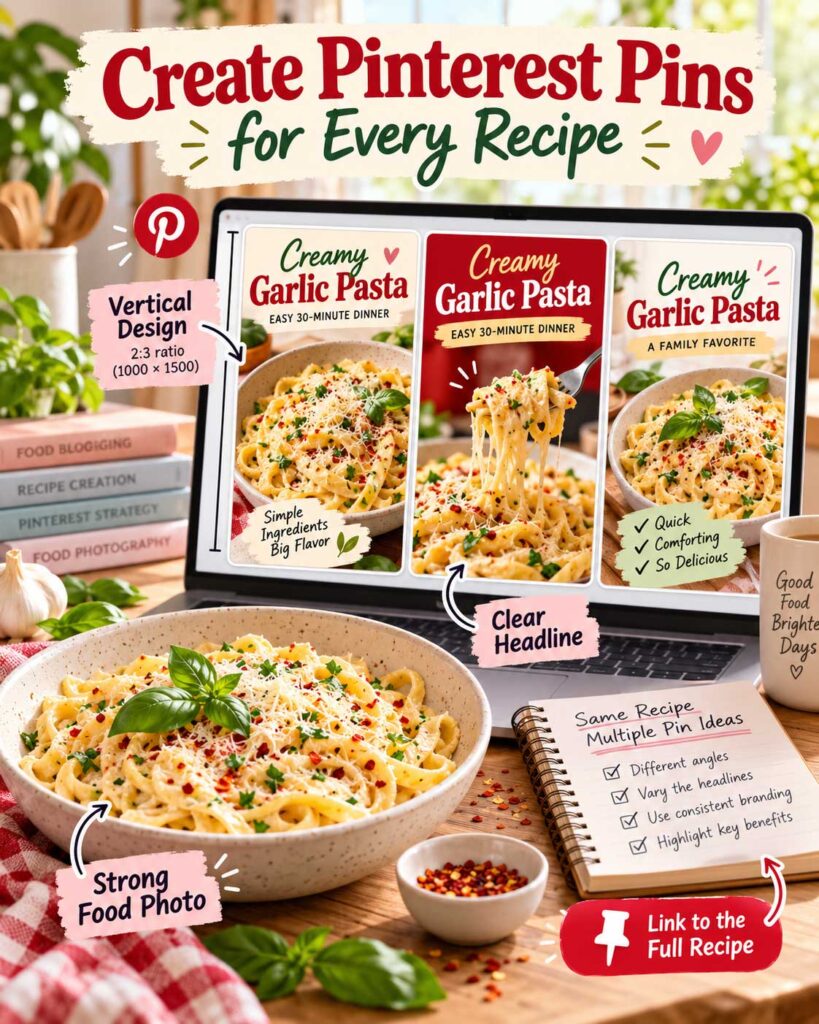
Whenever you publish a new recipe, create at least one vertical Pinterest image specifically for that page.
A strong pin usually combines an appealing photo of the finished dish with a clear headline, readable text, and simple branding.
The design should make sense at a glance, especially on mobile.
For example:
Easy Creamy Garlic Pasta
is much clearer than relying on a food photo alone with no explanation of what the recipe is.
You can also include your website name or URL in a subtle way so the pin remains connected to your brand.
Use Vertical Images
Pinterest is built around vertical content, so tall images usually work better than horizontal graphics.
A common starting point is a 2:3 aspect ratio, such as 1000 × 1500 pixels.
Pinterest’s own creative best practices are also worth reviewing when you are designing pins specifically for the platform.
That gives you enough space for a strong food image and a readable headline without making the design unnecessarily long.
Avoid creating extremely tall pins just to take up more space. Clean, readable designs are usually more useful than oversized graphics packed with text.
Keep the Recipe as the Main Focus
Food photography should remain one of the strongest elements of the pin.
You do not need to cover the entire image with text, decorative shapes, logos, and other design elements.
A simple layout with one strong photo and a clear headline can be more effective.
For example, a soup pin could feature a close-up of the finished dish with:
Easy Creamy Potato Soup
and a smaller supporting line such as:
Ready in 40 Minutes
That tells the user both what the recipe is and why it may be worth clicking.
Write a Clear Pin Title and Description
The design matters, but Pinterest also uses text to understand what your pin is about.
Write a natural title and description that clearly match the recipe.
For example:
This easy creamy potato soup is made with simple ingredients and is perfect for a cozy weeknight dinner. Save it for fall and winter meal planning.
That gives users useful context without stuffing the description with repetitive keywords.
Link Directly to the Recipe
Each pin should lead directly to the page it promotes.
If someone clicks a pin for chocolate chip cookies, send them to the chocolate chip cookie recipe rather than your homepage or a general recipe category.
The fewer unnecessary steps you add, the easier it is for users to find what they expected.
Create Pins for Older Recipes Too
Pinterest is not only for new content.
Your existing recipe archive can provide months of promotional material without requiring you to publish a new article every day.
Start with your strongest recipes, seasonal posts, and pages that already receive some search traffic.
Then work through older content and create fresh pin designs where it makes sense.
If you have 100 recipes and create two or three useful pins for each one over time, you suddenly have a large library of Pinterest content to promote.
For food bloggers, Pinterest can become much more than another social platform. It can develop into a long-term discovery channel that continues sending new readers back to your recipes.
15. Use Multiple Pinterest Designs for Each Post
One recipe does not need to have only one Pinterest pin.
Creating several different designs for the same article gives you more chances to test what gets noticed, saved, and clicked.
The recipe stays the same, but the image, headline, layout, or promotional angle can change.
For example, one chicken recipe could be promoted as Easy Garlic Butter Chicken, 30-Minute Chicken Dinner, One-Pan Chicken Recipe for Busy Nights, or Easy Weeknight Chicken With Simple Ingredients.
Each version highlights a slightly different reason to click.
Test Different Images
If you photographed the recipe from several angles, use those photos across different pin designs.
One pin might show the entire plate, another could use a close-up of the finished texture, and a third might feature an overhead shot of the meal.
Different images can appeal to different users, and testing them gives you a better idea of what your audience responds to.
Change the Headline Angle
You can also promote the same recipe from different angles without changing the actual content.
A baked salmon recipe, for example, could become Easy Baked Salmon, Healthy Weeknight Salmon Dinner, 20-Minute Oven-Baked Salmon, or Simple Salmon Recipe for Beginners.
You are not creating four different recipes. You are emphasizing four different benefits.
That can help you reach people who are drawn to different parts of the same dish.
Keep Your Branding Recognizable
Your pins do not need to look identical, but they should still feel connected to the same website.
You might use similar fonts, a consistent photography style, recognizable layouts, or a subtle placement of your website name.
The goal is not to make every pin look like a copy of the last one.
It is to build enough consistency that someone who sees several of your pins can begin recognizing your brand.
Create Real Variations, Not Near-Duplicates
Multiple designs are most useful when they are genuinely different.
Changing one tiny element and repeatedly publishing almost identical graphics gives you much less to learn from.
A better approach is to vary the headline, image, layout, or value proposition in a noticeable way.
That gives each pin a distinct reason to exist.
Create More Pins for Proven Recipes
When a recipe begins performing well on Pinterest, that is a good reason to create more designs for it.
You already know that the topic attracts interest.
Instead of moving on immediately, build on that momentum with new creative.
The same idea works especially well with seasonal content. A Christmas dessert can receive fresh pin designs every year while still pointing to the same strong article.
Let Pinterest Data Shape Future Designs
Pinterest analytics can show you which pins attract impressions, saves, outbound clicks, and engagement.
Look for patterns rather than judging one pin in isolation.
You may discover that close-up food photography performs better than overhead shots, that headlines mentioning preparation time attract more clicks, or that simpler graphics outperform designs with too much text.
Use those patterns when creating future pins.
Over time, your own data can tell you far more than guesswork about which creative styles are most effective at bringing readers back to your food blog.
16. Optimize Pinterest Titles and Descriptions
Pinterest is a visual platform, but the words you use still matter.
Your pin title and description help people understand what the content is about and give Pinterest additional context about where that pin may belong.
For food bloggers, that means every pin should be treated as more than just an image.
Write Clear Pin Titles
Your Pinterest title should quickly explain what the recipe is.
For example:
Easy Lemon Chicken Recipe
is much clearer than:
You Have to Try This
A strong title can also include a useful detail such as preparation time, cooking method, meal type, or convenience.
30-Minute Creamy Lemon Chicken, Easy No-Bake Cheesecake, or One-Pot Weeknight Pasta all tell the user something useful before they click.
Use Natural Keywords
Pinterest search works best when your content is clearly connected to the phrases people are actually looking for.
If your post is about an easy chicken dinner, your title and description might naturally include phrases such as easy chicken dinner, weeknight chicken recipe, or 30-minute dinner.
You do not need to repeat the same keyword several times.
Write for people first and use relevant search phrases only where they fit naturally.
Make Descriptions Helpful
A good Pinterest description should briefly explain what the user will find after clicking.
For example:
This easy garlic butter chicken is ready in about 30 minutes and makes a simple weeknight dinner. Serve it with rice, pasta, or vegetables for an easy family meal.
That gives Pinterest useful context while also telling the reader why the recipe may be worth saving.
Match the Pin to the Landing Page
The text on the pin, the title, the description, and the destination page should all match.
Do not create a pin promising 10 Healthy Breakfast Ideas and send users to a single pancake recipe.
That creates a poor experience and can reduce trust.
If the pin says Easy Strawberry Smoothie, it should lead directly to your strawberry smoothie recipe.
Use Seasonal Wording When It Truly Fits
Seasonal phrases can be useful when they genuinely match the recipe.
A pumpkin dessert might naturally fit searches related to fall desserts, Thanksgiving recipes, or pumpkin baking.
A grilled chicken recipe may be relevant to summer dinners or grilling season.
The important part is relevance.
Do not add holiday or seasonal keywords simply because they are popular.
Vary the Description When You Test New Pins
If you create several pins for the same recipe, you can also test different descriptions.
One version might emphasize how quickly the recipe comes together. Another could focus on simple ingredients. A third might position it as a meal-prep option.
That gives you more ways to present the same recipe without changing the underlying content.
Pinterest optimization does not require complicated tricks.
Clear titles, useful descriptions, relevant keywords, strong images, and accurate destination links can go a long way toward helping the right people discover your recipes.
17. Create Pinterest Boards Around Specific Topics
Your Pinterest boards should make it easy for both users and Pinterest to understand what kind of content you publish.
Instead of creating broad boards with vague names such as Food or Recipes I Love, use more specific topics.
A food blog might have boards for Easy Dinner Recipes, Healthy Breakfast Ideas, Air Fryer Recipes, Chicken Recipes, Smoothie Recipes, Easy Desserts, Meal Prep Ideas, or Vegetarian Recipes.
Focused boards give your pins stronger context and make your Pinterest profile easier to browse.
Match Boards to Your Main Content Categories
Your strongest Pinterest boards should usually reflect the topics you publish most often on your food blog.
If your site focuses heavily on baking, for example, you might create boards for Easy Baking Recipes, Chocolate Desserts, Cookie Recipes, Cake Recipes, Bread Recipes, and Holiday Baking.
This creates a clearer connection between your Pinterest strategy and the content already available on your website.
Use Descriptive Board Names
Choose board names that are clear and easy to understand.
A title such as Weeknight Wonders may sound creative, but Easy Weeknight Dinner Recipes tells users exactly what they will find.
You can still add personality to your branding, but clarity should come first.
Write a Useful Board Description
Each board should have a short description explaining what belongs there.
For example:
Easy weeknight dinner recipes including chicken, pasta, casseroles, one-pot meals, slow cooker dinners, and quick family-friendly meals.
Keep the description natural and focused on the topic.
There is no need to repeat the same keyword several times.
Pin Content to the Most Relevant Board
When you publish a new pin, place it on the board that best matches the recipe.
A strawberry smoothie belongs much more naturally on a smoothie or healthy breakfast board than on a general dinner board.
You may have more than one relevant option, but avoid placing every pin on every board simply because you can.
Relevance is more useful than volume.
Don’t Create Too Many Empty Boards
A smaller number of focused, active boards is usually more useful than dozens of boards with only a few pins each.
Start with your strongest content categories and expand as your recipe library grows.
If you eventually publish a large number of air fryer recipes, for example, you may be able to create more specific boards for Air Fryer Chicken Recipes, Air Fryer Vegetables, or Air Fryer Dinner Recipes.
Use Seasonal Boards Strategically
Seasonal boards can also work well for food content.
You might create boards around Thanksgiving recipes, Christmas desserts, fall baking, summer grilling, Valentine’s Day treats, or Easter brunch.
Start adding relevant pins before the season arrives rather than waiting until the final week.
A well-organized Pinterest account can become an extension of your food blog’s content structure.
When your boards closely match the topics you want to grow, every new pin has a more logical place to live and another opportunity to reach people interested in that type of recipe.
18. Turn Recipes Into Short-Form Videos
Short-form video gives food bloggers another way to reach people who may never discover the recipe through Google or Pinterest.
A single recipe can often be repurposed into content for Instagram Reels, TikTok, YouTube Shorts, and Pinterest.
You do not need to create a brand-new concept every time. Start with recipes you have already tested, photographed, and published.
Keep the Video Focused
A short recipe video should move quickly and show the parts that matter most.
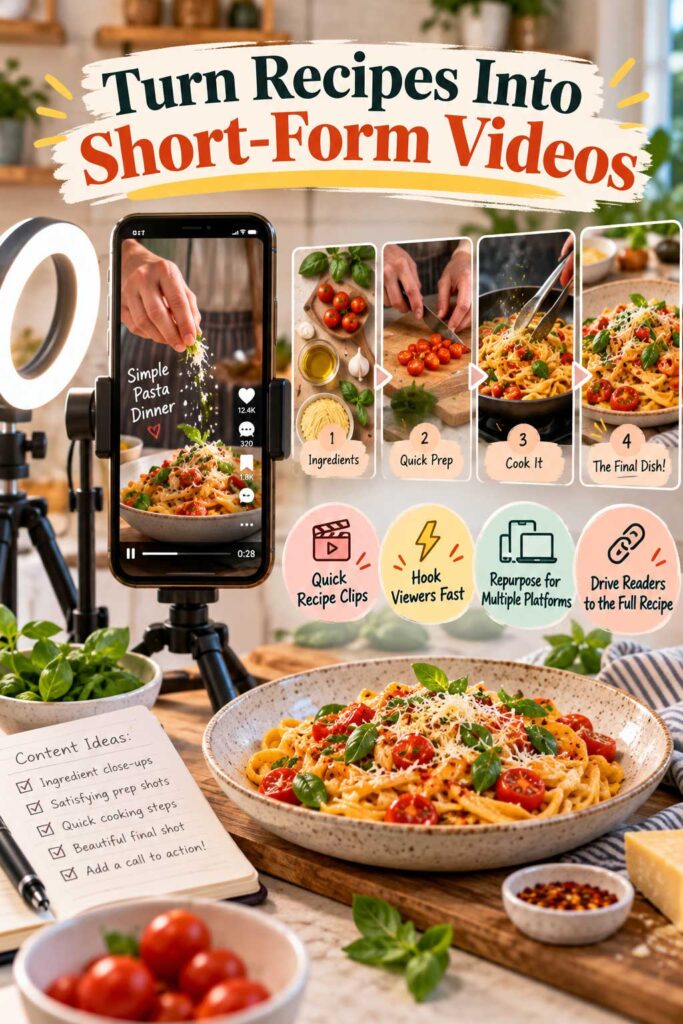
Open with the finished dish, then show a few important ingredients, the key preparation steps, and the final result.
You do not need to include every detail from the full article.
The goal is to make the recipe look useful and achievable while giving viewers a reason to visit your site for the complete instructions.
Hook the Viewer Early
The first few seconds matter.
Instead of starting with a long introduction, show the finished dish or the most visually appealing moment right away.
You might open with:
This creamy garlic pasta takes about 20 minutes.
or:
Here is an easy chicken dinner for busy weeknights.
Then move directly into the cooking process.
Add On-Screen Text
Because viewers may encounter your video without sound, a little on-screen text can make the recipe easier to understand immediately.
Simple phrases such as 5 ingredients, Ready in 30 minutes, No oven needed, or High-protein breakfast can quickly explain why the recipe is worth watching.
Keep the text short and large enough to read comfortably on a phone.
Repurpose the Same Footage Across Platforms
You do not need to film a completely different video for every social network.
A well-planned vertical recipe video can often be adapted for TikTok, Instagram Reels, YouTube Shorts, and Pinterest.
You may want to adjust the caption, title, music, or editing slightly for each platform, but the core footage can often stay the same.
That makes video content much more manageable.
Repurposing becomes much easier when your overall workflow is organized. Our guide to the best productivity tools for food bloggers includes tools that can help with planning, scheduling, and managing content across multiple platforms.
Send Viewers Back to the Full Recipe
Social views are useful, but your website should remain the main home for the complete recipe.
The blog post can provide exact ingredient quantities, printable instructions, substitutions, storage tips, nutrition information, and related recipes.
That gives viewers a clear reason to move from the social platform to your site.
Start With Recipes That Already Perform Well
You do not have to create videos for every recipe immediately.
Start with posts that already receive search traffic, perform well on Pinterest, or attract strong engagement.
If readers already respond well to a recipe, that is a good sign it may also work in video form.
Short-form video can be unpredictable, and not every post will take off. But it gives you another way to distribute content you have already created and introduce your food blog to a new audience.
19. Promote Your Recipes on Instagram
Instagram can help food bloggers build recognition, connect with readers, and bring more attention to both new and existing recipes.
Food content is naturally visual, which makes Instagram a good place to showcase finished dishes, quick cooking clips, behind-the-scenes moments, and useful recipe tips.
A strong photo, Reel, carousel, or Story can introduce your content to someone who has never visited your blog before.
A beautiful final photo is useful, but one recipe can produce much more content than that.
You might share part of the preparation process, a cooking tip, a substitution, a common mistake, a before-and-after transformation, or a short video showing the recipe coming together.
That helps you get more value from each recipe instead of creating a completely new idea for every post.
Use Carousels to Teach Something
Instagram carousels work well when each slide gives the reader a reason to keep swiping.
For a banana bread recipe, for example, you could structure the carousel like this:
Slide 1: Easy Moist Banana Bread
Slide 2: Use very ripe bananas
Slide 3: Don’t overmix the batter
Slide 4: How to tell when it is done
Slide 5: How to store it
Slide 6: Visit the blog for the full recipe
That gives people useful information while naturally leading them toward the complete article.
Use Reels for Discovery
Reels can help your content reach people who do not already follow you.
Keep them visually focused and get to the food quickly.
A simple Reel might move from the finished dish to the ingredients, preparation, cooking process, and a final close-up.
A short headline such as Easy 20-Minute Dinner or Crispy Air Fryer Potatoes can make the topic clear even before someone reads the caption.
Make Your Profile Lead Somewhere Useful
If your goal is blog traffic, make it easy for an interested Instagram user to reach your website.
Your profile should clearly explain what kind of recipes you publish and include a useful link.
That link might lead to your homepage, latest recipes, a dedicated recipe hub, or a curated landing page.
The fewer unnecessary steps between discovering you on Instagram and reaching the recipe, the better.
Promote Older Recipes Again
You do not need a brand-new article for every Instagram post.
Older recipes can be brought back into your content calendar, especially when they are seasonal, evergreen, already popular, or starting to gain renewed interest.
A recipe you published two years ago may still be completely new to most of your current followers.
Build Recognition, Not Just Clicks
Instagram may not always send as much direct traffic as Google or Pinterest, but it can still play an important role in growing your audience.
Someone may discover one of your Reels today, follow your account, save several posts, and visit your website later.
That makes Instagram useful not only for immediate clicks, but also for building familiarity and trust over time.
The most sustainable approach is to use Instagram to make your food content more discoverable while keeping your blog as the main home for the complete recipe.
20. Use TikTok to Reach New Audiences
TikTok can help food bloggers reach people who may never discover their recipes through traditional search.
Food works well in short-form video because viewers can quickly see the finished dish, the cooking process, and the final texture in just a few seconds.
You also do not need a huge following to get started. A useful, visually appealing recipe can sometimes reach far beyond your existing audience.
Start With a Strong Visual Hook
The opening seconds should give viewers a reason to keep watching.
Instead of beginning with a long introduction, lead with the most appealing part of the recipe. That might be the finished dish, a cheese pull, a crispy texture, sauce being poured, or a dramatic before-and-after moment.
Then quickly explain what you are making.
For example:
This 20-minute creamy chicken pasta is perfect for busy weeknights.
That tells the viewer exactly what they are about to see.
Turn Existing Blog Content Into Videos
If your food blog already contains dozens or hundreds of recipes, you have a large content library to work with.
One recipe post can become several different TikToks.
You might create a full cooking video, a quick tip, a substitution idea, a common mistake to avoid, a close-up of the final result, or a meal-prep variation.
That means you do not have to invent a completely new idea every time you want to post.
Create Videos Around Reader Questions
Not every TikTok needs to be a full recipe.
Some of your strongest ideas may come from common cooking questions.
You could create short videos answering things like Why are my cookies spreading?, Can you freeze cooked rice?, How do you keep chicken breast from drying out?, or What can I substitute for buttermilk?
These videos can help establish your expertise while naturally leading viewers toward related articles on your blog.
Use Clear, Search-Friendly Captions
TikTok is also used as a search tool, especially for recipes and cooking ideas.
Write captions that clearly describe what the video is about.
Instead of:
You NEED this 😍
try:
Easy air fryer chicken thighs with crispy skin and simple seasoning.
The second version gives both viewers and the platform much more useful context.
Send Viewers to the Full Recipe
When appropriate, direct viewers to the corresponding blog post for exact measurements, printable instructions, substitutions, storage information, and other details that do not fit comfortably into a short video.
Use Comments to Find Your Next Content Ideas
TikTok comments can become a useful source of future topics.
If several people ask whether they can substitute an ingredient, that may deserve its own video.
If viewers want an air fryer version, that could become another recipe.
If people keep asking how to store the dish, that is a sign the original blog post may need a stronger storage section.
Used this way, TikTok is not just another place to promote your food blog. It can also help you understand what your audience wants next.
21. Build a YouTube Channel Around Your Recipes
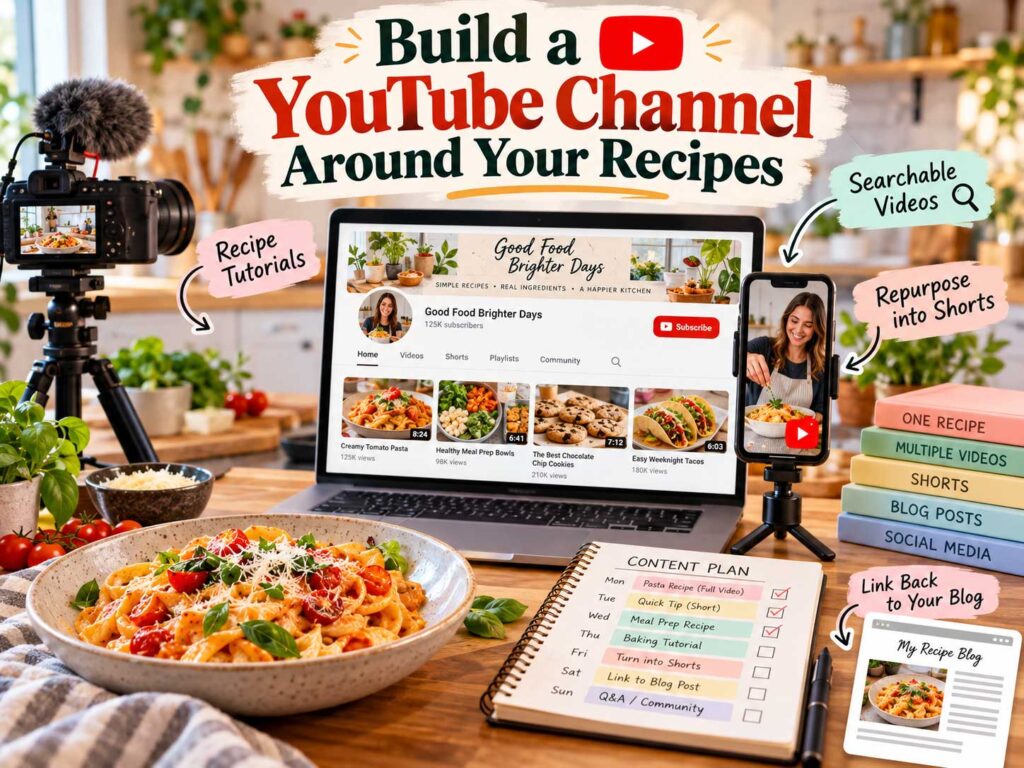
YouTube can give food bloggers another long-term source of discovery because useful recipe videos can continue getting views months or even years after they are published.
Unlike platforms where content moves quickly through a feed, YouTube also functions as a search engine. People actively look for recipes, cooking techniques, meal ideas, ingredient substitutions, product comparisons, and step-by-step tutorials.
That makes it a natural extension of a food blog.
Turn Your Best Recipes Into Video Tutorials
Start with recipes that already perform well on your website.
If a post receives consistent Google traffic, Pinterest clicks, email engagement, or social interest, that is a good sign there is demand for the topic.
A popular recipe can become a full cooking tutorial, while other strong opportunities might include seasonal dishes, beginner cooking guides, baking techniques, meal-prep ideas, ingredient substitutions, or common cooking mistakes.
You do not always need to guess what to film next. Your existing traffic data can help you decide.
Make the Video Useful, Not Overproduced
You do not need a television-quality kitchen or expensive production setup to create helpful cooking videos.
Clear footage, good lighting, understandable instructions, and a reliable recipe matter far more than complicated editing.
Show the finished dish early, walk viewers through the important preparation steps, and highlight anything that may be difficult to understand from text alone.
If texture matters, show it. If there is an easy way to tell when the dish is done, demonstrate it. If one step commonly causes problems, explain it while viewers can actually see what you mean.
That is where video can add something your written recipe cannot.
Optimize Your Videos for Search
Like a blog post, a YouTube video should have a clear topic.
If your tutorial is about homemade pizza dough, a title such as:
Easy Homemade Pizza Dough for Beginners
is far more useful than something vague like:
You Won’t Believe How Good This Is
The title, description, thumbnail, and video itself should make it easy to understand what the viewer will learn.
Clear topics also make it easier to connect your YouTube content with articles already published on your blog.
Link Back to the Full Recipe
Your video can demonstrate the recipe while your website remains the complete resource.
When appropriate, link to the corresponding article from the video description.
The blog post can provide exact measurements, printable instructions, substitutions, storage advice, nutrition information, equipment recommendations, and links to related recipes.
That gives viewers a practical reason to move from YouTube to your website rather than keeping the entire experience on someone else’s platform.
Repurpose Longer Videos Into Short-Form Content
One longer cooking tutorial can also become several smaller pieces of content.
A full lasagna video, for example, could produce a Short showing the layering process, a quick clip of the finished texture, an Instagram Reel, a TikTok, or another vertical video for Pinterest.
This helps you get more value from the time spent filming and editing.
Instead of thinking of every platform as requiring completely separate content, build a system where one recipe can feed several channels.
Build a Searchable Video Library Over Time
Do not judge a YouTube video only by what happens during its first few days.
A useful cooking tutorial may continue appearing in search and recommendations long after publication.
As your channel grows, organize related videos into playlists such as Easy Weeknight Dinners, Beginner Baking Recipes, Air Fryer Recipes, Healthy Breakfast Ideas, or 30-Minute Meals.
Those collections make it easier for viewers to continue watching related content rather than leaving after one video.
For a food blogger, YouTube can eventually become much more than another social profile. It can grow into a searchable video library that introduces new people to your recipes and sends interested viewers back to your website.
22. Grow an Email List
An email list gives you something search engines and social platforms cannot fully provide: a direct way to reach your readers again.
If someone discovers your recipe through Google, Pinterest, Instagram, or TikTok and then leaves, there is no guarantee they will ever return.
But if that visitor joins your email list, you have another opportunity to bring them back whenever you publish something useful.
That repeat traffic becomes increasingly valuable as you continue trying to get traffic to your food blog from multiple sources.
Give Readers a Reason to Subscribe
Most people will not sign up simply because a form says:
Join Our Newsletter
Give them a clear reason.
For a food blog, that might be a free weekly meal plan, a printable grocery list, a collection of quick dinner recipes, a baking conversion chart, a smoothie guide, a holiday recipe ebook, or a meal-prep checklist.
Choosing the right platform can make this much easier. See our comparison of the best email marketing platforms for food bloggers if you are still deciding which service to use.
The best offer is closely connected to the content your ideal reader already cares about.
Place Signup Forms Where They Make Sense
Do not hide your email form in the footer and expect strong results.
Place signup opportunities where readers are already engaged with your content.
That might be inside a recipe post, after the recipe card, near the end of an article, on your homepage, or on a relevant category page.
A well-timed popup or slide-in can also work, as long as it does not make the site frustrating to use.
The goal is to make subscribing easy without interrupting the reading experience.
Segment Readers When It Becomes Useful
As your list grows, different subscribers may be interested in different types of content.
Someone who joined through a baking guide may be especially interested in cookies, cakes, and bread.
Another reader who downloaded a high-protein meal plan may care more about healthy dinners and meal prep.
You do not need a complicated segmentation system when your list is small, but over time it can help you send more relevant emails and keep subscribers more engaged.
Focus on Returning Visitors
The value of an email subscriber is not limited to one click.
A reader may return to your blog every week, open several recipes, share your content, or eventually purchase something through one of your affiliate recommendations.
That makes email especially valuable for repeat traffic.
Search engines and social platforms may introduce someone to your website for the first time.
Your email list helps turn that one-time visitor into someone who comes back regularly.
For a growing food blog, that makes email list building one of the most valuable long-term traffic strategies you can start early.
23. Send New Recipes to Your Subscribers
Building an email list only helps if you actually stay in touch with the people who joined it.
When you publish a strong new recipe, your subscribers can become one of the first sources of traffic to that page.
You do not need to send an email for every small website update. Focus on content that is genuinely useful, timely, and relevant to the people on your list.
Make the Email About the Reader
Instead of writing:
We published a new recipe. Click here.
give people a reason to care.
For example:
Need an easy dinner for a busy night? This creamy garlic pasta comes together quickly and uses simple ingredients you may already have at home.
That frames the recipe around the reader’s needs rather than around the fact that you published something.
Use Email to Support Seasonal Traffic
Your email list can be especially useful when seasonal interest starts rising.
Before Thanksgiving, you might highlight make-ahead side dishes, holiday desserts, or leftover turkey recipes.
During summer, you could bring attention back to grilling recipes, cold salads, no-bake desserts, or refreshing drinks.
This gives older content another chance to perform without requiring you to publish something new every time.
Feature More Than One Recipe When It Makes Sense
Not every email needs to focus on a single post.
A newsletter built around 5 Easy Weeknight Dinners, for example, can send readers to several related recipes on your site.
That gives subscribers more choice and can create more than one pageview from a single email.
Promote Strong Content Again
If a recipe has performed well before, there is nothing wrong with bringing it back when it becomes relevant.
A pumpkin bread recipe can return every fall. A popular grilling recipe can be promoted again each summer.
Many subscribers will not remember every link you have ever sent, and newer subscribers may never have seen the older post at all.
Stay Consistent
You do not need to email readers every day.
For many food blogs, one useful email per week is enough to stay connected without overwhelming subscribers.
The important part is consistency.
If someone joins your list and then hears nothing from you for months, they may forget why they subscribed in the first place.
A simple email that includes your newest recipe, one older favorite, and perhaps a quick cooking tip can be enough to keep readers engaged.
Email traffic is valuable because these readers already chose to hear from you.
Instead of depending entirely on algorithms to bring them back, your newsletter gives you a direct way to remind readers that your food blog has something worth visiting again.
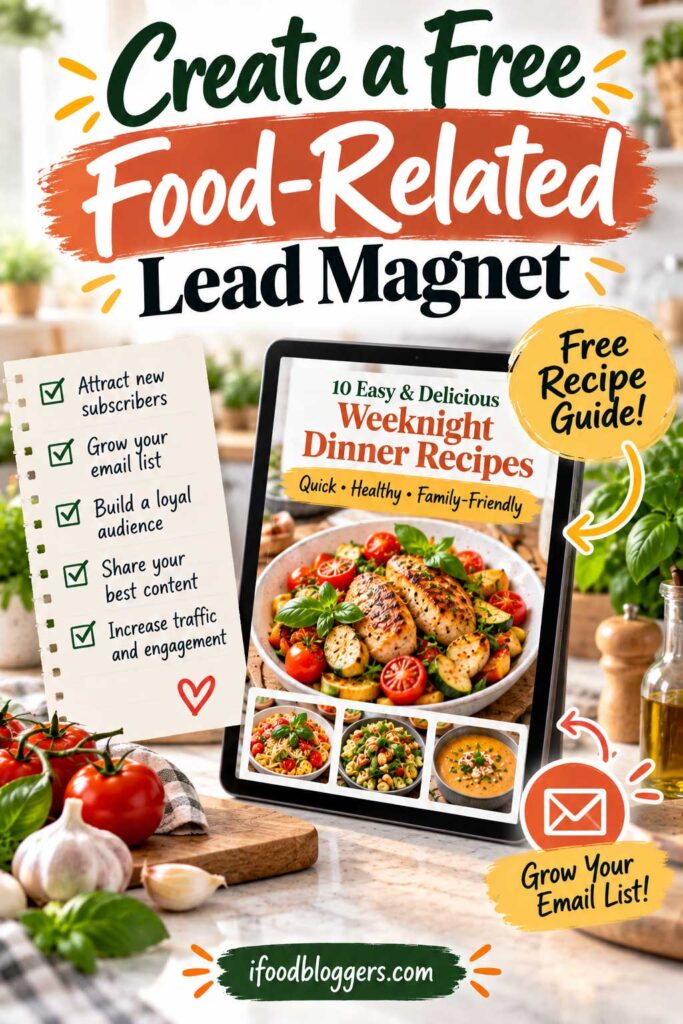
24. Create a Free Food-Related Lead Magnet
A lead magnet is a free resource you offer in exchange for someone joining your email list.
For food bloggers, this can work especially well because readers often want something practical they can save, print, or use later.
Instead of asking someone to subscribe with no clear benefit, you give them a specific reason to join.
Choose Something Closely Related to Your Content
The best lead magnets attract the same kind of readers you want visiting your blog.
A meal-planning site might offer a 7-day meal plan or printable grocery list. A baking blog could create a conversion chart or ingredient substitution guide. A smoothie site might offer a small recipe ebook, while a family dinner blog could provide a collection of easy 30-minute meals.
The closer the resource is to your main content, the more likely those subscribers are to remain interested in what you publish later.
Solve One Specific Problem
A lead magnet does not need to be long or complicated.
In many cases, a short, focused resource is more useful than a large ebook that tries to cover everything.
For example:
10 Easy 30-Minute Dinners
is much clearer than:
The Ultimate Guide to Everything About Cooking
Readers should immediately understand what they are getting and why it will help them.
Promote It Where It Fits Naturally
Place the offer inside content that already matches the topic.
If someone is reading an article about meal prep, a printable meal planner makes sense.
If the post is about smoothies, a smoothie recipe guide feels relevant.
If your site focuses on baking, a conversion chart or substitution guide may be a natural next step.
This usually works better than showing the same generic signup offer on every page.
Create a Simple Landing Page
A dedicated landing page can make the offer easier to understand and give readers one clear action to take.
Keep it focused.
Explain what the resource is, who it is for, and why it is useful. Show a preview if possible, then make the signup form easy to find.
Avoid cluttering the page with unrelated links or distractions.
Use the Lead Magnet to Build Repeat Traffic
The free resource should be the beginning of the relationship, not the end.
Once someone joins your email list, you can continue sending useful recipes, seasonal ideas, cooking tips, and new content.
That is where the long-term traffic value comes from.
A free PDF may earn the initial signup, but consistent, useful emails are what can turn that subscriber into a regular visitor.
For a food blog, even one strong lead magnet can become a valuable tool for turning anonymous traffic into an audience you can reach again and again.
25. Get Backlinks to Your Food Blog
Backlinks are links from other websites pointing to your content.
For food bloggers, relevant backlinks can send referral traffic, help more people discover your work, and give search engines additional signals about how your content connects to the wider web.
The key word is quality.
One relevant link from a respected food, lifestyle, nutrition, travel, or local website can be far more valuable than dozens of low-quality links from unrelated sites.
Create Content People Actually Want to Reference
The easiest backlinks usually come from content that gives another publisher a genuine reason to link to it.
That could be an original recipe, a detailed cooking guide, a useful ingredient substitution chart, a seasonal recipe collection, original food photography, a cooking calculator, a conversion tool, or unique data.
A standard recipe can earn links, but useful resources often create more natural opportunities because they solve a problem other writers may want to reference.
Contribute to Relevant Websites
Contributing to another relevant publication can introduce your expertise and recipes to an audience that may not know your blog yet.
You might contribute a seasonal recipe, a cooking tip, a food photography tutorial, a meal-planning article, or an expert quote to another established site.
The goal should be to add something valuable to the publication, not simply to place a link.
If the contribution is useful, the link becomes a natural part of the content rather than the entire reason for creating it.
Reclaim Unlinked Mentions
Sometimes another website may mention your blog, recipe, brand, or photograph without linking back to the original source.
When that happens, a polite request for a link can be reasonable.
The strongest opportunities are usually cases where the publisher is already referring to your work and a link would genuinely help readers find the original content.
Avoid Spammy Link-Building Tactics
Be cautious when someone promises hundreds of backlinks quickly or cheaply.
Automated link packages, irrelevant directories, comment spam, private blog networks, manipulative paid links, and excessive reciprocal linking can do more harm than good.
A backlink is most valuable when it exists because the content deserves to be referenced, not because it was manufactured at scale.
Focus on Earning Links Over Time
Backlink growth is usually gradual.
As your food blog publishes stronger recipes, original photography, useful tools, and in-depth guides, more opportunities can appear naturally.
The long-term strategy is simple: create content worth referencing, build genuine relationships in your niche, and make your best work easy to discover.
Backlinks should support your overall traffic strategy, not become the only thing you focus on.
26. Collaborate With Other Food Bloggers
Collaborating with other food bloggers can introduce your content to new audiences and create opportunities that are difficult to build on your own.
The goal is not simply to exchange links.
The strongest collaborations create something useful for both audiences.
Contribute to Recipe Roundups
Recipe roundups are one of the easiest ways to collaborate.
Another blogger may be putting together a post such as 25 Easy Summer Desserts, 20 Healthy Breakfast Recipes, or 30 Slow Cooker Dinners.
If you have a recipe that genuinely fits, you can offer it for consideration.
That can introduce your recipe to a new audience and may also result in a relevant backlink.
Create Collaborative Content
You can also work with other bloggers on larger pieces of content.
That might include a holiday recipe collection, a shared meal-planning guide, expert cooking tips, a seasonal menu, an interview, or a themed cooking challenge.
For example, several bloggers could each contribute one favorite Thanksgiving side dish to a shared collection.
Each participant then has a reason to promote the finished resource, which can increase its reach.
Feature Other Creators When It Adds Value
Collaboration does not always have to begin with asking someone else for something.
You can feature another blogger’s recipe, quote, or expertise when it genuinely improves your own article.
Then let them know they were included.
Some may choose to share the post with their audience, which can create additional exposure naturally.
Appear on Podcasts, Videos, or Interviews
Your expertise can extend beyond individual recipes.
You may have useful experience in recipe development, food photography, baking, meal planning, kitchen organization, content creation, or growing a food website.
Podcast appearances, YouTube interviews, and written interviews can all introduce your work to people who may not have discovered your blog otherwise.
Collaborate With Complementary Niches
You do not have to work only with recipe bloggers.
A healthy food blogger might collaborate with a fitness or wellness site.
A travel food blogger could work with a destination publisher.
A baking blogger might partner with a kitchen equipment or home-living site.
The best collaborations happen when the two audiences overlap naturally.
Build Relationships, Not Link Exchanges
A message that says:
I’ll link to you if you link to me
is unlikely to build a meaningful relationship.
Look for opportunities where both sides gain something useful.
You might contribute an original recipe, provide an expert tip, participate in an interview, help create a joint resource, or promote a collaborative project.
Relationships built this way can lead to repeated collaborations, referral traffic, mentions, and backlinks over time.
Food blogging may look like a solo business, but you do not have to grow entirely on your own.
Building genuine connections with other creators can open new traffic channels while also making your brand more visible within your niche.
27. Submit Recipes to Relevant Food Communities and Platforms
Your own website should remain the main home for your recipes, but selected food communities and discovery platforms can help introduce your content to new readers.
The key is to be selective.
You do not need to submit every recipe everywhere. Focus on places where people are already looking for cooking ideas, meal inspiration, recipes, or answers to food-related questions.
Choose Platforms That Fit Your Content
The best opportunities depend on your niche.
A sourdough recipe, for example, may perform much better in a community focused specifically on bread baking than on a broad platform with no clear food audience.
You might find useful opportunities in recipe discovery communities, niche cooking groups, food forums, local food websites, relevant Facebook groups, community newsletters, specialty food communities, or seasonal recipe roundups.
The closer the audience matches your content, the more valuable the traffic is likely to be.
Follow Community Rules
Before sharing your content, read the rules.
Some communities allow links to personal blogs. Others permit them only when they directly answer a question, while some do not allow self-promotion at all.
Respect those guidelines.
Dropping links into every discussion can quickly look like spam and may hurt your reputation.
A better approach is to contribute something genuinely useful first.
Answer Questions With Real Help
If someone asks:
Why did my banana bread turn out dry?
you could explain several likely causes based on your experience.
If you also have a detailed banana bread guide that adds useful information, linking to it may make sense when the community allows it.
The important part is that your answer should still be helpful even if the person never clicks the link.
That is the difference between contributing and simply promoting yourself.
Look for Smaller, More Relevant Communities
Large platforms are not always the best source of traffic.
A smaller community focused on gluten-free cooking, sourdough baking, meal prep, grilling, air fryer recipes, budget meals, or another specific topic may send fewer visitors overall but a much more interested audience.
Those readers are also more likely to explore other related content on your site.
Track Which Sources Are Worth Your Time
Not every external platform will be useful.
Use your analytics to see which communities actually send visitors who engage with your content.
If one platform consistently sends interested readers while another produces almost nothing, adjust where you spend your time.
A smaller niche community can sometimes be far more valuable than a much larger general platform.
Keep Your Website at the Center
External communities are useful for discovery, but they should support your website rather than replace it.
Platforms can change their rules, algorithms, reach, or visibility at any time.
Your food blog, email list, and content library are assets you have much more control over.
Use external communities to introduce people to your work, then give those visitors a reason to become regular readers of your own site.
28. Improve Website Speed and Mobile Experience
You can have excellent recipes and strong SEO, but if your website is slow or frustrating to use, visitors may leave before they ever reach the recipe.
This matters even more for food blogs because many readers are browsing on their phones while shopping, cooking, or planning meals.
A fast, clean mobile experience can help keep visitors engaged and make better use of the traffic you already have.
Test Your Site on a Real Phone
Do not judge your website only from a desktop computer.
Open your most important pages on an actual phone and use them the way a reader would.
Check whether the page loads quickly, the text is easy to read, buttons are comfortable to tap, images display correctly, and the recipe card is easy to use.
Also pay attention to whether popups cover the content, ads cause the page to jump around, or the mobile menu feels difficult to navigate.
A site can look excellent on desktop and still be frustrating on a smaller screen.
Compress Large Images
Food photography is often one of the biggest contributors to slow page loading.
Use appropriately sized images and compress them before or during upload.
Modern formats such as WebP can help reduce file size without making the photos look noticeably worse.
There is little benefit in uploading a massive camera file if the image will only display at a fraction of that size on the page.
Review Your Plugins
WordPress plugins can add useful functionality, but unnecessary or poorly optimized plugins can also add extra weight to your site.
Periodically review what you have installed.
Remove tools you no longer use and avoid running several plugins that perform essentially the same job.
The goal is not to use as few plugins as possible. It is to make sure each one serves a real purpose.
Use Caching and Reliable Hosting
Caching can help your website deliver pages more efficiently, while a reliable hosting environment can improve overall performance as your traffic grows.
If your site becomes noticeably slower during traffic spikes or takes too long to respond even when pages are optimized, it may be worth reviewing whether your current hosting setup still fits your needs.
Hosting plays a major role in performance as a site grows. Our guide to the best hosting for food bloggers compares options for different types of food websites.
Be Careful With Ads and Popups
Display ads can be an important source of income for food bloggers, but they should not make the site difficult to use.
The same applies to email popups and promotional overlays.
If visitors have to close several boxes before reaching the recipe, or if ads constantly shift the page while they are trying to read, the experience can quickly become frustrating.
Monetization works better when the site still feels usable.
Readers should be able to move around your site without having to figure out where everything is.
Clear links to major areas such as breakfast, dinner, desserts, meal prep, popular recipes, and seasonal content can help.
Search, category pages, breadcrumbs, and related-recipe sections can also make it easier for visitors to find another useful page after they finish the one they are reading.
Keep Your Most Important Pages Clean
Your homepage, recipe pages, category pages, and mobile navigation deserve extra attention because they are likely to receive a large share of your traffic.
Security plugins are another area where quality matters more than quantity. See our guide to the best WordPress security plugins for food bloggers for options designed to help protect a growing site.
If you are still deciding what platform should power your site, our comparison of the best blogging platforms for food bloggers explains the main options and their tradeoffs.
Avoid unnecessary animations, oversized banners, autoplaying media, or decorative features that add weight without helping the reader.
For a food blog, speed and usability are part of the traffic strategy.
Getting someone to your website is only the first challenge. The next is making the experience good enough that they stay, explore another recipe, and want to come back.
29. Study Google Search Console and Double Down on Winning Content
Google Search Console can show you which pages and search queries are already beginning to work.
That makes it one of the most useful free tools for deciding what to improve and what to publish next.
Google’s Search Console Performance report lets you review clicks, impressions, average position, and the queries that are bringing your pages into search results.
Instead of guessing which topics deserve more attention, you can use real search data from your own website.
Look for Pages That Are Starting to Gain Visibility
A page does not need to be getting a lot of clicks yet to be interesting.
If Google is already showing one of your recipes for many searches, that can be a sign that the topic has potential.
Pay attention to pages with growing impressions, rankings near the bottom of page one, positions on page two, or a wide range of related search queries.
Those pages are often good candidates for an update because Google already sees some relevance there.
Find Keywords You Are Almost Ranking For
Some of the best opportunities are queries where your page is already appearing just outside the strongest search positions.
If a page is showing around positions 8–20, Google is already associating it with that search. Check whether clearer content, stronger internal links, better images, or a more compelling title could improve the page.
A few thoughtful changes can sometimes produce more value than publishing another completely unrelated article.
Pay Attention to Unexpected Queries
Search Console can also reveal keywords you never intentionally targeted.
You might publish a general chicken pasta recipe and discover that users are finding it through searches such as chicken pasta without cream or easy chicken pasta for meal prep.
That tells you something about what people are actually looking for.
You may decide to improve the existing article so it answers that need more clearly, or create a separate post if the search intent is different enough.
Compare Performance Over Time
Do not judge a page based on one week of data.
Look at longer periods so you can identify real patterns.
You may notice that an older recipe is steadily losing clicks, a newer article is gaining impressions every month, a seasonal post is beginning to rise again, or one entire category is outperforming the rest of your site.
Those trends can help shape your content calendar.
Use Data Without Obsessing Over Daily Rankings
Search positions move constantly.
A recipe may rank slightly higher one day and slightly lower the next.
Focus on the bigger picture.
Are impressions growing? Are clicks increasing over several months? Which topics consistently bring visitors? Which pages are showing potential but still need work?
Google Search Console can help turn those questions into a much more informed content strategy.
Instead of treating every post equally, identify the topics already showing signs of success and put more effort behind them.
Sometimes the next big traffic opportunity is not a brand-new idea. It is a topic Google is already telling you to pursue further.
30. Create More Content Around Posts Already Getting Traffic
One of the smartest ways to grow a food blog is to pay attention to what is already working and create more content around those successful topics.
If one recipe starts bringing in steady traffic, do not treat it as an isolated win.
Use it as a clue.
For example, if your healthy banana smoothie becomes one of your top-performing posts, that may be a sign that your audience is also interested in high-protein banana smoothies, banana smoothies without yogurt, peanut butter banana smoothies, banana breakfast smoothies, or smoothies made with oats.
Instead of guessing what to publish next, you are using real performance data to guide the decision.
Look for Patterns Across Your Top Posts
Review your highest-traffic pages and ask what they have in common.
You may discover that air fryer recipes consistently outperform other categories, or that readers respond especially well to 30-minute dinners, chicken recipes, high-protein meals, smoothies, easy desserts, or meal-prep content.
Those patterns can reveal where your site already has momentum.
When several posts around the same subject perform well, that is often a stronger signal than one successful article on its own.
Expand the Topic, Not Just the Keyword
Do not create nearly identical posts simply because one keyword performed well.
Think about the broader need behind the successful article.
If an easy chicken meal prep post performs well, related content might include chicken meal-prep bowls, healthy chicken lunches, high-protein chicken dinners, meal-prep sauces, freezer-friendly chicken meals, or a guide to storing cooked chicken safely.
That creates a deeper content library instead of several pages competing for essentially the same search.
Improve the Winning Post Too
Before moving on, make sure the successful article itself is as strong as possible.
A page already receiving traffic may benefit from better internal links, clearer instructions, updated photography, stronger Pinterest graphics, additional reader questions, related recipes, or a short supporting video.
You may also be able to improve the email signup offer or connect the page to a relevant lead magnet.
A post that already attracts visitors deserves extra attention because every improvement affects an audience you already have.
Connect the New Content Together
As you publish related articles, link them to one another.
A successful post can become the entry point into a much larger topic.
For example, Easy Air Fryer Chicken Thighs could naturally connect to Air Fryer Chicken Breast, Air Fryer Chicken Wings, Best Air Fryer Side Dishes, or a guide explaining how cooking times vary for different cuts of chicken.
Those supporting pages can link back to the original recipe as well.
Over time, one successful article can grow into an entire content cluster that gives readers more reasons to stay on your site.
Let Your Audience Help Decide What Comes Next
Traffic data is only one signal.
Search queries, email clicks, Pinterest performance, social engagement, comments, and reader questions can all reveal what people want more of.
If readers consistently respond well to a particular type of content, pay attention.
The goal is not to chase every trend or copy every successful post.
It is to recognize where your food blog is already gaining traction and build intelligently around that momentum.
That is often one of the most effective ways to turn a few successful posts into a much larger and more sustainable source of traffic.
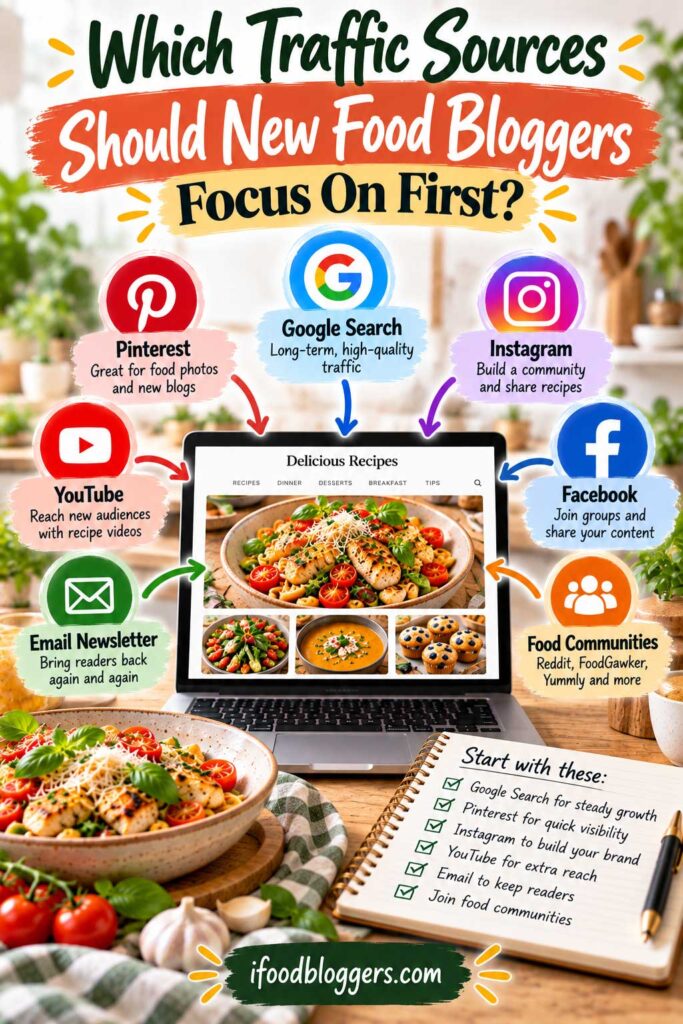
Which Traffic Sources Should New Food Bloggers Focus On First?
With so many ways to promote a food blog, it is easy to feel like you need to be everywhere at once.
You do not.
For most new food bloggers, it makes more sense to focus on a few traffic sources, build a repeatable system, and only then add more platforms.
For many food bloggers, a practical starting combination is Google Search, Pinterest, and email marketing.
Once those pieces are working consistently, you can expand into Instagram, TikTok, YouTube, and other channels.
Start With Google SEO
Google can become one of the most valuable long-term traffic sources for a food blog.
A well-optimized recipe may continue bringing visitors for months or even years after it is published.
Start by learning the fundamentals: keyword research, long-tail keywords, search intent, useful recipe content, internal linking, recipe schema, page speed, and updating older posts.
SEO usually takes time, but the traffic can become increasingly valuable as your content library grows.
Build Pinterest Alongside SEO
Pinterest is a natural fit for food content because users actively search for recipes, meal ideas, desserts, seasonal inspiration, and cooking tips.
You also do not need hundreds of published recipes before you start.
Create pins as you publish new content and gradually build a library around your strongest posts.
For recipes with good potential, create several pin designs over time instead of relying on a single graphic.
Start Building Your Email List Early
Many bloggers wait until they have significant traffic before building an email list.
That can be a missed opportunity.
Even if only a few people subscribe each week in the beginning, those subscribers can add up over time.
Your email list gives you a direct way to bring readers back without depending entirely on Google, Pinterest, or social media algorithms.
Add Social Media Strategically
Instagram, TikTok, and YouTube can all be valuable, but trying to create original content for every platform can quickly become overwhelming.
Choose the platform that best matches the type of content you enjoy making.
If short cooking videos feel natural, Instagram Reels or TikTok may be a good fit. If you prefer longer tutorials, YouTube may make more sense.
You can also reuse the same recipe footage across several platforms rather than creating everything from scratch.
Build a Simple Promotion System
The goal is not to be active everywhere.
A practical workflow might look like this:
Publish the recipe → optimize it for Google → create Pinterest pins → send it to your email list → repurpose it into social content when you have time.
That keeps your website at the center of the strategy and makes promotion much easier to manage.
For most new food bloggers, a few dependable traffic channels are far more valuable than trying to maintain a presence on every platform at once.
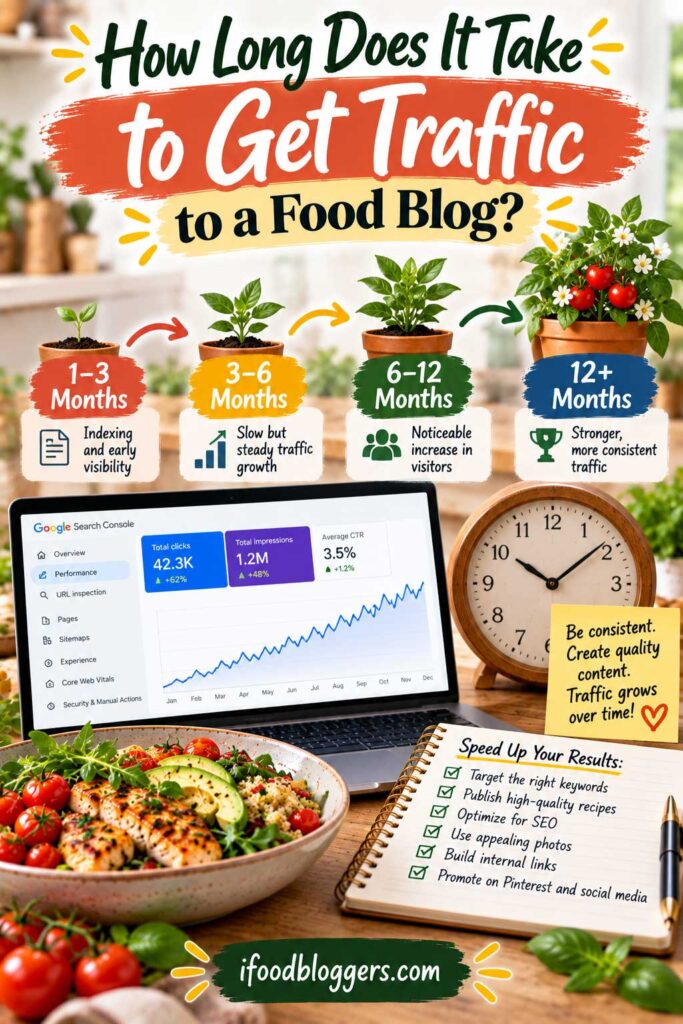
How Long Does It Take to Get Traffic to a Food Blog?
There is no exact timeline for growing a food blog.
Some sites begin gaining meaningful traffic within a few months, while others take much longer. Results depend on factors such as competition, content quality, publishing consistency, SEO, site authority, promotion, and how closely your topics match what people are actually searching for.
For a brand-new food blog, the first few months can feel especially slow.
That does not automatically mean the strategy is failing.
Search engines need time to discover and evaluate new content, Pinterest may take time to distribute your pins, and your email list may still be small.
The First 3 Months
During the first few months, focus more on building a strong foundation than obsessing over traffic numbers.
Publish useful content consistently, target realistic keywords, improve your site structure, create Pinterest pins, start building your email list, and connect related articles with internal links.
This is also the time to make sure your recipes are properly optimized and your site is technically sound.
You may begin seeing impressions and occasional clicks from Google during this stage, but traffic can still be inconsistent.
Around 3 to 6 Months
As you publish more useful content and search engines become more familiar with your site, you may start seeing more pages appear in search results.
Some posts may begin receiving steady impressions and clicks, while Pinterest can start contributing more traffic as your account builds a larger content library.
This is a good stage to start looking more closely at your analytics.
Which topics are gaining visibility? Which posts are getting clicks? Which Pinterest pins are sending visitors?
Those early signals can help shape what you publish next.
Around 6 to 12 Months
After several months of consistent publishing, you may have enough content and performance data to make much better decisions.
You may start seeing clearer winners.
Perhaps your air fryer recipes are gaining search traffic. Maybe smoothie content performs especially well on Pinterest. Or several older posts begin moving into stronger Google positions.
Instead of publishing randomly, you can start building more content around the topics that are already showing momentum.
Older Blogs Can Still Grow
Website age alone does not determine how much traffic you can get.
An older food blog with weak content or technical problems can struggle, while a newer site with focused topics and strong execution can gain traction more quickly.
Older sites can also see significant growth after improving outdated articles, fixing technical issues, strengthening internal links, and expanding topics where they already have some authority.
Focus on Trends, Not Individual Days
Traffic naturally moves up and down.
One day may be much stronger or weaker than another, and seasonal recipes can create major swings throughout the year.
Instead of reacting to every daily change, look at broader patterns.
Compare recent performance with the previous month or quarter, and compare seasonal periods with the same time last year when you have enough historical data.
The bigger questions matter more:
Are impressions growing? Are more pages receiving clicks? Are your strongest topics becoming clearer? Is your overall traffic moving in the right direction?
Growing a food blog is usually a long-term process.
A recipe that receives almost no traffic during its first few weeks can still become one of your strongest pages later.
The important part is to keep publishing useful content, study what your audience responds to, and improve the areas that are already beginning to work.
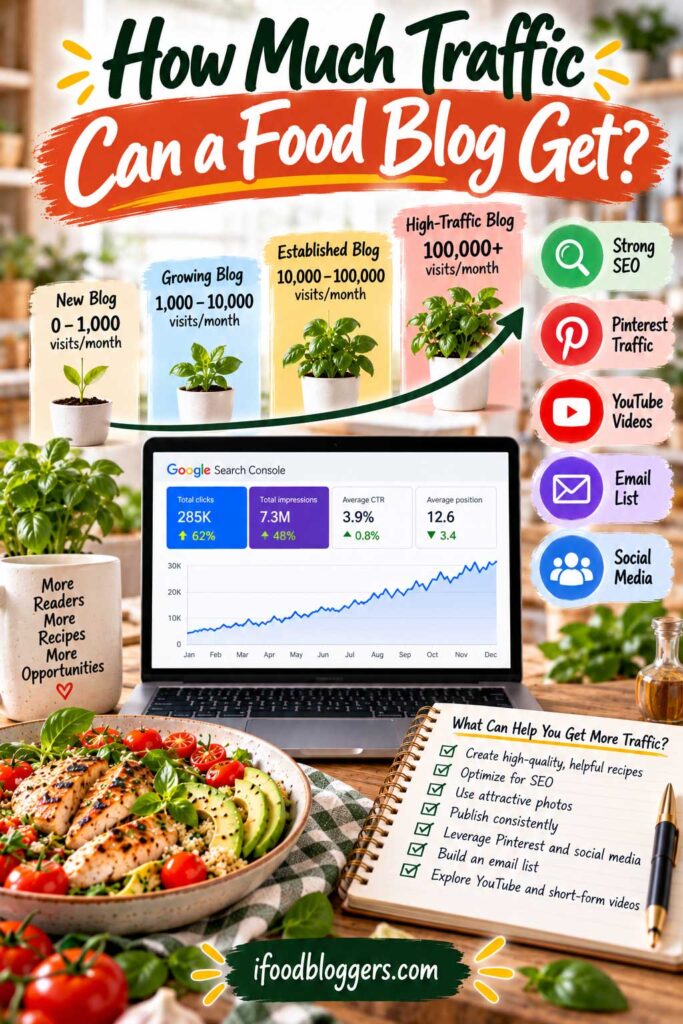
How Much Traffic Can a Food Blog Get?
There is no fixed limit to how much traffic a food blog can receive.
Traffic varies enormously from one food blog to another. Some sites serve a relatively small niche audience, while large established recipe sites can attract very substantial monthly traffic.
The outcome depends on many factors, including content quality, competition, search visibility, Pinterest performance, internal linking, returning visitors, and how many traffic sources the site develops over time.
A smaller library of strong, well-targeted content can outperform a much larger site filled with weak or poorly focused posts.
More Useful Content Creates More Entry Points
Every strong article gives someone another way to discover your website.
If you publish recipes around several related topics, your blog can begin ranking for hundreds or even thousands of different searches.
One post may bring only a small amount of traffic on its own, but when dozens or hundreds of pages each attract visitors, the total can grow significantly.
As a simple illustration, if 100 articles each averaged 10 visits per day, the site would receive about 1,000 visits per day—even without one enormous traffic winner.
In reality, traffic is rarely distributed evenly. A relatively small number of top-performing pages often bring a large share of total visits.
Build Traffic From More Than One Source
Google does not have to provide all of your traffic.
A healthy food blog may attract visitors through Google Search, Google Images, Pinterest, email newsletters, social media, YouTube, referral links, direct visits, and relevant food communities.
That diversification can make growth more stable.
If one platform slows down, another source may continue sending visitors.
Expect Seasonal Traffic Swings
Food content is highly seasonal.
A recipe that receives modest traffic most of the year may suddenly become one of your strongest pages during Thanksgiving, Christmas, summer grilling season, or another relevant period.
That is why monthly traffic can change dramatically throughout the year.
When reviewing performance, compare similar seasons rather than assuming every month should look the same.
Focus on Building the Next Traffic Level
Instead of asking only:
How can I get 100,000 visitors?
it can be more useful to focus on the next realistic milestone.
That might mean growing from 100 visits per day to 500, then from 500 to 1,000, and continuing from there.
At each stage, look at where the traffic is coming from and which pages are driving the growth.
Then create more content around the topics and formats that are already performing.
There is no guaranteed traffic number for a food blog, but the potential can become substantial when strong content, SEO, Pinterest, email, internal linking, and consistent publishing begin working together.
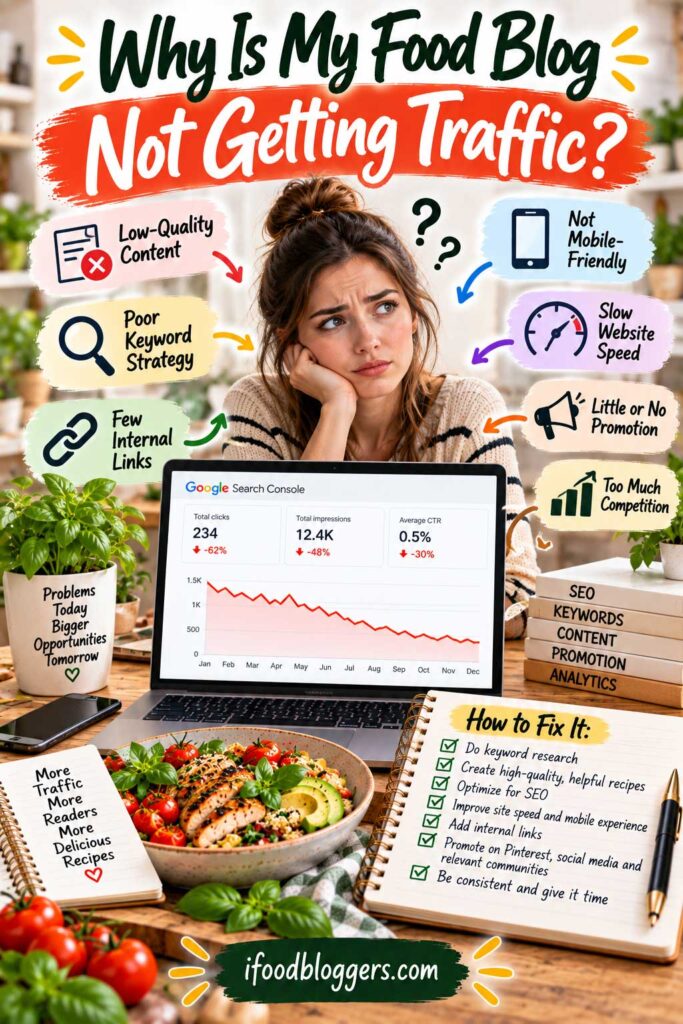
Why Is My Food Blog Not Getting Traffic?
If your food blog is not getting much traffic yet, there is usually more than one reason.
The good news is that most traffic problems become easier to fix once you identify where the bottleneck is.
If you are struggling to get traffic to your food blog, work through the problems below one at a time rather than assuming the entire site needs to be rebuilt.
You Are Targeting Keywords That Are Too Competitive
Trying to rank for broad terms such as chicken recipes, dinner recipes, cake recipe, or healthy meals can be extremely difficult, especially for a newer website.
Start with more specific searches where the competition is more realistic.
You can also use Google Trends to compare interest in food topics and see how demand changes over time.
Instead of targeting chicken recipes, for example, you might go after easy baked chicken thighs with potatoes.
The more specific keyword may have less search volume, but it can also be much easier to rank for and may attract a reader with clearer intent.
Your Content Does Not Match Search Intent
You may be targeting the right keyword but creating the wrong type of content.
If people searching a keyword clearly want a recipe, a long informational guide may struggle to rank.
Check the current search results and make sure your page matches what users appear to want.
The format, depth, and angle of the article should fit the search.
You Do Not Have Enough Strong Content Yet
A food blog with only 10 or 20 posts may simply need more time and a larger library of useful content.
Every strong article gives you another opportunity to appear in Google, Pinterest, internal links, and other discovery channels.
That does not mean publishing low-quality posts just to increase your count.
The goal is to build a focused collection of genuinely useful content.
Your Posts Are Not Internally Connected
If your articles are isolated from one another, both readers and search engines may have a harder time understanding how your content fits together.
Link related recipes naturally, create useful category pages, and build topic hubs around subjects you cover in depth.
Someone who lands on one recipe should have an easy path to several more relevant pages.
Your Site May Be Too Slow
Large images, heavy themes, unnecessary plugins, ad scripts, and weak hosting can all slow down a food blog.
If the site feels frustrating on mobile, readers may leave quickly.
Test your most important pages on an actual phone and fix the obvious usability and performance problems first.
You can also test individual pages with Google’s PageSpeed Insights to identify performance and Core Web Vitals issues.
Your Titles Are Not Earning Clicks
Sometimes a page receives impressions in Google but very few clicks.
That can mean the title is too vague or fails to communicate why the recipe is useful.
Compare:
Chicken Dinner
with:
30-Minute Garlic Butter Chicken Dinner
The second title gives the reader much more information before they click.
You Are Ignoring Older Content
New content matters, but older posts can contain some of your best opportunities.
Look for pages that already receive impressions, rank just outside the strongest positions, or have started losing traffic.
Updating those articles can sometimes create faster gains than publishing another unrelated post.
You Are Relying on One Traffic Source
If your entire strategy depends on Google, growth can feel slow and unpredictable.
Pinterest, email marketing, YouTube, short-form video, referrals, and returning visitors can all give your blog additional ways to reach people.
You do not need to build every channel at once, but relying on only one source makes your traffic more fragile.
You Are Publishing Without a Clear Strategy
Publishing random recipes can make it difficult to build momentum around any particular topic.
Pay attention to what is already working.
If your air fryer recipes are gaining traction, create more useful content around that topic.
If smoothies are performing well, expand that area.
Let your own data help guide what you publish next.
Low traffic does not automatically mean your food blog needs a complete reset.
In many cases, the biggest gains come from improving keyword targeting, content quality, internal linking, site performance, promotion, and consistency rather than starting over.
As your traffic strategy becomes more advanced, the tools you use for SEO, writing, email, planning, and promotion start to matter more. Our guide to the best tools for food bloggers brings many of those resources together in one place.
Frequently Asked Questions
What Is the Best Way to Get Traffic to a New Food Blog?
For most new food blogs, a strong starting strategy is to combine SEO, Pinterest, and email marketing.
SEO can build long-term search traffic, Pinterest can help people discover your recipes visually, and email gives you a direct way to bring readers back after their first visit.
You do not need to master every platform at once. A repeatable system built around a few dependable traffic sources is usually more useful than trying to be everywhere.
How Many Blog Posts Do You Need Before You Start Getting Traffic?
There is no magic number.
Some food blogs begin getting traffic with only a handful of strong posts, while others need a much larger content library before growth becomes noticeable.
Quality, competition, topic selection, internal linking, and search intent matter more than simply reaching a certain post count.
A smaller collection of strong, focused articles can outperform a much larger archive of thin or poorly targeted posts.
How Often Should a Food Blogger Publish?
There is no perfect publishing schedule.
For one blogger, a well-produced recipe each week may be realistic. Another may have the resources to publish several times per week.
Choose a schedule you can maintain without sacrificing recipe testing, photography, writing quality, SEO, or promotion.
Consistency matters more than publishing as often as possible.
Is Pinterest Still Worth Using for Food Blogs?
Pinterest can be a valuable traffic source for food blogs because recipes, meal ideas, desserts, seasonal dishes, and cooking inspiration are naturally visual and easy to save.
Its value will vary by niche and account, so track the traffic it actually sends to your website rather than judging success only by impressions or followers.
Can You Get Food Blog Traffic Without Social Media?
Yes.
A food blog can grow through Google Search, email, backlinks, referral traffic, direct visits, and returning readers without relying heavily on social media.
Platforms such as Instagram, TikTok, YouTube, and Pinterest can create additional discovery opportunities, but they are not the only way to build an audience.
How Long Should a Food Blog Post Be?
There is no ideal word count for every recipe.
A post should be long enough to help someone make the recipe successfully without adding unnecessary sections simply to increase the length.
A simple smoothie may need relatively little explanation, while a technical bread or baking recipe may benefit from troubleshooting, substitutions, storage advice, and step-by-step guidance.
Write for usefulness, not for a target word count.
Should I Update Old Recipes or Publish New Ones?
Usually both.
New posts create additional opportunities to reach readers, while older articles may already have rankings, backlinks, impressions, or Pinterest history that can be improved.
A good content strategy includes new publishing alongside regular updates to older pages with clear potential.
Can a Small Food Blog Compete With Large Recipe Websites?
Yes, but smaller blogs usually need to be more focused.
Large publishers may dominate broad searches, while smaller food blogs can compete through specific long-tail keywords, deeper niche coverage, strong first-hand experience, and recipes created for a clearly defined audience.
You do not need to beat the largest recipe sites at everything. You need to become especially useful for the topics you choose to cover.
Does More Traffic Automatically Mean More Income?
Not necessarily.
Revenue depends on the quality and source of the traffic, reader engagement, advertising setup, affiliate offers, email strategy, geographic mix, and the type of content people visit.
A smaller audience with strong intent can sometimes be more valuable than a much larger audience that rarely engages or converts.
What Should I Do First If My Food Blog Has Almost No Traffic?
Start by making sure the site is technically accessible and your important pages can be indexed.
Then look at the content itself.
Target realistic long-tail keywords, strengthen internal links, improve older posts, create Pinterest content, begin collecting email subscribers, and use Google Search Console to identify pages that are already gaining impressions.
Most importantly, avoid completely changing direction every few weeks.
Food blog traffic usually grows through many small improvements that compound over time.
Final Thoughts: How to Get More Traffic to Your Food Blog
Getting more traffic to your food blog usually does not come from one trick, one viral pin, or one perfectly optimized recipe.
Growth tends to happen when several strategies begin working together.
SEO helps new readers discover your recipes through Google. Pinterest can bring visual discovery traffic. Email gives you a way to bring readers back. Social media and video can introduce your content to completely new audiences, while internal linking and strong site structure help visitors discover more once they arrive.
You do not need to implement all 30 strategies at the same time.
If your food blog is still growing, focus first on the fundamentals: publish useful, well-tested content, target realistic long-tail keywords, match search intent, connect related articles with internal links, create Pinterest content for your strongest recipes, begin building an email list, and pay attention to what Google Search Console is telling you.
Then build from there.
As your traffic grows, look closely at the topics that consistently perform well. Those successful posts can show you where to create additional recipes, supporting guides, videos, Pinterest content, and email campaigns.
Most importantly, give the process time.
A recipe that receives very little traffic when you first publish it may eventually become one of your strongest pages. The same can happen with an older article after a thoughtful update or a Pinterest pin that begins gaining traction months later.
Focus on creating a food website that becomes more useful every month.
Keep improving what you publish, pay attention to what readers respond to, and build on the traffic sources that are already working. Over time, each useful post gives another person a way to discover your blog and another reason to return.
Keep Growing Your Food Blog
If you want to keep improving your traffic, SEO, content strategy, and monetization, these guides are a good place to continue:
Best Free Keyword Research Tools for Food Bloggers
Find practical tools for uncovering keywords, search opportunities, and new recipe ideas.
Best SEO Tools for Food Bloggers
Compare useful SEO tools for keyword research, competitor analysis, rankings, backlinks, and site optimization.
SEO Mistakes Food Bloggers Should Avoid
Learn which common SEO mistakes can limit your visibility and what to do instead.
Best Tools for Food Bloggers
Explore tools for content creation, SEO, photography, email marketing, productivity, and running your food blog.
Best Blogging Platforms for Food Bloggers
Compare the major blogging platforms and see which options make the most sense for building and growing a food website.
Best WordPress Security Plugins for Food Bloggers
Protect your site while keeping your WordPress setup reliable as your traffic grows.